Ethnography in Design: A Practical Guide for Innovators

You shipped a feature the team felt good about. The roadmap was clear, the requirements were approved, and the interface looked polished in review. Then customers used it in ways nobody expected, or ignored it completely.
That gap usually isn't a design execution problem. It's an understanding problem.
Teams often build from secondhand knowledge: a sales summary, a few support tickets, analytics dashboards, maybe a survey. Useful inputs, but incomplete. People are messy. They forget steps when they describe their workflow. They normalize workarounds. They say one thing in an interview and do another when they're rushing, multitasking, or dealing with a real constraint.
Ethnography in design helps close that gap. It means studying people in context so you can see not just what they say they need, but how their environment, habits, tools, and pressures shape what they do in practice. For a small team, that can be the difference between shipping a clever feature and shipping something people adopt naturally.
This isn't only for anthropologists or big-budget innovation labs. It's a practical way to reduce guesswork. If you manage projects, run a small business, freelance, or lead marketing and product decisions, ethnographic thinking gives you a better starting point. Instead of asking, "What should we build?" in the abstract, you ask, "What is happening in the user's real world that our product should fit?"
Introduction Why Great Products Start with People
Good products usually don't fail because teams lacked effort. They fail because the team filled in missing knowledge with assumptions.
A project manager sees deadlines slipping and asks for a simpler onboarding flow. A founder hears customers want automation and adds more automation. A marketer rewrites messaging based on objections from a few sales calls. All of that sounds reasonable. It still breaks down when nobody has watched the customer's actual workflow unfold.
That's where ethnography becomes useful. Not as a slow academic exercise, but as a disciplined way to learn from real behavior. You observe a person where the work happens, notice the tools around them, see the interruptions, and hear the informal language they use to describe problems. Those details change design decisions.
What assumptions miss
Over-reliance on direct answers is common. If you ask someone how they manage invoices, leads, or internal handoffs, you'll get a tidy version of events. Real work is rarely tidy.
You might hear, "I log everything in one place." Then you watch the process and find a spreadsheet, an email inbox, a sticky note, and a Notion page all involved in the same task. That's the kind of mismatch ethnographic research is built to uncover.
Practical rule: If a workflow matters enough to design for, it's worth observing at least once in the environment where it actually happens.
For small teams, the payoff is simple. You stop designing for an imagined user and start designing for a lived routine. That makes prioritization easier. It also saves time later, because fewer features need rescue work after launch.
What Is Ethnography in Design Really
Ethnography sounds heavier than it needs to. In practice, it means learning by observing people in context instead of relying only on what they report after the fact.
A survey asks, "Do you like fishing?" Ethnography watches someone prep the gear, untangle the line, complain about the weather, improvise when something breaks, and celebrate the catch with family later. One method gives you an answer. The other gives you a world.
In design, that world matters because products don't live in isolation. A CRM sits inside a sales routine. A Notion workspace sits inside a team's communication habits. A checkout flow sits inside someone's home, commute, childcare schedule, device constraints, and trust level.

What makes it different from surveys and analytics
Surveys and analytics are useful. They answer different questions.
| Method | Best for | Misses |
|---|---|---|
| Analytics | Patterns at scale, drop-off points, frequency | Motivation, local context, social dynamics |
| Surveys | Opinions, preferences, stated attitudes | Workarounds, contradictions, hidden habits |
| Ethnography | Unspoken behavior, routines, environmental constraints | Broad statistical confidence |
Ethnography produces what researchers often call thick data. That means rich observations drawn from notes, photos, videos, artifacts, conversations, and behavior in place. It doesn't replace metrics. It gives metrics meaning.
A drop-off in onboarding analytics tells you where users leave. Field observation might show why: maybe they switch devices midway, ask a coworker for approval, search old emails for information, or pause because the language doesn't match how they think about the task.
Why design teams adopted it
Ethnography moved into product and service design in a serious way during the 1990s, when firms like IDEO and R&D groups at Microsoft and Intel established dedicated ethnographic research groups. By the early 2000s, it was already seen as a proven way to encourage innovation and reduce product development risk, as discussed in EPIC's account of ethnography and design practice.
That history matters for one reason. It shows ethnography in design isn't a trend term. Teams adopted it because observing behavior in context consistently improved how they defined problems in the first place.
What small teams should take from that
You don't need a formal research lab to use the mindset well. You need discipline.
Watch real use before debating solutions. Capture evidence instead of impressions. Look for patterns across a small number of people rather than trying to interview everyone. Small studies often work because ethnographic depth matters more than broad volume when you're trying to understand why a workflow feels broken.
The point isn't to collect more comments. It's to see the system the customer is already using so your product can fit it, simplify it, or replace the painful parts.
Key Ethnographic Research Methods Explained
Three methods do most of the practical work for small teams: participant observation, contextual interviews, and shadowing. They overlap, but they aren't interchangeable. Choosing the right one depends on what kind of uncertainty you're trying to reduce.

If you're building your broader toolkit, it's also worth reviewing other design research methods so you know when ethnographic approaches are the right fit and when a different method will answer the question faster.
Participant observation
This is the closest thing to classic ethnographic work. You spend time in the user's environment and observe how tasks unfold, what interruptions happen, which artifacts matter, and what people don't bother to explain because it feels obvious to them.
You don't always need to become part of the activity in a literal sense. In product work, participant observation often means being present enough to understand the rhythm of the work, the dependencies, and the local language.
Use it when:
- The workflow is complex: Multiple tools, handoffs, and exceptions are involved.
- People rely on tacit knowledge: They know how to do it but can't explain it cleanly.
- The physical or social setting matters: Warehouses, clinics, retail spaces, homes, classrooms, and team operations all fit this pattern.
What it reveals is often structural. You notice unofficial steps, social approvals, tool switching, and environmental constraints. Those rarely appear in a survey.
Contextual interviews
A contextual interview is a conversation grounded in the place where the work happens. Instead of asking abstract questions on a call, you ask the person to show you what they do while you're talking.
That "show me" shift changes the quality of evidence. Users point to folders, screens, handwritten notes, inboxes, browser tabs, and physical reminders. Their memory becomes less important because the environment does some of the recall for them.
Good contextual interview prompts sound like this:
- Show me the last time you did this
- What happens right before this step
- What do you do when this goes wrong
- Who else needs to approve or touch this
- What's the part you dread
These interviews are especially useful for SaaS products, internal tools, dashboards, and operational systems because they tie stated needs to visible behavior.
Field note habit: Ask the participant to narrate the last real example, not the ideal process. "Walk me through yesterday" is better than "How do you usually do this?"
Shadowing
Shadowing is lighter-touch. You follow someone through part of their day or through a specific workflow and observe without interrupting much. It's often the best option when the task is fast-moving and too many questions would distort the behavior.
Use shadowing when:
- Speed matters: The user makes quick decisions and can't stop to explain.
- The workflow is repetitive: Patterns become clear through repetition.
- You need to see transitions: Moving between systems, teams, or locations is part of the problem.
Shadowing is excellent for service operations, fulfillment, field teams, support roles, and administrative routines. It's also good when you suspect the main problem isn't one interface but the seams between tools.
Choosing between them
Here's a simple decision guide:
| If you need to understand... | Start with... |
|---|---|
| Hidden routines and environmental context | Participant observation |
| Decision-making during a task | Contextual interviews |
| Flow, pace, and handoffs | Shadowing |
Small teams don't need to pick only one. A strong low-budget study often mixes them. You observe first, ask focused questions second, and shadow one or two complete workflows to catch the gaps between what people explain and what the process requires in practice.
Planning Your First Ethnographic Study
Most weak research doesn't fail in the field. It fails before the first conversation because the team starts with a vague question, recruits whoever is easiest to reach, and treats notes like proof without deciding how those notes will inform a decision.
A good study begins with a practical question. Not "What do users think?" but something narrow enough to guide observation. Examples include: where freelancers lose momentum when preparing invoices, how a project manager gathers status updates across tools, or why leads stall between first contact and follow-up.
Start with a decision, not curiosity alone
Ethnographic research works best when tied to a design choice.
Ask:
- What decision will this research inform
- What behavior do we need to observe to make that decision responsibly
- What would change in the product, process, or messaging if we learn something important
That framing keeps the study honest. It also prevents the common small-team trap of collecting interesting stories that never shape the roadmap.
Recruit for relevance
You don't need a huge sample to start. In design ethnography, smaller groups are often used because the goal is depth and contextual understanding, not population-level measurement. What matters is that participants match the workflow you care about.
Recruit based on:
- Behavior, not job title: "Sends proposals from a mix of email and Notion" is better than "marketing manager."
- Recent experience: Prioritize people who completed the task recently enough to show artifacts and recall details.
- Useful variation: Mix novice and experienced users, or organized and workaround-heavy users, if that contrast matters to the product.
A practical first round for a small team is enough participants to see repeated patterns and meaningful exceptions. Once the same friction appears in different settings, you usually have something worth acting on.
Build a field guide, not a script
A field guide keeps you focused without forcing every session into the same shape. Think of it as a checklist of what you need to notice.
Include:
- Observation targets: tools, interruptions, dependencies, artifacts, handoffs
- Core prompts: "Show me the last time," "What changed this step," "What do you do when you're rushed"
- Capture plan: notes, photos if permitted, screenshots, timestamps, follow-up questions
- Decision tags: what evidence would support or challenge your current assumptions
For teams working inside Notion-heavy operations, it helps to review examples of how people already structure communication and workflows in tools like this guide to creating and sending email from Notion. It can sharpen the kinds of field questions you ask when email and workspace management overlap.
Ethics is not optional
Fast research can still be extractive. Critiques of design ethnography warn that without cultural reflexivity, researchers can end up "kidnapping" field data or doing shallow analysis. A study of design students reported that 60% used informal methods but saw low value because the analysis was weak, a warning discussed in this critique of ethnography and better design.
That matters for small teams because speed often encourages bad habits.
Protect against that with a few non-negotiables:
- Get informed consent: Explain what you're observing, recording, and using.
- Respect privacy boundaries: Don't capture sensitive information casually because it's visible.
- State your role clearly: Don't pretend to be a neutral observer if you're influencing product decisions.
- Check your interpretations: Separate what you saw from what you think it means.
- Give people room to refuse: Participants should be able to skip questions or stop the session.
Good ethnography is curious, but it isn't entitled. Access to someone's workflow is a privilege, not a shortcut to better product decisions.
From Raw Notes to Actionable Insights
Fieldwork produces mess. That's normal. You come back with scribbled notes, screenshots, photos, timestamps, fragments of quotes, and a vague sense that something important happened but you can't yet explain it cleanly.
The work that follows is where ethnography in design becomes useful to the rest of the team.

One study found that using ethnographic data to guide prototype specifications improved technology efficacy by 25-40% in usability benchmarks compared with non-ethnographic designs, which shows how field insights can shape better product outcomes when teams translate them into design decisions, as described in this Design Society paper on ethnography and design.
Start with affinity mapping
Affinity mapping is the most practical way to move from fragments to patterns. You take individual observations and group them by similarity until themes emerge.
Each note should contain one thing only. One behavior. One quote. One workaround. One constraint. One moment of confusion.
Good note examples:
- Customer checks old email before completing a form
- Team member copies status from Slack into Notion manually
- Participant uses handwritten reminder for a step the system doesn't surface
- User delays sending because they want one final approval from a colleague
Then cluster. Don't force categories too early. Let repetition do the work.
Look for pattern types, not just repeated complaints
A weak synthesis session becomes a wall of grievances. A better one distinguishes the kind of pattern you're seeing.
Use categories like these:
- Behavioral patterns: repeated actions, sequences, habits
- Environmental patterns: interruptions, physical setup, device switching
- Coordination patterns: approvals, dependencies, informal handoffs
- Meaning patterns: language people use, what they consider risky, what feels "done"
Small teams often get stuck. They collect data but can't convert it into decisions. If your Notion workspace already handles project notes and collaboration, practical guidance on structuring information can help. Teams that need cleaner organization often benefit from tactics like those in these tips for getting more out of Notion.
A useful test: If a theme can't influence a product choice, a workflow change, or a messaging shift, it may still be interesting, but it isn't yet an insight.
Build personas from behavior, not demographics
Personas often go wrong when teams write fictional profiles based on assumptions. Ethnographic personas should come from repeated behavior patterns you observed.
A useful persona isn't "Sarah, 34, busy freelancer." That's fluff.
A useful persona sounds more like this:
- Keeps work moving through inbox-first triage
- Distrusts automation unless there's a visible review step
- Uses Notion as a planning layer, but email as the final record
- Delays sending when information is scattered across tools
That kind of persona helps design because it points toward interface needs, workflow support, and messaging.
Map the journey where friction actually lives
Customer journey maps are most helpful when grounded in observed reality, not idealized funnels. For ethnographic work, map what the person did.
A practical journey map should include:
- Trigger: what started the task
- Sequence: what they did in order
- Artifacts: tools, documents, notes, messages
- Pain points: delays, confusion, workarounds, duplicated effort
- Opportunities: what the product could simplify, combine, or make visible
Sometimes the problem isn't one bad screen. It's that users are carrying state across several systems and your product doesn't acknowledge that.
A quick explainer on synthesis techniques can help teams visualize this step:
<iframe width="100%" style="aspect-ratio: 16 / 9;" src="https://www.youtube.com/embed/Hrh32Xn0PCs" frameborder="0" allow="autoplay; encrypted-media" allowfullscreen></iframe>
End with design principles, not only findings
Insights become actionable when you rewrite them into design guidance.
Examples:
- Preserve user confidence with visible review before sending
- Reduce cross-tool memory load by pulling task context into one place
- Support interrupted workflows with clear resume points
- Design for exception handling, not only happy-path completion
Those principles travel well. A product manager can prioritize from them. A designer can sketch from them. A marketer can align messaging with them. Without that translation step, ethnographic notes stay interesting and nothing changes.
Making Insights Stick with Notion and NotionSender
Research usually breaks down after the study. Notes live in one folder, screenshots in another, observations inside a slide deck, and next month nobody can find the evidence behind the product decision. For small teams, that fragmentation is expensive because the same questions keep coming back.
A major barrier is time. 70% of SMBs cite "research time" as a barrier to user-centered design, which is why lightweight systems matter so much for turning findings into action, as noted in this design ethnography resource for constrained teams.
Build a research repository in Notion
Notion works well as a small-team research repository because it combines structured properties with flexible pages. You don't need an enterprise repository to stay organized. You need one database that everybody can trust.
Create a database with properties like:
- Participant
- Workflow studied
- Date
- Observation type
- Theme
- Artifact
- Pain point
- Opportunity
- Evidence link
Then decide on a rule: every field session creates entries in the same place within a day. If you wait until the end of the week, details disappear.
A useful page template might include:
- Session summary
- Key moments
- Photos or screenshots if consent allows
- Direct observations
- Interpretation notes kept separate
- Open questions for follow-up

Capture evidence while the moment is fresh
The best field notes are often the fastest ones. A photo of a workspace, a quick audio summary transcribed later, a forwarded message that shows a handoff problem, or a note sent from your phone right after a visit will usually be more accurate than a reconstructed summary hours later.
A small-team workflow matters more than a perfect methodology. If the capture process is clumsy, people stop doing it.
A simple operating model looks like this:
| Moment | What to capture | Where it goes |
|---|---|---|
| During session | Short notes, artifacts, timestamps | Session page |
| Immediately after | Fresh observations, early themes | Inbox database |
| Synthesis day | Clustered themes, decisions, opportunities | Insight database |
| Project planning | Design principles, tasks, owners | Product workspace |
Use email capture to reduce admin work
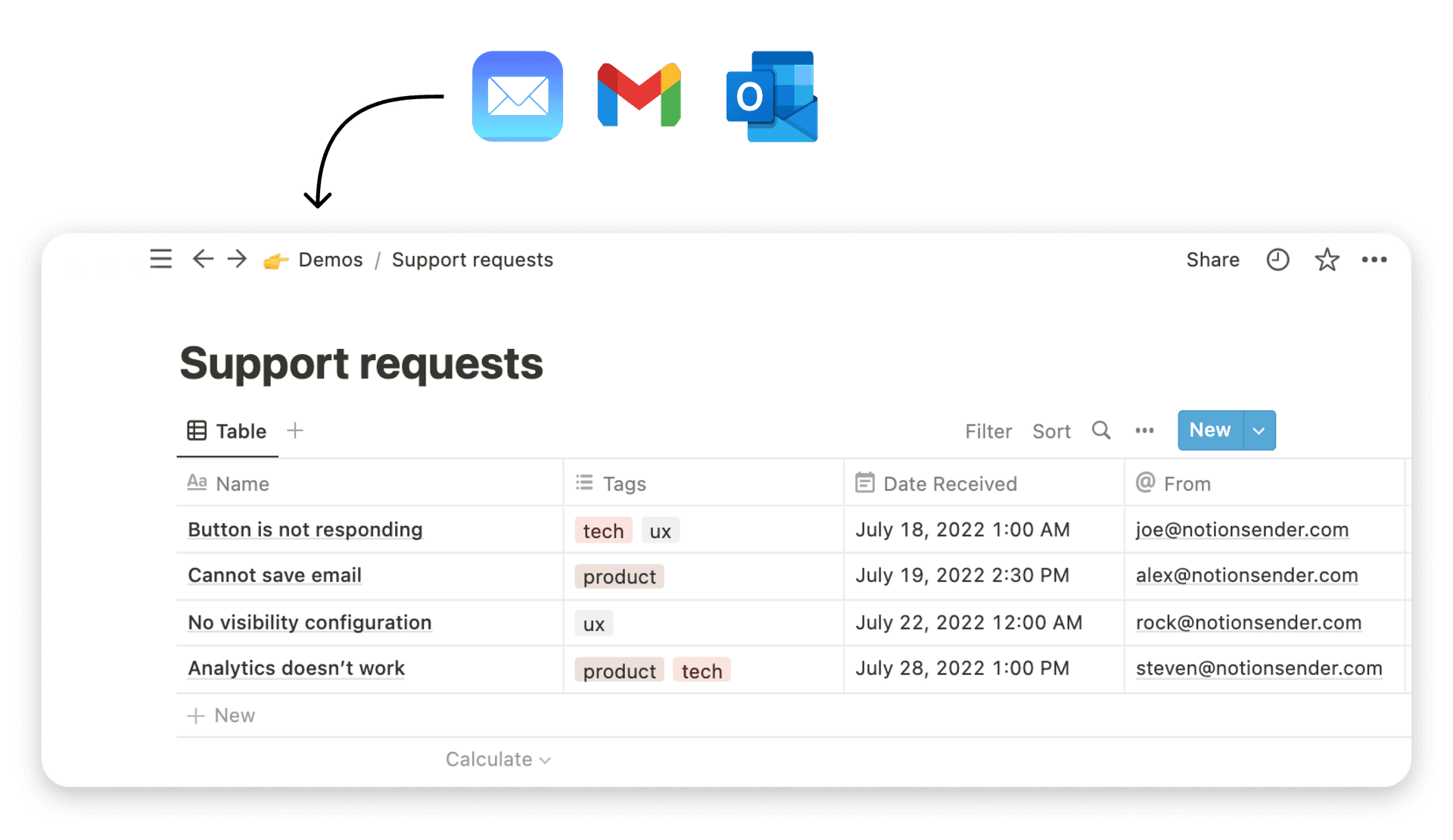
One practical way to keep evidence moving is to let email act as the intake layer. In many teams, email is still the fastest way to forward observations, screenshots, approvals, and follow-up materials from the field into a central workspace.
If your process depends on moving communications into a structured database, it helps to look at workflows for saving emails to Notion. The core value isn't novelty. It's reducing the gap between noticing something and storing it where the team can use it.
Research becomes durable when capture is boring, repeatable, and easy enough that people keep doing it under deadline pressure.
Make insights visible in project work
The last step is operational, not analytical. Link themes from your repository to actual roadmap items, design explorations, content updates, and process fixes.
For example:
- A recurring approval bottleneck becomes a requirement for review states
- Repeated context switching becomes a case for consolidating task information
- User discomfort around sending becomes a cue to rewrite confirmation language
- Frequent manual copying becomes a trigger for automation or templating
If the insight database never touches delivery work, the research system is still incomplete. The goal isn't to archive learning. It's to make better decisions faster the next time the same problem shows up.
Real-World Examples of Ethnography in Action
Ethnography proves itself when a team sees something in context that they would have missed from a remote interview or dashboard.
One of the clearest examples comes from a warehouse study for a grocery distributor. Researchers observed workers doing manual math on the sides of boxes and in the margins of packing slips. That behavior revealed inefficiencies that weren't obvious from process documents alone. Those observations directly informed more efficient inventory tools that reduced delays and errors, as described in Fuzzy Math's account of ethnographic research in design.
What that example teaches
Nobody in a conference room would invent "box-side arithmetic" as a design requirement. You only catch that by watching the work where it happens.
The lesson for project managers is sharp. Don't define the problem only from the official process. Study the unofficial process too. The workaround often tells you where the real design opportunity lives.
A second example from the same source involved in-home tax research. Researchers used physical artifacts to help participants express comfort levels and talk through difficult parts of the process. That work exposed pain points around software choice, frustration, and discomfort during complex deductions. Those details gave the team something more actionable than "taxes are hard." They highlighted where the interface needed clearer support and redesign attention.
Why these examples matter for small teams
You don't need a warehouse contract or consumer software budget to use the same logic. A freelancer can observe how a client assembles assets before approving a campaign. A small SaaS team can watch how leads move from form submission to follow-up. A service business can sit with one coordinator and see where work spills out of the official system.
If you want more examples of how research translates into product and service decisions, these human-centred design examples are useful for comparing how different teams turn user evidence into design choices.
The pattern is consistent. Context changes what you think the problem is. Once the team sees the actual task, better design often becomes more obvious.
Conclusion Start Small Start Now
Ethnography in design doesn't require a research department, a long timeline, or a perfect process. It requires attention, discipline, and a willingness to look at real behavior before locking in solutions.
For a small team, the most practical version is often enough. Observe one real workflow. Ask someone to show you the last time they completed a task. Capture the artifacts around the task, not just the spoken explanation. Cluster the evidence. Turn the pattern into one design decision.
That's how teams stop building from assumptions.
If you're a project manager, freelancer, or small business owner, start with one problem that keeps returning. Watch it happen in context. The point isn't to become an anthropologist. It's to make better product decisions because you understand the work people are already doing.
If your team already runs work inside NotionSender, it's worth looking at how email capture can support lightweight research operations. When observations, screenshots, and follow-up notes flow into the same workspace where projects are managed, it's much easier to keep ethnographic insights visible and usable instead of letting them disappear into a forgotten document.