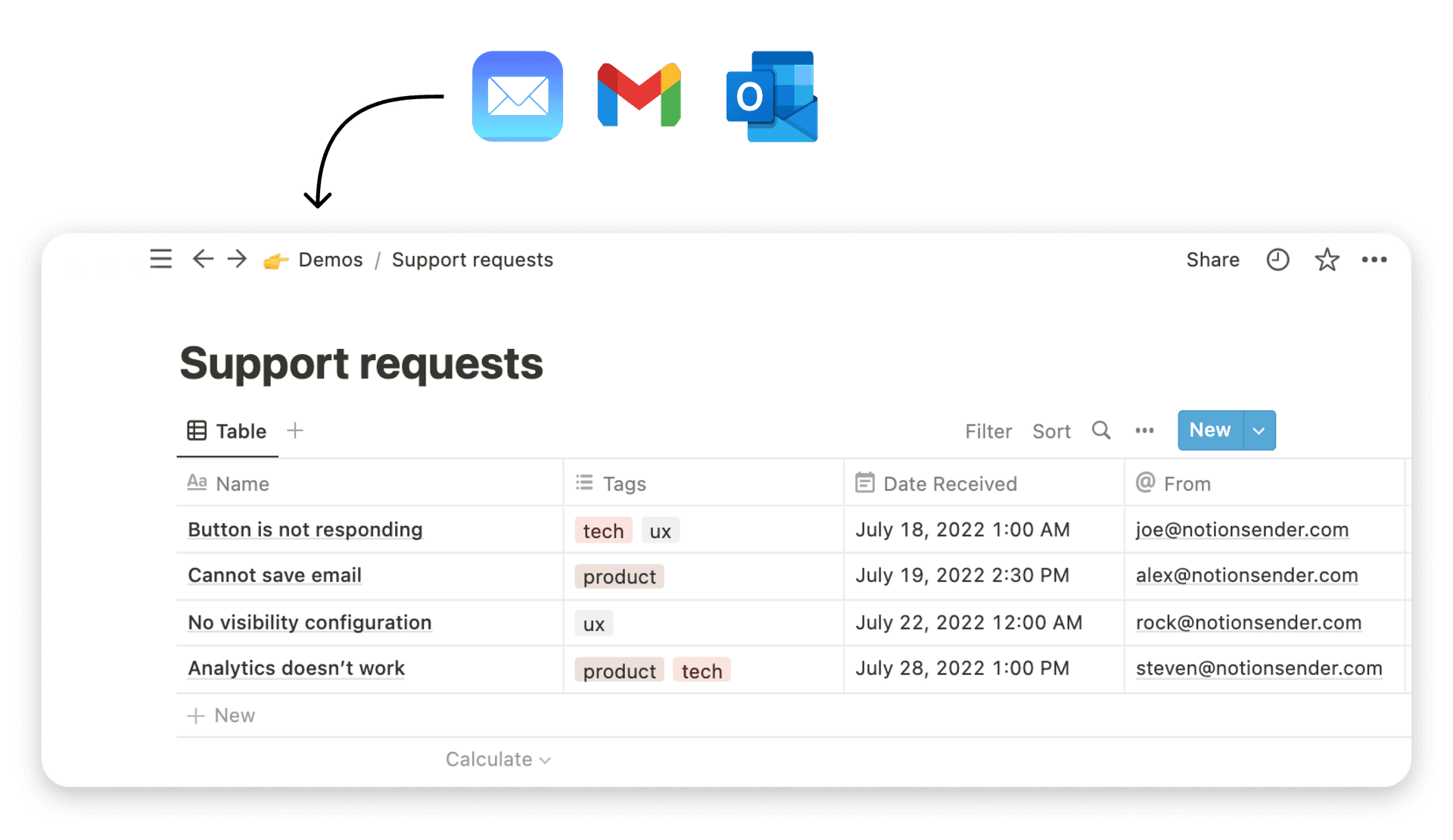
The Inbox Zero Method Your Guide to Mastering Email in Notion

Let’s be honest: "inbox zero" isn't really about having a perpetually empty inbox. That’s a myth. It’s a productivity philosophy, a mindset shift designed to reduce the mental real estate your email is occupying. The goal is to turn your inbox from a chaotic, never-ending to-do list into a streamlined processing station. This frees you up to focus on what actually matters, instead of just reacting to the latest notification ding.
Why Your Email Is Costing You More Than Time

If you feel like you're fighting a losing battle against your inbox every single day, you're in good company. For freelancers, project managers, and small business owners, the constant flood of messages is more than just a nuisance—it’s a direct hit to your productivity and mental clarity. It creates a kind of "email debt," where every unread message piles onto a growing mountain of obligation.
This digital avalanche isn't just a feeling; the numbers are staggering. In 2025, it's projected that 376.4 billion emails will be sent and received every single day. For the average professional, that breaks down to around 117 emails hitting their inbox daily.
It's no surprise, then, that many of us are sinking 28% of our workweek—that’s over 10 hours—just trying to manage our inboxes, often with very little to show for it. If you want to see just how deep this rabbit hole goes, you can find more insights about email volume statistics that paint the full picture.
The table below breaks down where that time goes. Seeing it laid out like this can be a real eye-opener.
| Weekly Time Lost to Unproductive Email Tasks |
|---|
| This table breaks down the average professional's 10.8 hours of weekly email time into specific, unproductive categories, highlighting the urgent need for a better system. |
| Email Category |
| Reading/Replying to Irrelevant Emails |
| Searching for Information in Old Emails |
| Managing Spam and Subscriptions |
| Context Switching Due to Notifications |
| Manually Sorting/Filing Messages |
| Total Unproductive Time |
Looking at that, nearly 9.5 hours are spent on tasks that don't move the needle. That’s more than a full workday, every single week, lost to email friction.
The Hidden Cost of a Cluttered Inbox
The constant stream of notifications is a focus killer. It shatters your attention, making deep, meaningful work almost impossible. Each time an email alert pops up, it pulls you away from what you were doing. The real cost isn't just the two minutes you spend reading the email; it's the 15 minutes it takes to get your brain fully back on track.
This "context switching" is the real productivity thief.
When your inbox dictates your to-do list, your priorities are set by whoever emailed you last, not by your own strategic goals. You end up playing defense all day.
The core issue isn't a lack of work ethic; it's a broken system. A reactive email strategy puts you in a defensive position, constantly fighting fires instead of making progress on important projects.
This is the "aha" moment for so many people. The problem isn't you—it's the way we've been taught to handle email. Once you recognize that, you can start taking back control. By putting a structured system like the inbox zero method in place, you can finally shift from being reactive to proactive, putting yourself firmly in charge of your workday and your focus.
Understanding the Real Philosophy of Inbox Zero
Let’s clear up the biggest myth about the inbox zero method right off the bat. The goal is not a perpetually empty inbox. If you think it’s about compulsively clearing every single message daily, you’re setting yourself up for more anxiety, not less—the very problem we're trying to solve.

The "zero" in Inbox Zero isn't about the number of emails. It’s about the amount of time and mental energy your brain spends dwelling on what’s lurking in there. It’s a complete mindset shift, designed to turn your email from a chaotic digital storage unit into a clean, efficient processing center.
Productivity expert Merlin Mann, who came up with the whole concept, was really talking about making quick, decisive actions. Your job is to process each message and get it out of the inbox, not let it sit and become another undefined task on a messy, invisible to-do list.
The Four Core Actions of Email Triage
The entire inbox zero method really just boils down to a simple, powerful framework. For every single email you open, you have one of four choices. The trick is to make the decision immediately and act on it.
-
Delete/Archive: Be ruthless here. Does this email actually require action or contain critical info you'll need later? If the answer is no, just delete it. If you think you might need it for reference down the road, archive it. The main goal is to simply get it out of your sight.
-
Delegate: Are you really the right person to handle this? If not, forward it to the appropriate colleague or team member right away. Once it's delegated, your part is done (for now), so you can archive the original and move on.
-
Defer: This is for any email that requires more than a couple of minutes of work. Instead of letting it fester in your inbox, you defer it. In our system, this means forwarding it directly into your Notion database, where it instantly becomes a structured task with a clear deadline and priority.
-
Do: If you can reply or complete the action in two minutes or less, just do it right then and there. This "two-minute rule" is a game-changer. It prevents tiny tasks from piling up and becoming a huge source of stress later on.
This decisive approach is incredibly effective. It's all about methodically processing messages to free up your mental bandwidth, which is a big deal when some professionals are spending 2-5 hours a day just wrestling with their email.
In one real-world case, a professor who'd just achieved inbox zero noticed an unusual surge of 57 emails in one day. Because his inbox was otherwise clear, this anomaly stood out immediately, alerting him to a glitch in a student assignment system he was then able to fix. You can actually read more about how this method sharpens focus on marriott.byu.edu.
The core idea is to touch each email only once. You open it, decide which of the four actions to take, and execute. No more rereading the same message five times because you haven't decided what to do with it.
By adopting this decision-making framework, you stop letting your inbox dictate your priorities. You’re the one back in control, turning reactive chaos into a proactive, organized workflow that actually serves your goals. That’s the true power of the inbox zero method.
Building Your Email Command Center in Notion
This is where the rubber meets the road. We're taking the Inbox Zero theory and turning it into a real, working system right inside of Notion. Forget living in your email client; we're about to build a central hub that transforms incoming emails into actionable tasks instead of a never-ending list of demands. This is how you take back control.
First things first, you need a dedicated Notion database. This isn't just another to-do list. Think of it as your personal email triage unit—a dynamic workspace where every single message gets a clear purpose and a path forward.
Designing Your Action-Oriented Database
For this to actually work, your database needs the right properties—ones that line up with the core actions of Inbox Zero. We’ll start with a simple table, but we'll build it in a way that lets you sort, filter, and organize everything that comes in. You'll always know exactly what to work on next.
I've found that a handful of specific properties are absolutely essential for making this system click. Here's a look at the foundational setup I recommend for your email management database.
Essential Notion Database Properties for Inbox Zero
This simple schema is your starting point. It provides just enough structure to turn chaotic emails into an organized workflow without getting overly complicated. Each property serves a distinct purpose in helping you triage messages effectively.
| Property Name | Property Type | Purpose & Example Use |
|---|---|---|
| Email Title | Title | The subject line of the email. This makes it instantly recognizable when you're scanning your list. |
| Status | Select | This tracks where an item is in your workflow. I use To-Do, In Progress, Delegated, and Done. |
| Priority | Select | Helps you decide what to tackle first. Simple High, Medium, and Low tags are all you need. |
| Sender | Automatically captures the sender's email so you can reply or follow up without digging around. | |
| Project | Relation | This is a game-changer. It links the email to a specific project, keeping all related comms in one place. |
| Due Date | Date | This is what turns a vague email into a concrete task with a deadline. |
With this structure, every email that lands in your Notion database has a clear next step. It's no longer just a message; it's a task with context. And if you want to get more advanced, you can always check out Notion integration documentation for connecting other tools into this workflow.
Activating Your Unique Notion Address
Okay, database built. Now for the magic. We need to connect it to your email inbox, and a tool like NotionSender is perfect for this. It generates a unique, private email address specifically for your new database.
Think of this special address as a direct pipeline. Any email you forward to it automatically pops up as a new item in your Notion database. The subject line becomes the title, and the email's body is neatly tucked away inside the page.
For instance, a freelance designer could have an address for their "New Client Inquiries" database. When a prospect emails their main inbox, they just forward it. Instantly, it becomes a structured lead in their Notion system, all teed up and ready for them to follow up on.
Here’s a look at how NotionSender makes this happen behind the scenes.
You can see how it automatically parses key details like the sender, subject, and even attachments, dropping them into the right properties. This alone saves a ton of tedious manual entry.
The goal is to create a system where you process email in your inbox, but you manage the resulting work in Notion. This separation is crucial for maintaining focus and achieving a true state of Inbox Zero.
This entire setup is the foundation for a workflow that finally supports the Inbox Zero method instead of working against it. If you want to get into the nitty-gritty of setting this up, we have a complete guide on saving emails to Notion that walks through the whole process.
Alright, you've built your Notion command center. Now it's time to put it to work for you—on autopilot.
Getting to Inbox Zero consistently isn't about frantically sorting emails all day. That’s just trading one busy-work task for another. The real magic happens when you build an intelligent, automated system that triages your email before you even lay eyes on it. This is how you actually get your time and mental energy back.
Let Your Inbox Organize Itself
The whole process starts by setting up a few smart forwarding rules in your main email client, whether that’s Gmail, Outlook, or something else. Think of these as little gatekeepers for your inbox. You can create simple filters that look for specific keywords, senders, or subjects, and then—poof—they automatically forward those messages straight to your unique NotionSender address.
Just like that, your inbox starts to clean itself.
For instance, if you're a freelancer, you could set up a rule that says any email containing the word "invoice" or "payment" gets immediately forwarded to your "Finance" database in Notion. All your financial emails are now captured and categorized, and you didn't have to lift a finger.
This flowchart shows just how simple the flow is once you get it set up. It goes from your inbox directly into your organized Notion database, no detours.

As you can see, it’s a hands-off process. You're turning a repetitive manual chore into a seamless background operation.
Make NotionSender Do the Heavy Lifting
Here’s where it gets even better. A tool like NotionSender doesn't just dumbly drop an email into a Notion page. It’s smart enough to read the email and automatically fill out the database properties you just created.
- Sender: The sender's email address? Dropped right into your 'Sender' property.
- Subject: The email's subject line automatically becomes the title of the new Notion page.
- Attachments: Any files attached to the email are saved right there inside the Notion page. Easy.
This alone saves you from the soul-crushing task of manual data entry. An email from a potential new client doesn't just sit there. It lands perfectly in your "Leads" database with the contact info and subject already filled out, ready for you to prioritize and act on.
The more you lean into tools like this, the more you'll appreciate the power of no-code automation to handle the grunt work.
Your job is to make decisions, not to copy and paste text. Let the automation handle the admin so you can focus on the strategic work that actually requires a human brain.
Trigger Your Workflows from Inside Notion
The final piece of the puzzle happens right inside Notion itself. Once an email is processed by NotionSender and lands in your database, you can use Notion’s own automations to kick off the next step in your workflow.
Let’s say you’re a project manager. You get an email with an urgent task, so you forward it to your "Project Tasks" database. The moment you change its status from 'To-Do' to 'Delegated' and assign it to a team member, a Notion automation can fire off a Slack notification to that person. The communication loop is closed, instantly and automatically.
This is what a truly modern Inbox Zero system looks like—it’s not just about a clean inbox, but about connecting that inbox to your actual work. If you want to take it a step further, you can even create and send email from Notion to close the loop completely. By connecting these systems, you can be confident that nothing ever falls through the cracks again.
Your Daily and Weekly Inbox Zero Routine
<iframe width="100%" style="aspect-ratio: 16 / 9;" src="https://www.youtube.com/embed/uXdEVeoGRRc" frameborder="0" allow="autoplay; encrypted-media" allowfullscreen></iframe>
Building a slick, automated system in Notion is a huge step, but let's be real—the true test of the inbox zero method is consistency. A brilliant setup is just a pretty picture without the daily habits to back it up. The goal is to break free from the reactive cycle of constantly checking your email and shift to a proactive, scheduled routine.
This means you can finally stop keeping your inbox tab open all day. Seriously. Instead, you'll block out time for a "daily triage." Maybe it's once in the morning and once before you wrap up for the day. During this time, your only mission is to process what's landed in your Notion email database. This simple change puts you back in the driver's seat.
And the process isn't about doing all the work right then and there. It's about making quick, decisive actions to clarify what needs to be done, by when, and by whom.
The Daily Triage Checklist
To keep these sessions fast and focused, run through this mental checklist for every new email that appears in your Notion database. The golden rule is to touch each item just once.
- Categorize New Items: The first thing you should do is assign a
Priorityand link the email to a relevantProject. This step alone gives you a massive amount of context at a glance. - Action Urgent Tasks: Does it take two minutes or less to handle? Just do it now and get it off your plate. If it takes longer, assign a
Due Dateand move on. Don't get bogged down. - Archive Completed Emails: Once you've processed an email, change its
StatustoDoneor whatever you use for completion. Then, get it out of your main "triage" view. Out of sight, out of mind.
This is the core discipline of the inbox zero method. You ruthlessly process every message to a decision instead of letting them pile up for endless re-reading. For project managers, this disciplined categorization is everything. Some teams even track "reopen rates"—the percentage of resolved tasks that come back—to see how clear their initial processing is.
Your Essential Weekly Review
The daily triage is for managing the flow, but the weekly review is your safety net. This is your non-negotiable ritual, maybe on a Friday afternoon, to close out the week feeling completely in control.
Your weekly review is your safety net. It’s a dedicated time to reflect, plan, and ensure your system is working for you, not against you.
This is where you zoom out and look at the bigger picture. Scan your Notion database for any delegated items—do you need to follow up? Check on any deferred tasks with upcoming deadlines. It's your chance to reset your workspace, clear out what's been done, and map out your priorities for the week ahead. You'll walk into Monday with a totally clear head.
For more practical ways to keep your email under control, check out our guide on simple email management tips to boost your productivity.
Your Top Inbox Zero Questions, Answered
Let's be real—adopting a new system, especially one that overhauls how you manage something as critical as email, is going to bring up some questions. It's totally normal. These are the little hurdles and "what if" scenarios that can trip people up when they first try to combine the Inbox Zero method with Notion.
By getting these common sticking points out of the way now, you'll have the clarity and confidence to actually make this system stick. So, let's jump into the questions I hear most often.
Does Inbox Zero Mean I Have to Delete Everything?
Nope, and this is probably the biggest myth floating around. "Zero" doesn't mean zero emails in your account; it means zero decisions left to make in your inbox. The real goal is to simply process every message that comes in.
You can—and absolutely should—archive messages you might need for your records later. The whole point is just to get them out of your active, attention-grabbing inbox. With our NotionSender setup, all that important info is neatly filed away in your Notion database anyway, making it a breeze to find when you actually need it.
What if an Email Is Actually a Huge Task?
This is exactly where the Notion and NotionSender system shines. If an email comes in that requires more than a couple of minutes of work, you just "Defer" it. How? By forwarding it straight to your dedicated Notion database.
In an instant, that email becomes a new to-do item in your trusted system. From there, you can assign it a due date, connect it to a bigger project, and break it down into smaller, more manageable sub-tasks. The email is gone from your inbox, successfully converted into a real, actionable task inside your main project hub.
Your inbox is for communication, not project management. Forwarding complex emails to Notion creates the clean separation you need to stay focused and organized.
How Long Is This First Big Cleanup Going to Take?
I won't sugarcoat it: that first pass can feel like a beast, especially if you’re looking at an inbox with thousands of old messages. My advice? Block out a couple of dedicated, uninterrupted hours to power through it.
A popular strategy is to declare "email bankruptcy" on anything older than, say, a month. Just select all of those old emails, hit archive, and commit to processing everything new from this day forward. Once you're up and running with your automated NotionSender system, your daily email maintenance should only take 15-30 minutes.
Ready to stop letting email run your day? NotionSender turns your Notion workspace into a powerful command center for all your communications. Capture, organize, and act on emails without ever leaving your project hub. Start building your automated email workflow today by visiting https://www.notionsender.com.