A Complete Guide to Notion for Desktop in 2026

While you can absolutely get by using Notion in a web browser, the dedicated desktop app is the true command center for anyone serious about their productivity. It's a standalone application built for deep, focused work.
Think of it this way: the browser version is like a portable workbench you can set up anywhere. The Notion for desktop app? That’s your fully-equipped, professional workshop.
Why The Desktop App Is A Game-Changer

Have you ever tried to do important work with a dozen browser tabs open? It’s a nightmare. Social media, news alerts, and random cat videos are all just one click away, constantly pulling at your attention. That’s what using Notion in a browser feels like.
The desktop app solves this by giving your work its own dedicated home. When you open it, you’re stepping into your digital headquarters, completely walled off from the chaos of the open web. It's not just a feeling; it’s a genuine strategic advantage for getting more done.
The Power Of A Dedicated Environment
For power users—from project managers to freelancers—the desktop app isn’t just a nice-to-have. It’s essential. Here are the main reasons why people who live in Notion all day swear by it:
- A True Focus Zone: By separating Notion from your browser, you create a powerful mental boundary. It kills the temptation to wander off, keeping you locked in on the task at hand.
- Blazing Fast Performance: If you’re wrangling huge databases with thousands of entries, the browser can start to lag. The desktop app taps directly into your computer’s power, making everything feel faster and smoother.
- Work From Anywhere, Seriously: For anyone who works on the go or has spotty Wi-Fi, the offline mode is a lifesaver. You can keep writing, organizing, and planning without ever needing an internet connection.
The numbers don't lie. By early 2026, a massive 91.86% of all traffic to Notion's website came from desktop users, while only 8.14% came from mobile. It’s clear proof that the real, heavy-lifting happens on a desktop. You can dig into similar data over at Semrush.
To really understand where each app shines, let's break down the key differences.
Notion Desktop vs Web and Mobile
| Feature | Notion for Desktop | Notion Mobile App |
|---|---|---|
| Primary Use | Deep work, building systems, content creation, complex project management. | Quick capture, viewing pages, checking updates, making small edits. |
| Offline Mode | Full access. Create and edit pages offline; changes sync when you reconnect. | Limited access. You can view recently opened pages but cannot create new ones. |
| Performance | Optimized. Uses native resources for fast loading and smooth handling of large databases. | Variable. Performance depends on device and connection; can be slow with large pages. |
| Interface | Distraction-free. A dedicated window keeps you focused on your work. | On-the-go. Designed for quick interactions and mobile-specific tasks. |
| Best For... | Building your company's wiki, managing a client pipeline, writing long-form content. | Jotting down a quick idea, checking your daily tasks, looking up a contact's info. |
This table shows a clear division of labor: the desktop is for building and creating, while mobile is for capturing and consuming.
Built For The Builders
At the end of the day, think of it like this: the web and mobile versions are great for viewing and making quick edits. But the Notion for desktop app is where you build.
It’s where you design a sophisticated project tracker from scratch, map out a new client portal, or manage your entire business. With support for multiple windows, you can have a to-do list open right next to your project plan, something a single browser tab just can’t do. If you want Notion to be the backbone of your workflow, the desktop app isn't just an option—it's the foundation.
Getting Started with the Notion Desktop App

Ready to take Notion from a handy browser tab to a full-blown productivity powerhouse? The Notion for desktop app is where the real magic happens, creating a focused, faster, and more powerful digital workspace. Think of it as moving from a temporary setup to your permanent headquarters.
The best part? Getting started is incredibly simple, whether you're on a Mac or a Windows machine. Just head over to the official Notion downloads page. The website is smart enough to detect your operating system and will offer up the correct file right away—no guesswork needed.
Downloading and Installing Notion
Notion's team clearly wanted the installation to be painless. For both Mac and Windows, it’s a clean, guided process that takes just a few clicks.
On macOS:
- Download the .dmg file. Notion provides versions for both Intel and Apple Silicon chips.
- Open the file you just downloaded.
- Simply drag the Notion icon into your Applications folder. That’s it!
On Windows:
- Download the .exe installer file.
- Run the installer and just follow the on-screen prompts.
- The app will install itself and pop open automatically when it's done.
Once installed, find the Notion icon and launch it. You'll see the familiar login screen. Just sign in with your account, and everything—all your pages, databases, and setups—will be there waiting for you, perfectly synced from the cloud.
You might hear the Notion desktop app called an "enhanced wrapper." All this means is that it takes the core web experience and bolts on native features from your operating system. This gives you offline access, better performance, and a dedicated icon, making it feel and act like a true standalone program.
Your First Steps After Installation
With Notion now living on your desktop, you’ve carved out a dedicated home for your work. You're no longer just another tab in a crowded browser, which immediately cuts down on distractions and creates a more stable environment for your projects. The performance boost is real, especially when you're wrangling large databases.
The key is that Notion now operates as its own program, unlocking powerful features that a browser just can't match.
- Offline Mode: Notion automatically caches your recently viewed pages. This means you can keep writing and editing without an internet connection. As soon as you're back online, all your changes will sync up.
- Multiple Windows: Ever need to look at two Notion pages at once? Just hit
Ctrl/Cmd + Shift + Nto pop open a new window. This is a game-changer for multitasking and something you just can't do in a single browser tab. - A Focused Environment: By pulling your work out of the browser, you create a space for deep work. For freelancers and small teams who live and die by their ability to concentrate, this isn't a small perk—it's critical.
This dedicated app is the foundation for building more advanced workflows. It gives you the stability you need to turn Notion from a simple notes app into a true command center for your entire operation.
Mastering Core Features for Peak Productivity

Making the switch to the Notion for desktop app is a great first step. But the real magic happens when you start digging into the features that are built specifically for it. At first glance, it might look just like the web version you’re used to, but don't be fooled. The desktop environment is hiding some serious power designed for speed and focus.
This is where you graduate from basic note-taking to becoming a genuine power user. It all comes down to mastering three key areas: its fantastic offline mode, a deep library of keyboard shortcuts, and the ability to juggle multiple windows. Get these down, and you’ll completely change how you work, making sure a spotty internet connection or clunky navigation never breaks your flow.
Embrace Uninterrupted Work with Offline Mode
One of the biggest wins for the Notion desktop app is its robust offline capability. We've all been there—on a flight, in a coffee shop with terrible Wi-Fi, or just hitting a dead zone. On the browser, that would bring your work to a screeching halt. The desktop app, on the other hand, lets you keep right on working.
Here’s how it works: the app automatically saves a cached version of pages you’ve recently opened directly on your machine. That means you can open, edit, and even create new content on those pages without any internet connection at all. All the changes are just saved locally.
Once your connection is back, Notion for desktop automatically senses it and syncs everything you did offline back to the cloud. The process is completely seamless—you don't have to lift a finger—and it ensures your work is always up-to-date across every device.
Honestly, this is more than just a convenience. It’s a lifeline for anyone who travels or just wants the peace of mind that their workspace is always accessible. It turns your laptop into a completely self-sufficient productivity hub.
Accelerate Your Workflow with Keyboard Shortcuts
Relying on your mouse for everything is a huge productivity drain. All those seconds spent dragging your cursor to click on menus and buttons really add up. The Notion for desktop app was built to be driven by the keyboard, and learning just a handful of shortcuts can easily save you hours over time.
Think of shortcuts as a secret language between you and the app. Instead of hunting through menus, you can tell Notion exactly what to do, instantly.
Essential Shortcuts to Master:
- Quick Find a Page (
Ctrl/Cmd + P): This is the one you’ll use most. It lets you instantly search and jump to any page in your entire workspace, no sidebar navigation needed. - Create a New Page (
Ctrl/Cmd + N): Quickly fire up a blank page without breaking your train of thought. - Open a New Window (
Ctrl/Cmd + Shift + N): This is a game-changer for multitasking. You can view and work on two pages side-by-side. - Navigate Page History (
Ctrl/Cmd + [and]): Jump back and forth between your recently viewed pages, just like using the back and forward buttons in a web browser.
These commands don't just make you faster; they help you stay in that focused state of flow by cutting out the little distractions. For more ideas on how to speed things up, check out these 10 tips to get the most out of Notion for even more efficiency hacks.
Multitask Like a Pro with Windows and Tabs
The ability to pop out multiple, separate windows is exclusive to the desktop app, and it’s a total game-changer for complex projects. While you can use tabs in a browser, having truly independent, resizable windows you can place anywhere on your screen is next-level.
For example, you could have your main project plan open in one window while you draft a client email in another. Or, keep a high-level dashboard on one half of your monitor and a detailed task list on the other. It completely eliminates the constant back-and-forth of flipping between tabs.
This multi-window setup turns Notion from a simple document editor into a proper command center, perfectly built to handle the messy reality of modern work.
This is where the Notion desktop app really starts to earn its keep. Once you move past basic notes and to-do lists, you can start building some seriously powerful, connected systems for your work. For small teams and freelancers, the desktop app is the perfect command center for your entire operation.
Think of it as moving from playing with loose LEGO bricks to building an entire LEGO city. Instead of having bits of information scattered everywhere, you’re creating a single, cohesive space where everything just works together. This is where the desktop app’s ability to handle big, complex databases really pays off, letting you build out professional-level workflows.
Create a Centralized Client Portal
If you're a freelancer or run a small agency, you know how quickly client work can descend into a mess of emails, shared folders, and "just checking in" messages. A client portal built right in Notion cleans all that up. It gives both you and your client one single place to find everything.
With a few interconnected databases, you can easily build a portal that includes:
- Project Timelines: A clean, visual timeline showing key milestones and deadlines.
- Task Lists: A shared to-do list where you can assign tasks and track statuses like "In Progress" or "Ready for Review."
- Deliverables: A gallery view of finished work ready for client feedback and approval.
- Invoices & Contracts: A secure page to house all the important documents.
This approach doesn't just make you look incredibly organized; it cuts down on the back-and-forth admin work dramatically. Your client knows exactly where to go, and you spend less time digging through old email threads.
Build a Dynamic Content Calendar
For content creators, a Notion content calendar is a game-changer. It’s way more than a simple list of dates—it’s your entire production pipeline, from a rough idea to a published piece. You can set up a master database where every entry is a blog post, video, or social media update.
By using database properties, you can track everything from the initial idea to drafting, review, and final publication. A well-designed calendar gives you a bird's-eye view of your entire content strategy, helping you stay consistent and avoid any last-minute panic.
You can then create different views of that same database for different needs. For instance, a calendar view shows you what’s going live and when, a Kanban board tracks each piece’s progress through your workflow, and a simple table view lets you quickly see who’s assigned to what.
Design a Unified Project Management Dashboard
This is where you bring it all together. A project management dashboard pulls information from all your other databases into one high-level overview. The desktop app is perfect for this, especially with its ability to handle multiple windows. You can keep your main dashboard open while you click into specific tasks or pages without losing your place.
Your dashboard can show you live data from other databases, such as:
- Active Projects: A linked view of your projects database, filtered to show only what's currently in motion.
- Upcoming Tasks: A list of all tasks assigned to you, automatically sorted by the due date.
- Team Directory: Quick access to contact info and roles for everyone on the team.
- Meeting Notes: A feed showing the latest notes from your team meetings database.
This setup gets rid of the constant need to jump between different apps and docs. Everything you need to plan your day is right there on a single screen. And because the desktop app is so stable, even a dashboard packed with data will load quickly and run smoothly.
The desktop environment is what makes these complex builds possible. It's no surprise that Notion is on track to hit 100 million users by 2026. More than 4 million of those are paying customers—many of them small business owners in the US, UK, and Japan who use the app's modular power for everything from tracking invoices to coordinating meetings. You can find more details on Notion's user base and growth on sqmagazine.co.uk.
And if you want to push things even further, you can connect external tools and services using Notion’s API to automate your workflows. To get started, check out our guide to the Notion API documentation to see what's possible.
Connecting Email with NotionSender for Ultimate Efficiency
<iframe width="100%" style="aspect-ratio: 16 / 9;" src="https://www.youtube.com/embed/54l-1NfXnX8" frameborder="0" allow="autoplay; encrypted-media" allowfullscreen></iframe>
Even with the most organized Notion setup, there's always one thing that pulls you away: your email. Hopping back and forth between your project board and your inbox is a huge productivity killer. It breaks your focus and adds a layer of manual work nobody enjoys.
What if you could stop the constant context-switching? What if your emails could land directly inside your Notion databases, right where they belong?
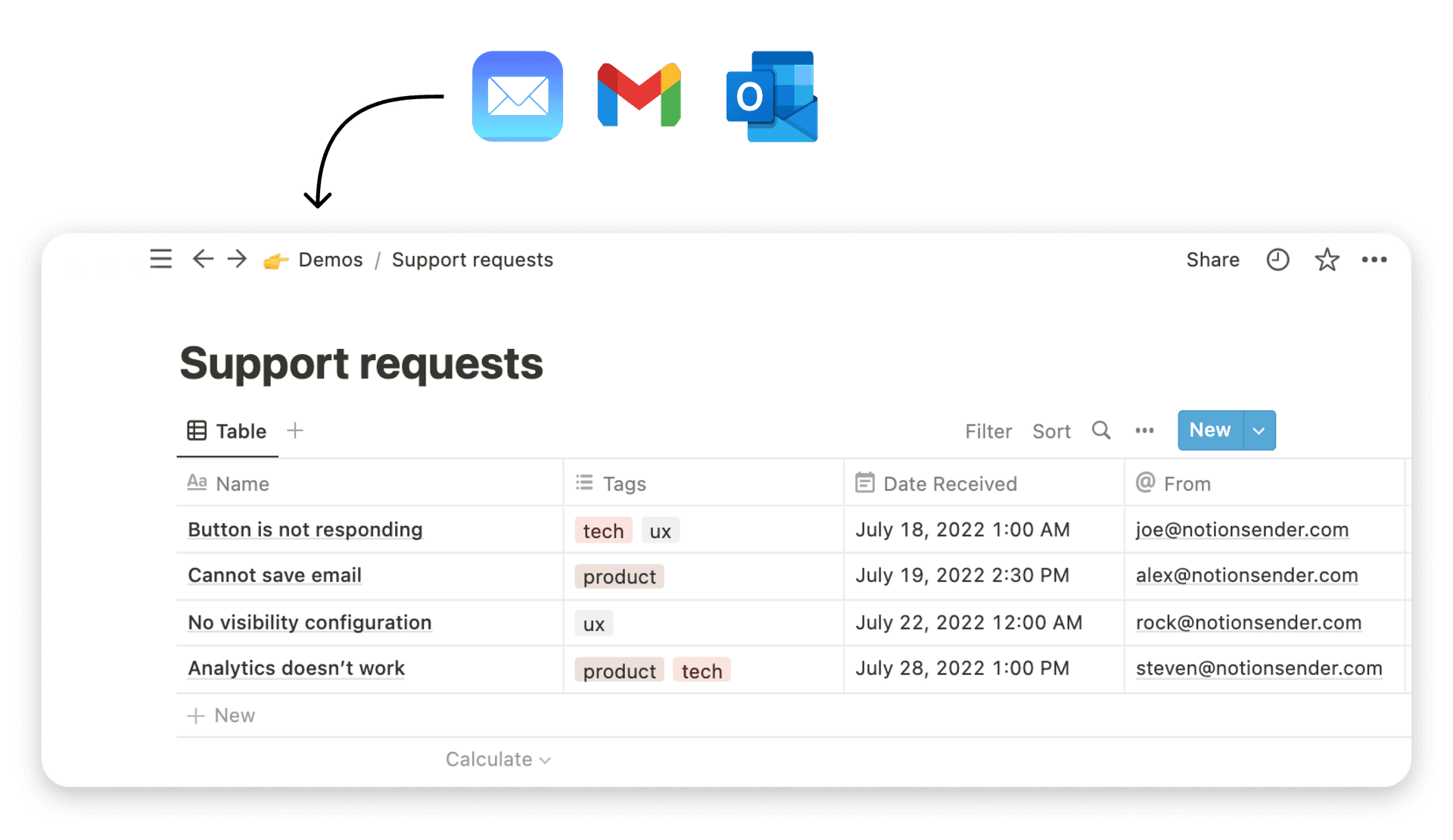
This is exactly what you can do with a tool like NotionSender. It bridges the gap between your inbox and your workspace. Forget manually copying client details or forwarding invoices. Instead, you can have emails create new, perfectly organized items in your Notion databases automatically.
Setting Up Your Email-to-Notion Pipeline
The concept is surprisingly straightforward. NotionSender gives you a unique email address for each of your Notion databases. When you send or forward an email to that address, the tool reads the content—sender, subject, body, even attachments—and creates a new entry in your database with all that info.
Getting this up and running only takes a few minutes.
- Create a NotionSender Account: First, sign up and connect it to your Notion account. You'll just need to grant it permission to access the pages you want to use.
- Connect a Database: Pick a database where you want emails to go. This could be a "Client Inquiries" table, a "Project Tasks" board, or anything else.
- Get Your Unique Email: NotionSender instantly generates a special email address specifically for that database.
You can create as many of these email addresses as you need. Give one to your CRM, one to your finances database, and another for content ideas. This lets you route different types of information to the right place from the get-go.
Practical Use Cases for Professionals
Once you're connected, this simple setup opens up a world of automation. The real magic happens when you use these dedicated email addresses to get rid of the repetitive tasks that eat up your day.
The goal is to make your Notion desktop app the true source of truth for your work. By pairing it with NotionSender, you can centralize everything.
A lot of professionals are already finding ways to make Notion their central hub. For example, some are using it to build everything from client portals to project dashboards. The key is to integrate the tools you're already using.
Here are just a few ways you can put this into practice:
- Automate Your CRM: Give clients a specific email address that feeds directly into your "Clients" database. Every time a new person reaches out, a new profile is created for them, complete with their contact info and their first message.
- Track Invoices Effortlessly: Create a rule in your email client to automatically forward any email with the word "invoice" to your "Finances" database email. Just like that, you have a central log of all your bills without lifting a finger.
- Manage Meetings and RSVPs: Planning an event? Ask attendees to RSVP to a dedicated email address linked to your "Events" database. Each reply adds an entry, giving you a live headcount.
This diagram gives you a good idea of how these different workflows can connect, turning separate processes into a single, unified system.

As you can see, things like a client portal or content calendar don't have to be isolated. They can all be fed by automated data streams, including your email.
Here's a quick look at how different roles can benefit.
NotionSender Use Cases for Professionals
| Professional Role | Use Case with NotionSender | Primary Benefit |
|---|---|---|
| Freelance Writer | Forward client briefs and feedback emails to a "Projects" database. | Automatically creates tasks and centralizes all project-related communication in one place. |
| Sales Manager | Use a unique email for a "Leads" database shared on a contact form. | New leads are instantly added to the CRM in Notion, ready for follow-up without manual data entry. |
| Small Business Owner | Auto-forward receipts and invoices from services like AWS or Google Workspace. | Keeps a real-time, organized log of all business expenses in a "Finances" database for easy accounting. |
| Recruiter | Link a unique email to a "Candidates" database for job applications. | Each application creates a new candidate profile with the resume attached, streamlining the hiring pipeline. |
These are just starting points, of course. The real power comes from tailoring this to your specific daily tasks.
By integrating your email, you’re essentially building an automated assistant right inside your Notion desktop app. It saves a ton of time, stops important info from getting lost in your inbox, and keeps your databases updated with what's actually happening.
Of course, automation is only half the battle. For outreach, you'll also want to focus on effective communication techniques like cold email personalization to make sure your messages actually get read and answered.
But the best part? You can also compose and send emails from Notion, which completely closes the loop. If you want to see exactly how that works, check out our guide on how to create and send email from Notion. It'll turn your desktop app from just a planning tool into a real communication hub.
Your Top Questions About Notion for Desktop
Once you start using the Notion for desktop app regularly, you're bound to have some questions. It’s a seriously capable tool, and getting to know its little quirks is the secret to making it work for you. This section tackles the most common questions we see pop up.
We’ll give you clear, no-fluff answers to help you get the hang of the desktop experience, covering everything from working offline to handy shortcuts. Think of this as your quick-reference guide for building a better digital workspace.
Is The Notion Desktop App Better Than The Web Version?
While both versions have the same core functionality, the desktop app is generally better for focused, heavy-duty work. It’s designed to be your command center, away from the endless distractions of browser tabs.
Here's why many power users prefer the desktop app:
- Reliable Offline Access: You can keep working on your pages and databases even without Wi-Fi. This is a lifesaver when you're traveling or just have a spotty connection.
- Superior Performance: If you have a massive workspace with lots of connected databases, the desktop app feels faster and smoother because it uses your computer’s own power.
- Distraction-Free Environment: Having Notion in its own window, separate from your browser, helps create a mental boundary. It’s easier to get into deep work and avoid the temptation to just open another tab.
- Native OS Features: It plays nicely with your computer's operating system, letting you open multiple Notion windows and get system-level notifications.
For these reasons, the desktop app is the go-to choice for anyone who spends a good chunk of their day inside Notion.
How Does Offline Access Work On Notion For Desktop?
Offline access on the Notion desktop app is a game-changer for getting things done anywhere. It works by saving a copy (or "caching") the pages you’ve recently opened directly onto your computer. This gives you a snapshot of your workspace that you can access anytime, internet or not.
When you open the app offline, you can still read, edit, and even create new content on those saved pages. Every single change you make is logged locally on your device.
As soon as you get back online, the Notion for desktop app automatically senses the connection. It then syncs all your offline changes with Notion's servers, all happening quietly in the background. You don’t have to do a thing.
This makes it possible to stay productive on flights, during your commute, or anywhere else the internet is less than reliable.
Can I Use Integrations Like NotionSender With The Desktop App?
Absolutely. The Notion desktop app fully supports any integration that connects to your Notion account, and that definitely includes powerful tools like NotionSender.
NotionSender works by sending emails to a unique address tied to one of your databases. Because of how it's built, it doesn't matter if you're using Notion on the web, on your phone, or on the desktop app.
In fact, pairing NotionSender with the desktop app creates a really slick workflow. You can manage incoming emails—like client messages or automated reports—right from your main, focused workspace. This means no more bouncing between Notion and your email client. And to make sure your email strategy is on point, it's always a good idea to check out the best email outreach automation tools for 2026 for other helpful resources.
What Are Some Essential Keyboard Shortcuts For The Desktop App?
Learning a few keyboard shortcuts is the fastest way to speed up your work in the Notion desktop app. When you can keep your hands on the keyboard, you stay in the flow and get things done much faster.
Here are a few of the most important shortcuts to get you started:
- Quickly Find a Page (
Ctrl/Cmd + P): This is the ultimate shortcut. It pops open a search bar that lets you find and jump to any page in your workspace instantly, no matter how buried it is. - Open a New Notion Window (
Ctrl/Cmd + Shift + N): This one is exclusive to the desktop app and is incredibly useful. You can open a second Notion window to compare two pages side-by-side or keep a dashboard open while you work on a task. - Go Back or Forward in Page History (
Ctrl/Cmd + [or]): This lets you navigate your recently viewed pages just like using the back and forward buttons in a web browser. - Create a New Page (
Ctrl/Cmd + N): Instantly start a new blank page without clicking around. It’s perfect for capturing a quick thought before it disappears. - Create a Comment (
Ctrl/Cmd + Shift + M): Highlight anything and hit this combo to leave a comment for your team or a note for your future self.
Just getting these five down will make a huge difference in how fluid and efficient your work in Notion feels.
Transform your Notion workspace from a static planner into a dynamic communication hub. With NotionSender, you can send and receive emails directly within your databases, automating workflows and centralizing your projects like never before. Start streamlining your work today at https://www.notionsender.com.