How to Save an Email in Gmail The Right Way
Saving a specific email in Gmail is a cinch. Just open the email, click the three-dot menu, and you've got a couple of choices: "Download message" to get a raw .EML file or "Print" to save it cleanly as a PDF. Done.
This little trick ensures you have a copy on your machine for legal records, important receipts, or project communications—no internet connection required.
Why Saving Emails Offline Still Matters
In a world where everything lives in the cloud, saving a local copy of an email might feel a bit old-school. I get it. Gmail's search is so powerful it can find a needle in a digital haystack from a decade ago.
But here's the thing: relying only on the cloud has its own risks. A simple offline backup can be a real lifesaver. This isn't about digital hoarding; it's about smart information management and being prepared.
When you save a copy, you have total control over your most critical communications, independent of your internet connection or even your account access.
Reasons for Keeping Local Copies
Think about some real-world situations where having that saved email is non-negotiable. Legal disputes, for instance, often hinge on having pristine copies of correspondence for evidence. A freelance designer I know saves every single project approval email to have undeniable proof of client sign-off.
Even for personal stuff, saving travel confirmations or online purchase receipts gives you a reliable backup if the original gets lost in the shuffle or accidentally deleted.
Here are just a few solid reasons you might want to save an email from Gmail:
- Legal Compliance and Audits: Keeping immutable records of contracts, official notices, or financial agreements.
- A Permanent Personal Archive: Building your own knowledge base from important conversations, mentorship advice, or even family memories.
- Offline Accessibility: Making sure you can pull up that flight ticket or hotel reservation when you’re stuck somewhere with no Wi-Fi.
This simple workflow really breaks down the core strategy for effective email archiving.

The process really just boils down to identifying what's important, saving it somewhere safe, and knowing it's there when you need it most.
Having an offline archive is your ultimate safety net. It protects your most valuable information from accidental deletion, account lockouts, or service outages, giving you true ownership of your data.
This isn't some niche practice, either. It’s a common habit among many of Gmail's over 1.8 billion active users. And with over 75% of people checking their email on mobile, having quick, reliable ways to save crucial info on the go has never been more important. You can dig into more insights about the massive scale of Gmail usage and see just how central it is to our digital lives.
When you just need a simple, universally readable copy of an email, saving it as a PDF is your go-to move. Think of it as a perfect digital photocopy—it locks in the layout, images, and text exactly as you see them on screen. It’s my preferred method for archiving important stuff like receipts, signed contracts, or any official correspondence I might need later.
The whole process cleverly uses Gmail's built-in "Print" function. Don't worry, you don't actually need a printer. It’s really more of a "prepare to save" button, and it's by far the most straightforward way to save an email without any extra software.
Turning Emails into PDFs
First, just open the email thread you want to save. Look for the little printer icon in the top-right corner of the message. If you don't see it, click the three-dot menu, and you'll find the "Print" option there. Clicking this will pop up your computer's standard print dialog box.
Now, this is the important part. Instead of sending it to a physical printer, look for the "Destination" dropdown menu and simply select "Save as PDF" from the list. After that, just choose where you want to save the file on your computer, and you're all set. The entire email conversation is now a single, tidy PDF document.
This is the standard menu you'll encounter when you choose to print your email.

The key is just knowing that the "Destination" setting is where you can switch from physical printing to digital saving.
A crucial point to remember is that this method only saves the visual content of the email itself. It does not embed or include any file attachments. If you need to keep attachments bundled with the message, you’ll need to download them separately or use a different saving format.
This approach works like a charm on both desktop and mobile. On your phone, the process is almost identical. Just open the Gmail app's menu, tap "Print," and then choose the "Save as PDF" option from your phone’s sharing or printing screen. It's perfect for archiving an important confirmation email the moment you receive it, no matter where you are.
Preserving the Original Email as an EML File
While a PDF creates a perfect visual snapshot, sometimes you need more than just a picture. For situations where you need the complete, unaltered digital package—headers, metadata, exact formatting, and all attachments bundled together—the EML file is your go-to. This method saves the raw data of the message itself.
Think of it as a digital time capsule. An EML file is a standard format that most email clients, like Outlook, Apple Mail, and Thunderbird, can easily understand. This makes it the best option for legal discovery, technical troubleshooting, or simply moving a specific message to another email program without losing a single byte of data.
How to Download the EML File
Thankfully, Gmail makes this incredibly simple.
First, open the email you want to save. Find the three-dot menu icon next to the reply button and give it a click. A dropdown list will appear—from there, just select "Download message".
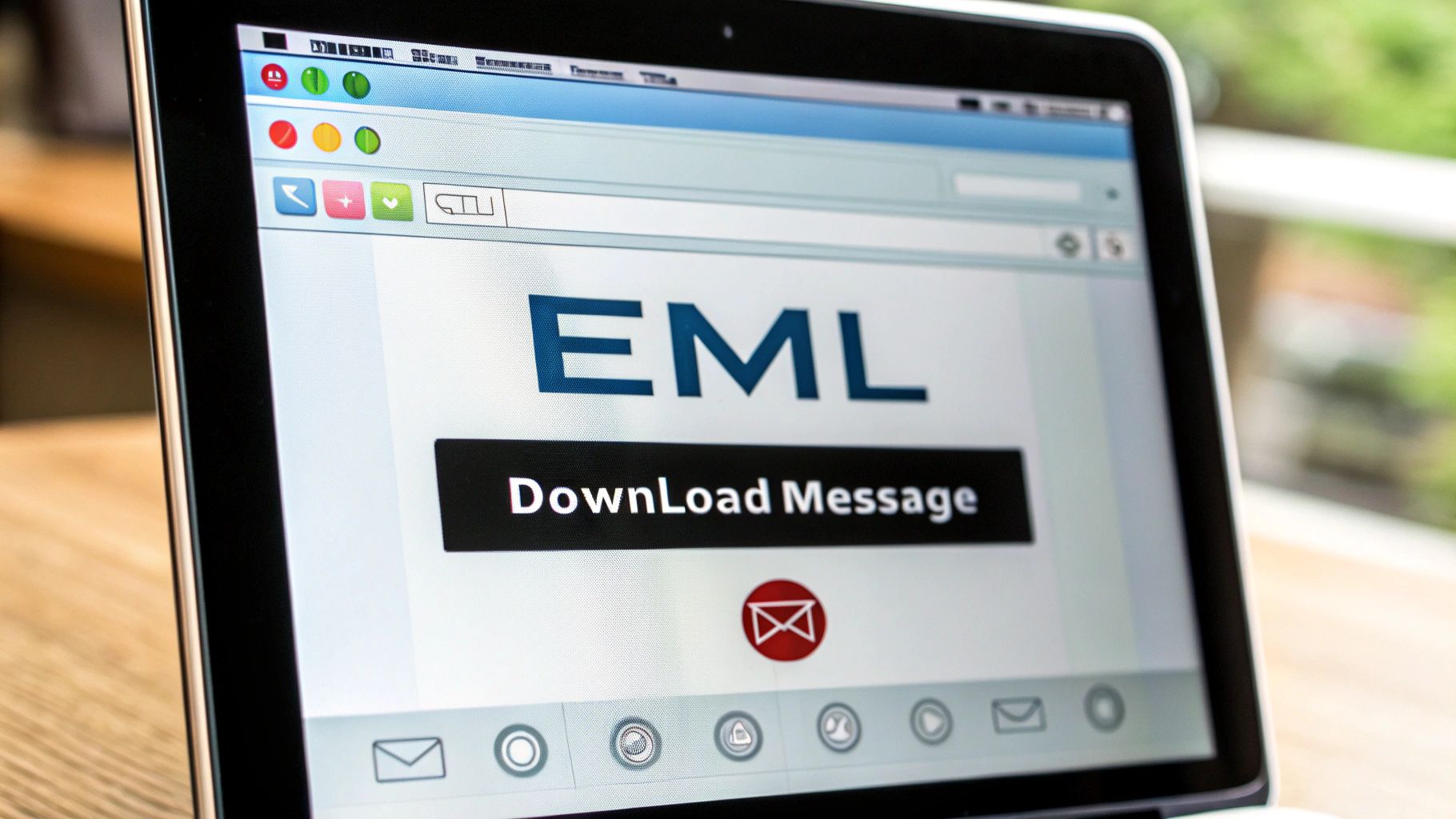
That’s all there is to it. Gmail will immediately save a .eml file to your computer’s download folder. This single file now contains the entire email and its attachments, ready for you to archive or import somewhere else.
The key difference is integrity. A PDF captures what an email looks like, while an EML file captures what an email is. For archival purposes where authenticity is paramount, the EML format is the industry standard.
This is one of those powerful, straightforward features that makes Gmail so functional. The platform’s dominance, holding about 39.54% of the global email market, is built on a foundation of features like this that help billions of users manage their communications effectively. You can discover more insights about Gmail's massive user base and its features.
This raw-data approach is also a huge plus for developers and other technical users. The complete header information inside an EML file is invaluable for diagnosing delivery issues or integrating with other systems. To get a sense of how email data can be used programmatically, you can explore the NotionSender API documentation and see how email content can be parsed and automated.
Let's be honest, manually saving emails is fine for the odd one-off, but it's a huge drag when your inbox is a core part of your daily workflow. If you live and breathe in a tool like Notion, the constant back-and-forth of downloading and uploading files just shatters your focus. It's pure friction.
This is where a more connected approach can be a game-changer.
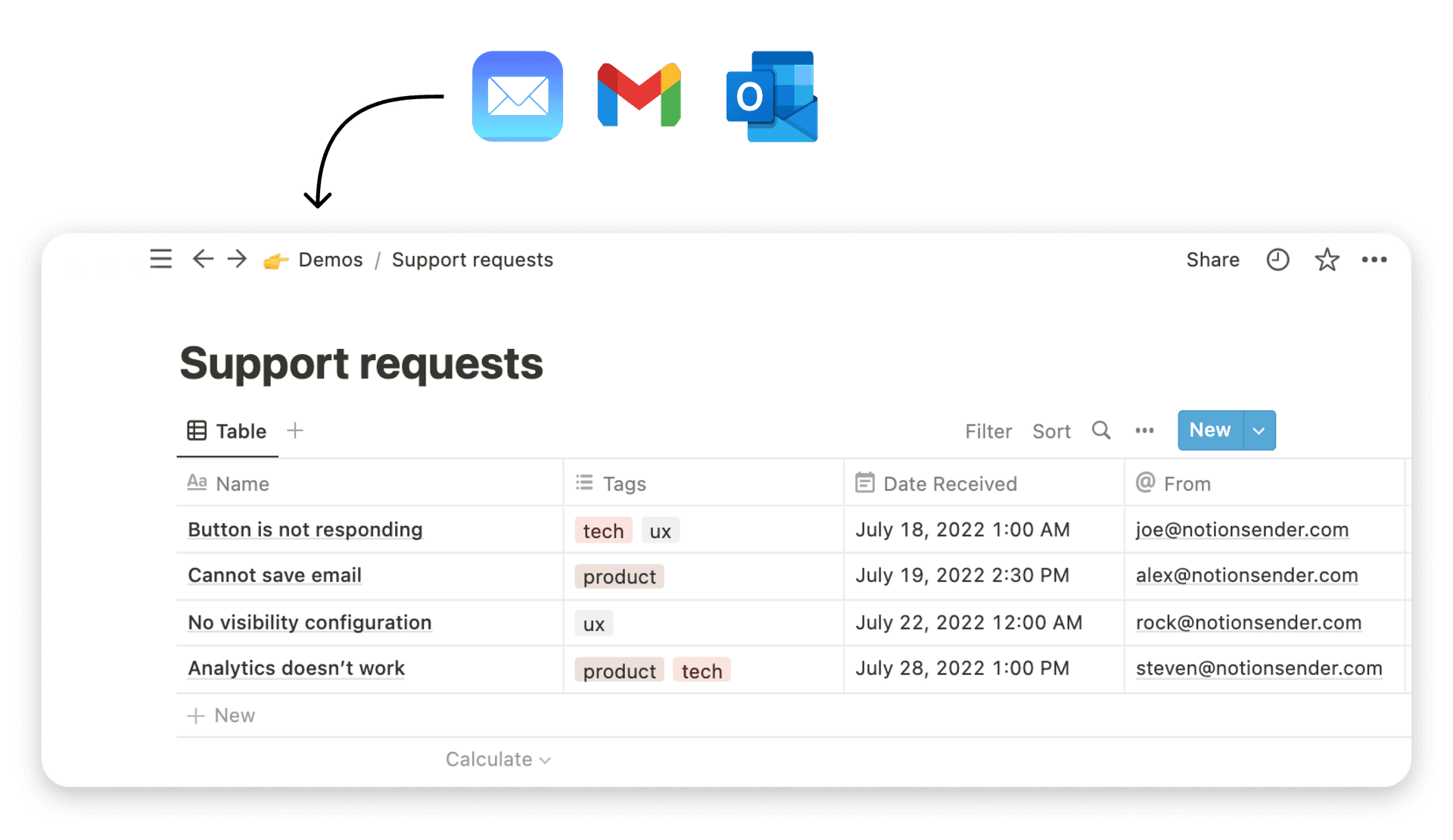
Instead of seeing your inbox and your workspace as two separate islands, you can build a bridge between them. Using a dedicated tool lets you save an email from Gmail directly to a Notion database in a single click. It's like turning a static message into something you can actually do something with—a task, a client record, or a new resource for your knowledge base.
<iframe width="100%" style="aspect-ratio: 16 / 9;" src="https://www.youtube.com/embed/IS0NPa0yqi4" frameborder="0" allow="autoplay; encrypted-media" allowfullscreen></iframe>
Turn Your Inbox into a Command Center
Picture this: a client pings you with critical feedback on a project. Instead of the old copy-and-paste routine, you can zap that entire email straight into your "Project Tasks" database in Notion. All the original context is preserved, and every piece of communication stays in one central hub.
Here's how that plays out in the real world:
- For Project Managers: You can capture stakeholder requests on the fly and instantly convert them into trackable tasks. No more lost emails.
- For Freelancers: Save client agreements and project briefs right to their dedicated client page in Notion. Everything you need is exactly where you expect it to be.
- For Researchers: Got an important article or conversation thread in your inbox? Archive it directly into a centralized research library for easy reference later.
This kind of integration transforms your inbox from a passive holding pen into an active, dynamic part of your entire productivity system.
Here's the logo for Notion, the tool that can become the central hub for all your important emails and workflow.

When you connect Gmail to Notion, you're not just moving data around; you're building a powerful, tailored information hub that actually works the way you do.
This method is less about simple storage and more about building a system. When you automatically parse emails into a structured database, you’re not just saving a message; you’re enriching your entire workflow with valuable, organized data.
For a much deeper dive, check out our full guide on the specific benefits of saving emails to Notion. This is just one example of how powerful integrations can be. If you're curious about what else is possible, it's worth exploring all the different Notion integration capabilities out there.
Smart Tips for Effective Email Archiving
So, you've figured out how to save an email from Gmail. Great! But let's be honest, just downloading files isn't enough. The real goal is to build an offline archive that’s actually useful—one you can search through quickly, not a digital junk drawer where important messages go to die. Getting this right comes down to being proactive and systematic from the start.
A simple yet powerful habit to build is a consistent file naming convention. Don't just stick with whatever default filename Gmail spits out. Instead, rename every single file with a logical structure. I'm a big fan of "YYYY-MM-DD_Sender_Subject" because it instantly tells me what the email is about and when it was sent. It also makes sorting files by date a total breeze.
Build an Organized Folder Structure
Once you’ve got your naming system down, the next step is to create a sensible folder structure on your computer to put everything in. The best approach I've found is to just mirror the categories you already use in your work and personal life. It's intuitive and requires almost no learning curve.
Here are a few ideas to get you started:
- Financial Records: Set up a main "Finance" folder with subfolders for things like "Invoices," "Receipts," and "Tax Documents."
- Project-Based Work: Give each client or project its own dedicated folder. Inside, you can create subfolders for "Contracts," "Feedback," and "Approvals."
- Personal Documents: Create folders for "Travel Itineraries," "Medical Records," or "Online Orders" to keep personal admin tidy.
This one habit will save you so much time down the line. You'll be able to find any saved email in seconds without having to rack your brain for specific keywords or dates.
The secret to a good archive is consistency. Pick a naming convention and a folder structure, and then stick to it. That’s the single most important thing you can do to turn your saved emails into a valuable, long-term resource.
Think about it: the average person spends about 28 minutes on Gmail every single day. That's a huge chunk of our lives. As email continues to dominate how we communicate, mastering these archiving habits is no longer a "nice-to-have"—it's a necessity.
If you want to take your organization to the next level, you can explore the best email archive solutions for more powerful tools. And to see how this fits into a bigger picture, check out our guide on https://www.notionsender.com/blog/post/6_simple_email_management_tips_to_boost_your_productivity.
Common Questions About Saving Gmail Emails
Even with a few solid methods under your belt, you’ll probably bump into some specific questions when you actually go to save an email. Let's clear up some of the common hurdles so you can nail down your workflow and pick the right approach every time.
Here are the questions I see pop up most often.
Can I Save Multiple Gmail Emails at Once?
Straight out of the box, Gmail’s "Download message" and "Print" features are built for one-off jobs. They handle a single email conversation at a time, which is great for saving individual records but a real drag for bulk archiving.
When you need to save a whole bunch of messages, your best friend is Google Takeout. This tool lets you export every email under a specific label (or even your entire inbox) into one big MBOX file. You can then open that file with a desktop email client like Mozilla Thunderbird or Apple Mail.
If you’re looking for something more selective but still want to work in batches, the Google Workspace Marketplace has third-party add-ons that can download multiple emails as PDFs or other formats.
Do PDFs Include Email Attachments?
Nope. When you save an email as a PDF, you’re only capturing the visual body of the message. Any files attached to that email are left behind. The PDF is basically just a digital snapshot of the conversation.
Think of it this way: a PDF saves what you see, not what’s attached. To keep your files and the message together, you have to download the attachments separately from the original email in Gmail.
If bundling attachments with the message is a must, then saving the email as an EML file is the way to go. The EML format keeps the whole package intact—the message, headers, and all original attachments—inside a single, self-contained file.
Is It Safe to Use Third-Party Apps?
You should always be careful about what you let into your inbox. The safest bet is to stick with well-known apps from the official Google Workspace Marketplace, since Google has already vetted them.
Before you grant access to any third-party tool, always take a minute to review the permissions it’s asking for. Make sure you understand exactly what data it needs and why. It’s also a good idea to check out user reviews and the developer’s privacy policy.
When you're dealing with highly sensitive information, though, nothing beats the security of Gmail’s own built-in saving features.
Ready to transform your email workflow? With NotionSender, you can stop manually saving emails and start integrating them directly into your projects. Try NotionSender today and turn your inbox into a productivity powerhouse.