Build a Unified Web Based Email Login Workspace in Notion

If your day involves constantly jumping between your inbox and your project management tools, you know how frustrating a disconnected web based email login workspace can be. It's a huge bottleneck that leads to lost information, delayed tasks, and that nagging feeling that you're never quite on top of things.
The problem is simple: your conversations live in one place, and your work lives somewhere else entirely.
The Hidden Costs of a Disconnected Workspace
For most of us, the daily routine is a frantic digital shuffle. You open your email to check for a new message from a client, then you flip over to your project board to update a task. A few minutes later, you're back in your inbox, hunting for an attachment that needs to be added to that very same project.
This constant toggling isn't just a minor annoyance; it’s a massive productivity killer.
Every time you switch apps, your brain has to recalibrate, leaving behind what researchers call "attention residue." These tiny moments of lost focus add up. Over a week, they can easily amount to hours of wasted time that you could have spent on actual, meaningful work.
The Real Impact on Your Workflow
Think about a small business owner juggling a few different client projects. A critical approval email lands in their inbox, but it sits there unread while they're focused on a task in their project software.
Later, they completely forget to copy that approval into the project's official record. This tiny oversight can spiral into confusion, delays, or even work being done that was never signed off on—all because the communication wasn't connected to the project plan.
Manually transferring information—copying text, downloading attachments, and updating statuses across different apps—is like a hidden tax on your team's productivity. It opens the door for human error and guarantees that no single platform ever gives you the full, true picture of a project.
Why Silos Create Bottlenecks
When your systems don't talk to each other, you create information silos. Essential data gets trapped in one app, completely invisible to others. This forces your team to constantly chase down updates that should be easy to find.
The consequences are pretty clear:
- Delayed Decisions: When information is scattered everywhere, it takes way too long to get the context you need to make a good call.
- Missed Deadlines: Key instructions or files buried in an email thread are easily overlooked, putting your entire project timeline at risk.
- Reduced Visibility: It's almost impossible for project managers to accurately track progress and spot problems early when there's no single source of truth.
By finally bridging the gap between your email and your project hub, you can eliminate these headaches for good. A great first step is exploring simple email management tips to boost your productivity.
Ultimately, a unified web based email login workspace isn’t a luxury—it’s a necessity for getting things done efficiently.
Connecting Your Email to Your Notion Workspace
Alright, let's get to the good stuff: linking your inbox directly to your Notion workspace. This is where you stop being a glorified copy-paste machine and start building a smart, automated web based email login workspace.
Think about it. You're a freelancer, and a new project lead comes in via email. Instead of manually creating a new entry in your 'Client Projects' database, what if that email could just... show up there on its own? That’s the goal.
So many of us are stuck in a cycle of chaos that looks something like this:

That diagram is the reality for too many people. Every manual step is a chance for information to get lost, creating silos and wasting time you could be spending on actual work.
Getting Started with Account Creation
First things first, you'll need an account with an integration tool like NotionSender. The signup process is designed to be quick and secure. You'll use your existing Google or Microsoft account—the same one you want to connect—to get started.
This part is really important for peace of mind. These tools don't ask for your email password. Instead, they use an industry-standard protocol called OAuth 2.0. It's like giving a parking valet a key that only starts your car; they can't get into your glove compartment or trunk. You’re granting very specific permissions, not handing over the keys to your entire digital life.
Securely Authorizing Your Email Access
Once your account is up and running, it's time to connect it to Notion. This is the handshake that allows the tool to see your databases and, more importantly, add new pages to them for you.
Here's what happens behind the scenes:
- Granting Permission: A prompt will ask you to pick which Notion pages or databases you want to connect. Our freelancer, for example, would just select their "Client Projects" database.
- Confirmation: Notion then confirms your choice and creates a secure connection. The tool gets access only to what you've approved, not your entire account.
This level of control is a huge security win. You're always in the driver's seat, deciding exactly what gets connected.
At its core, this whole process is about turning messy, unstructured emails into neat, organized database entries. To do this effectively, the system relies on powerful email parser solutions that can intelligently read and sort your incoming mail.
This is the tech that finds the sender, subject line, and attachments and maps them perfectly to the right properties in your Notion database.
Generating a Unique Database Email
Now for the really cool part. With everything authenticated, you can generate a unique email address for any specific database in your Notion workspace.
For our freelancer, they’d create one for their "Client Projects" database. This address becomes a dedicated inbox for that single database. Any email sent or forwarded to it is automatically turned into a new item right where it belongs.
You can create as many of these as you need. Imagine having:
invoices.123@ns.comfor your accounting databaseleads.456@ns.comto feed your sales CRMsupport.789@ns.comfor tracking customer tickets
This is incredibly powerful when you consider how much of our work lives in email. Web-based email is king, with Gmail holding 30.7% market share and Apple Mail at 53.67%. Together, they handle over 80% of all emails worldwide. That’s a huge slice of the 376.4 billion messages sent daily in 2025, which is expected to grow to 392.5 billion by 2026. You can dig into more of these email usage trends on AboutChromebooks.com.
By setting this up, you’re creating a direct pipeline from your primary communication channel right into the heart of your workspace. No more friction, just flow.
Managing Your Emails Directly Inside Notion

Okay, you’ve built the bridge between your inbox and your Notion workspace. This is where things get interesting. We're moving past the initial setup and into the day-to-day workflow where you’ll really feel the difference in your web based email login workspace. The real power isn’t just getting emails into Notion; it’s what you can do with them once they’re there.
Let’s go back to our freelancer juggling a few different clients. Before, when a client sent an approval email, it would just sit in their inbox, completely disconnected from the actual project it belonged to. They’d have to remember to copy the text, download the attachments, and then jump over to Notion to update the project status. It’s a pain, and it’s easy for things to fall through the cracks.
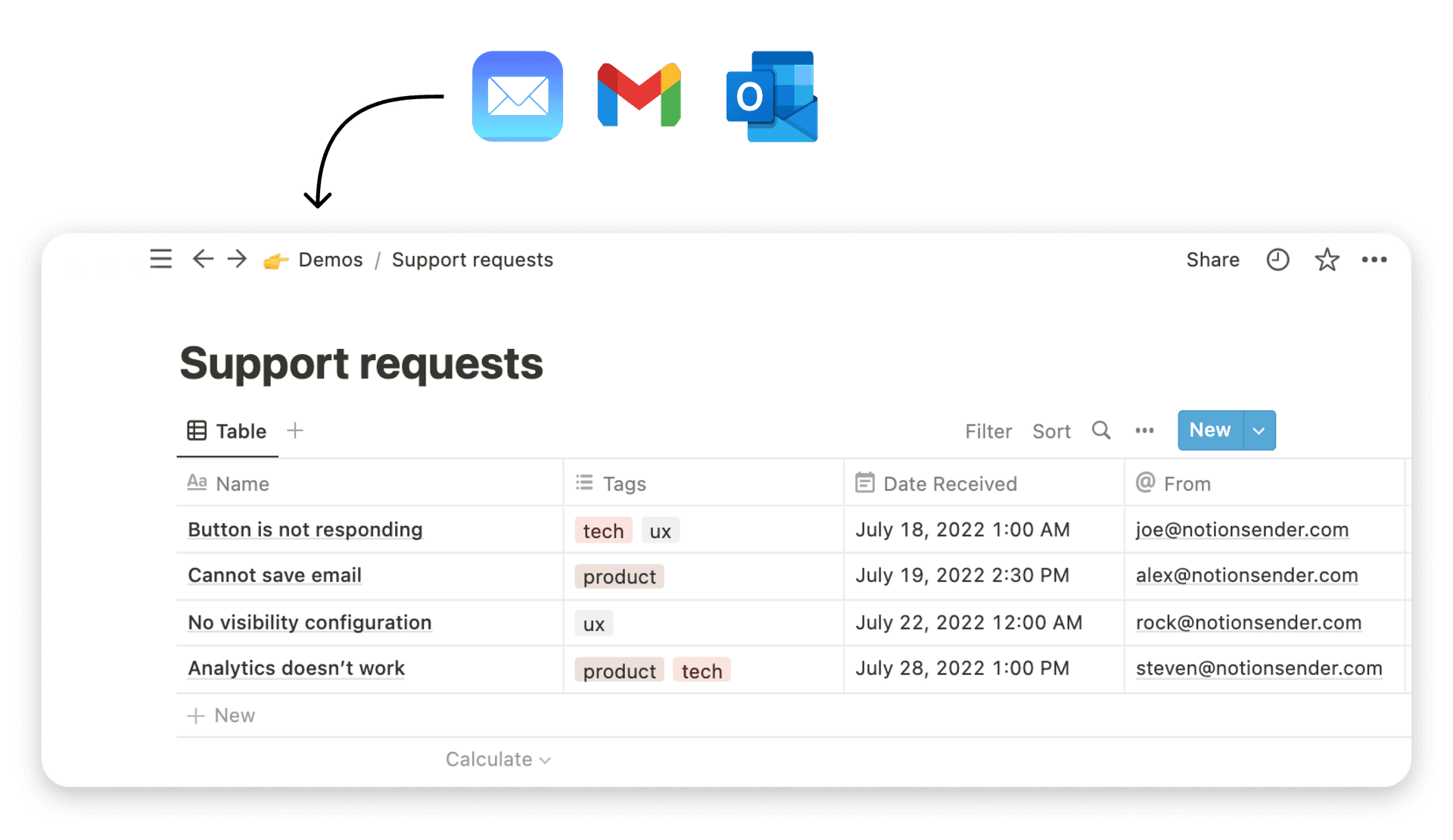
Now, using a tool like NotionSender, that same approval email gets forwarded to the project’s unique address. Instantly, it pops up as a new page in their "Client Projects" database, perfectly organized and ready to go.
How It Turns Emails Into Usable Data
This isn't just a clunky copy-and-paste. A good integration can intelligently read the email’s data, automatically sorting each piece of information into the right property in your Notion database. This is how you turn a messy email thread into structured, actionable data without any manual work.
Here’s a breakdown of what gets captured automatically:
- Sender Information: The client's email address lands right in your "Contact" or "Email" property.
- Subject Line: This becomes the title of the new Notion page, giving you context at a glance.
- Email Body: The entire message is saved inside the Notion page, so you never lose the original context.
- Attachments: Any files—signed contracts, design mockups, feedback documents—are downloaded and attached directly to the page.
For our freelancer, this means every piece of communication and every file is logged automatically. This creates a rock-solid single source of truth for each project. They never have to dig through their inbox to find a specific file or confirm a detail again. You can learn more about the nuts and bolts of saving emails to Notion and how it reshapes project management.
Creating a Single Source of Truth
We’re all drowning in email. By 2026, it's predicted that a mind-boggling 422 billion emails will be sent every day. The average employee already spends about 11 hours per week just managing their inbox. Over a career, that’s almost 3,000 working days spent on email admin. These staggering email statistics highlight just how much time we lose to disorganized communication.
This is where integrating your workspace really pays off. The table below shows a simple before-and-after of what this looks like in practice.
Before and After Integrating Your Email Workspace
| Task | Traditional Workflow | Integrated NotionSender Workflow |
|---|---|---|
| Log Client Feedback | Receive email, copy feedback, open Notion, find project, paste text, upload attachments. | Forward email to project's unique address. Done. |
| Find an Attachment | Search inbox with keywords, filter by sender/date, open multiple emails to find the right file. | Go to the project page in Notion. All attachments are right there. |
| Onboard a New Team Member | Forward dozens of old email threads, try to explain project history. | Grant them access to the Notion database. The entire project history is organized and in context. |
| Track Project Approvals | Use folders, flags, or stars in the inbox to mark approval emails. Hope nothing gets missed. | Approvals are logged as pages in Notion, linked directly to the task and visible to the whole team. |
As you can see, the shift is from a scattered, manual process to a centralized, automated one.
This integration transforms your Notion database from a simple project tracker into a comprehensive client communication log. Every interaction, approval, and deliverable is captured and organized chronologically, providing a complete history of the project accessible to your entire team.
The impact is huge. Think about bringing a new team member onto a project that's already moving. Instead of forwarding them a mountain of old email chains, you just give them access to the Notion database. They can see the entire history of client communication from day one, all tied directly to the project tasks.
This approach gets rid of the guesswork and makes sure everyone is on the same page. It turns your cluttered inbox from a source of stress into a streamlined, searchable archive that actually works for you.
Automating Email Workflows from Your Notion Hub

Pulling emails into Notion is a solid first step, but the real magic happens when you turn your workspace into a command center for sending them back out. This is where you go from just organizing information to actively sending and scheduling emails straight from your databases.
The end goal is a powerful, automated web based email login workspace that practically runs itself, saving you from the black hole of your inbox.
Let's walk through a common scenario. Imagine you’re running a large-scale outreach campaign. You need to contact hundreds of potential partners, follow up without fail, and track every single interaction—all without living inside your email client.
Building Your Outreach Command Center
First things first, you need a dedicated "Outreach Contacts" database in Notion. This isn't just a list; think of it as the mission control for your entire campaign.
For each person you're contacting, you'll want to create an entry with a few key properties to make automation and personalization possible:
- Name: The contact's full name.
- Company: The organization they're with.
- Email: Their direct email address, of course.
- Status: A dropdown property is perfect here (e.g., "Not Contacted," "Emailed," "Follow-up Sent," "Replied").
- Last Contacted Date: A date property to keep your timeline straight.
Getting this structure right is the foundation for everything that follows. It turns a static list into an active tool.
Using Dynamic Templates for Personalization
Nobody likes getting generic mass emails. They're easy to spot and even easier to ignore. This is where dynamic templates, especially with a tool like NotionSender, become your best friend.
You can create email templates that automatically pull information from your database properties. For example, your first email could start like this:
Hi {{Name}}, I saw the great work your team at {{Company}} is doing...
When you fire off the email from Notion, the {{Name}} and {{Company}} placeholders are instantly replaced with the actual data from that contact's row. This means you can send hundreds of uniquely personal emails with just a few clicks. For those who want to get more advanced, you can find documentation for creating powerful template expressions to really customize your messages.
This approach gives you the best of both worlds: the efficiency of automation and the personal touch of a one-on-one message. Every email feels like it was written just for the recipient, which can make a huge difference in your response rates.
Scheduling Follow-Up Sequences
Let's be honest, the real work in any campaign is in the follow-up. Trying to manually track who needs a nudge and when is a recipe for disaster. Automating it guarantees you stay on top of every lead.
You can set up rules that trigger follow-up emails based on your database properties. A classic example is creating a rule to automatically send a second email if the "Status" property has been stuck on "Emailed" for seven days. Set it up once, and you'll never have to worry about a lead falling through the cracks again.
Beyond just email, the ability to integrate and automate your sales pipeline processes can bring a whole new level of efficiency to your entire operation.
The sheer volume of email flying around today is exactly why this kind of automation is a necessity, not a luxury. Consider that 86% of professionals juggle at least three email addresses, and the global daily email traffic is set to hit 422 billion messages. A huge chunk of that—38% and growing by 9% each year—is system-triggered. These numbers don't lie; automating your routine communication is the only way to keep up.
Security and Best Practices for an Integrated Workspace
<iframe width="100%" style="aspect-ratio: 16 / 9;" src="https://www.youtube.com/embed/7yN0X5R_o9Y" frameborder="0" allow="autoplay; encrypted-media" allowfullscreen></iframe>
Bringing powerful tools like NotionSender into your workflow is a huge win for efficiency. But connecting apps also means you need to be smart about security. Getting your web based email login workspace locked down isn't about becoming a tech wizard—it's about building a few simple, solid habits.
The most important piece of the security puzzle is how the apps talk to each other. Secure tools like NotionSender use OAuth 2.0, which is the industry standard for a reason. Think of it like giving an app a temporary keycard with limited access instead of handing over your master key. You grant very specific permissions without ever sharing your actual password. It's the same method Google and Microsoft use to keep your accounts safe.
This method is non-negotiable for good security. It means if you ever want to stop using a service, you can instantly revoke its access without the hassle of changing your main email password.
Managing Permissions and Access
With a secure connection in place, the next step is managing who sees what inside your workspace. Not everyone on your team needs access to every single email or piece of data. This is where a little organization inside Notion goes a long way.
A great practice is to set up dedicated databases for anything sensitive. For instance, create a specific database just for "Invoices" or another for "Contracts." By controlling access to the database right inside Notion, you guarantee that only the right team members can see or edit financially sensitive emails that land there.
Here are a few practical tips you can start using today:
- Use Dedicated Databases: Keep sensitive communications—like HR conversations or financial records—in their own separate, access-restricted Notion databases.
- Audit Permissions Regularly: Make it a habit to check who has access to your key databases every few months. People's roles change, and their permissions should, too.
- Avoid Shared Logins: Every single person on your team needs their own Notion account. This isn't just for convenience; it creates a clear audit trail of who did what.
- Be Wary of Phishing: Remind your team to stay vigilant. Just because an email is saved neatly in Notion doesn't mean the links or attachments inside it are automatically safe.
When you pair a secure authentication method like OAuth with thoughtful permission management, you build a workspace that’s not just efficient but also fundamentally secure. The goal is simple: let information flow easily to the right people, and keep it protected from everyone else.
Your Top Questions About Notion Email Integration
Even with a super smooth setup, you're probably wondering a few things as you get your new web based email login workspace sorted. It's totally normal. Let's walk through some of the questions that pop up most often so you can feel completely confident about how this all works.
What About Connecting Multiple Email Accounts?
You bet. One of the best things about a tool like NotionSender is that you aren't limited to just one inbox. You can easily connect several different web-based email accounts right into your workspace, which is a game-changer for organizing a business.
Think about how a small business might use this:
- A
support@email could automatically create new pages in a "Customer Tickets" database. - The
sales@address could feed right into a "New Leads" CRM built in Notion. - Your personal
name@inbox can be used for all the general project chatter.
The beauty is that each account can be pointed to its own specific database. This keeps all your conversations neatly separated but still accessible from one central place.
How Secure Is It to Give a Tool Access to My Email?
This is a big one, and you’re right to ask it. The security really comes down to how the tool connects to your email, and any reputable integration service will use OAuth 2.0. This is the industry gold standard for secure authorization, trusted by giants like Google and Microsoft to keep user data safe.
With OAuth, you never actually hand over your password. What you’re doing is granting the application very specific, limited permissions to act on your behalf.
It's like giving a valet a key that only starts the car and opens the door. They can’t get into the trunk or the glove compartment. You're always in control and can revoke access instantly, without ever needing to change your main email password.
What Happens to My Emails If I Cancel My Subscription?
Don't worry, your data is always yours. Any emails that have already been pulled into your Notion databases are there to stay, permanently. They've essentially become native Notion pages, completely separate from the tool that brought them in.
If you decide to end your subscription, the only thing you'd lose is the ability to automatically capture new emails or send messages from inside Notion. All of your existing, organized work remains safe and sound right where you left it.
Does This Work with Any Web Based Email Provider?
For the most part, yes. Modern integration tools are designed to play nicely with the major web-based email providers that support standard connection protocols. This almost always includes Gmail and Outlook, which cover a huge chunk of the email world.
That said, it’s always smart to double-check the tool's compatibility list on their website just to be sure your specific provider is supported before you dive in.
Ready to turn Notion into your team's ultimate command center? With NotionSender, you can stop the constant tab-switching and start managing your emails right alongside your work. Get your unique Notion email address today at https://www.notionsender.com and build the unified workspace you've been waiting for.