Automation for Windows: Your Guide to Productivity

If you're like most people, your Windows PC is the command center for your work. But think about all the repetitive little tasks you do every single day—downloading the same reports, sorting files into folders, or sending that standard follow-up email. It adds up.
At its heart, automation for Windows is all about teaching your computer to handle those repetitive jobs for you. Instead of you doing the work manually, you create simple, smart workflows that run in the background, saving you a massive amount of time and preventing simple mistakes.
It’s how you turn your PC from a passive tool into a genuine productivity partner.
Unlocking Your PC's True Potential with Automation

Your Windows computer is like having a super-smart assistant on standby, but most of us only ever ask it to do basic filing. The real magic happens when you let it manage the complex, time-sucking jobs all on its own. That's the core idea here: teaching your machine to work for you.
And don't worry, this doesn't require a computer science degree or any complex coding. With the modern tools available today, anyone can start building powerful automations. The hours you’re losing to boring, manual tasks can be yours again.
What Is a Workflow?
A workflow is just a sequence of tasks that you've instructed your computer to carry out automatically. It all starts with a "trigger"—a specific event that kicks things off. Once the trigger happens, it sets off a series of "actions" you've already defined.
Imagine a digital domino effect: a new client email arrives (the trigger), which then automatically creates a new project card in your management tool, logs the contact in a database, and sends a confirmation message back to the client (the actions).
This flips the script from a reactive, manual process to a proactive, automated one. For small business owners, project managers, and freelancers, this is a total game-changer. It means less time buried in admin and more time focused on the high-impact work that actually moves the needle.
To make this clearer, let's break down the basic ideas you'll encounter when you start automating.
Core Concepts of Windows Automation
Here's a quick summary of the fundamental ideas behind automating tasks on your Windows computer.
| Concept | What It Means For You | Example |
|---|---|---|
| Trigger | The starting signal. This is the event that tells your automation to begin. | A new file is saved to your "Downloads" folder. |
| Action | The specific job to be done. It's the task that your automation performs after the trigger. | Move that new file to a specific project folder. |
| Workflow | The complete sequence. It's the combination of one trigger and one or more actions working together. | When a file is downloaded, move it to the right folder, and then send an email notification. |
Once you get the hang of these three concepts, you can start building all sorts of helpful automations.
How Automation Benefits You
The practical uses are almost endless and can be customized for just about any role. The main reasons people set up automation for Windows are pretty straightforward:
- Save Time: Stop doing the same things over and over, every single day. This can easily free up dozens of hours a year that you can put toward more important work.
- Reduce Errors: An automated system doesn't get tired and make typos. It won't forget a step in a process, which means your data entry and communications are always consistent and accurate.
- Improve Responsiveness: You can set up automations to instantly reply to a new client inquiry or process an order the second it comes in. This boosts customer satisfaction and makes you look incredibly professional.
Ultimately, automation helps you stay organized, efficient, and laser-focused on what really matters for growing your business or finishing your projects.
Choosing the Right Windows Automation Tools
When you start looking into Windows automation, you'll find a whole world of different tools, from stuff already built into your computer to really powerful third-party apps. It can feel like walking into a hardware store for the first time—do you need a simple screwdriver or a full-on power drill? The right choice really just depends on what you're trying to build, how comfortable you are with tech, and your budget.
Some tools are perfect for simple, everyday tasks, while others are designed for much bigger, more complex jobs. The trick is to figure out your own goals first. Are you just trying to organize files, or are you looking to build a workflow that connects your desktop apps to your cloud services? It's a choice worth thinking about, especially since the market for this kind of automation is growing fast—projected to jump from USD 36.21 billion in 2026 to over USD 54.52 billion by 2035.
Native vs. Third-Party Tools
The first big question is whether to stick with what Microsoft offers or bring in an outside tool. Both have their own strengths.
-
Microsoft Power Automate: Since this is a Microsoft product, it’s already hooked into the Windows and Office 365 world. It's a fantastic starting point if most of your work happens in Outlook, Excel, SharePoint, or Teams. It works on both your desktop and in the cloud, so you can connect local tasks with online services.
-
Zapier and Make: Think of these as the universal adapters for the internet. They're brilliant at getting thousands of different web apps to talk to each other. If your day involves jumping between Google Workspace, Slack, Trello, and Notion, these platforms are absolute game-changers.
If you want to see what this looks like in the real world, checking out how to build Power Automate workflows for non-technical teams is a great way to get your bearings.
Before we go deeper, here’s a quick comparison to help you see where each tool shines.
Windows Automation Tool Comparison
This table gives you a quick overview of some popular automation tools, helping you pick the right one based on your technical skills and what you need to get done.
| Tool | Best For | Key Feature | Ease of Use |
|---|---|---|---|
| Power Automate | Microsoft-centric workflows (Office 365, etc.) | Deep integration with the Windows ecosystem. | Moderate |
| Zapier/Make | Connecting hundreds of web-based apps. | Huge library of app integrations. | Easy |
| NotionSender | Email workflows connected to Notion. | Directly sending emails from a Notion database. | Easy |
| AutoHotkey | Highly custom, complex desktop tasks. | Powerful scripting for ultimate control. | Difficult |
Ultimately, the "best" tool is the one that fits your specific process. For cloud-heavy workflows, Zapier is a great choice. For deep Windows integration, Power Automate has the home-field advantage. And for specialized tasks like email, a dedicated tool like NotionSender is often the most direct route.
No-Code vs. Low-Code and Scripting
Another way to think about these tools is how much technical skill they ask of you. The good news is that most modern tools are built for people who aren't developers. They use visual drag-and-drop interfaces instead of code.
Think of no-code platforms as building with LEGO blocks. You just connect pre-made "triggers" and "actions" in a visual editor to build your workflow. You don't have to write a single line of code, which makes automation for Windows something anyone can do.
For those who want a bit more control, some tools offer a "low-code" option. This might mean you write a simple formula or a small bit of code to customize what an action does. For instance, some integrations let you use an API to send or receive data, which opens up a ton of possibilities for custom solutions. You can see an example of how this works in our NotionSender API documentation.
And for those who want total control, you have pure scripting tools like AutoHotkey. It's a free, open-source scripting language that lets you automate almost anything on your Windows desktop by programming keystrokes and mouse clicks. It definitely has a learning curve, but for custom desktop automation, its power is hard to beat.
Building Your First Powerful Automation Workflow
Theory is great, but the real magic of Windows automation happens the first time you build something that genuinely gives you back part of your day. So, let's move past the concepts and get our hands dirty by creating a seriously useful workflow from scratch.
This is a real-world scenario that’s a game-changer for freelancers, project managers, and small business owners.
Imagine a new client sends an email with the subject "New Project Inquiry." Right now, you probably copy their details, create a task in your project management tool, and then type out a reply. We're going to build an automation that handles all of that in a blink.
The Anatomy of Our Workflow
Every good automation is just a trigger and a few actions. Think of it as a simple "if this happens, then do that" recipe for your work.
Here’s our game plan:
- Trigger: A new email lands in your inbox with "New Project Inquiry" in the subject line.
- Action 1: Grab the sender's email, the subject, and the body of the message.
- Action 2: Create a new page in your "Client Projects" database in Notion, filling it with all that info.
- Action 3: Automatically fire off a confirmation email to the sender, letting them know you've got their inquiry.
This simple sequence turns a tedious, multi-step process into a single event that runs quietly in the background, so you don't have to think about it.
Setting Up the Trigger
The trigger is the starting gun for your automation. In most no-code tools like Power Automate or Zapier, you’ll kick things off by choosing the app that starts the workflow—in our case, that’s your email client (like Outlook 365 or Gmail).
After connecting your account, you get to be specific about what event kicks things off. You can get really granular here, using filters to make sure the automation only runs exactly when you want it to. For example, you could set the trigger to only fire for emails from a certain company or those marked as high importance.
Key Takeaway: A well-defined trigger is the secret to reliable automation. By filtering for a specific subject like "New Project Inquiry," you stop the workflow from running on every single email, keeping your process clean and focused.
Defining the Actions
With the trigger in place, it’s time to build the "then do that" part of our recipe. All the data from our trigger—the email content—is now ready to be used in the next steps.
-
Connecting to Notion: First, add an action to "Create a database item" in Notion. After connecting your Notion account, you'll point it to your "Client Projects" database. You can then map the fields from your email (Sender, Subject, Body) directly to the right properties in your Notion table. It’s like a digital game of connect-the-dots.
-
Sending the Confirmation: The final piece is sending that reply. Add a "Send Email" step. For the recipient, you’ll simply use the "Sender's Email" data pulled straight from the original trigger email. You can then write a professional, pre-canned reply thanking them for reaching out.
Once you’ve picked your favorite Windows automation tools, you can jump into a practical guide to Power Automate to start building powerful workflows just like this one.
And for anyone looking to run these kinds of processes directly from Notion itself, you can learn more about how to use Notion to send emails in our detailed guide.
Connecting Notion and Email for Seamless Workflows
If you're like a lot of us, you live in Notion. It's your command center for projects, tasks, and just about everything else. But there's always been a frustrating gap: getting information from the outside world—especially email—into your workspace.
Constantly switching between your email client on Windows and your Notion pages isn't just annoying; it kills your focus and adds a ton of manual copy-and-paste work. This is exactly where dedicated automation for Windows comes in, creating a bridge between these two essential tools.
That’s the whole idea behind NotionSender. It's built specifically to connect your email directly to your Notion databases. Instead of treating Notion like a static filing cabinet, you can turn it into a dynamic hub that actively works for you.
Turning Notion into an Active Command Center
The concept is simple, but the impact is huge. NotionSender gives any Notion database you choose its own unique, private email address. Anything you send to that address—an email, a forward, an automated message—instantly becomes a new item in your database.
Just like that, Notion stops being a place where you just store information and starts being a place where things happen.
- Capture Leads Automatically: Imagine a potential client fills out a contact form on your website. That submission can be sent to your "Leads" database email, instantly creating a new entry, all ready for you to act on.
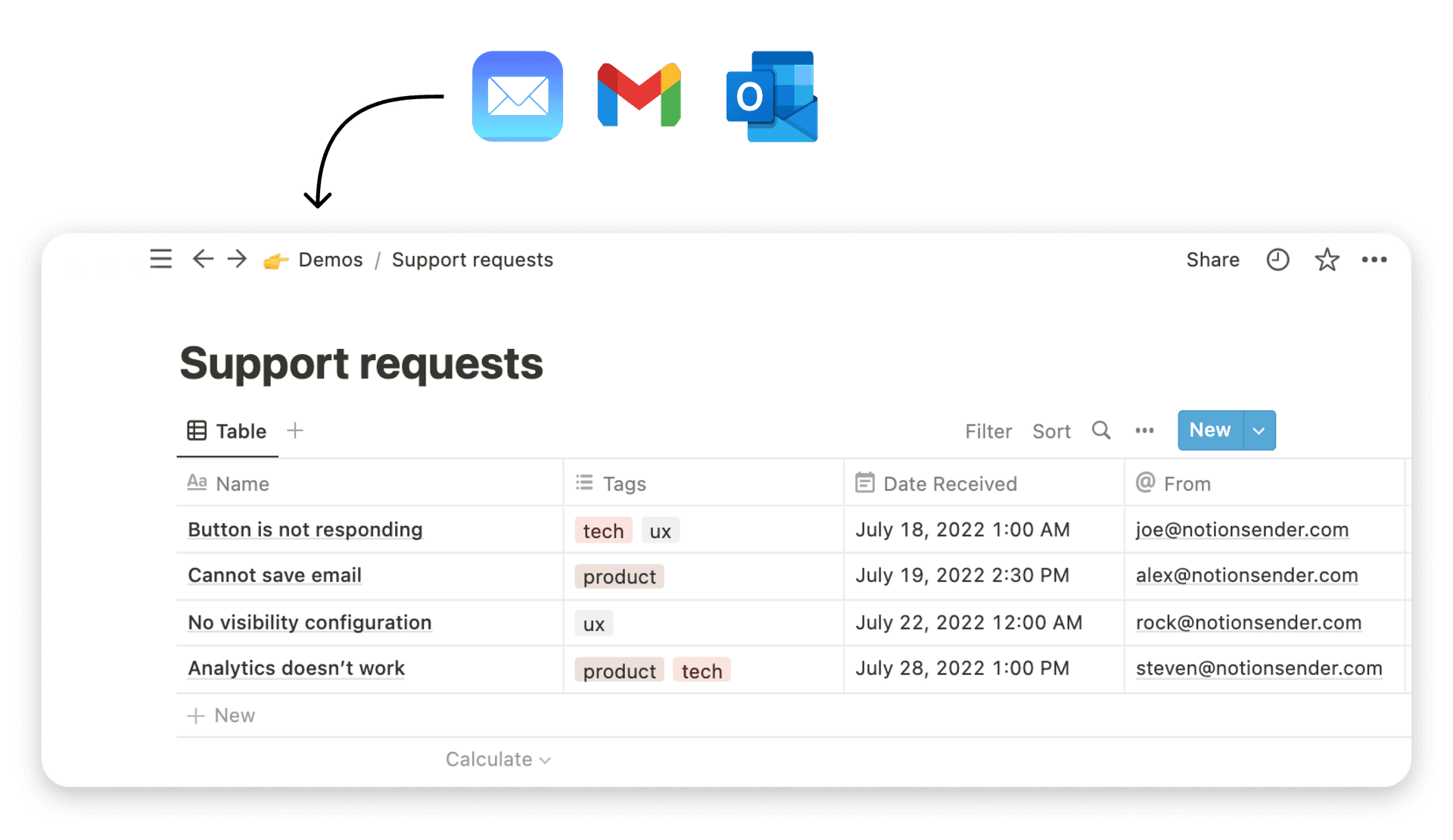
- Streamline Support Tickets: A customer emails your support address. You can have it automatically forward to your "Support" database in Notion, logging the ticket with all the customer's details without you lifting a finger.
- Organize Project Feedback: Instead of chasing down comments in endless email chains, your team can email feedback directly to a project's dedicated address. Everything lands in one organized place.
It's a straightforward flow: a trigger (the email) leads to an action (a new database item), which is then confirmed.

This diagram breaks it down visually, showing just how simple it is to set up a powerful workflow that starts with a single email.
A Practical Example: Freelancer Invoicing
Let’s look at a real-world scenario. Think of a freelance designer who tracks all their finances in a Notion database. Every time an invoice comes in via email, they have to stop what they're doing, open Notion, and manually type in all the details. It's slow, tedious, and easy to make a mistake.
With NotionSender, that whole process can be automated.
- When a client’s invoice email arrives, the freelancer simply forwards it to their unique "Invoices" database address.
- NotionSender instantly catches it and creates a new entry in their database.
- Better yet, it can intelligently pull out key details like the invoice amount and due date, automatically filling in the right properties in Notion.
- From there, the freelancer can even build another automation to send a payment reminder email directly from Notion a few days before the invoice is due.
This isn't just about saving a few minutes on data entry. The freelancer has built a small, automated system that helps them get paid faster, all without ever leaving their favorite workspace.
This is just one example of what's possible. To see how you can take this even further, check out our guide on how to create and send email from Notion. It's a perfect illustration of how a focused automation tool can solve some of the most common headaches in business.
Best Practices for Reliable Automation
<iframe width="100%" style="aspect-ratio: 16 / 9;" src="https://www.youtube.com/embed/r9K-2OJUmOE" frameborder="0" allow="autoplay; encrypted-media" allowfullscreen></iframe>
Getting your first automation running is a great feeling. The real magic, however, comes from building a system that just works, day in and day out, without you having to think about it.
To make sure your automation for Windows is reliable and easy to fix when something breaks, it pays to follow a few simple rules from the get-go. Think of it like a garden—you don't just plant seeds and hope for the best. You have to tend to it. Your automations need that same kind of care to keep running smoothly and grow with your business.
Start Small and Build Momentum
It’s always tempting to go after your biggest, most painful process first. But trust me, you're better off starting with a small, simple, high-impact task. Pick something repetitive but easy to map out, like automatically renaming downloaded files or forwarding specific types of emails.
When you nail that first small task, you get a quick win. It builds your confidence and helps you really get the hang of how your tools think. It's like learning the scales on a piano before you jump into a complex sonata—you're building the foundation.
A reliable automation system is built one successful workflow at a time. Each small victory provides the foundation and knowledge for the next, more ambitious project.
Document and Organize Your Workflows
Once you start building a few automations, things can get messy fast. If you don't have a clear system for organizing them, you'll eventually find yourself staring at a workflow, completely forgetting what it does or why you built it in the first place.
- Use Clear Naming Conventions: Instead of "Email Flow 1," name it something descriptive like "Forward Client Invoices to Notion." You'll thank yourself later.
- Add Detailed Descriptions: Most automation tools have a spot for notes or descriptions. Use it! Briefly explain the trigger, the main actions, and the goal. This is a lifesaver when you need to troubleshoot or update it months down the line.
This bit of discipline really pays off. The global market for window automation is projected to climb from USD 5.69 billion in 2026 to USD 6.72 billion by 2030, and your own little ecosystem of automations will grow right along with it. Good organization is the only way to manage that growth without creating a tangled mess. You can dig into more stats on this trend in The Business Research Company's market report.
Handle Errors and Secure Your Credentials
Let's be realistic: no automation is perfect. Sooner or later, a step will fail. The best workflows are built with this in mind.
Look for error-handling features in your tools. Many can be set up to send you a quick notification or simply try the failed step again after a few minutes. Turning these on ensures one small hiccup doesn't bring your entire process to a grinding halt.
Finally, always put security first. When you connect different apps, make sure you're using secure methods to store your API keys and passwords. The last thing you want to do is paste sensitive info directly into your workflow steps where it can be easily exposed.
The Real-World Benefits of Embracing Automation

Let's be honest, the thought of setting up automation for Windows can feel like just another task on an already endless to-do list. Why spend time on that when you have deadlines to meet?
The answer is simple: you get that time back, and then some. Think about a small, repetitive task you do every day—maybe it's organizing files or pulling numbers for a report. If that task takes you just 10 minutes, automating it frees up over 40 hours a year. That’s an entire workweek you can pour back into the projects that actually matter.
Beyond Time Savings
But saving time is just the beginning. The real magic of automation is the consistency it brings to your work. We're only human, and mistakes happen. An automated system, on the other hand, is a different story.
An automated system doesn’t have off days. It performs its duties with perfect precision every single time, dramatically reducing the costly and frustrating human errors that can creep into manual processes.
This level of precision has a direct impact on your professional image. When automations handle things like initial client responses or project updates, everything happens faster. Your business looks more organized, more reliable. Using tools like NotionSender to manage email workflows, for example, creates a single source of truth that keeps everyone on the same page, effortlessly.
This isn't just a niche trend; it's a massive shift in how work gets done. The global market for automated windows was valued at USD 5,528.82 million in 2024 and is on track to hit USD 7,831.41 million by 2032. This isn't just about smart homes; it's about smart offices and smart workflows. If you're curious about the numbers, you can dig into the data in a recent market analysis.
Ultimately, it all adds up. You get more done, you're less stressed, and you have more mental space for the creative and strategic thinking that your computer can't do for you.
A Few Common Questions
Jumping into the world of Windows automation can bring up a few questions. It’s a big topic, after all. Let's clear up some of the most common ones you might be thinking about.
Is This Stuff Too Technical for a Beginner?
Not like it used to be. A few years ago, you definitely needed to know how to write code or complex scripts to make anything happen. That’s all changed.
Today’s tools are built for everyone. Platforms like Power Automate, Zapier, and our own NotionSender use simple, visual editors. You're basically just connecting digital "blocks" that represent triggers (like "when a new file is added") and actions (like "send an email"). You can build some seriously powerful workflows without touching a single line of code.
My advice? Just pick one small, annoying task you do every day and try to automate it. Start there.
Can I Actually Connect My Desktop Apps to My Cloud Tools?
Absolutely. In fact, this is one of the most powerful features of modern automation. It’s all about bridging the gap between what happens on your computer and what happens in the cloud.
Many of these tools have small helper apps that run on your Windows desktop. They can watch for changes to local files or interact with the software you have installed.
This is the real magic. You can create a seamless flow where something that happens on your local machine—like saving a report—kicks off a whole process in an online service like Notion or Google Drive.
This is how you build true end-to-end workflows that tie together every part of your digital workspace, from your desktop to the web.
How Secure Is It to Give These Tools Access to My Apps?
That’s a great question, and it's smart to ask. Any reputable automation platform takes security as its number one job. They rely on industry-standard security like OAuth.
In simple terms, OAuth means you’re not handing over your passwords. Instead, you grant permission through a secure token that acts like a limited-access key. The automation service never sees or stores your actual password for Google, Notion, or anything else.
For extra peace of mind, always stick to well-known, trusted platforms. And just as importantly, make sure you have two-factor authentication (2FA) enabled on all the accounts you're connecting.
Ready to stop wrestling with your inbox and get your email workflow talking to your Notion workspace? NotionSender is the bridge you need. You can capture emails, automatically create new database items, and even send replies, all from inside Notion. Discover how to connect your email and Notion today.