Build a Content Marketing Campaign That Actually Works
Let’s be honest, a lot of what passes for "content marketing" feels a bit like throwing spaghetti at the wall. An occasional blog post here, a random social media update there. It’s busywork, not a strategy.
A content marketing campaign, on the other hand, is the complete opposite. Think of it as a focused, strategic mission designed to hit a specific business goal. It's a coordinated project with a clear beginning and end, a central theme, and—most importantly—results you can actually measure. It’s the difference between just showing up online and launching a full-scale initiative to land new clients for your latest service.
What Is a Content Marketing Campaign

Imagine trying to get your ideal customer from Point A (unaware of you) to Point B (a happy client). Shouting at them from across a canyon with traditional ads is one way, but it's expensive and annoying.
A content marketing campaign is like building a bridge, piece by piece, guiding them directly to your solution with helpful, valuable content. This approach turns a collection of scattered posts and updates into a cohesive, goal-driven system that works for you.
This isn’t just about making more stuff. It's about creating a connected experience for your audience. While your overall content strategy is the long-term blueprint for your brand, a campaign is a short-term sprint with a very specific prize at the finish line.
Core Components of a Campaign
Every single successful campaign I've ever seen is built on three foundational pillars. Get these right, and you'll move from disjointed efforts to an integrated plan that actually delivers.
- A Central Theme or "Big Idea": This is the sun your entire campaign orbits around. It could be a new product launch, a seasonal sale, or an educational series tackling a huge pain point for your customers.
- Interconnected Content Pieces: Instead of a lone blog post, you create a whole family of assets that support the main theme. This could be a big "cornerstone" article, a few smaller supporting posts, a video tutorial, an email mini-course, and a batch of social media graphics.
- Coordinated Distribution: Each piece of content is promoted across different channels in a planned sequence. This isn't random—it's about making sure your message hits the right people, at the right time, to get the most mileage out of every single asset.
This is how you build real trust and authority. By consistently showing up and delivering value around one focused topic, you become the go-to person in your niche.
For freelancers and small businesses, this model is a game-changer. It’s not about having a bottomless budget; it’s about making smart, concentrated pushes that create a predictable flow of leads and customers.
A campaign turns your content from a collection of individual assets into a powerful system where each piece amplifies the others, guiding your audience through a carefully planned journey.
To make sure you're on the right track, it's always a good idea to brush up on the fundamentals of content marketing best practices. This foundation helps you sidestep common mistakes and get to your goals faster. When you combine a strong theme with smart distribution, you build a system that delivers results you can see.
Setting Goals That Drive Business Growth
Launching a content marketing campaign without a clear destination is like setting sail without a map. You might feel busy creating content and sending emails, but you'll have no real way of knowing if any of it is actually moving your business forward. Vague hopes like "get more traffic" aren't goals; they're wishes.
To turn your content from a creative exercise into a real engine for growth, you need to set concrete, measurable objectives. These goals need to tie directly back to what success looks like for your company. This is where strategic goal-setting becomes the most important part of your entire campaign.
Define Your Targets with SMART Goals
The best way to create powerful objectives is by using the SMART framework. It’s a simple but effective way to make sure your goals are focused and actionable, giving you a clear scorecard to measure whether your content marketing campaign actually worked.
- Specific: Clearly state what you want to achieve. Instead of "increase leads," aim for something like "generate qualified leads for our new consulting service."
- Measurable: Define how you'll track success. Don't just "grow our email list"—make it "increase email list subscribers by 25%."
- Achievable: Be realistic. Set a goal you can actually hit with your current resources and timeline. Aiming for 100,000 new followers when you're starting from zero is just setting yourself up for failure.
- Relevant: Make sure the goal supports your bigger business objectives. If your company is focused on customer retention, a great campaign goal would be to "reduce churn by 5% with a new onboarding email series."
- Time-bound: Give yourself a deadline. For instance, "Generate 50 qualified leads for our new service in Q3."
Using this structure turns fuzzy ambitions into a tactical plan. It gives your team a clear target to aim for and provides a definitive way to know if you hit the mark.
Connecting Goals to Meaningful KPIs
Once you have your SMART goals locked in, the next step is to connect them to the right Key Performance Indicators (KPIs). Think of KPIs as the numbers on your campaign's dashboard—they're the specific metrics that tell you if you’re on track to meet your objectives.
A goal defines your destination, but KPIs are the road signs that tell you if you're heading in the right direction. Without tracking the right KPIs, you're flying blind.
For example, if your goal is lead generation, your primary KPIs would be things like the conversion rate on your landing page and your cost per lead. If you're aiming for brand awareness, you'd be tracking metrics like social media reach, brand mentions, and organic search traffic. Choosing the right KPIs is everything.
This focus on real business outcomes is what separates successful marketers from the rest. Recent data shows that 34% of marketers prioritize generating ROI and sales with their content, while another 29% are focused on improving their search engine rankings. This is especially true for small businesses in the B2B world; a whopping 46% plan to increase their content marketing budgets in 2025 because they see organic search as a top source of long-term traffic. You can dig into the numbers yourself in this full analysis of content marketing ROI stats. It all points to the same conclusion: great campaigns are built on goals that directly contribute to the bottom line.
Matching Campaign Goals to Essential KPIs
To make this crystal clear, here’s a breakdown of how common campaign goals line up with the KPIs you should be watching. This will help you choose the right metrics from the get-go.
| Campaign Goal | Primary KPIs to Track | Example Measurement |
|---|---|---|
| Increase Brand Awareness | Social Media Reach, Website Traffic, Brand Mentions, Share of Voice | Track a 15% increase in organic traffic from non-branded keywords over the next quarter. |
| Generate Leads | Conversion Rate, Cost Per Lead (CPL), Number of Qualified Leads | Generate 50 marketing qualified leads (MQLs) from the new ebook campaign with a CPL under $50. |
| Boost Sales & Revenue | Customer Acquisition Cost (CAC), Return on Investment (ROI), Sales Conversion Rate | Achieve a 3:1 ROI from the content campaign within six months. |
| Improve Customer Loyalty | Churn Rate, Customer Lifetime Value (CLV), Repeat Purchase Rate, Net Promoter Score (NPS) | Reduce customer churn by 5% among users who engage with the new onboarding email series. |
| Build Thought Leadership | Organic Search Rankings, Inbound Links (Backlinks), Media Mentions | Secure 10 high-quality backlinks to our pillar content page by the end of the year. |
Picking the right KPIs is less about tracking everything and more about tracking the few things that truly matter for the specific goal you've set. This table should give you a solid starting point for making those decisions.
Your Step-By-Step Campaign Planning Blueprint
Okay, you've got your goals locked in. Now it's time to shift from the "what" to the "how." A killer content marketing campaign doesn't just materialize out of thin air; it's built on a solid, deliberate plan. This blueprint breaks that process down into five clear, manageable steps, turning your big idea into a roadmap you can actually follow.
Think of it like building a house. You wouldn't just start throwing up walls and hope for the best, right? You need architectural drawings showing where everything goes. The same logic applies here—you can't start creating content until you have a plan for who it's for, what you'll say, and how every piece fits together.
Step 1: Build Your Target Audience Persona
Before a single word is written, you have to know exactly who you're talking to. A target audience persona is a sketch of your ideal customer, but it goes way beyond basic demographics. You need to get into their head and understand their biggest challenges, what drives them, and what they're trying to achieve.
Give this persona a name, something memorable like "Freelance Fiona" or "Startup Steve." It makes them feel real. What keeps Fiona up at night? What's the one big thing Steve wants to accomplish this year? Knowing this stuff helps you create content that hits home on an emotional level, making them feel like you truly get them.
Step 2: Conduct Keyword and Topic Research
Once you've got your "who," you need to figure out what they're searching for online. This is where keyword and topic research is your best friend. The mission is to uncover the exact questions, problems, and phrases your persona is typing into Google.
Start with broad "seed" keywords related to your campaign, then use tools like Google Keyword Planner or other paid options to dig deeper. You're looking for those specific, long-tail keywords—the longer phrases like "how to find first client as a freelance designer." These gems often have less competition and show someone is serious about finding a solution.
This research isn't just about SEO. It's like having a direct line into your audience's brain, confirming your assumptions and making sure your content solves a real, existing need.
Step 3: Map The Customer Journey
The customer journey is the path someone takes from vaguely hearing about you to happily becoming a paying client. One blog post almost never does all the work. You need to create different types of content for each stage of their journey.
- Awareness: This is the top of the funnel. People are just realizing they have a problem. Educational blog posts or shareable infographics are perfect for this stage.
- Consideration: Now they're actively looking for solutions. This is where case studies, webinars, and in-depth how-to guides help them weigh their options.
- Decision: At the bottom of the funnel, they're ready to pull the trigger. Product demos, free trials, or consultation offers are what you need to close the deal.
By mapping your content this way, you make sure you're serving up the right information at just the right moment. It guides people toward a decision without ever feeling like a hard sell.
A well-mapped customer journey ensures your content marketing campaign feels less like a sales pitch and more like a helpful, trusted guide leading them to the perfect solution.
Step 4: Brainstorm A Central Theme and Pillar Content
Every great campaign needs a big idea—a strong, unifying theme that ties all the moving parts together. This could be anything from the launch of a new service to a deep dive into a major industry trend.
This theme becomes the foundation for your pillar content piece. This is the main event, a massive, comprehensive asset like an ultimate guide, an ebook, or a big research report. It's the anchor for your entire campaign. Every other piece of content—the blog posts, social media updates, emails—will support and link back to this central pillar. This "hub and spoke" model is a powerhouse for SEO and cements your reputation as an expert on the topic.
Step 5: Organize Everything in a Content Calendar
Finally, you have to pull all these pieces together into a content calendar. This is your command center. It lays out what content gets published, on which channel, and on what date. A well-organized calendar is your secret weapon against last-minute chaos and ensures everything rolls out in a smooth, coordinated way.
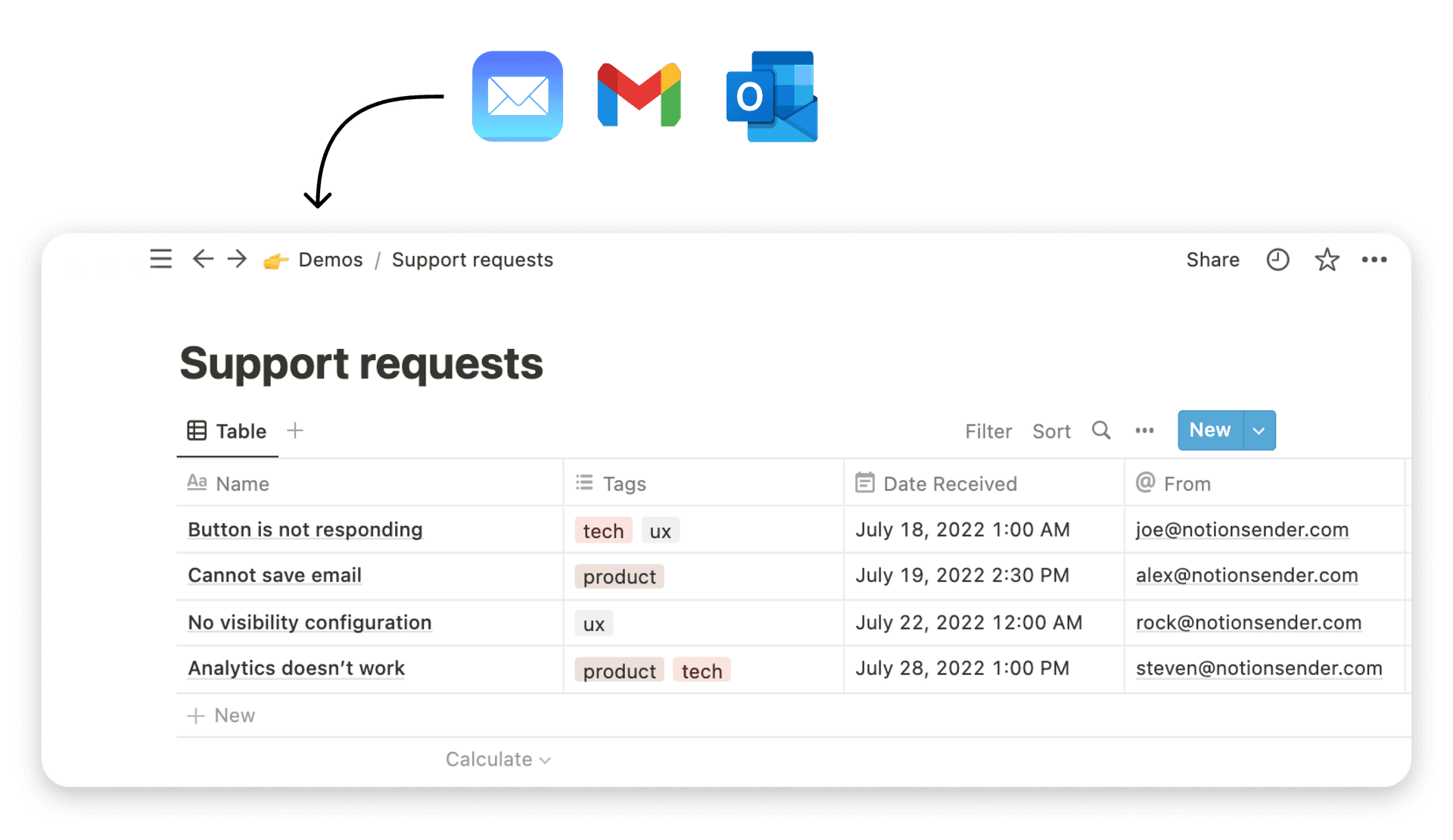
Your calendar should track the content title, format, target keyword, publication date, and the channels you'll use to promote it. For freelancers and small teams, getting this workflow organized is everything. Using a flexible tool can be a game-changer. In fact, there are many different ways to use Notion to send emails and manage your entire content schedule in one spot. This creates a single source of truth for the whole campaign.
Choosing Your Content and Distribution Channels
Creating great content is only half the job. A brilliant piece of work that nobody ever sees won't get you anywhere. The real magic happens when you pair the perfect message with the right platform—that’s how you get your content in front of the right people at the right time.
Think of your content formats like tools in a toolbox. You wouldn't use a hammer to cut a piece of wood, and you wouldn’t grab a saw to drive a nail. It’s the same with content; you have to pick the format that best fits the goal of your campaign.
A compelling video, for instance, is perfect for showing off a new product. On the other hand, a detailed case study is exactly what you need to build trust with serious buyers who are close to making a decision. It's all about matching the format to where your audience is in their journey.
Selecting the Right Content Formats
Your content mix should be diverse enough to keep people interested but focused enough that you can actually manage it, especially if you're a freelancer or part of a small team. The goal isn't to create everything, but to create the right things.
Here are a few of the most effective content formats and the best times to use them:
- Blog Posts and Articles: These are the real workhorses of any content campaign. They're fantastic for SEO, great for educating your audience on tricky subjects, and perfect for cementing your reputation as an expert.
- Video Content: Video is an absolute powerhouse for telling stories and grabbing attention. Use it for product demos, a behind-the-scenes look at your process, or customer testimonials to build a much stronger personal connection.
- Case Studies: When a potential client is weighing their options, a case study gives them the social proof they need. It shows them exactly how you solve real problems for people just like them.
- Infographics: Have a lot of data or a complex process to explain? Infographics break it all down into something that’s easy on the eyes and super shareable. They work wonders on social media or as a quick summary in a longer article.
This simple flowchart lays out the core planning process, from figuring out your ideal customer to building out your content calendar.
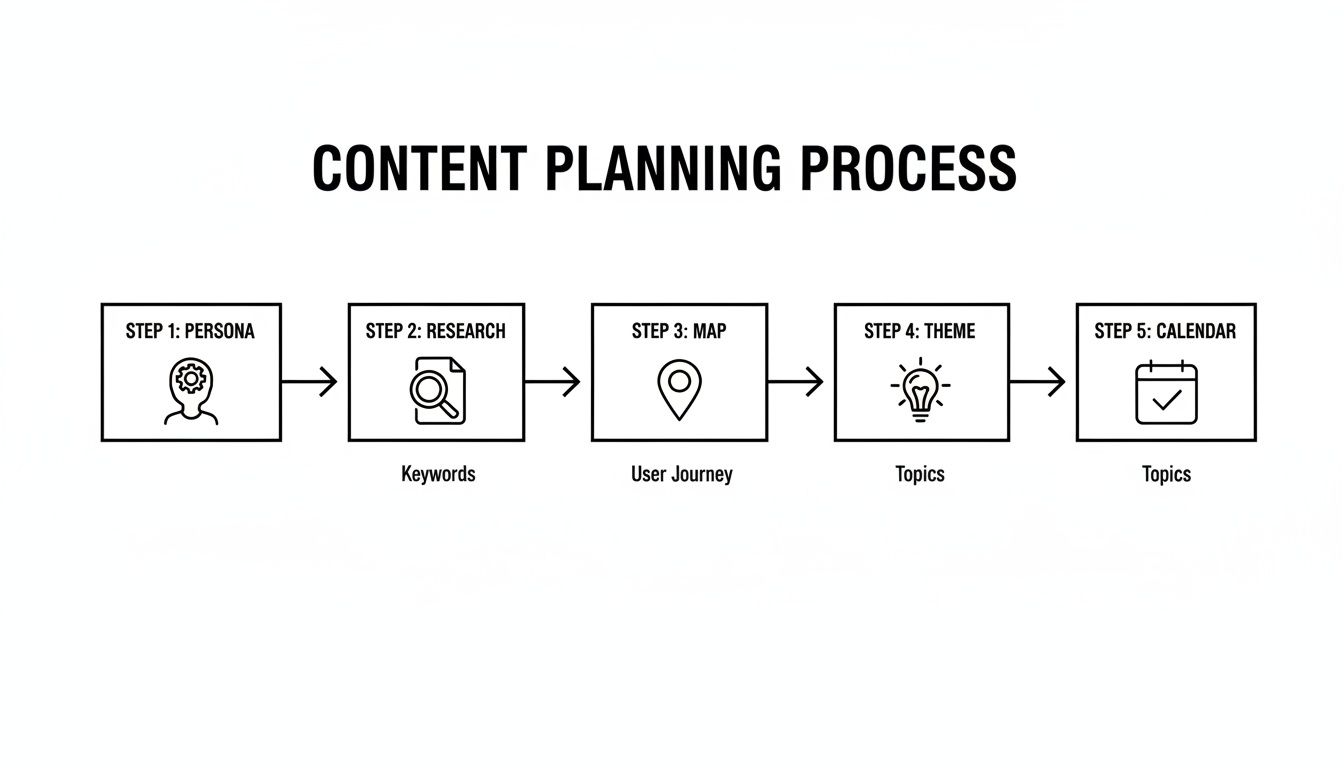
Mapping out the workflow like this helps you make sure every single piece of content you create is tied directly to a specific audience need and a clear campaign goal.
Mastering Your Distribution Channels
Once your content is polished and ready, you need a solid plan to get it out into the world. Don't just hit "publish" and cross your fingers. For freelancers and small teams, the trick is to get really good at a few key channels instead of spreading yourself too thin across many. A focused approach makes sure your limited time and money deliver the biggest bang for your buck.
Key Distribution Channels to Consider:
- Search Engine Optimization (SEO): Think of this as your long-term engine for organic growth. When you optimize your content for the right keywords, you start attracting a steady stream of visitors who are actively searching for the solutions you offer.
- Email Marketing: Email is the most direct line you have to your audience. It’s the perfect channel for promoting new content, nurturing leads with personalized messages, and driving people toward your campaign offers.
- Social Media: Go where your audience is. Pick the platforms they actually use and tailor your message for each one. That might mean a professional insight on LinkedIn, a visual story on Instagram, or a quick update on X (formerly Twitter).
The goal isn't just to push your content out; it's to start a conversation. Every channel gives you a unique way to engage with your audience, so be sure to adapt your style to fit the platform.
The shift toward visual and creator-led content is impossible to ignore. Video is leading the pack, with 49% of marketers already using it to showcase their products. What's more, 61% plan to increase their video budgets, pushing engagement on platforms like YouTube, which saw a staggering 79% year-over-year growth in usage. This lines up with the fact that 92% of brands planned to invest more in content creators in 2024. You can explore more insights on content marketing statistics to see just how these trends are shaping campaigns. All this data points to one thing: you have to choose channels and formats that match how people consume content today.
How to Automate Your Campaign with Email
Great content is fantastic for getting people interested, but it rarely converts them into paying clients on its own. That's where email comes in. Think of it as the central nervous system for your entire content marketing campaign—it’s what turns casual readers into engaged leads you can build a real relationship with.
This isn't about blasting out a generic monthly newsletter. It's about building a smart, automated engine that works behind the scenes to turn genuine interest into actual revenue.
For freelancers and small businesses, this kind of system is a lifesaver. It lets you manage your sales pipeline without letting anyone slip through the cracks, all while you stay focused on doing great work for your existing clients. Instead of manually chasing every new contact, you build a workflow that does the heavy lifting for you.
Capturing Leads Automatically
First things first: you need a smooth way for interested people to get onto your email list. Your best content—that cornerstone blog post or a killer downloadable guide—is the perfect magnet. Offer up that valuable resource in exchange for an email, and you've created a natural entry point into your campaign.
The key here is that this process should be completely hands-off. Once someone signs up, their info should be captured and funneled right into your system without you lifting a finger. This is where a tool like NotionSender becomes so powerful. It can link your sign-up forms directly to a Notion database, keeping every new contact perfectly organized from the moment they join.
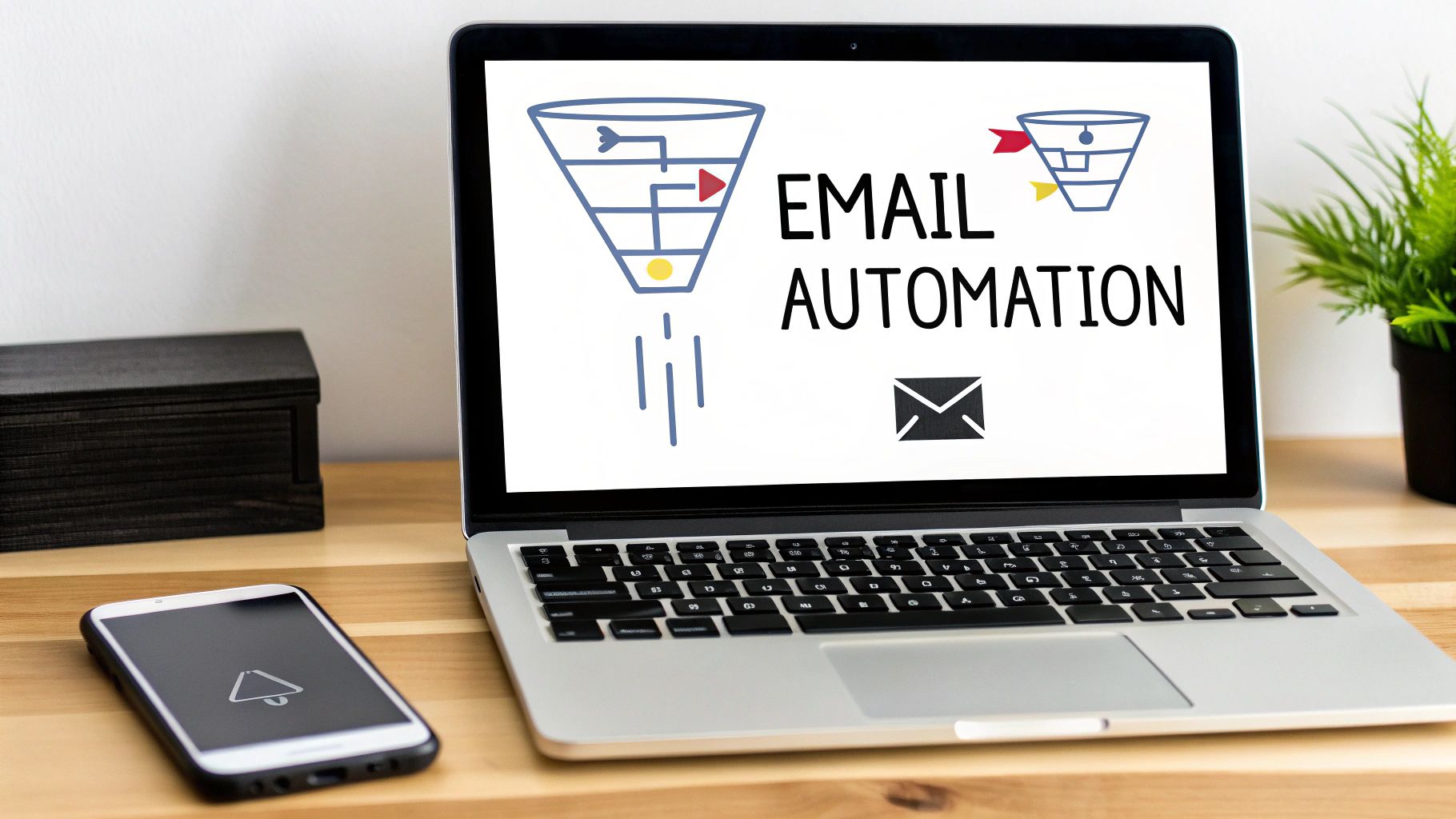
When you integrate your email system into a tool you already live in, like Notion, you’re creating a powerful marketing hub without adding a bunch of new, complicated software to your plate.
Building Your Welcome Sequence
Once a lead is in your system, the real relationship-building begins. A welcome email sequence is just a series of pre-written emails that are sent out automatically over a few days or weeks. This is your chance to make a stellar first impression and gently guide new subscribers on a journey with you.
A solid welcome sequence needs to do three things:
- Deliver Value Immediately: Your very first email has to deliver the goods you promised. Then, maybe throw in another quick, helpful tip. This instantly reinforces that signing up was a smart move.
- Introduce Yourself and Your Solution: Over the next few emails, tell your story. Explain how you help people solve their biggest headaches. This builds trust and positions you as the expert they've been looking for.
- Encourage Engagement: Don't just talk at them. End each email with a question or a simple call to action. Ask them to reply with their biggest challenge or to check out a relevant case study on your site.
This automated sequence ensures every single lead gets a consistent, high-quality introduction to your brand. It warms them up for a future sales conversation without you having to do a thing.
A well-crafted welcome sequence is like having your best salesperson personally greet every new prospect, 24/7. It builds rapport and qualifies leads while you sleep.
Creating Reusable Email Templates
For any small operation, efficiency is the name of the game. Writing every single email from scratch is a massive time-sink. Building a library of reusable templates is a total game-changer.
With a system like NotionSender, you can create and save these templates right inside your Notion workspace. If you want a step-by-step walkthrough, our guide on how to create and send email from Notion breaks it all down.
Here are a few templates every freelancer or small business should have ready to go:
- The Welcome Email: Your first, crucial touchpoint.
- The Problem/Solution Story: A template that shares a relatable client success story.
- The Soft Pitch: An email that gently introduces your services or a specific offer.
- The Follow-Up: A simple check-in for leads who've shown interest but gone quiet.
Using templates saves a shocking amount of time. Some studies show that inefficient email tools can cost marketers up to 60 hours a year. By standardizing your core messages, you maintain a consistent brand voice and free up your mental energy for bigger-picture strategy.
Tracking Engagement to Find Hot Prospects
Let's be honest: not all leads are created equal. Automation is brilliant because it helps you spot the people who are most interested by tracking how they interact with your emails.
The key metrics to watch are:
- Open Rates: Who’s consistently opening your stuff?
- Click-Through Rates: Who’s clicking the links to your blog, case studies, or service pages?
Think of these signals as digital body language. A subscriber who opens every email and clicks through to read a case study is a much hotter prospect than someone who hasn’t opened anything in weeks.
By keeping an eye on this data, you can start segmenting your list and sending more targeted offers to the people who are most likely to buy. This turns your email list from a simple broadcast channel into a dynamic, intelligent sales pipeline.
How to Measure and Optimize Your Campaign
<iframe width="100%" style="aspect-ratio: 16 / 9;" src="https://www.youtube.com/embed/y7a3emSHAFM" frameborder="0" allow="autoplay; encrypted-media" allowfullscreen></iframe>
Pushing your campaign live is just the beginning. The real magic happens when you start digging into the data to see what’s working, what’s a dud, and where you should double down. This is how you stop guessing and start building a reliable engine for growth.
If you aren't tracking performance, you're essentially flying blind. You have no idea which blog post is quietly becoming your best lead generator or why a certain email subject line completely bombed. The goal is to keep a close eye on the KPIs you defined earlier without getting buried in a mountain of data.
You don't need a fancy, expensive analytics suite to get going. A simple dashboard built with a free tool like Google Analytics gives you all the critical insights you need. It helps you draw a straight line from your content efforts to your business goals, so you know exactly what’s moving the needle. It's not just about setting goals; it's about mastering the art of measuring marketing campaign effectiveness to unlock real growth.
A Framework for Continuous Improvement
Optimization isn’t a one-and-done task. It’s a constant cycle of testing, learning, and tweaking. When you adopt this mindset, you guarantee that every campaign you run is a little bit smarter than the last.
A fantastic, no-fuss way to start is with A/B testing. All this means is creating two slightly different versions of one thing—an email subject line, a landing page headline, a button color—to see which one people respond to better.
Think of A/B testing as a scientific experiment for your marketing. By changing just one variable at a time, you can gather clear, actionable data on what your audience responds to most.
This approach strips away the guesswork and gives you hard evidence to back up your decisions. For instance, if your email engagement is tanking, you could test a few different calls to action. For more ideas, check out our guide on how to increase your open rates with these 10 email marketing tricks.
Spotting Insights and Taking Action
Your data is telling a story. You just have to learn how to read it. Make it a habit to review your dashboard, look for trends, and pinpoint your star performers and your duds. This is where you'll find your biggest opportunities.
Here’s a simple game plan to get you started:
- Double Down on Winners: Is a single blog post bringing in 70% of your organic traffic? That’s your golden ticket. Create a follow-up article, a video, or even a webinar on that same topic. Then, promote it like crazy on your best-performing channels.
- Refresh Underperforming Content: Remember that guide you poured your heart into, only for it to be met with crickets? Don't let it gather digital dust. Go back, update it with new stats, slap a more compelling title on it, or rewrite the intro. Give it a second shot at life.
- Reallocate Your Efforts: If your data clearly shows LinkedIn is driving ten times more leads than X (formerly Twitter), it's a no-brainer. Stop wasting time and energy on the platform that isn't delivering and shift those resources to the one that is.
Even with the best-laid plans, a few questions always seem to pop up right when you're about to launch a new content marketing campaign. Let's tackle some of the most common ones so you can move forward with total confidence.
How Long Should a Content Marketing Campaign Run?
Honestly, this completely depends on what you're trying to achieve. There's no magic number.
For something with a clear start and end date, like a product launch, a shorter burst of 4-6 weeks usually does the trick. That gives you just enough time to build some hype, launch with a bang, and follow up with your new audience.
But if you're playing the long game—say, trying to build real brand authority or climb the Google rankings for a tough keyword—you're looking at a much longer commitment. Think of it as an ongoing effort for 6-12 months, or even longer. The real key is to give yourself enough runway to create, distribute, measure, and actually act on what you learn.
How Much Should I Budget for a Campaign?
This is a huge plus for small businesses and freelancers: your budget can be incredibly flexible. You can get started with next to nothing if you’re willing to write the content yourself and lean on free tools for distribution and analytics.
If you're looking for a general rule of thumb, setting aside 10-25% of your total marketing budget is a solid starting point. Your main costs will likely be things like content creation tools (maybe a graphic design app or a video editor), web hosting, and maybe a small ad spend to give your best content an initial boost.
The smartest way to go about it is to start small. Prove that you can get a positive return on your investment, then confidently scale up your spending from there.
Key Takeaway: Think of it this way: your content strategy is the entire cookbook—it’s your brand’s philosophy on food, your signature flavors, and your long-term vision. A content marketing campaign is just a single, focused recipe from that book, designed to create one perfect dish.
What Is the Difference Between a Strategy and a Campaign?
It's easy to mix these two up, but the distinction is crucial.
Your content strategy is the big-picture blueprint. It defines who you are, what you stand for, your core themes, your brand voice, and your long-term business goals. For example, your strategy might be "to become the most trusted resource for freelance project management."
A content marketing campaign, on the other hand, is a specific, time-bound project that helps you execute a piece of that strategy. Using the example above, your campaign might be a 3-month push to launch a new ebook on "Agile for Freelancers." This would be a focused effort involving a series of blog posts, a couple of webinars, and a dedicated email sequence—all driving toward the single goal of a successful ebook launch.
Ready to make your email workflow the most efficient part of your campaign? With NotionSender, you can manage, automate, and send emails directly from your Notion workspace, turning your project hub into a marketing powerhouse. Start streamlining your campaigns today at https://www.notionsender.com.