Create Notion Template: A Comprehensive Guide

You're probably in one of two situations right now.
Either you've built a Notion page that looks good but falls apart the moment real work starts, or you're staring at a blank workspace trying to figure out how to create Notion template systems that people will use. Both problems come from the same mistake. Treating a template like a document instead of a workflow.
A useful Notion template isn't just a page with headings and icons. It's a repeatable operating system. It should tell people what to enter, where that information goes, what it connects to, and what happens next when new work shows up from clients, teammates, or email.
That shift matters more now because Notion templates are no longer a niche trick. Notion's Marketplace lists more than 30,000 free and customizable templates according to Notion's template gallery. The volume is impressive, but it also creates a problem. Most templates are easy to duplicate and hard to operate.
The better approach is to build for recurring business work. Projects. Requests. Follow-ups. Approvals. Intake. That's where templates stop being decorative and start saving time.
Planning Your Template Before You Build
The most common reason a Notion template fails is simple. Someone opens a blank page and starts building before they know what the system needs to do.
That works if you're making a personal notes page. It doesn't work if you need a repeatable setup for clients, projects, invoices, content, or support requests. In those cases, the template needs a blueprint before it needs a layout.

Start with the problem
Ask one question first. What recurring job should this template handle without extra thinking?
That wording matters. “I need a project dashboard” is too vague. “I need a project template that creates standard tasks, stores client details, tracks approvals, and gives me one place to review status” is specific enough to build from.
If you can't define the recurring job, you'll keep adding blocks that look helpful but don't support the workflow.
Practical rule: If a template doesn't reduce decisions for the next person who uses it, it isn't finished.
Map the system before the page
Before opening Notion, sketch the structure in a doc, on paper, or in a whiteboard tool. Notion's own guidance aligns with this approach. A practical benchmark is to define core features, draft the layout on blank pages, create a dedicated system settings page for all databases, then add views into placeholder areas and test before release, as described in Notion's guide to templates.
For a small business workflow, that usually means identifying these layers:
- Core databases such as Clients, Projects, Tasks, Meetings, or Invoices
- Key properties like Status, Owner, Due Date, Priority, Source, and Last Contacted
- Relations that connect records across databases
- Views that show the same data differently for different roles
A simple client-work template often starts with something like this:
| Database | Purpose | Typical relation |
|---|---|---|
| Clients | Stores account-level information | Related to Projects |
| Projects | Tracks active work | Related to Clients and Tasks |
| Tasks | Manages execution | Related to Projects |
| Meetings | Logs discussions and decisions | Related to Clients or Projects |
The point isn't to build more databases. The point is to keep each one responsible for one type of information.
Define what each user needs
A freelancer, project manager, and operations lead won't use the same template in the same way. One person wants speed. Another wants reporting. Another wants intake and handoff.
That's why I recommend listing users before building the page shell. Write down who touches the template and what they need to do without asking for help.
- Owner or admin needs settings, structure, and maintenance access
- Daily operator needs clean entry points and filtered views
- Reviewer or client-facing user needs clarity, not configuration
If you skip this step, you'll build a template that makes sense only to the person who created it.
For more practical workspace habits around structure and usability, this roundup of tips to get more out of Notion is worth reviewing before you lock the design.
Choosing Your Building Blocks Page vs Database Templates
A useful Notion template starts to break the moment real work hits it. An email arrives from a client, someone needs to log a request, a project changes status, and the team starts asking where that information should live. That is usually the point where the choice between a page template and a database template stops being cosmetic and starts affecting operations.

Use page templates for repeatable documents
A page template is the right choice when people need the same writing structure each time.
That usually means meeting notes, SOPs, interview scorecards, onboarding docs, or creative briefs. The goal is consistency inside the page itself. You want the same headings, prompts, and callouts so nobody has to rebuild the format from scratch.
Use a page template when the main job is helping someone capture information clearly and quickly.
Common examples:
- Meeting notes with agenda, decisions, and next steps
- Creative briefs with audience, message, references, and approvals
- Onboarding documents with checklists, contacts, and handoff notes
Page templates are easy to set up and easy to duplicate. They also have limits. Once you need status tracking, filtered views, recurring entries, or reporting across many items, a page template starts pushing structured work into unstructured documents. That is where teams lose visibility.
Use database templates for repeatable work units
A database template belongs inside a database and creates a new record with predefined properties, content, and views.
This is the better choice for work that moves through a process. Projects, tasks, client requests, support tickets, campaigns, invoices, and content production all fit here. Each new item should carry the same operational structure from day one, not just the same page design.
A good database template can include:
- preset properties such as owner, status, priority, and due date
- linked views filtered to show related tasks or notes
- instructions for the person handling the record
- default checklists for handoff, review, or delivery
This matters if you plan to connect Notion to inbound email later. For example, if NotionSender routes a client email into a Requests or Projects database, that incoming item needs a proper record structure to land in. A page template cannot give you that operational backbone. A database template can.
Choose based on what must happen after creation
The easiest filter is simple. Ask what needs to happen after the item is created.
| If the item needs... | Use this |
|---|---|
| A standard writing layout | Page template |
| Properties that can be sorted or filtered | Database template |
| Status, assignee, dates, or recurring creation | Database template |
| A document someone reads or fills out once | Page template |
I see one mistake often in client work. Teams build a polished homepage full of buttons and callouts, then store important work in random sub-pages because the homepage feels organized. It looks clean for a week. After that, nobody can report on open items, automate intake, or see bottlenecks without manual cleanup.
The better approach is to let pages support the experience and let databases run the system.
For business use, that usually means page templates for documents and database templates for anything that needs follow-up, ownership, or automation.
Adding Intelligence with Formulas and Relations
The difference between a static Notion template and a useful one usually comes down to whether it can connect records and interpret data.
A template becomes operational when it starts answering questions for you. What project is this task attached to? Which clients have open work? Which recurring record should appear today? Which items need attention first?

Use relations first
Start with Relation properties. They're the backbone of any template that needs to scale beyond one page.
If you run a project tracker, the minimum useful setup often looks like this:
- Tasks relate to Projects
- Projects relate to Clients
- Meetings relate to either Projects or Clients
- Invoices relate to Clients and sometimes Projects
This structure lets a task page inherit context without duplicating client details everywhere. It also prevents one of the worst Notion habits: copying the same information into five different places and then forgetting to update four of them.
A strong historical pattern in advanced template building is using linked databases and relations so the template generates usable data automatically. In the habit-tracker example described in this Notion template tutorial, each record is related to an analytics page so charts and statistics work correctly. That same principle applies to project systems. Connect the records first, and reporting becomes possible later.
Then add formulas that answer real questions
Formulas are often added too early and then go unused. Start with formulas that reduce manual triage.
A few practical examples:
- Priority indicator based on due date and status
- Days open for requests or tasks
- Completion signal based on checkboxes or related status fields
- Next action needed when a record is missing an owner or due date
Here's the standard I use. If a formula doesn't help someone decide what to do next, it's probably decoration.
Field test: Build formulas for decision-making, not for novelty.
Rollups make dashboards worth opening
Once relations are in place, Rollup properties give you summary context. A project can show related task counts, open items, or the latest meeting date without anyone updating that manually.
That matters because dashboards often fail when they rely on hand-maintained summary fields. People forget. Then leadership loses trust in the system.
For a project tracker, a useful setup might include:
| Database | Property type | What it helps with |
|---|---|---|
| Tasks | Formula | Flags urgency or incomplete setup |
| Projects | Rollup | Pulls open task status from related tasks |
| Clients | Rollup | Shows active project count or recent activity |
A walkthrough can help when you're wiring this together in a live workspace:
<iframe width="100%" style="aspect-ratio: 16 / 9;" src="https://www.youtube.com/embed/ZX-2Gblrv6A" frameborder="0" allow="autoplay; encrypted-media" allowfullscreen></iframe>
What usually breaks
The biggest mistake here isn't complexity. It's misplaced complexity.
People build formulas on top of unstable property names. They relate everything to everything. They create dashboards before they confirm the records are being entered consistently. Then the template looks advanced and behaves unpredictably.
What works better is tighter logic:
- Create the core databases.
- Add only the relations needed for real workflows.
- Add one or two formulas that support action.
- Test the system by creating sample records.
- Refine only after real usage reveals missing context.
That order keeps your template dependable. Dependable beats clever every time.
Automating Your Template with Email Workflows
Most Notion templates break at the same point. Information exists outside Notion, but the system assumes someone will manually bring it in.
That's fine for a personal dashboard. It's not fine for a business workflow where client requests, approvals, support questions, lead inquiries, and project updates arrive by email all day. If you want to create notion template setups that work in real operations, the template has to handle intake, not just storage.

A useful observation from template tutorials is that most of them show how to build a page, but not how to make it scalable for workflows with incoming data. Productivity gain comes from reducing context switching and turning Notion into a control center for email and task intake, as discussed in this video on system-focused Notion workflows.
Build the intake path before the dashboard
If incoming email is part of the workflow, start by identifying where each message should land.
A few common examples:
- Sales inquiries go into a Leads database
- Client requests go into a Requests or Support database
- Invoice-related replies go into a Finance or Client Communications database
- Content submissions go into a Content Pipeline database
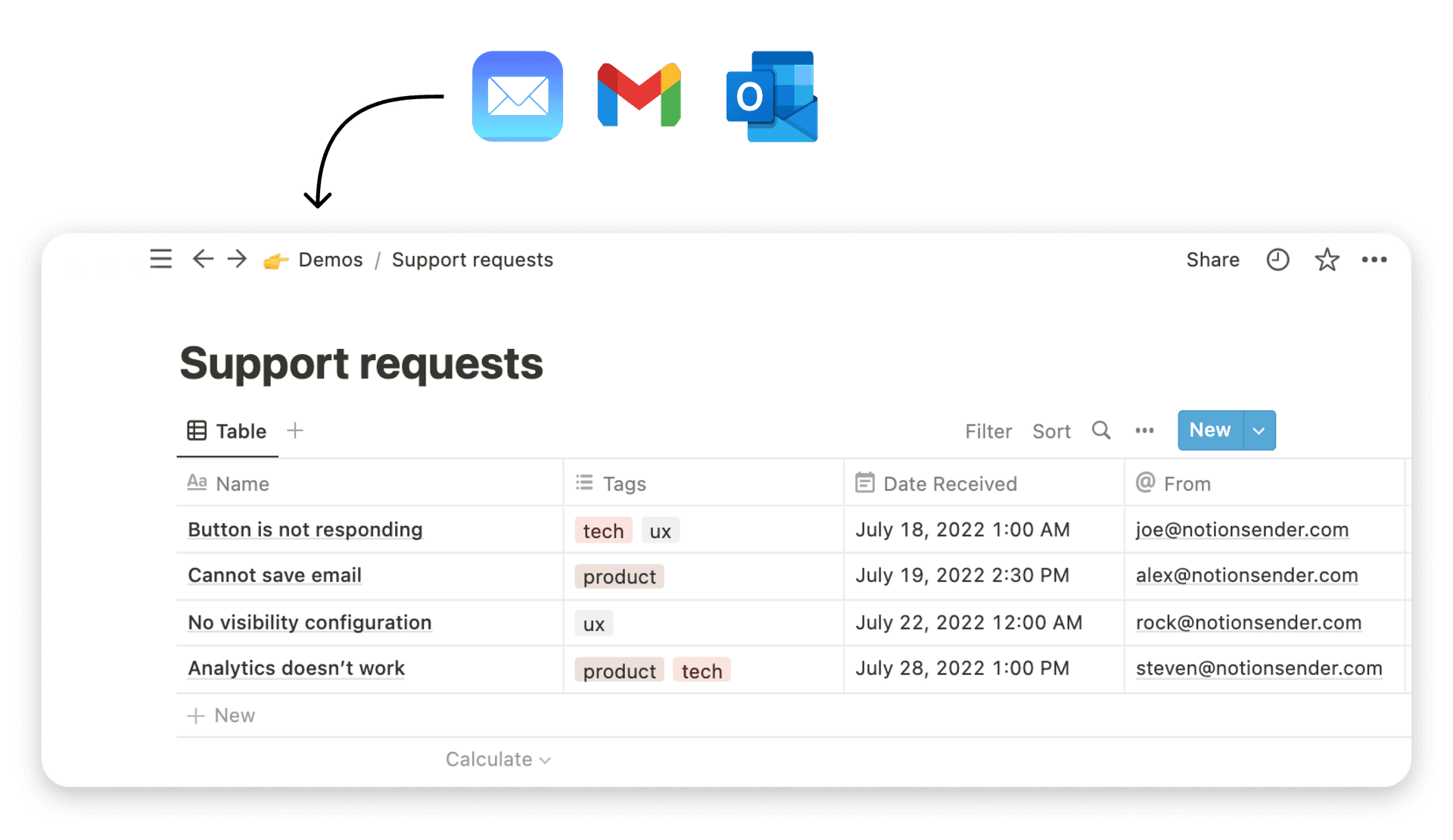
NotionSender fits naturally. It gives a Notion database its own email address, lets teams save incoming emails into that database, and supports template expressions for pulling details into properties. That makes it possible to design a database template that acts like an intake form for real email traffic, not just manual entries. If you want to see the outbound side of that workflow too, this guide on how to create and send email from Notion shows how the handoff can stay inside the workspace.
Design the template around extracted fields
The mistake here is trying to turn every incoming email into a perfectly structured record. Real email is messy. Design for triage first.
A practical intake template usually includes:
- Sender so you know who initiated the request
- Subject for quick scanning in database views
- Received date for queue management
- Status so someone can move it from new to in progress to resolved
- Related client or project if the message belongs to an existing record
- Clean summary field for the short version of the request
Then add a body area inside the database template for the full email content, notes, next steps, and any internal follow-up checklist.
Use email as the trigger, not the workload
The strongest pattern is to let email create or populate the record, then let the template handle what happens next.
For example, a client request enters a Requests database. The template can already contain:
- A default status
- A linked view of related client records
- A checklist for response handling
- A notes area for decisions and internal comments
- A relation field for attaching the request to a live project
That turns the template into an operational handoff. The email starts the record. The template standardizes the work.
If staff still has to copy subject lines, sender names, and request details by hand, the template isn't doing enough of the job.
What works in practice
Simple routing beats ambitious parsing. Don't aim for perfect automation on day one. Aim for cleaner intake and less copy-paste.
The best early use cases are narrow and repetitive:
| Workflow | Why it works well |
|---|---|
| Client request intake | Email structure is familiar and easy to route |
| Lead capture | Sender and subject are immediately useful |
| Internal approvals | Repetitive request patterns are easier to standardize |
| Content submissions | Messages can feed one review queue |
The payoff isn't just speed. It's consistency. Every incoming request enters the same system, with the same statuses, the same ownership pattern, and the same record structure.
Sharing and Distributing Your Finished Template
A template can be well built and still fail the moment someone else duplicates it.
The usual reason is that the creator shares a live workspace page without cleaning the system, removing private data, or adding basic instructions. What looked obvious during setup becomes confusing for everyone else.
Know what you're sharing
Notion gives you more than one sharing path, and they serve different purposes.
A public page is useful when you want someone to view content. A duplicatable template is useful when you want someone to install a clean copy into their own workspace and start using it. Those are not the same thing.
If you're distributing a system to clients, colleagues, or an audience, assume they won't know your internal logic. The template has to teach them enough to get started without a call or message.
Polish the duplicate, not the original
Before sharing, create a release version of the template and clean it like a product.
Use this checklist:
- Remove personal data such as real client names, internal comments, and test records
- Write short instructions with callout blocks at the top of key pages
- Rename properties clearly so users understand the field without training
- Create clean default views for common tasks like active work, backlog, and archive
- Check relations and filters so nothing appears broken when the template is duplicated
- Test from a blank duplicate instead of assuming the original workspace reflects the user experience
A polished template should answer basic operational questions on its own. Where does new work go? Which view should I use first? What fields are required? Which records are examples and which should be deleted?
Build for the next user, not just the current one
At this stage, many templates become fragile. The creator optimizes for their own memory.
That usually shows up as hidden logic, unclear property names, and dashboards that make sense only if you built them. Better templates include small amounts of guidance exactly where the user needs it.
The test isn't whether you can use the template. The test is whether your future self can understand it after a busy month.
If your workflow includes communication steps, distribution also means making the template easy to use alongside outbound actions. This overview of ways to use Notion for email workflows and sharing is a useful reference when your template needs to support both coordination and communication.
Best Practices and Common Mistakes to Avoid
The most effective Notion templates usually look less impressive than the ones people show off online.
They aren't packed with decorative widgets. They don't try to solve every edge case on day one. They just make recurring work easier, cleaner, and harder to break.
Keep the operating system small
Over-engineering is the fastest way to make a template unusable.
You see it when a Tasks database has too many properties, half of them rarely filled in, or when the project page includes dashboards, nested filters, and formulas that nobody understands. A system like that creates hesitation. Hesitation leads to incomplete records, and incomplete records kill trust.
Hard-won advice: Don't over-engineer. If a field doesn't change behavior, reporting, or handoff, question whether it belongs.
A small set of reliable properties beats a giant schema with weak adoption.
Build for maintenance
A template isn't finished when it looks polished. It's finished when someone can maintain it without fear.
That means using property names that won't confuse formula logic later, documenting settings pages, and resisting the urge to bury critical databases deep inside a visual shell. A maintainable template survives edits, staffing changes, and workflow updates.
A few standards help:
- Prefer plain names over clever labels for core properties
- Centralize settings when multiple linked databases support one system
- Test repeat workflows before adding niche cases
- Archive old views instead of deleting useful reporting paths too quickly
Start with one workflow that matters
A lot of people try to create notion template packs before they've proven one operational use case.
That usually leads to generic assets with weak adoption. A better sequence is narrower. Build one strong system for project intake, client management, approvals, or content production. Use it in real work. Notice where people get stuck. Then improve the template based on that behavior.
That process doesn't feel glamorous, but it's how durable systems are built.
Don't confuse aesthetics with clarity
Visual design matters. It helps people feel oriented. But visual polish can hide structural problems for a while.
If the template depends on manual copy-paste, unclear ownership, or duplicate databases, a good cover image won't save it. Clarity comes from clean data flow, obvious entry points, and records that connect correctly.
Build for maintenance, not just for launch.
That's a significant shift. A good template isn't just reusable. It's operational. It has a defined job, a clear structure, useful logic, and a path for outside information to enter without friction. When you build with that standard, Notion stops being a collection of pages and starts becoming a system people can rely on.
If your Notion workflow depends on email, NotionSender gives you a practical way to connect the two. You can send and receive emails inside Notion, assign a unique email address to a database, and route incoming messages into structured records so your templates work like operational systems instead of static pages.