Email Customer Service: A Complete Guide for 2026

You open the shared inbox before coffee and immediately see the pattern. One customer asked for a refund yesterday and never got a reply. Another sent the same question twice because two people on your team answered from different threads. A lead who wanted pricing details is buried between shipping complaints and password resets. Nothing looks catastrophic on its own. Together, it becomes a system that results in work going unaddressed.
That's how email customer service breaks down in most small businesses. Not because people don't care, but because the inbox becomes the process. Whoever sees a message first replies. Whoever remembers follows up. Important details live in someone's head, in a sent folder, or in a separate spreadsheet nobody updates consistently.
Email can work far better than that. Done right, it gives you a documented, searchable, low-friction support channel that customers already know how to use. The key is to stop treating support email as a pile of messages and start treating it as an operating system. That means intake rules, routing, writing standards, follow-up habits, and tools that keep the work visible.
Why Your Inbox Is a Ticking Time Bomb
The first version of email customer service usually looks harmless. A Gmail address. A shared password. Maybe a color label for “urgent.” It feels lightweight, which is exactly why it turns dangerous. You can get away with it for a while, especially when volume is still manageable and the founder can answer most messages from memory.
Then the cracks show.
A customer asks about an invoice. Someone replies and forgets to copy finance. A bug report arrives with a screenshot, but the file gets lost in a long thread. A freelancer checks the inbox after lunch and answers something that was already resolved that morning. Nobody has a clean view of what's open, what's blocked, or what needs a second reply.
What chaos looks like in practice
A messy inbox usually creates the same operational problems:
- Requests get stranded because emails are read but not assigned.
- Replies become inconsistent because each person writes from habit instead of a shared standard.
- Context disappears when product details, order references, and prior decisions live in separate places.
- Good opportunities get missed because sales follow-ups and support messages compete in the same queue.
The inbox doesn't announce these failures. It hides them. That's why teams often realize the problem only after a customer says, “I already explained this.”
Practical rule: If you can't tell in a few seconds who owns a customer email, what stage it's in, and what happens next, you don't have a support workflow. You have a pile of messages.
Why small teams feel this fastest
Small businesses are especially exposed because the same few people handle support, sales, operations, and delivery. Every incoming email competes with actual fulfillment work. That makes triage inconsistent and follow-up fragile.
If your current setup feels familiar, Tooling Studio's email management guide is a useful companion read because it addresses the operational habits that turn overload into something manageable. The core lesson is simple. Email problems rarely come from volume alone. They come from unclear ownership, weak structure, and no system for deciding what happens after a message lands.
The Power of Asynchronous Support
A lot of new business owners assume support should feel instant to feel good. That pushes them toward live chat thinking, even when email would serve the customer better. In practice, email customer service has a different strength. It gives both sides room to be precise.
Many customers prefer asynchronous email because it preserves context and is easier to document, and good support depends on collecting complete context upfront, including the subject line, description, and screenshots, not just replying faster, according to Common Angle's support guidance.

Why slower can actually be better
Fast isn't the same as useful. A rushed answer that asks three clarifying questions often creates more work than a measured first reply that includes a complete solution. Email gives agents time to check an order, verify an account issue, talk to engineering, or pull the right document before responding.
That matters when the issue has moving parts. Refunds, subscription changes, bug reports, damaged shipments, and handoff questions all benefit from a written thread that someone can revisit later without relying on memory.
Here's what email does well that real-time channels often don't:
- Keeps a clean record so the customer and your team can refer back to the same instructions.
- Lets customers reply on their schedule instead of forcing them into a live session.
- Gives agents investigation time when the answer isn't obvious.
- Reduces pressure on small teams that can't staff real-time coverage all day.
What good asynchronous support requires
Asynchronous doesn't mean vague or slow. It means structured.
A strong email support setup does two things at once. It acknowledges receipt quickly, and it gathers enough detail to prevent a long clarification loop. If a customer says “it's broken” and your process accepts that as sufficient intake, the thread is already off course. If the first message includes what happened, when it happened, and what they saw, the agent can act.
Email works best when the customer doesn't have to repeat themselves and the agent doesn't have to guess.
That's the primary advantage of asynchronous support. You're not trying to imitate a phone call. You're using a channel built for documentation, thoughtful replies, and traceable decisions.
Building Your First Email Support Workflow
You don't need enterprise software to build a solid workflow. You need a repeatable path that every email follows. Once that path exists, tools can support it. Without it, tools just make disorganization faster.
Start with the full lifecycle, not just the reply. An incoming message should move through intake, acknowledgment, sorting, assignment, response, and closure. Each stage answers one operational question.

The basic workflow that works
-
Email arrives
Every request needs one visible home. Don't let messages sit in personal inboxes if they relate to customer support. -
Auto-acknowledgment goes out
This confirms receipt and sets expectations. Keep it short, human, and clear about what happens next. -
Categorization and prioritization
Sort by type first, urgency second. Billing, technical issue, product question, refund, and account access are common starting categories. -
Assignment
One owner per thread. Other people can help, but one person is accountable for the next action. -
Investigation and drafting
The agent checks the account, order, logs, attachments, or internal notes before writing back. -
Response sent
The reply should resolve, advance, or deliberately narrow the issue. It should never just restate the customer's message. -
Follow-up and close
Confirm the issue is resolved, record what happened, and archive the conversation in a way your team can find later.
A visual walkthrough helps if you're setting this up for the first time:
<iframe width="100%" style="aspect-ratio: 16 / 9;" src="https://www.youtube.com/embed/ci7zd5sEGjI" frameborder="0" allow="autoplay; encrypted-media" allowfullscreen></iframe>
Intake is where most teams lose time
To improve triage and resolution speed, agents should have relevant identifiers upfront, such as order numbers, customer IDs, and a detailed problem description, and intake templates that capture this metadata reduce follow-up requests, according to DoneDone's guidance on email customer service.
That changes how you design the front door of support. Instead of inviting “email us anytime” and hoping the message is usable, ask for the details your team needs.
A simple intake checklist might include:
- Identity details such as customer name, account email, order reference, or customer ID.
- Issue context including what happened, when it happened, and whether it can be reproduced.
- Evidence like screenshots, copied error text, or relevant attachments.
- Desired outcome so the team knows whether the customer wants a fix, explanation, replacement, or refund.
Keep the workflow where the work already happens
Many small teams break support by separating the inbox from the rest of operations. The support message lives in one tool, the customer record in another, and the task list somewhere else. That split creates lag and dropped context.
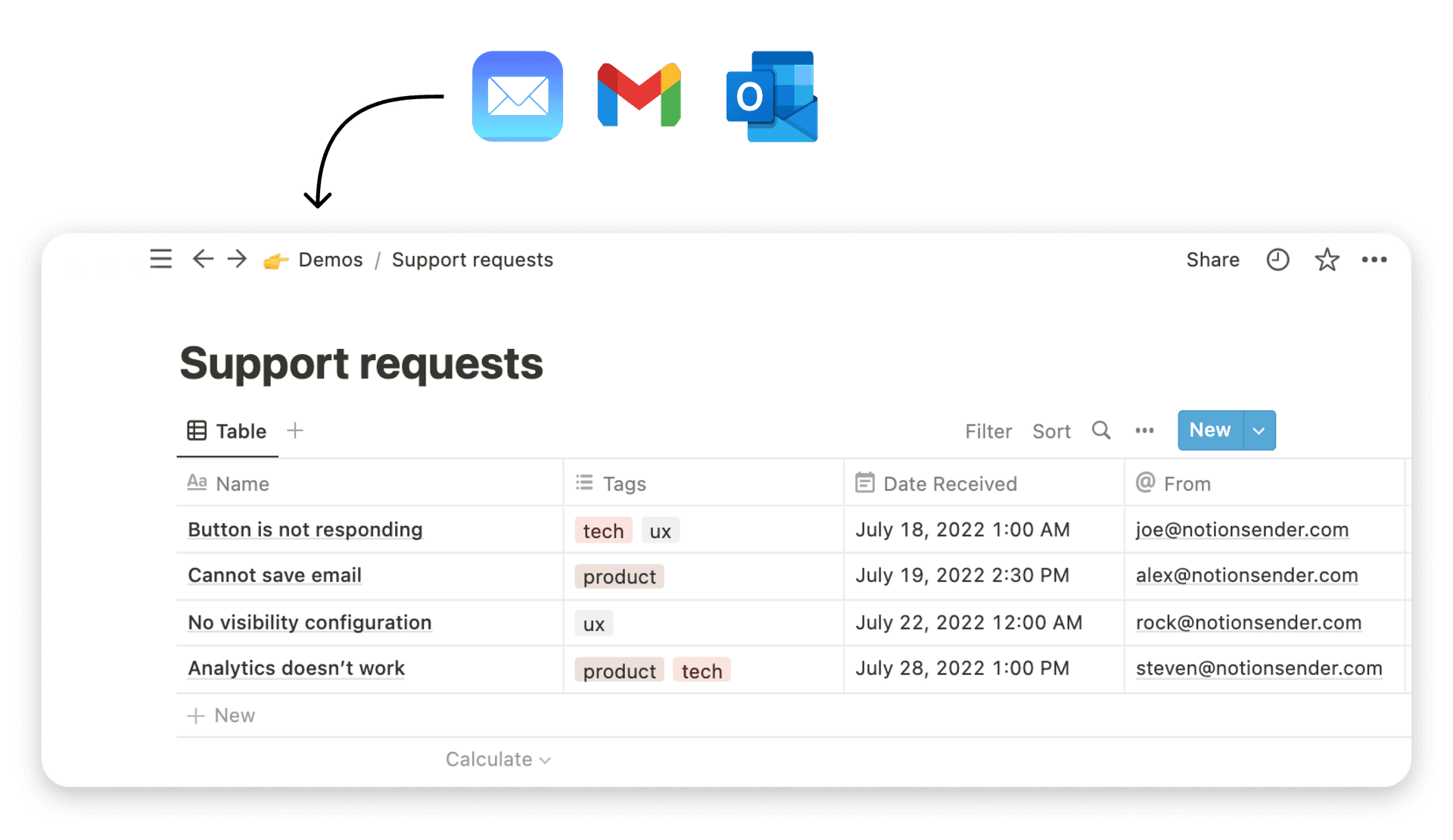
If your team runs work in Notion, it helps to see how to create and send email from a Notion workflow so incoming support conversations and outgoing replies stay tied to the same records. The principle matters even if you use another stack. Put support where fulfillment, product, and follow-up can see it.
| Workflow stage | What to decide | Common failure |
|---|---|---|
| Intake | Do we have enough information to act | Vague first messages |
| Triage | What type of issue is this | Everything marked urgent |
| Assignment | Who owns the next step | Multiple people replying |
| Resolution | What will solve this | Answers without verification |
| Closure | Is the issue actually done | Threads closed too early |
Best Practices for Writing Great Support Emails
A workable process gets the email to the right person. Good writing gets it resolved.
Support emails don't need flair. They need control. The best replies are short, clear, and easy for a stressed customer to act on. RingCentral recommends an ideal business email length of up to 125 words, and advises teams to avoid negative language while structuring replies around acknowledgment, a concise solution, and a clear call to action, as described in RingCentral's support email guidance.

A simple structure for almost every reply
Use this three-part shape:
-
Acknowledge the issue
Show that you understood the problem in plain language. -
Give the solution or next action
State what you did, what they should do, or what you need from them. -
End with one clear call to action
Ask for a screenshot, confirm a choice, or direct them to the next step.
That structure prevents a common mistake. Teams often write polite but incomplete replies that sound responsive while pushing the actual work into the next email.
A support email is weak when the customer has to read it twice to figure out what happens now.
What to avoid
Some habits create friction fast:
- Long setup paragraphs that delay the answer.
- Negative phrasing like “we can't” or “unfortunately” when a clearer, action-oriented alternative exists.
- Template dump language that sounds copied and barely edited.
- Multiple asks in one message when one next step would move the case forward better.
For broader writing hygiene, Humantext.pro's email tips are useful because they reinforce clarity, professionalism, and readable structure without making messages stiff.
Copy-ready templates you can adapt
Acknowledging a bug report
Hi [Name], Thanks for flagging this. I understand you're seeing [brief issue] when you try to [action].
I've logged the issue and I'm checking it with our team now. Please reply with a screenshot and the exact error text if you have it. That will help us confirm the cause and update you with the right fix.
Best, [Agent Name]
Handling a refund request
Hi [Name], I've reviewed your request about [order or service].
I can help with the refund process. Please reply to confirm that you want a refund rather than a replacement or account credit, and I'll send the next steps right away.
Best, [Agent Name]
Following up after a fix
Hi [Name], I'm checking in on the issue you reported with [brief issue].
The change has been applied on our side. Please try the action again and let me know if it's working as expected. If anything still looks off, reply to this email and I'll keep the thread open.
Best, [Agent Name]
If you want a separate reference for persuasive email structure outside pure support use, this guide on how to send the perfect email to get the response you want is a practical read. The same discipline applies in customer service. One clear message, one clear ask, one obvious next move.
Key Metrics to Measure Email Service Performance
If you don't measure your email customer service, you'll end up managing by anecdotes. One person thinks the inbox is under control because they answered a few threads this morning. Another thinks support is falling behind because a customer complained publicly. Metrics give you a shared view of reality.
Email is the most widely used customer service channel, with 95% of support teams and 98% of customers using it, which makes email-specific performance tracking central to understanding support quality and efficiency, according to EmailAnalytics' customer service statistics roundup.

The metrics worth tracking first
You don't need a huge dashboard on day one. Start with a small set that tells you whether customers are waiting too long, whether issues are getting solved, and whether your team is drowning in unfinished work.
First response time
This is the time between the customer's initial email and your first human reply. It tells you how quickly the team acknowledges demand. If this drifts upward, customers feel ignored before you've even started solving the issue.
Resolution time
This measures how long it takes to fully close an issue. It captures more than responsiveness. It reflects routing quality, internal coordination, and whether agents are getting enough context upfront.
Backlog size
Backlog is the count of unresolved emails sitting in the system. A growing backlog is often the earliest sign that your process is failing before customers start complaining loudly.
Customer satisfaction
A short post-resolution check can tell you whether the issue felt resolved from the customer's point of view, as a thread can be technically closed and still leave the customer frustrated.
How to use metrics without getting misled
Metrics are useful only when paired with review habits.
| Metric | What it reveals | What can distort it |
|---|---|---|
| First response time | How quickly customers feel seen | Auto-replies counted as real replies |
| Resolution time | How efficiently issues get solved | Prematurely closing threads |
| Backlog size | Whether demand exceeds capacity | Poor categorization |
| Customer satisfaction | Whether the experience felt helpful | Tiny survey response volume |
Track trends, not vanity. A clean-looking average can hide a few neglected threads that matter a lot to customers.
A practical review cadence works better than constant monitoring. Check response and backlog daily. Review resolution patterns weekly. Read actual conversations alongside the numbers so you can spot whether the issue is staffing, intake quality, or weak writing.
Centralizing Support with the Right Tools
Tool choice shapes the support system more than new teams expect. If email lives in one place, customer records live in another, and task tracking lives somewhere else, every reply depends on someone copying context by hand. That works for a while. Then threads get missed, handoffs get messy, and the inbox turns into a private memory test.
The goal is not to buy the biggest help desk you can afford. The goal is to build one workflow where incoming email, ownership, work in progress, and the final reply stay connected.
What different tool setups are good at
A shared inbox is fine at the start if one person handles nearly everything. It is fast to set up and cheap to run. The weakness shows up as soon as support becomes shared work. One teammate reads a message, another plans to answer it, and nobody can tell what is pending.
A traditional help desk adds assignment, tags, macros, and reporting. That is useful when support has become its own function with dedicated agents and clear queue management. The trade-off is separation. If operations, fulfillment, product, or account management need to work the issue, the substantive work often happens outside the help desk while the customer conversation stays trapped inside it.
An integrated workspace setup fits many small teams better. Support emails get attached directly to the order, client record, project, or internal task your team already uses. That reduces duplicate entry and gives the person doing the work the same context the customer saw.
What to look for in a support tool
Pick the setup that matches how your team already solves problems.
- Clear ownership so one person is responsible for the next action.
- Structured fields for issue type, customer identifiers, attachments, and status.
- Shared history so anyone stepping in can understand the case quickly.
- Reply capability inside the workflow so agents do not jump between systems to answer and track work.
- Basic automations for confirmations, reminders, and follow-up prompts.
If your team already runs operations in Notion, saving emails to a Notion database can close the gap between the inbox and the work queue. NotionSender is one example of that approach. It lets teams save incoming emails into Notion databases and send replies from Notion-based workflows. That setup makes sense when support tasks are tightly tied to fulfillment, project delivery, or account work already managed in the same workspace.
A practical decision test
Use this table to avoid overbuilding too early.
| Setup | Works well when | Starts to fail when |
|---|---|---|
| Shared inbox | One person handles most support | Several people need visibility and handoffs |
| Help desk | Support has dedicated ownership and steady volume | Other departments need case context every day |
| Integrated workspace | Support is closely tied to operations or delivery | You need advanced routing, SLAs, or enterprise controls |
Good tools make the state of work obvious. You should be able to see who owns the thread, what needs to happen next, and where the customer record lives without asking around. If a tool cannot do that, it does not centralize support. It just gives the chaos a nicer screen.
Troubleshooting and Scaling Your Operations
A support system proves itself when volume rises. That's when weak intake, fuzzy ownership, and inconsistent writing show up all at once. The fix usually isn't dramatic. It's tightening the basics you already put in place.
When volume spikes
If the inbox suddenly jumps, don't start by rewriting every template or shopping for new software. Protect the queue first.
- Triage harder by separating urgent blockers from general questions.
- Reduce custom writing for repeat issues with reviewed response templates.
- Set expectations clearly in acknowledgments and follow-ups so customers know when to expect movement.
- Create temporary categories for surge-related issues such as launch questions, shipping delays, or billing confusion.
A spike is easier to manage when your intake captures usable details from the start. Otherwise, every email becomes a mini-investigation.
When to hire your first support person
Hire when support work is interrupting delivery work so often that both are getting worse. That usually shows up as delayed replies, forgotten follow-ups, and founders answering the same categories of questions repeatedly.
Your first support hire doesn't just need empathy. They need judgment, writing discipline, and the ability to follow a process without sounding robotic. Give them three things early:
- A category system so they know how to sort issues.
- Approved templates they can personalize without drifting off-brand.
- Escalation rules that define when product, finance, or leadership needs to step in.
The easiest way to scale badly is to add people before you define how the work moves.
How quality holds as the team grows
As soon as more than one person is replying, review real threads every week. Not to police tone, but to catch preventable problems. Look for missing next steps, vague requests for more information, and replies that solve only part of the issue.
Quality stays stable when the system makes good work easier. Strong intake reduces guesswork. Clear ownership stops duplication. Good templates improve consistency. Shared records preserve context. That's the compounding effect of building email customer service as a system instead of a habit.
If you already run work inside Notion and want customer emails tied to the same records your team uses every day, NotionSender is worth a look. It gives you a way to save incoming emails into Notion databases and handle outgoing replies from the workspace where your projects, tasks, and customer context already live.