10 Powerful Email Drip Campaign Examples to Steal in 2025
Email drip campaigns are the workhorses of modern marketing, silently nurturing leads, onboarding users, and recovering sales while you focus on the bigger picture. But moving from theory to practice can be daunting. What separates a campaign that converts from one that gets ignored? The answer lies in the strategy, timing, and automation behind each message. A well-designed sequence feels personal and helpful, not robotic.
This guide moves beyond generic advice and provides a complete blueprint for 10 powerful email drip campaign examples. We’ll dissect each one, covering everything from the initial goal and audience segmentation to specific subject lines and body copy that get results. You won't just see the "what"; you'll understand the "why" behind every element, including the key performance indicators (KPIs) you need to track for success.
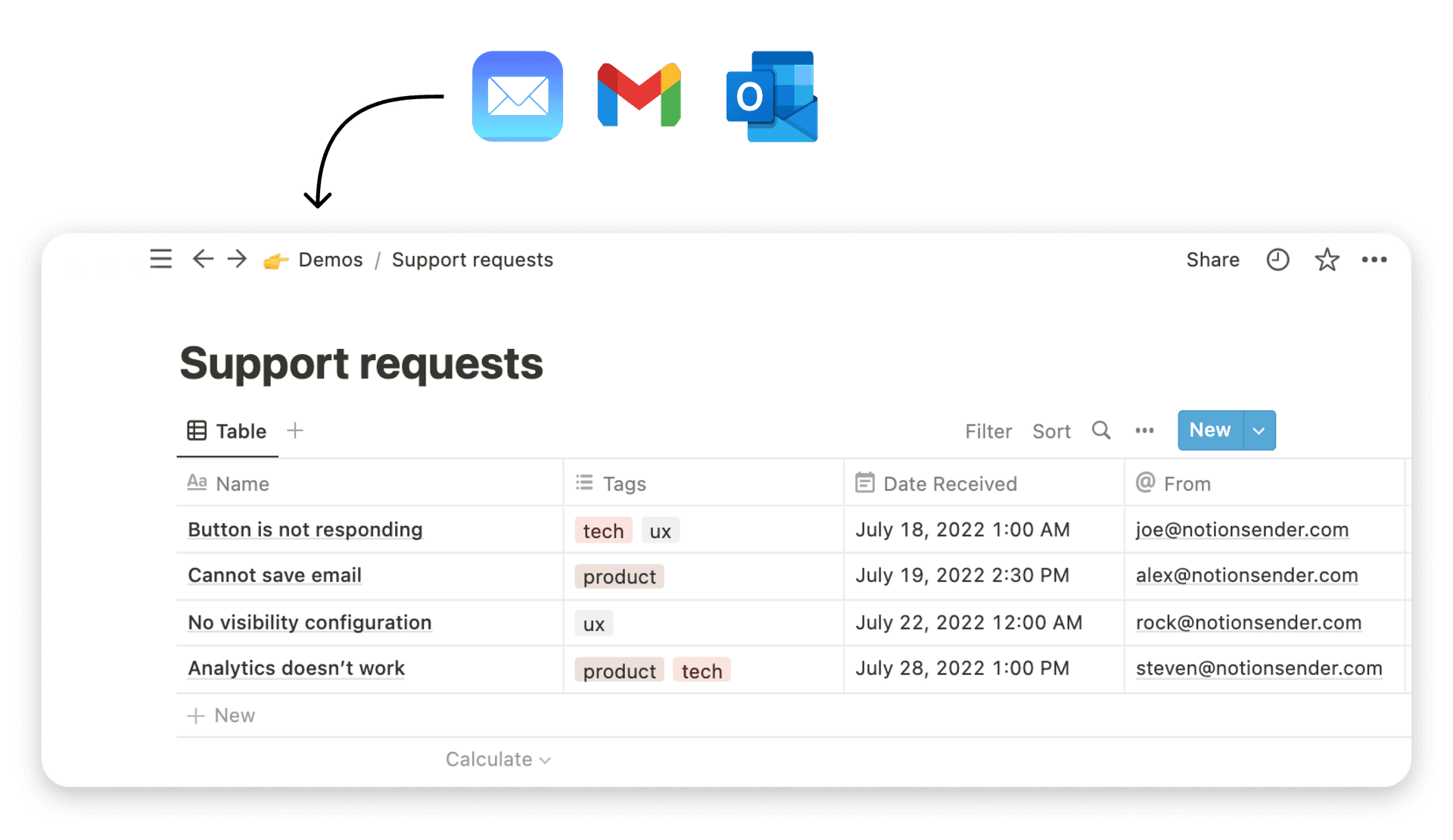
More importantly, this article is built for action. For each example, you’ll get step-by-step instructions for implementing and automating the entire sequence using NotionSender. We’ll show you how to save triggers to databases, manage templates, and schedule messages for a truly hands-off system. To further refine your strategy for automated success, explore these tips to rocketcharge your email marketing with interactive video. Get ready to transform your email strategy from a manual chore into an automated revenue engine by leveraging these proven frameworks. Let's dive into the examples.
1. The Welcome Series: Your First Impression on Autopilot
A welcome series is an automated sequence of emails sent immediately after a user subscribes to your list, whether through a newsletter signup, a lead magnet download, or an account creation. This foundational drip campaign is arguably the most important one you'll ever create. It capitalizes on the moment of peak interest, setting the stage for the entire customer relationship. Its primary goal isn't to sell hard, but to build trust, deliver on your initial promise, and guide new subscribers toward their next logical step.
Strategic Breakdown
- Goal: Nurture new leads, build brand trust, set expectations, and drive initial engagement (e.g., follow on social, read a key blog post, browse a product category).
- Audience: All new subscribers. Segmentation can be based on the signup source (e.g., a specific lead magnet vs. general newsletter form) to tailor the initial value proposition.
- Timing: The sequence typically runs for 3-7 days. The first email should be sent instantly, with subsequent emails spaced 1-2 days apart to maintain momentum without overwhelming the inbox.
Example Welcome Sequence
Here is a classic 3-part welcome series, one of the most effective email drip campaign examples for building an initial connection.
Email 1: The Welcome & Value Delivery (Sent Immediately)
- Subject Line: Welcome to [Brand Name]! Here’s your [Lead Magnet]
- Body Copy: Start with a warm, personal welcome. Immediately deliver the promised resource. Briefly state your brand's core mission and what subscribers can expect from your future emails (e.g., weekly tips, exclusive offers).
Email 2: The Brand Story & Connection (Sent Day 2)
- Subject Line: So, what's our story?
- Body Copy: Share your origin story or the "why" behind your brand. This humanizes your company and builds an emotional connection. End with a simple, engagement-focused question like, "What’s the biggest challenge you're facing with [Topic]?"
Email 3: The Next Step & Social Proof (Sent Day 4)
- Subject Line: Ready for this? [Benefit-focused CTA]
- Body Copy: Guide them to the next valuable action. This could be following you on social media, reading a pillar blog post, or browsing a best-selling product category. Include a powerful testimonial or a link to customer reviews to build credibility.
2. The Product Launch Campaign: Building Hype for Maximum Impact
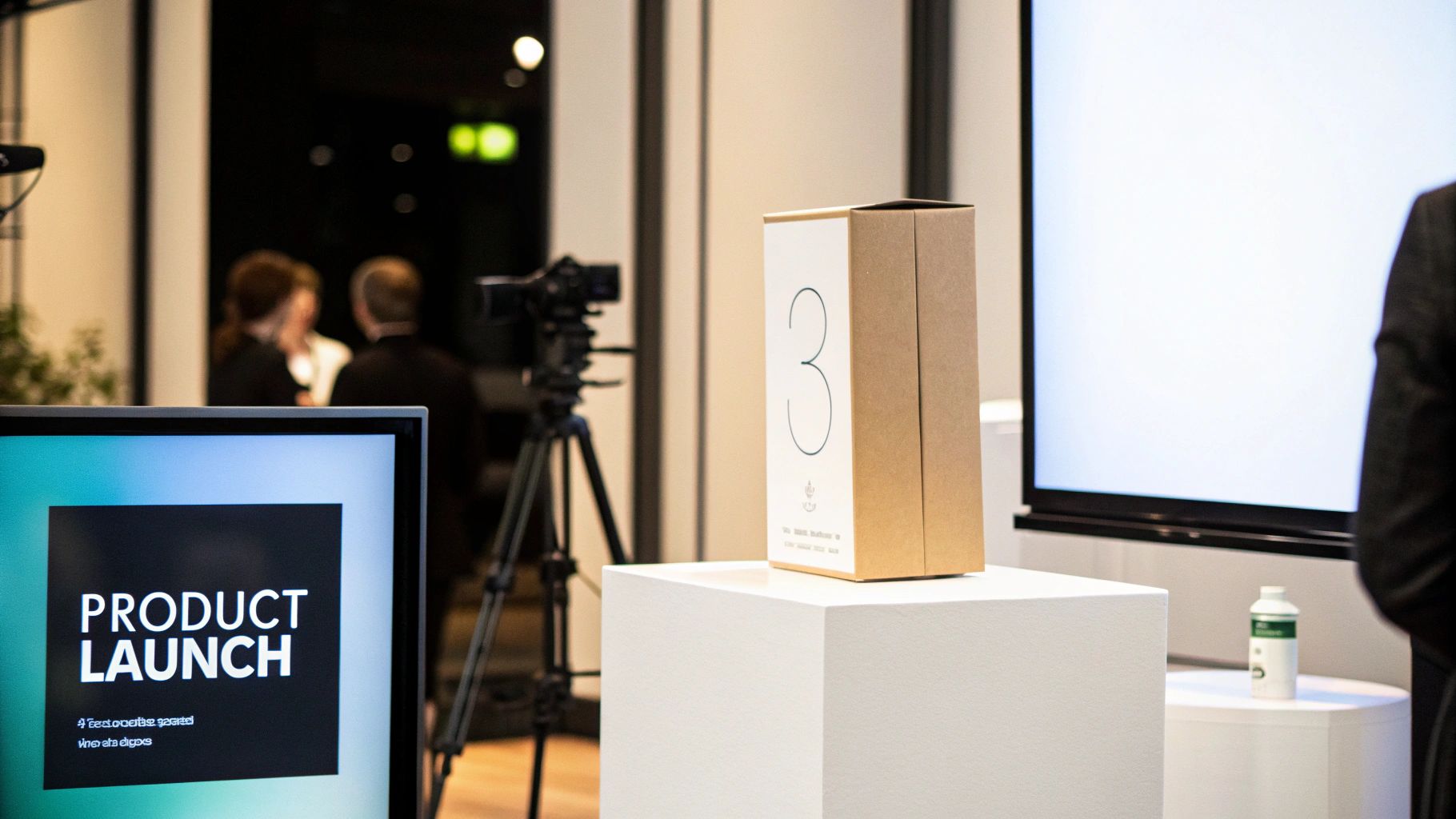
A product launch campaign is a meticulously planned email sequence designed to generate buzz, build anticipation, and drive sales for a new product, feature, or service. Unlike a standard announcement, this drip campaign tells a story over several days or weeks, turning a simple release into a must-see event. It systematically warms up your audience, educates them on the value of the new offering, and culminates in a strong call to action, maximizing initial adoption and revenue.
Strategic Breakdown
- Goal: Build anticipation and excitement, educate subscribers on the new product's value, drive early sales, and gather initial feedback.
- Audience: Your entire email list, but with crucial segmentation. Create segments for highly engaged users or past purchasers of similar products to receive early access or exclusive bonuses.
- Timing: The pre-launch phase typically runs 1-2 weeks before the launch date. Emails are spaced 2-4 days apart to build momentum, with frequency increasing on launch day and the day after.
Example Launch Sequence
This 4-part product launch is one of the most effective email drip campaign examples for turning a release into a commercial success.
Email 1: The Teaser (Sent 7 Days Before Launch)
- Subject Line: Something BIG is coming next week...
- Body Copy: Hint at a new solution to a common customer pain point without revealing the product itself. Use curiosity-driven language and visuals. End with a CTA to "keep an eye on your inbox" for the big reveal.
Email 2: The Reveal & Key Benefit (Sent 3 Days Before Launch)
- Subject Line: It’s almost here! Introducing [Product Name]
- Body Copy: Officially announce the product and its name. Focus on the single most powerful benefit it provides. Use a high-quality image or GIF. Include a countdown timer to create urgency and direct users to a "learn more" landing page.
Email 3: The Launch Day Offer (Sent on Launch Day)
- Subject Line: It’s LIVE! Get your exclusive launch discount on [Product Name]
- Body Copy: Announce that the product is officially available for purchase. Clearly state the special launch offer (e.g., 20% off for the first 48 hours). Include a prominent CTA button that links directly to the sales page and add social proof like an early beta-tester testimonial.
Email 4: The Final Reminder (Sent 24 Hours After Launch)
- Subject Line: Last Chance: Your launch discount for [Product Name] expires tonight!
- Body Copy: Create a final sense of urgency. Remind subscribers that the special launch pricing or bonus is ending soon. Address a common objection or highlight a key feature one last time to persuade those who are still on the fence.
3. The Educational Content Series: Building Authority Through Knowledge
An educational content series is a drip campaign designed to nurture leads over a longer period by delivering valuable, structured learning content. Instead of a quick welcome, this sequence functions like a mini-course delivered via email, breaking down a complex topic into digestible lessons. It’s a powerful strategy for establishing your brand as a trusted authority and thought leader in your niche. The primary goal is to empower your audience with knowledge, building a deep, trust-based relationship before ever asking for a sale.
Strategic Breakdown
- Goal: Establish industry authority, nurture long-term leads, educate prospects on the value of your solution, and qualify leads by their engagement with the material.
- Audience: Leads who have downloaded a top-of-funnel resource (like an ebook or a webinar) and are seeking deeper knowledge but are not yet ready to buy.
- Timing: This is a long-play campaign, often running for several weeks. Emails are typically spaced 3-5 days apart to give subscribers time to absorb and apply the information from each lesson.
Example Educational Sequence
Here is a 3-part example of an educational series, a fantastic email drip campaign example for B2B SaaS or knowledge-based businesses.
Email 1: The Kickoff & Learning Objectives (Sent Day 1)
- Subject Line: Your [Course Name] starts now! Lesson 1 is inside.
- Body Copy: Welcome the subscriber to the course and set clear expectations. Outline the learning objectives and what they will be able to achieve by the end of the series. Deliver the first lesson, focusing on a foundational concept.
Email 2: Deeper Dive & Actionable Homework (Sent Day 4)
- Subject Line: Lesson 2: Mastering [Specific Skill]
- Body Copy: Build upon the previous lesson with more advanced content. Use visuals like diagrams or short video clips to explain complex points. End with a simple, actionable "homework" assignment that encourages them to apply the knowledge.
Email 3: The Capstone & The Pivot (Sent Day 8)
- Subject Line: Final Lesson: Tying It All Together
- Body Copy: Deliver the final piece of the educational puzzle, summarizing the key takeaways from the entire series. This is the perfect time to naturally pivot to your product or service, explaining how it helps them implement everything they’ve just learned on a larger scale.
4. The Cart Abandonment Recovery Sequence
A cart abandonment sequence is an automated series of emails triggered when a known user adds items to their online shopping cart but leaves the website without completing the purchase. This is one of the highest-return email drip campaign examples an e-commerce business can implement. It directly targets high-intent prospects at the exact moment of hesitation, aiming to recover otherwise lost revenue by addressing common purchase barriers like cost, distraction, or uncertainty.
Strategic Breakdown
- Goal: Recover lost sales, overcome purchase objections (price, shipping), and bring high-intent shoppers back to the checkout page.
- Audience: Website visitors or existing customers who are logged in or have entered their email at checkout and then abandoned their cart. Segmentation can be based on cart value (offer larger discounts for higher-value carts) or customer history (new vs. repeat customer).
- Timing: The sequence is time-sensitive and typically runs over 1-3 days. The first email should arrive within an hour, the second within 24 hours, and a final attempt around 48-72 hours.
Example Cart Abandonment Sequence
This 3-part sequence is a proven framework for converting hesitant shoppers into paying customers.
Email 1: The Gentle Reminder (Sent within 1 hour)
- Subject Line: Did you forget something?
- Body Copy: Keep it simple and helpful. Remind the customer what they left behind, using high-quality product images and a direct link back to their cart. Avoid offering a discount in this first email; many users just got distracted and will complete the purchase with a simple nudge.
Email 2: The Sweetener (Sent at 24 hours)
- Subject Line: Still thinking it over? Here’s 10% off.
- Body Copy: For those who needed more than a reminder, introduce a compelling incentive. Offer a limited-time discount or free shipping to overcome price sensitivity. Use language that creates a sense of urgency, like "Your offer expires in 24 hours."
Email 3: The Final Push (Sent at 48 hours)
- Subject Line: Your cart is about to expire...
- Body Copy: This is the last chance to recover the sale. Reiterate the offer and introduce scarcity or social proof. Mention low stock levels ("Only 2 left!") or include a top-rated customer review for the abandoned product to build confidence and prompt immediate action.
5. The Re-engagement Campaign: Winning Back Inactive Subscribers
A re-engagement or "win-back" campaign is an automated email sequence designed to reactivate subscribers who have stopped engaging with your emails. These dormant contacts hurt your deliverability and skew your metrics, so this campaign serves a dual purpose: it attempts to reignite their interest or, failing that, cleans your list by confirming their disinterest. It's a strategic effort to remind them of your value before they're gone for good.
Strategic Breakdown
- Goal: Re-engage inactive subscribers, boost open and click-through rates, clean the email list to improve deliverability, and remind users of the brand's value.
- Audience: Subscribers who haven't opened or clicked an email in a set period (e.g., 30, 60, or 90+ days). The trigger should be based on your typical sales cycle and email frequency.
- Timing: The sequence often consists of 2-4 emails sent over 1-2 weeks. The goal is to get a quick response, either positive (an open or click) or negative (an unsubscribe), so the sequence is more compressed than a welcome series.
Example Re-engagement Sequence
This 3-part re-engagement sequence is one of the most effective email drip campaign examples for either reviving interest or pruning your list.
Email 1: The Gentle Nudge & Reminder (Sent at 60-day inactivity mark)
- Subject Line: Is everything okay? We miss you!
- Body Copy: Start with a friendly, low-pressure tone. Remind them of the value they signed up for, perhaps highlighting popular content or a key benefit. A great tactic is to use personalization, like referencing their name or past interests.
Email 2: The Exclusive Offer (Sent 3 days later)
- Subject Line: A special offer just for you
- Body Copy: Present an exclusive, time-sensitive incentive not available to active subscribers, such as a special discount, a free resource, or early access. This creates a compelling reason to re-engage immediately. You can find more tips for boosting engagement in our guide on how to increase your email open rates.
Email 3: The Last Chance & Unsubscribe (Sent 5 days later)
- Subject Line: Goodbye from [Brand Name]?
- Body Copy: Be direct and transparent. State that this is the final email and you'll be removing them from the list to respect their inbox. Provide two clear choices: a "Keep me subscribed" link and a prominent "Unsubscribe" button. This final step is crucial for list hygiene.
6. The Customer Onboarding and Success Sequence
The moment a customer makes a purchase is the beginning, not the end, of your relationship. A customer onboarding sequence is a post-purchase series designed to guide new users, ensure they experience the full value of your product, and achieve their desired outcomes. This proactive approach is crucial for reducing churn and boosting long-term loyalty. Instead of leaving customers to figure things out alone, this campaign helps them achieve "first wins" quickly, turning initial interest into active, successful usage.
Strategic Breakdown
- Goal: Increase product adoption, reduce early-stage churn, improve customer satisfaction, and create opportunities for future upsells or advocacy.
- Audience: All new customers. Critically, this audience should be segmented based on their purchase (e.g., specific product, subscription tier) or their stated goals during signup to provide hyper-relevant guidance.
- Timing: The sequence can run from one week to several months, depending on the product's complexity. The first email must be sent within an hour of purchase, with subsequent emails triggered by user behavior (or lack thereof) or spaced out every 2-5 days.
Example Onboarding Sequence
This 4-part onboarding series is a powerful email drip campaign example for SaaS or digital product companies like Slack and Asana, designed to drive key activation milestones.
Email 1: The Welcome & First Key Action (Sent within 1 hour of purchase)
- Subject Line: Welcome aboard! Your next step with [Product Name]
- Body Copy: Start with an enthusiastic welcome and confirm their purchase. Focus on guiding them to complete the single most important first action, like creating their first project or inviting a teammate. Keep it simple and direct.
Email 2: Feature Spotlight & "Aha!" Moment (Sent Day 3)
- Subject Line: Did you know you could do this with [Product Name]?
- Body Copy: Introduce a core feature that helps users experience the product's value (the "aha!" moment). Use a short video tutorial or an animated GIF to demonstrate the feature in action, making it easy to understand and replicate.
Email 3: Milestone Celebration & Social Proof (Sent Day 7 or upon action)
- Subject Line: Congrats on creating your first [Project/Item]!
- Body Copy: Use behavioral triggers to celebrate a user's progress. Congratulate them on reaching a key milestone. Reinforce their smart decision by sharing a case study or testimonial from a similar customer who achieved great results.
Email 4: Pro Tips & Support (Sent Day 12)
- Subject Line: 3 advanced tips for [Achieving Goal]
- Body Copy: Share best practices or advanced tips to help them become a power user. Reassure them that help is available by providing clear links to your knowledge base, support chat, or community forum.
<iframe width="560" height="315" src="https://www.youtube.com/embed/S1XA3m5UE0M" frameborder="0" allow="accelerometer; autoplay; clipboard-write; encrypted-media; gyroscope; picture-in-picture" allowfullscreen></iframe>
7. Lead Nurturing Sequence Based on Industry/Persona
A persona-based lead nurturing sequence is a sophisticated drip campaign that moves beyond one-size-fits-all messaging. Instead of sending the same content to every lead, it uses segmentation based on industry, job title, company size, or specific challenges to deliver highly relevant, tailored content. This approach acknowledges that a CFO in the healthcare industry has different pain points than a marketing manager at a tech startup. By speaking directly to a recipient's specific context, you dramatically increase relevance, build authority, and accelerate their journey through the sales funnel.
Strategic Breakdown
- Goal: Nurture leads with hyper-relevant content, address specific industry/role pain points, build authority within a niche, and identify sales-ready leads for handoff.
- Audience: B2B leads segmented into distinct personas or industry verticals. The key is to have enough data (from forms, enrichment tools, or progressive profiling) to place leads into the correct bucket.
- Timing: These are often longer-term "always-on" campaigns. Emails are typically spaced 4-7 days apart to educate and build trust over several weeks or even months, depending on the sales cycle length.
Example Persona-Based Nurturing Sequence (For a SaaS company targeting "Marketing Managers")
Here is a 3-part sequence, a common structure within more extensive email drip campaign examples designed for deep segmentation.
Email 1: Acknowledge Their World & Offer a Relevant Resource (Sent 2 days after signup)
- Subject Line: Drowning in marketing data, [First Name]?
- Body Copy: Start by directly referencing a common challenge for their role. For example, "As a marketing manager, you're constantly asked to prove ROI while juggling a dozen different channels." Immediately offer a high-value, role-specific resource like a "Marketing Analytics Template for Managers" or a case study from a similar company.
Email 2: Connect Features to Their Specific Pains (Sent Day 6)
- Subject Line: Your [Specific Pain Point] solution
- Body Copy: Instead of listing generic features, connect one or two key features directly to their primary pain points. "Our automated reporting dashboard eliminates the 10+ hours you spend manually compiling reports, giving you back time for strategy." Include a testimonial from another marketing manager.
Email 3: The Role-Specific Demo/Consultation Offer (Sent Day 11)
- Subject Line: A 15-min plan for your marketing team
- Body Copy: Frame the call to action around their specific goals. Instead of a generic "Book a Demo," offer a "Personalized walkthrough on how to streamline your team's campaign reporting." This positions the sales call as a valuable, consultative session tailored to their needs.
8. The Post-Purchase Upsell and Cross-sell Campaign
A post-purchase drip campaign is an automated email sequence designed to increase customer lifetime value by strategically recommending additional products. This isn't about a hard sell; it’s about enhancing the customer's initial purchase with relevant add-ons (cross-sells) or superior versions (upsells). By leveraging purchase data, you can present highly relevant offers that feel like helpful suggestions rather than aggressive advertisements, turning a one-time buyer into a loyal, repeat customer.
Strategic Breakdown
- Goal: Increase average order value (AOV) and customer lifetime value (LTV). Deepen customer loyalty by demonstrating you understand their needs and can offer more value.
- Audience: Recent customers. This audience should be segmented based on the specific product or category they purchased to ensure recommendations are perfectly complementary.
- Timing: The sequence typically starts 7-21 days after the initial purchase. This delay allows the customer to receive and experience their first product, making them more receptive to complementary offers. Subsequent emails can be sent weekly or bi-weekly.
Example Upsell/Cross-sell Sequence
This 3-part sequence is one of the most effective email drip campaign examples for ecommerce and SaaS businesses aiming to maximize revenue from their existing customer base.
Email 1: The Smart Recommendation (Sent Day 7-14)
- Subject Line: A perfect match for your new [Product Name]
- Body Copy: Start by referencing their recent purchase to make the email feel personal. Introduce a small, curated selection of cross-sell products that directly complement what they bought. For example, if they bought a coffee maker, recommend specific filters or a premium bean blend.
Email 2: The Upgrade Opportunity (Sent Day 14-21)
- Subject Line: Ready to unlock more? Upgrade your [Product Name]
- Body Copy: Focus on the benefits of upgrading. If it's a SaaS product, highlight the top 3 features they would gain by moving to a higher-tier plan. For a physical product, this could be a premium version or a bundle offer. Use social proof like, "Customers who upgraded saw a 50% increase in productivity."
Email 3: The Exclusive Offer (Sent Day 21-28)
- Subject Line: A special offer, just for you
- Body Copy: Create a sense of exclusivity and urgency. Offer a small, time-sensitive discount (e.g., "15% off your next purchase, this week only") on a recommended product or upgrade. This encourages immediate action and makes the customer feel valued.
9. The Feedback and Review Request Sequence
A feedback and review request sequence is an automated campaign sent after a customer has had enough time to experience a product or service. This powerful drip campaign serves a dual purpose: it generates invaluable social proof (reviews, testimonials) that fuels future marketing and it provides direct feedback for product or service improvement. By systemizing the ask, you transform satisfied customers into brand advocates and gather the data needed to enhance the customer experience.
Strategic Breakdown
- Goal: Generate authentic customer reviews, testimonials, and user-generated content. Gather product feedback to identify areas for improvement and increase social proof to build trust with new prospects.
- Audience: Recent customers who have completed a purchase or service. Segmentation can be based on the specific product purchased or the customer's purchase history (e.g., first-time vs. repeat buyer).
- Timing: The sequence trigger is typically tied to a delivery or completion date. The first email is often sent 3-7 days post-delivery to give the customer time to use the product, with a gentle follow-up 7-10 days later if no action is taken.
Example Feedback Sequence
This 2-part sequence is one of the most effective email drip campaign examples for systematically building a library of social proof.
Email 1: The Initial Ask (Sent 5 days post-delivery)
- Subject Line: How did we do, [Customer Name]? Share your thoughts on [Product Name]
- Body Copy: Start by thanking them for their recent purchase. Include a picture of the item to jog their memory. Directly and politely ask for a review, explaining how their feedback helps both other shoppers and your team. Provide a clear, one-click link to the review platform (e.g., your site, Google, Trustpilot).
Email 2: The Gentle Reminder & Incentive (Sent 12 days post-delivery)
- Subject Line: A quick question about your recent order
- Body Copy: This email is a soft reminder for those who haven't yet left a review. Keep it short and friendly. To increase conversion, consider adding a small incentive like a 10% discount on their next purchase or entry into a giveaway as a thank you for their time. Reiterate the direct link to leave a review.
10. Event, Webinar, and Seasonal Campaigns
Event, webinar, and seasonal drip campaigns are time-sensitive sequences designed to drive action around a specific date. Whether promoting a live webinar, a virtual summit, or a Black Friday sale, these campaigns build anticipation, maximize attendance or sales, and handle crucial follow-up communication. They work by creating a sense of urgency and relevance, aligning your messaging with a key moment in your audience's calendar.
Strategic Breakdown
- Goal: Drive event registrations, boost webinar attendance, maximize holiday sales, and deliver timely post-event resources or offers.
- Audience: Segmented lists based on past event attendance, purchase history (for seasonal sales), or interest in a specific topic. For example, a webinar on "Advanced SEO" would target users who engaged with SEO-related content.
- Timing: Promotion typically starts 2-4 weeks before the event or holiday. The sequence includes pre-event hype, a series of reminders leading up to the date (e.g., 1 week, 1 day, 1 hour before), and post-event follow-ups sent within 24 hours.
Example Webinar Promotion Sequence
This 3-part sequence is a classic framework for promoting a live online event, serving as a powerful email drip campaign example for boosting attendance.
Email 1: The Initial Invitation & Value Prop (Sent 2 Weeks Before)
- Subject Line: You're Invited: Live Webinar on [Webinar Topic]
- Body Copy: Announce the webinar, clearly stating the date, time, and the core problem it will solve for the attendee. Use bullet points to highlight the key takeaways or skills they will learn. Include a prominent call-to-action button to register.
Email 2: The Final Reminder & Urgency (Sent 1 Day Before)
- Subject Line: [Reminder] Our webinar on [Topic] is tomorrow!
- Body Copy: Create a sense of urgency by reminding them that the event is just 24 hours away. Briefly restate the main benefit and include a testimonial from a previous event attendee if possible. Provide the "Register Now" link again for last-minute signups. For a deeper dive, explore these effective marketing and promotion strategies for events.
Email 3: The Post-Event Follow-Up (Sent within 24 Hours After)
- Subject Line: The [Webinar Topic] recording is here!
- Body Copy: Thank attendees for joining and provide a direct link to the webinar recording and any slides or resources mentioned. For non-attendees, send a separate version with a subject like "You missed it, but here's the recording" to re-engage them. This is also a great place to introduce a related product or service. You can learn more about how Notion can help you schedule and manage these campaigns.
10 Email Drip Campaigns: Side-by-Side Comparison
| Campaign | 🔄 Implementation Complexity | 💡 Resource Requirements | ⚡ Speed / Time-to-impact | 📊 Expected Outcomes & Quality ⭐ | Ideal Use Cases / Key Advantages |
|---|---|---|---|---|---|
| Welcome Series for New Subscribers | Low — simple triggers, 3–7 day cadence | Low — copy, templates, minor segmentation | ⚡ Immediate (first email within minutes) | 📊 Very high opens (often 50%+); builds trust and initial ROI ⭐ | New signups; quick brand introduction; high early engagement |
| Product Launch Campaign | High — multi-phase coordination, countdowns | High — creative assets, cross-team planning | Medium — weeks of build, spike at launch ⚡ | 📊 Short-term sales spikes, strong awareness; high impact if timed well ⭐ | New product/feature launches; driving urgency and FOMO |
| Educational Content Series | Medium–High — long-term sequencing, curriculum design | High — content creation (videos/guides), expert input | Slow — weeks to months to convert | 📊 Builds authority and engagement over time; strong lead nurture ⭐ | Lead nurturing, complex buying cycles, thought leadership |
| Cart Abandonment Recovery Sequence | Low–Medium — needs e‑commerce integration | Low — templates + product data feed | ⚡ Very fast (24–72 hrs to recover revenue) | 📊 Very high ROI; recovery rates vary (10–35% top performers) ⭐ | E‑commerce checkout recovery; fast revenue recapture |
| Re-engagement Campaign for Inactive Subscribers | Medium — segmentation + win‑back cadence | Medium — tailored content, incentives | Medium — runs over 30–90 days | 📊 Modest reactivation (target 20–30%); improves deliverability ⭐ | Win back dormant users; list hygiene and deliverability gains |
| Customer Onboarding and Success Sequence | High — milestone tracking, product education | High — support docs, tutorials, analytics | Medium — weeks–months to reduce churn | 📊 Reduces churn (up to ~30%), increases LTV and adoption ⭐ | Post‑purchase onboarding (SaaS/complex products); retention focus |
| Lead Nurturing Sequence Based on Industry/Persona | High — deep segmentation, dynamic content | High — data management, multiple content tracks | Slow–Medium — longer nurture to qualify leads | 📊 Higher conversion (2–3× vs generic); better lead quality ⭐ | B2B/persona-driven campaigns; account‑based marketing |
| Post-Purchase Upsell and Cross-sell Campaign | Medium — recommendation triggers, timing rules | Medium — product data, recommendation engine | Medium — typically 7–14 days post-purchase ⚡ | 📊 Increases AOV (20–35% lift); upsell conversion 5–15% ⭐ | Increase revenue from recent buyers; complementary offers |
| Feedback and Review Request Sequence | Low — post-delivery trigger and follow-ups | Low–Medium — survey tools, possible incentives | Medium — 3–7 days after delivery | 📊 Low baseline response (2–5%), optimized 10–15%; builds social proof ⭐ | Collect reviews/UGC, improve product insights and SEO |
| Event, Webinar, and Seasonal Campaigns | High — multi-phase timing and logistics | High — creative, landing pages, cross-team work | Variable — promotion weeks to months; spikes at event ⚡ | 📊 Boosts attendance (30–50%), seasonal revenue lift 20–50% ⭐ | Driving event attendance, holiday promotions, time‑sensitive sales |
Your Turn: Automate Your Next Campaign with NotionSender
We've explored a comprehensive blueprint of email drip campaign examples, moving far beyond generic templates to dissect the strategic machinery that makes them work. From the initial handshake of a welcome series to the gentle nudge of a re-engagement campaign, the common thread is clear: successful email marketing is proactive, not reactive. It’s a deliberate conversation, automated to deliver value at precisely the right moment in the customer lifecycle.
The power isn't in just copying and pasting the email text we've shared. The real, scalable success comes from understanding the underlying strategy. It’s about recognizing the psychological triggers behind a cart abandonment sequence and the relationship-building goals of a customer onboarding flow. Each example serves as a testament to the fact that personalization, segmentation, and timing are not just buzzwords; they are the fundamental pillars of effective communication that drives conversions and builds lasting brand loyalty.
From Blueprint to Automated Reality
The journey from understanding these concepts to implementing them can often feel daunting. You might have the perfect idea for a lead nurturing sequence but get stuck on the technical hurdles of connecting your CRM, your email client, and your project management tools. This is where the gap between strategy and execution widens, and where most great ideas stall.
The critical takeaway from all these email drip campaign examples is the importance of a unified system. Your ability to execute a sophisticated re-engagement campaign hinges on your ability to easily identify inactive subscribers. A successful post-purchase sequence relies on having immediate access to customer order data. When your data, templates, and triggers live in separate, disconnected platforms, you introduce friction and inefficiency that stifle growth.
Key Insight: The most effective email automation isn't built on the most complex tools, but on the most integrated workflow. Success lies in centralizing your contact data, your messaging, and your triggers in one place to create a seamless, manageable system.
Your Actionable Next Steps
Mastering email automation is an iterative process. You don't need to launch ten complex campaigns overnight. Instead, focus on creating one powerful, well-oiled machine first.
- Choose Your Highest-Impact Campaign: Review the examples. Is your biggest opportunity in recovering abandoned carts, or is it in nurturing new leads from your latest webinar? Pick one area that promises the most significant return.
- Map Your Sequence in Notion: Before writing a single email, use a simple Notion database to outline your chosen campaign. Create columns for Trigger (e.g., "Status is 'Inactive'"), Wait Period (e.g., "30 days"), Subject Line, and Goal (e.g., "Get user to log in"). This creates your strategic blueprint.
- Implement and Automate: Use the step-by-step guides within each example to connect your Notion database to your email sending. Set up the trigger, link your email template, and activate the sequence. The goal is to "set it and forget it," allowing the system to work for you.
- Track and Optimize: The journey doesn't end at "send." Monitor the key performance indicators we outlined for your chosen campaign. Pay close attention to open rates, click-through rates, and conversion rates. Small tweaks to a subject line or call-to-action can yield massive improvements over time.
By embracing this structured approach, you transform email marketing from a series of manual, time-consuming tasks into a powerful, automated engine for business growth. You are no longer just sending emails; you are building intelligent, responsive systems that nurture relationships and drive revenue around the clock.
Ready to turn these email drip campaign examples into your reality? NotionSender is the bridge between your strategic planning in Notion and powerful email automation, allowing you to trigger campaigns directly from your databases. Start building your automated email engine with NotionSender today and take control of your customer journey from a single, unified workspace.