Habit Tracker Notion: Build Your Dynamic 2026 Productivity System

If you've ever tried a standard habit tracking app, you probably know the feeling. They're often rigid, bloated with features you'll never use, and just don't seem to fit into your actual life. This is where a habit tracker in Notion comes in—it gives you a completely blank canvas to build a system that finally works for you, not against you.
Why Your Old Habit Tracker Is Holding You Back
Let's be honest: most habit trackers fail because they force a one-size-fits-all model onto your very specific goals. You get stuck with their categories and their limited ways of tracking things, which quickly becomes a problem when your objectives don't fit into neat little boxes.
Think about it. A project manager might need to track daily team check-ins, while a freelance writer is focused on hitting a daily word count. A generic app just can't handle both well, pushing you into a workflow that doesn't match reality. When you compare them, many find their old trackers fall short; browsing a list of the best habit tracking apps really shows how powerful a custom Notion setup can be.
The Problem with Generic Apps
Most habit apps are little more than digital checklists. They’ll tell you if you did something, but they offer no context on why it matters or how it connects to your bigger goals. That lack of connection is exactly why so many people give up on them.
I've seen it time and again. The main limitations boil down to a few key things:
- No Central View: Your fitness goals live in one app, your work tasks in another, and your learning progress is stuck on some random spreadsheet. There’s no single source of truth.
- Inflexible Tracking: They really struggle with anything that isn't a simple daily task. Good luck tracking "hit the gym 3 times this week" or a habit tied to a specific project.
- Weak Data Visualization: You might get a basic streak count, but you can't really see your progress over time, spot trends, or analyze how you’re doing by category.
- Zero Integration: They're isolated. They don't talk to your project plans, your meeting notes, or your long-term goals.
The Power of a Custom Notion System
This is where building your own habit tracker in Notion completely changes the game. You're not just making a checklist; you're creating a dynamic productivity engine. Since Notion is just a collection of building blocks—databases, pages, and formulas—you can design a tracker that perfectly mirrors your life.
The move toward personalized systems is massive. In 2026, Notion habit tracker template downloads exploded by 450% year-over-year, passing 1.2 million worldwide. A recent report also found that 72% of users said custom features like progress bars and charts helped them keep habits going for over 60 days—a huge jump from the 35% reported for traditional apps. If you want to see what a polished system looks like, check out a top-rated Notion habit tracker template from Productive Temply.
The real advantage is moving from just passively tracking to actively analyzing. You're not just checking off boxes; you're building a feedback loop that gives you real insights to stay motivated and on track.
Before we dive into building, it helps to see the big picture. Here’s a quick overview of what we're about to create.
Core Components of Your Future Notion Habit Tracker
This table outlines the key elements we'll construct, giving you a clear roadmap of the powerful, interconnected system you're about to create.
| Component | Purpose | Key Feature |
|---|---|---|
| Main Habit Database | The central hub where every habit entry is stored. | A single source of truth for all your data. |
| Custom Properties | Fields to track specific details like habit type, frequency. | Checkboxes, select tags, and date properties. |
| Formula Properties | Automatically calculate progress and completion rates. | Visual progress bars and daily/weekly summaries. |
| Database Views | Different ways to visualize your data (calendar, board, etc.). | Calendar for scheduling, board for progress. |
| Page Templates | Pre-built entries for daily or weekly habit sets. | One-click setup for recurring tasks. |
This structure allows you to connect your daily actions directly to your bigger, overarching goals. For more strategies on leveling up your Notion skills, take a look at our guide on 10 tips to get the most out of Notion.so.
In the next sections, we'll get our hands dirty and build this exact system from scratch.
Building Your Foundation: The Habits Database
Every great Notion setup starts with a solid foundation. In our case, that's the central database for our habits. This isn't just a simple table; think of it as the engine that will store, organize, and power every insight you get from your daily efforts. It's time to ditch the scattered apps and clunky spreadsheets and build a single source of truth from scratch.
First things first, let's get a new page up in Notion and drop in a database. I always start with the simplest view: a Table (Full Page). This gives you a clean, wide-open canvas to start laying down the properties that will bring your tracker to life. Each row in this table will be a single day, and each column will represent a piece of data we want to track.
This simple shift—from a generic app to a structured Notion system—is what allows you to turn raw data into real, actionable insights.

The whole point here isn't just to check boxes. It's about creating a feedback loop that actually helps you improve.
Defining Your Core Properties
With our blank table ready, it’s time to shape its structure. Go ahead and delete the default "Tags" property—we’re going to build our own, and each one will have a specific job. Getting this initial setup right is the key to creating a habit tracker in Notion that’s both scalable and easy to use.
The default "Name" property is perfect for our daily entry title. I've found that a consistent naming convention like "YYYY-MM-DD" or even something more descriptive like "Monday, October 28" makes your entries instantly recognizable and a breeze to sort later.
Now, let's add the properties that do the heavy lifting.
- Date: This one's non-negotiable. Add a property and set the type to "Date." This single field is what unlocks calendar views and lets you filter your entries by any timeframe you want. It's the anchor for everything time-based.
- Day of Week (Formula): To make weekly reviews a snap, you can add a "Formula" property that automatically shows the day. Just paste in this formula:
formatDate(prop("Date"), "dddd"). It’ll pull the day name (like "Monday") right from your Date property. Simple. - Category (Select): This is how you bring different parts of your life into the tracker. Use a "Select" property to create categories like
Business,Health,Learning, orPersonal. This is great for seeing if you're balancing your habits across the areas that matter most to you.
A well-structured database is the difference between a simple checklist and a powerful life-management tool. Taking a few extra minutes to set up these core properties now will save you hours of reorganization later.
Adding Your Individual Habits
Alright, here comes the satisfying part: adding the checkboxes for the actual habits you want to track. For this system, every single habit gets its own "Checkbox" property. I know it might seem like a lot of columns at first, but trust me, this approach gives you maximum flexibility and makes analyzing your data incredibly easy down the road.
For instance, a freelance writer might set up checkbox properties for:
- Write 500 Words
- Client Outreach
- Read for 30 Mins
- Exercise
But a project manager's list could look totally different:
- Daily Team Check-in
- Review Project Metrics
- Inbox Zero
- Plan Tomorrow
This method lets your habit tracker grow with you. When you decide to start a new habit, you just add a new checkbox property to the database. No need to tear down your whole system. The goal is a structure that's both organized and adaptable to your ever-changing goals.
With this foundational database in place, we've built a robust system for capturing our daily actions. The real magic, though, comes from what we do with all this data. In the next section, we’ll bring this static table to life with dynamic formulas, progress bars, and multiple database views that turn raw data into powerful motivation.
Alright, you've built the foundation of your habit tracker. That's a huge first step. But right now, it’s just a static list of checkboxes, which isn't very inspiring. Let's be honest, data entry is a chore. The real magic happens when your tracker starts giving back, showing you the progress you're making in a way that’s actually motivating.
This is where we level up. We're about to transform that raw data into a dynamic dashboard that gives you real, actionable feedback. We'll use a few of Notion's powerful formulas to handle the math for us, and then create different views to see your progress from every angle. This is the secret that separates a world-class tracker from a simple to-do list.

Creating Your First Formula: A Progress Bar
Let's start with something incredibly satisfying: a visual progress bar. This little formula will count how many habits you've ticked off for the day and display it as a clean, simple percentage. It provides that immediate hit of dopamine you get from seeing your effort pay off in real-time.
First, you'll need to add a new "Formula" property to your database. Go ahead and name it "Daily Progress." When you open up the formula editor, it might look a bit intimidating, but it’s just doing some basic math for you.
Here's an example formula you can adapt. Let's say you're tracking three habits: "Read," "Exercise," and "Plan Day."
round((toNumber(prop("Read")) + toNumber(prop("Exercise")) + toNumber(prop("Plan Day"))) / 3 * 100) / 100
So, what's this code actually doing?
toNumber(prop("Read")): ThetoNumber()function is the key here. It translates a checkbox's state into a number. A checked box becomes a 1, and an unchecked box is a 0. We do this for each of our habits.(...) / 3: We simply add up the values of all the habits (which are now 1s and 0s) and then divide by the total number of habits you’re tracking. In our case, that's three. This gives us a decimal like0.66if you've done two out of three.* 100andround(...): To turn that decimal into a percentage, we multiply by 100. Theround()function just cleans up any stray decimal points./ 100: This last bit might seem weird, but dividing by 100 again is necessary to make sure the output plays nicely with Notion's own progress bar visualization.
After you've pasted that in, click on the property, hit "Edit property," and find the "Number format" option. Change it to "Percent" and then—the fun part—set "Show as" to "Bar." Now, as you check off your habits, you'll see a colorful bar fill up, giving you instant visual feedback on how your day is going.
Crafting Custom Views for Powerful Insights
Having a single table full of data is fine for input, but it's terrible for actually understanding what's going on. The true power of your habit tracker in Notion comes alive when you create multiple views of the same database. Each view can be filtered, sorted, and displayed differently to give you a unique perspective on your progress.
Let's build three essential views that will turn your simple tracker into a genuine productivity dashboard.
The Today View: A Focused Dashboard
First up, the "Today" view. Think of this as your daily command center. It cuts through all the noise and shows you only one thing: today's habits. This is crucial for avoiding the overwhelm of seeing weeks of entries at once.
- Start by duplicating your main table view and just rename it "Today."
- Look for the "Filter" button at the top-right of your database.
- Set the filter to show entries where the "Date" property is Today.
That's it. This view now automatically shows only the current day, giving you a clean, focused space to get things done. It’s a tiny change with a massive impact on how usable your tracker feels day-to-day.
The Calendar View: Visualizing Consistency
The calendar view is my personal favorite for getting a bird's-eye look at consistency over time. It's how you spot winning streaks and, just as importantly, identify the days you might have fallen off track so you can get back on.
To create it, click the "+" button next to your existing views and choose "Calendar" from the layout options. The key here is to go into the calendar's properties ("...") and tell it to show your "Daily Progress" property. Now you'll see your little progress bar on each day of the month, creating a powerful visual heatmap of your commitment.
Seeing a month filled with completed progress bars is one of the most powerful motivators I've found. It shifts your focus from a single day's success to building a visual record of your commitment over time, which reinforces the desire to not break the chain.
The Board View: Tracking by Category
If you've set up categories for your habits—like "Health," "Work," and "Learning"—then a board view is fantastic for analyzing your progress in different areas of your life.
Create a new "Board" view, and when it asks how to organize it, choose to "Group by" your "Category" property. This will create columns for each category, with your daily entries showing up as cards inside them. This perspective is brilliant for a weekly or monthly review, as it immediately highlights if you're accidentally neglecting a key area of your life.
This kind of detailed, visual tracking is becoming the standard. The demand for advanced templates has exploded, with the Notion habit tracking ecosystem seeing a 250% increase in templates like these since 2024. The most popular ones now let users monitor over 15 activities at once, with users reporting an impressive 83% average completion rate thanks to these visual dashboards. More importantly, tools like heatmap calendars have been shown to boost long-term habit adherence to 77%—a massive leap from the 42% seen with basic checklists.
You can see how these advanced systems are put together in templates like the 2026 Life Tracker on Notion's own template gallery.
Let's be honest, manually creating a new page in your habit tracker every single day is a drag. It’s a tiny bit of admin, sure, but those little tasks create friction. And friction is the enemy of consistency. The real secret to making a habit stick is to make it as effortless as possible to get started.
This is where Notion’s recurring database templates really shine. We can build a perfect blueprint for our daily, weekly, or even monthly habits. Then, we just tell Notion to automatically create a new page for us on a set schedule.
Imagine waking up, and your "Daily Habits" page for the day is already there, created at 7 AM sharp. It has the right icon, all your checkboxes are ready to go, and you can just dive in. This one simple automation transforms your tracker from a manual chore into a system that works for you.
<iframe width="100%" style="aspect-ratio: 16 / 9;" src="https://www.youtube.com/embed/K-gGidl-UMQ" frameborder="0" allow="autoplay; encrypted-media" allowfullscreen></iframe>
Setting Up Your First Database Template
First things first, let's build the template for a daily entry. Inside your habits database, find the little blue "New" button. Instead of clicking it directly, click the dropdown arrow right next to it and choose "+ New template." This opens up a blank page that will become our blueprint.
Let's give this template a clear name, something like "Daily Habits." Now, we can set it up exactly how we want it.
- Give it an icon: I like using something simple like a checkmark ✅ or a sun ☀️ so I can spot my daily entries at a glance.
- Pre-fill properties: The recurring feature will add the date automatically, so you can leave that blank. But you can pre-select the "Category" as
Dailyto save a click later. - Add content to the page: You can even add blocks inside the page template. Maybe you want a small section for daily gratitudes or a quick notes area.
This is your chance to design the perfect daily page just once. From now on, you'll get a perfect copy every single time without having to set it all up from scratch.
For example, a marketing pro might create a "Weekly Campaign" template. It could include checkboxes for drafting emails, scheduling social posts, and analyzing metrics, ensuring no step gets missed during a busy week. You could even use this to create and send emails directly from Notion, connecting your habits directly to your outreach.
The real power of templates is standardization. They ensure every entry is consistent, which makes your data cleaner and your filtered views more reliable. It’s a small setup for a massive long-term payoff in organization.
Activating Recurring Templates for Full Automation
Now for the magic. Let's make this template appear automatically. Head back to the template list by clicking the dropdown next to the "New" button again. Find your "Daily Habits" template, click the three dots (...) next to it, and select "Repeat."
A menu will pop up where you can set the schedule.
- Set "Repeats" to Daily.
- Pick a "Create at" time that fits your routine, like 7:00 AM.
- Click Save.
And that's it! Your habit tracker in Notion is now on autopilot. Every morning at 7 AM, a fresh, pre-configured page will pop into your database, ready and waiting for you. This tiny feature is often the difference between a tracker you use for a week and one that becomes a core part of your routine for years.
More advanced pre-built systems take this a step further. Some premium trackers have templates that auto-generate entire weekly habit pages, which can save users up to 10 hours of manual setup per month. Many also bake in features like automatic streak counters that log your longest run—averaging 45 days for consistent users—and visual analytics that can show up to 78% habit adherence over time. You can see how these are built by exploring templates like the 2026 Advanced Habit Tracker to get more ideas.
Integrating Your Tracker With Real-World Workflows
A good habit tracker in Notion is useful, but a great one doesn't just sit there in a silo. The real magic happens when your tracker starts talking to the other tools you use every day. This turns it from a simple checklist into a command center for your life and work.
Think about it: by connecting external information and automating a few key tasks, you can slash the time you spend on manual data entry. Your habits get linked to real-world events, making the whole process feel effortless.
Let's imagine a practical scenario. Say you're in marketing and one of your key habits is daily outreach. Instead of sending an email campaign and then having to go into Notion to tick a box, what if you could just forward the "Campaign Sent" confirmation email? That simple forward could automatically check off the "Email Outreach" habit for the day.
This is all about bridging the gap between doing the work and tracking it. When logging your progress becomes a natural byproduct of your existing routine, you're much more likely to stick with it.

Connecting Your Email to Your Habit Tracker
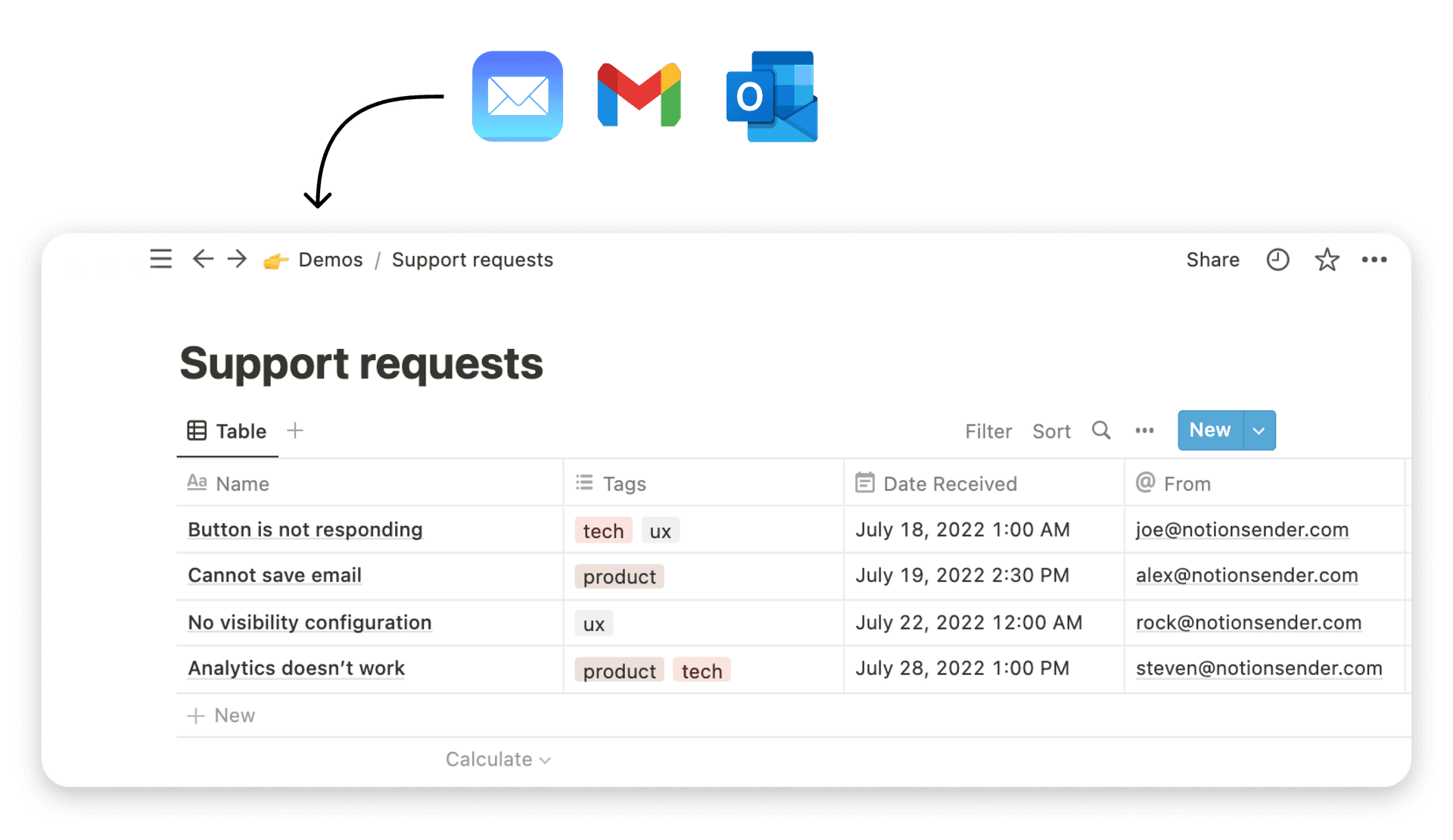
One of the most powerful integrations you can set up is connecting your email directly to your Notion database. If you're a professional who lives in your inbox, this opens up a ton of automation possibilities. Using a tool like NotionSender, you can give your habits database its own unique email address.
Anything you send to that address can instantly create a new page in your tracker. It's that simple.
Here’s how a freelancer could put this to work:
- Habit: Log all client feedback.
- Workflow: A client emails you with feedback. You just forward that email to your special address, like
habits@yourdomain.nsender.io. - Automation: NotionSender grabs that email and creates a new page in your tracker. It can pull the subject line for the page title, log the sender's email, and drop the body of the email right into the page content.
You’ve just logged your habit of processing feedback without ever leaving your inbox. It’s a game-changer.
Automating Reminders and Motivational Nudges
Your tracker can also work the other way around—it can communicate out to you. Instead of just being a passive place to store data, it can become an active partner in helping you stay on track by sending automated email reminders.
You can set up automations that trigger emails based on the data inside your tracker. The possibilities are pretty much endless and can be tweaked to fit what motivates you personally.
- Motivational Streak Reward: Set up a trigger that shoots you a congratulatory email when your "Streak" property hits 30 days. It's a small, automated pat on the back for your consistency.
- Missed Habit Nudge: Create an automation that checks if a critical habit is still unchecked by 6 PM. If so, it can send you a quick "Hey, don't forget!" email.
- Weekly Summary Report: Configure a weekly email that pulls key stats—like your overall completion percentage and best habit—and sends it to you every Sunday evening to prep for the week ahead.
Automating this communication turns your tracker from a passive database into an active accountability partner. It closes the feedback loop, not only showing you your progress but actively encouraging you to keep going.
Practical Scenarios for Integrated Workflows
Let's look at how a few different professionals might use these integrations to tie their daily work directly into their habit tracker in Notion.
For the Project Manager:
- Integration: Connect their project management tool's email notifications to the habit tracker.
- Use Case: A team member completes a major task, and the notification email gets forwarded to Notion. This automatically checks off a "Review Team Progress" habit for the day.
- Benefit: The manager stays on top of project milestones while also tracking their own management habits.
For the Content Creator:
- Integration: Use an email-to-Notion workflow for saving content ideas.
- Use Case: They find an interesting article and email it to their tracker with the subject "Content Idea." This logs a "Research" habit and saves the article in one go.
- Benefit: It merges the act of discovery with the habit of consistent research, building an idea library without any extra effort.
These workflows are all about removing friction. The less you have to think about the tracking part, the more likely you are to be consistent. By baking your habit tracker into the tools you're already in all day, you make building good habits the path of least resistance.
For anyone interested in the technical nuts and bolts, you can dig into the NotionSender API documentation to see exactly how these connections are made.
Common Habit Tracker Questions Answered
As you build and refine your habit tracker in Notion, you'll likely run into some common questions. It's all part of the process. Let's walk through some of the frequent sticking points and find clear solutions to keep your system running smoothly.
A common puzzle is how to manage habits that don't happen every single day. This is exactly where a custom-built Notion tracker really shines compared to a rigid, pre-made app.
How Can I Track Habits That Are Not Daily?
This is a great question. The simple checkbox approach is perfect for daily tasks, but it falls short for goals like "go to the gym 3x a week" or "publish two blog posts." For these, a checkmark just doesn't capture partial progress.
The solution is to use Number properties instead of checkboxes for these specific habits. You'll want to add two to your database:
- Target: Set this to the number of times you aim to complete the habit. For a weekly goal, this might be
3. - Completed: Here, you'll manually log your progress. Each time you go to the gym, you just update this number from
1to2, and so on.
To really bring this to life, you can add a formula property to create a progress bar. A simple formula like prop("Completed") / prop("Target") will give you a dynamic, visual snapshot of how close you are to hitting your weekly goal.
My Notion Tracker Is Getting Slow. What Can I Do?
A slow, lagging database is a real issue, especially as your tracker grows with months or years of entries. When you notice pages taking too long to load or filter, the answer is usually archiving.
There's no need to delete all that valuable data. At the end of a month or quarter, just create a new filtered view showing all the entries from that period. Then, select them all and use the "Move to" function to send them to a dedicated "Archive" database. Make sure your archive database has the exact same properties to avoid any data loss.
Archiving keeps your main habit tracker fast and responsive for daily use. It also preserves your historical data for bigger annual reviews. You get the best of both worlds: speed and complete data integrity.
Also, be mindful of your Rollup properties. They are incredibly powerful, but if you have many complex rollups pulling data from several large databases, they can be a major source of slowdowns. Use them wisely.
Can I Connect My Habit Tracker to Other Databases?
Absolutely. This is where you can turn your Notion workspace into a truly interconnected system, not just a collection of pages. The "Relation" property is the key here.
Let's say you have a separate database for your "Goals." You can add a relation property to your habit tracker to link a specific daily habit entry directly to a larger goal, like "Launch New Product." So, a habit like "Work on landing page copy for 1 hour" can be tied directly to that project.
From there, you can go into your "Goals" database and use a "Rollup" property to see all the habits associated with that goal. You could even use a rollup to calculate the total time spent or to create a progress bar for the goal itself. It creates a powerful feedback loop where you see exactly how your daily actions contribute to your long-term ambitions.
Ultimately, the best tools are the ones you use consistently. Learning how to stay consistent and build habits that actually stick is the foundation that makes all this tracking worthwhile.
Ready to supercharge your Notion workflows? With NotionSender, you can connect your email directly to any Notion database, automating your habits and centralizing your communication. Save emails, trigger reminders, and turn your tracker into a true productivity hub. Learn more and get started at https://www.notionsender.com.