Mailchimp Free Alternatives: Explore mailchimp free alternatives for 2026
Mailchimp has long been a go-to for email marketing, but its free plan has become increasingly restrictive, sending many small business owners, freelancers, and marketing professionals searching for more generous mailchimp free alternatives. If you've hit the subscriber or send limits, or simply need more advanced features like marketing automation without a hefty price tag, you're in the right place. The good news is the market is filled with powerful platforms that offer robust free tiers.
This guide is designed to help you navigate these options efficiently. We will dive deep into 12 of the best free email marketing platforms, moving beyond surface-level feature lists. For each alternative, you'll find a detailed analysis of its free plan's specific limitations, its ideal user profile, and practical use-case scenarios. We'll explore who benefits most from each tool, from e-commerce stores needing sophisticated automation to bloggers seeking simple, beautiful newsletters.
You will get an honest look at what you can achieve without spending a dime, complete with screenshots, direct links, and insights on integrating these tools with your existing workflow, including using a tool like NotionSender. Our goal is to provide a clear, comprehensive comparison so you can confidently select the platform that best aligns with your business needs and growth goals. To help you navigate the broader landscape, you can also review this in-depth guide on the 12 best email marketing software options for 2025. This article, however, focuses specifically on platforms offering the most value on their free plans today. Let's find your perfect fit.
1. MailerLite
MailerLite consistently ranks as a top-tier Mailchimp free alternative, primarily due to its remarkable ease of use and a free plan that packs a surprising punch. It’s an excellent starting point for small businesses, freelancers, and content creators who need more than just basic email sending. The platform’s intuitive drag-and-drop editor for both emails and landing pages makes it incredibly simple to create professional-looking assets without any coding knowledge.
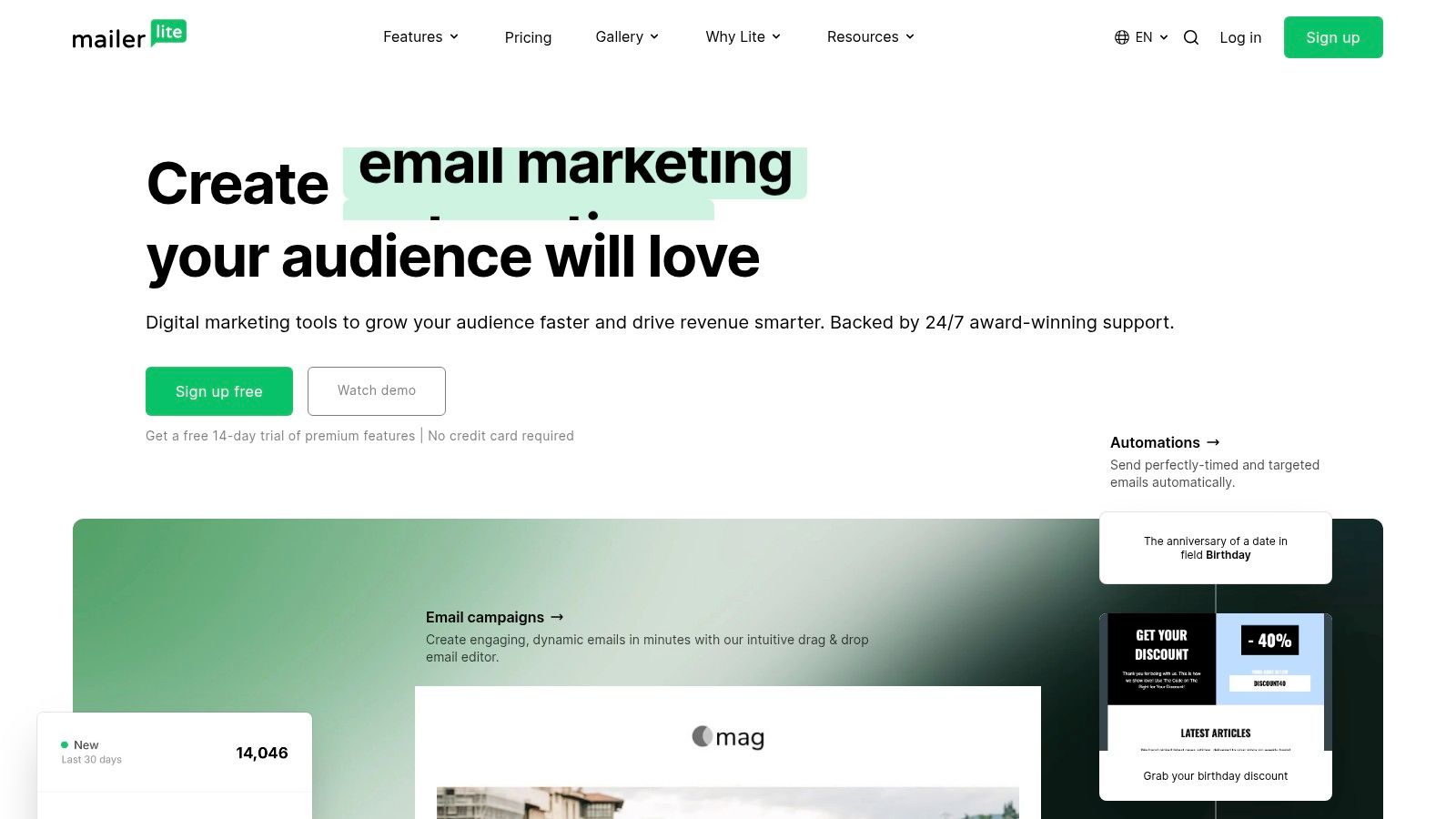
What sets MailerLite apart is the breadth of features included for free. Beyond email campaigns, you can build a simple website and up to 10 landing pages, create sign-up forms, and even set up basic automation workflows to welcome new subscribers. This all-in-one approach provides significant value, allowing users to manage multiple aspects of their marketing from a single dashboard.
Key Details & Limitations
- Free Plan: Up to 500 subscribers and 12,000 emails per month.
- Best For: Beginners, bloggers, and small businesses focused on growing their list with lead magnets and simple newsletters.
- Pros: Very user-friendly interface, generous feature set on the free plan (including websites and landing pages), and a 14-day trial of premium features upon signup.
- Cons: The free subscriber limit was reduced to 500 (effective September 2025), and ongoing support is limited after the initial 30 days.
For those just starting, crafting engaging welcome emails is crucial. You can find detailed strategies on how to send the perfect email to get the response you want to maximize your initial impact.
Website: https://www.mailerlite.com
2. Brevo (formerly Sendinblue)
Brevo, formerly known as Sendinblue, positions itself as a powerful all-in-one marketing platform and an excellent Mailchimp free alternative for users who need to manage a large contact list without an immediate budget. Its free plan is uniquely structured around daily sending volume rather than subscriber count, making it ideal for businesses that are growing their audience but send campaigns less frequently. The platform extends beyond email to include SMS, WhatsApp marketing, and live chat, offering a multi-channel approach from the start.
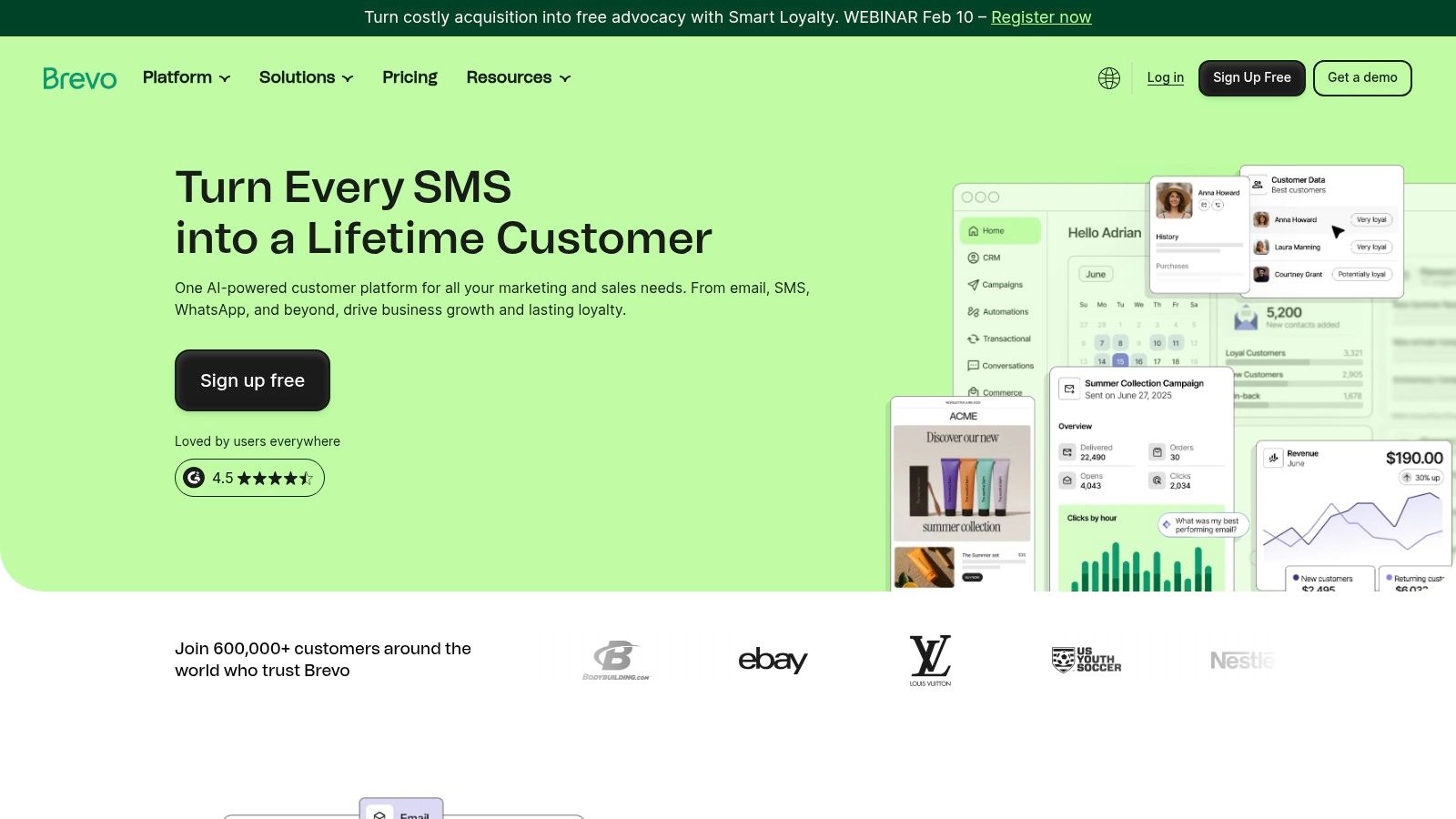
What truly makes Brevo stand out is its generous contact allowance and the inclusion of transactional emails on the free tier, a feature often locked behind a paywall. Users can leverage its drag-and-drop editor to create campaigns and set up basic automation workflows. This combination of a large contact database with essential marketing tools provides a scalable foundation for businesses expecting significant list growth.
Key Details & Limitations
- Free Plan: Unlimited contacts and up to 300 emails per day (9,000 per month).
- Best For: Startups and businesses with large but low-engagement contact lists, or those needing free transactional email services.
- Pros: Generous unlimited contact storage on the free plan, includes transactional emails, and offers email support even for free users.
- Cons: The daily sending cap of 300 emails is restrictive for sending larger campaigns, and emails sent from the free plan include Brevo branding.
To ensure your campaigns are effective despite the daily limit, it is crucial to maximize engagement. You can find helpful advice on how to increase your open rates with 10 email marketing tricks to make every send count.
Website: https://www.brevo.com
3. HubSpot (Email Marketing in Marketing Hub)
HubSpot offers a powerful suite of tools where email marketing is just one component of a much larger ecosystem. As a Mailchimp free alternative, its main strength lies in its native integration with a robust, free CRM. This is ideal for businesses that want to build a comprehensive view of their customer relationships from the very beginning, connecting email campaigns directly to contact records, deal stages, and other sales activities.
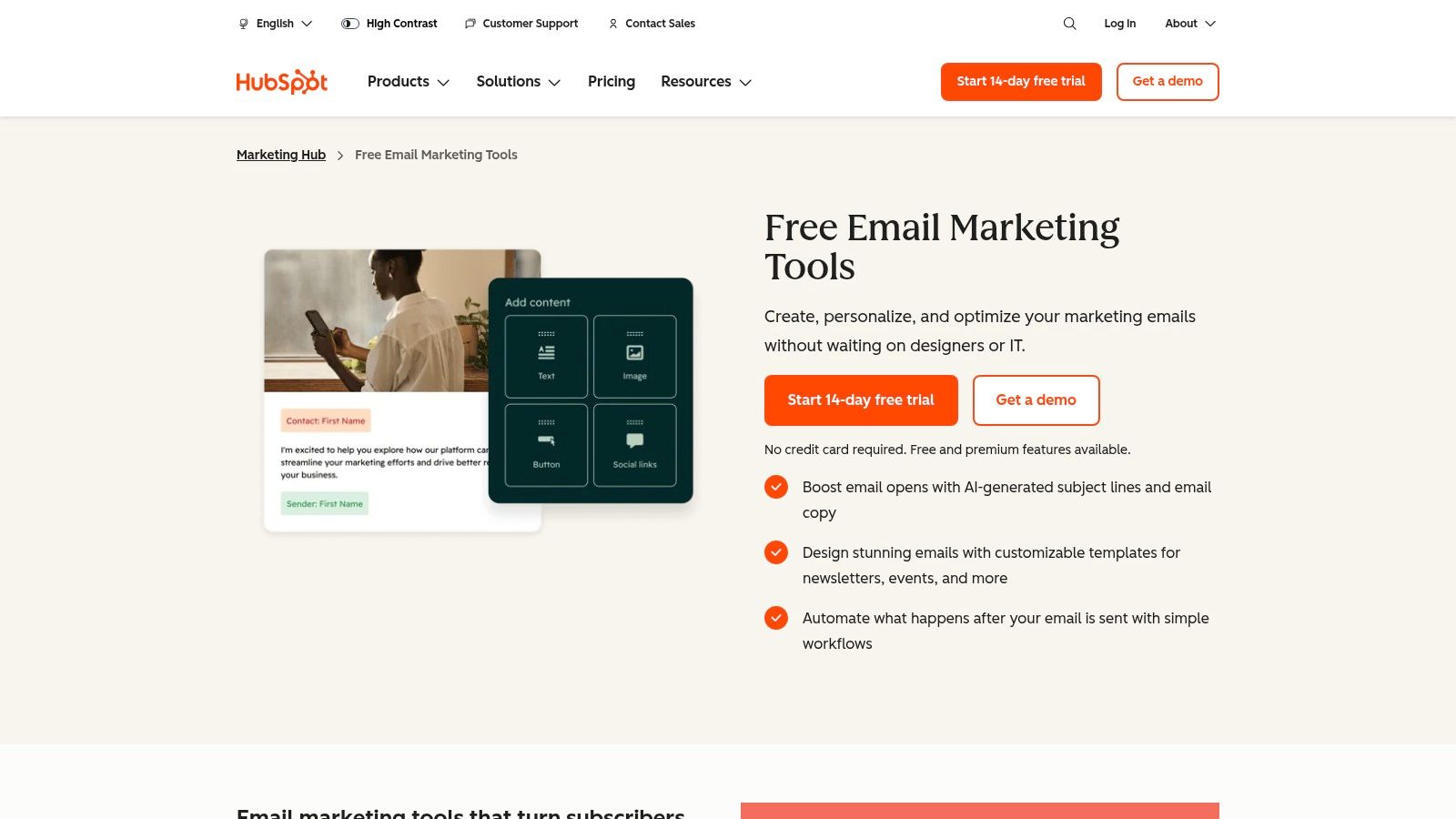
The free plan provides more than just email; it includes forms, landing pages, live chat, and basic chatbots, all feeding into the central CRM. This allows teams to capture leads and track their entire lifecycle in one place. While its free email send limit is lower than some competitors, the value comes from the unified data and reporting, making it a strategic choice for businesses focused on sales and marketing alignment from day one.
Key Details & Limitations
- Free Plan: Up to 2,000 email sends per month with HubSpot branding.
- Best For: Small businesses and startups wanting an all-in-one marketing, sales, and service platform with a strong CRM backbone.
- Pros: Powerful free CRM is included, providing a single source of truth for customer data. The platform offers a clear and scalable upgrade path.
- Cons: The 2,000 email/month limit is restrictive for larger lists, and advanced automation features are gated behind expensive paid plans.
As your contact list grows, you'll need to optimize your workflow. You can explore strategies to send more emails, faster and better to scale your efforts efficiently.
Website: https://www.hubspot.com/products/marketing/email
4. Klaviyo
Klaviyo is a powerhouse in the ecommerce marketing space, making it a compelling Mailchimp free alternative for online stores. It excels at leveraging customer data for hyper-targeted, automated marketing across both email and SMS. The platform’s free plan is designed for new stores to explore these advanced features without an initial investment, allowing you to build sophisticated flows based on customer behavior like abandoned carts, browsing history, and purchase frequency.
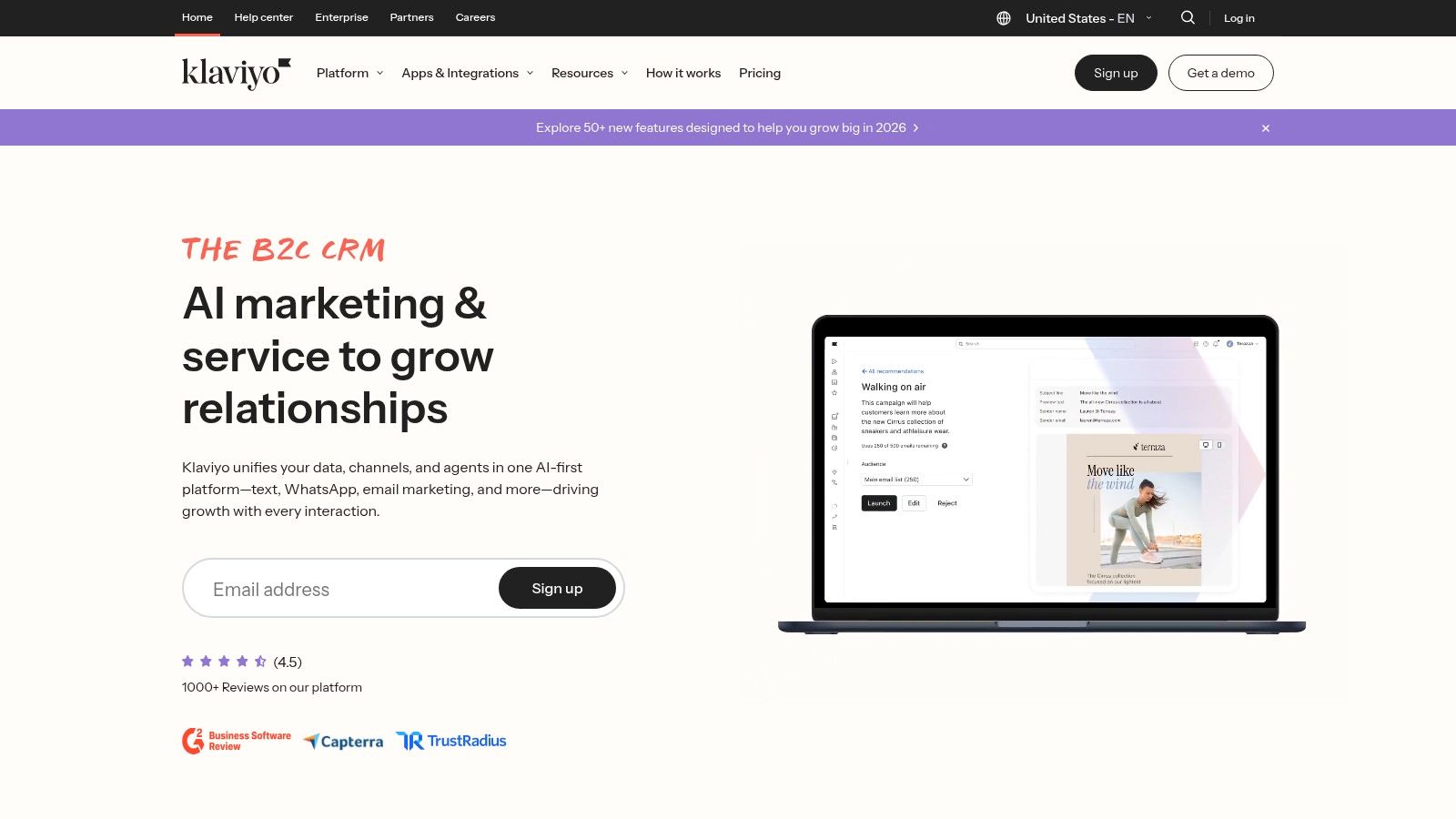
What truly makes Klaviyo stand out are its deep, native integrations with platforms like Shopify, BigCommerce, and WooCommerce. This seamless connection enables powerful segmentation and personalization that other platforms struggle to match. Its AI-assisted tools for subject lines and predictive analytics provide a competitive edge, helping you optimize campaigns for maximum revenue generation and understand customer lifetime value with impressive clarity.
Key Details & Limitations
- Free Plan: Up to 250 contacts and 500 email sends per month. Includes 150 free SMS/MMS credits.
- Best For: Ecommerce businesses and direct-to-consumer (DTC) brands that want to leverage deep customer data for automated sales funnels.
- Pros: Unmatched ecommerce integrations and data syncing, powerful segmentation and automation capabilities, and strong analytics focused on revenue attribution.
- Cons: The free plan has very tight limits on contacts and sends, and pricing scales quickly as your list grows, making it a more expensive option long-term.
Website: https://www.klaviyo.com
5. Omnisend
Omnisend carves out its niche as a powerful Mailchimp free alternative specifically for e-commerce businesses. Its strength lies in combining email, SMS, and web push notifications into a single, cohesive marketing automation platform. This omnichannel approach allows online stores to create sophisticated customer journeys that engage shoppers across multiple touchpoints, a feature set often reserved for expensive, enterprise-level tools. The platform is designed from the ground up to integrate deeply with e-commerce platforms like Shopify, BigCommerce, and WooCommerce.
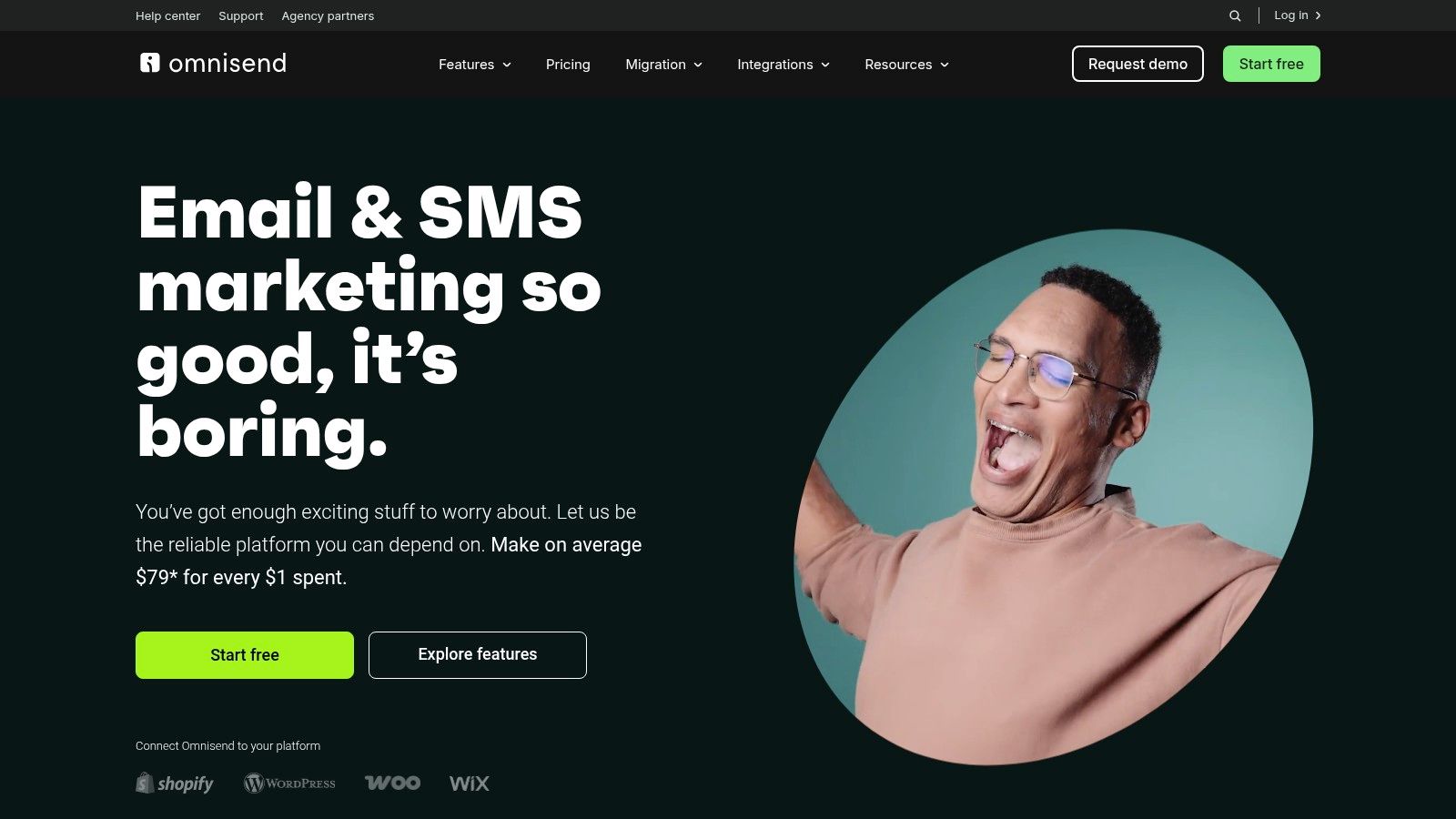
What makes Omnisend's free plan compelling for e-commerce startups is that it provides access to all features, including advanced automations and reporting, just with usage limits. This allows new businesses to test and build out complex workflows like cart abandonment, browse abandonment, and welcome series without an initial financial commitment. Even the inclusion of free SMS credits and web push notifications gives a taste of a true multichannel strategy.
Key Details & Limitations
- Free Plan: Up to 250 contacts, 500 emails per month, 500 web push notifications, and 60 international SMS credits.
- Best For: E-commerce store owners who need robust, sales-focused automation features and want to experiment with an omnichannel marketing strategy.
- Pros: Strong e-commerce focus with deep integrations, access to all features on the free plan (with limits), and includes SMS and web push notifications from the start.
- Cons: The free contact and email send limits are very restrictive, making it suitable only for stores in their earliest stages. The real power is unlocked in the paid tiers.
Website: https://www.omnisend.com
6. AWeber
AWeber is one of the most established names in email marketing, and its free plan makes it an approachable Mailchimp free alternative for those just starting. The platform is known for its reliability and strong focus on helping users get started quickly with email marketing essentials. Its interface is straightforward, guiding new users through creating their first list, designing an email, and setting up a basic automated welcome sequence.
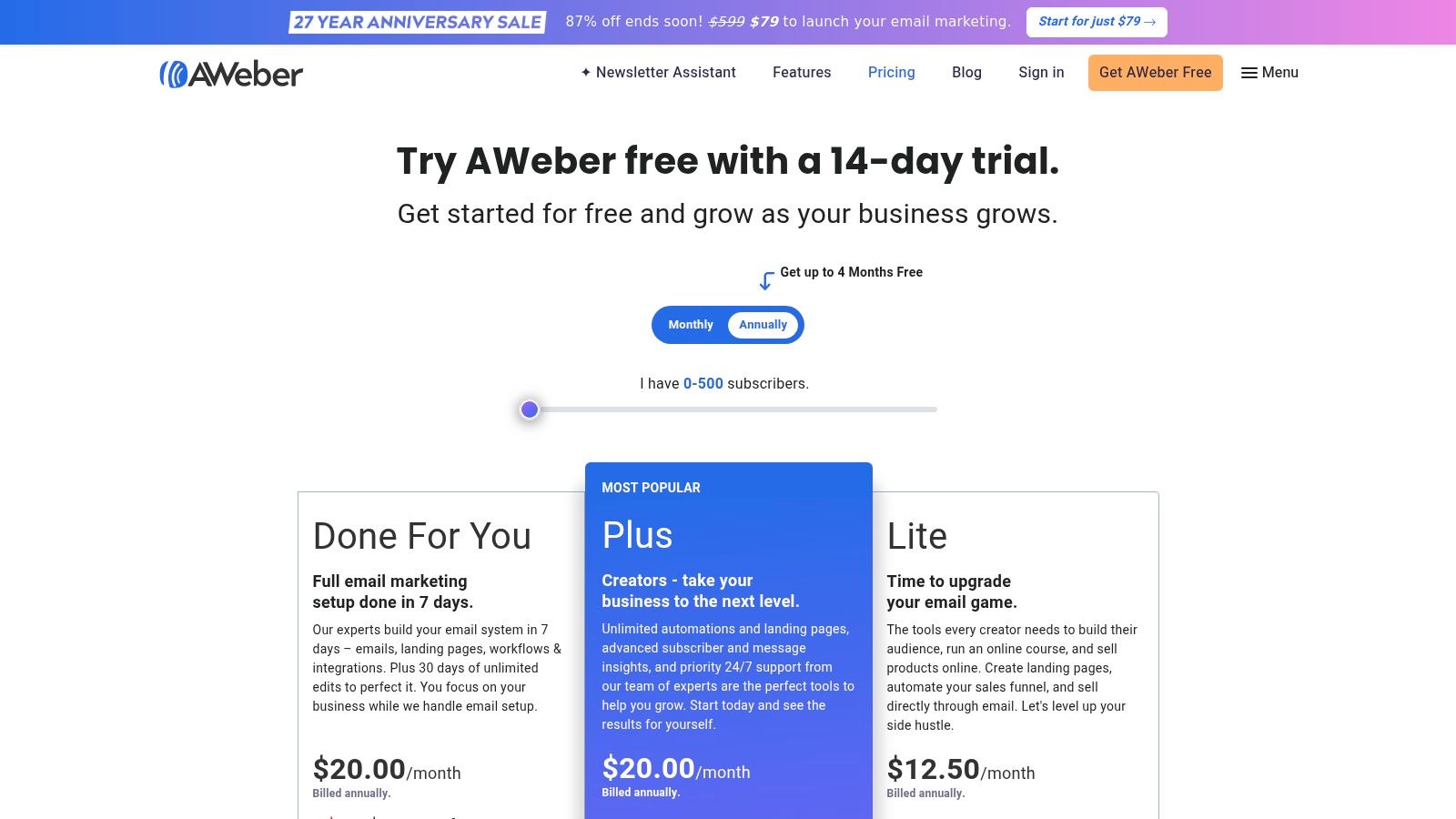
The free plan provides core functionalities, including a drag-and-drop email builder, a library of pre-built templates, and the ability to create landing pages to capture new leads. AWeber’s strength lies in its excellent customer support and extensive library of educational resources, which are accessible even to free users. This makes it a great choice for entrepreneurs who value guidance and want to learn the fundamentals of email marketing from a trusted source.
Key Details & Limitations
- Free Plan: Up to 500 subscribers and 3,000 emails per month.
- Best For: Solopreneurs and small businesses who prioritize ease of use, strong support, and educational resources.
- Pros: Very beginner-friendly platform, excellent reputation for customer support and reliability, and includes landing pages and basic automation on the free plan.
- Cons: The free plan is quite restrictive, limiting users to only one email list and one automation workflow, which can hinder scalability as your needs grow.
Website: https://www.aweber.com/pricing.htm
7. GetResponse
GetResponse positions itself as more than just an email tool, offering a suite of inbound marketing features even on its free plan. This makes it a compelling Mailchimp free alternative for marketers who want to dabble in landing pages and simple lead funnels without an immediate financial commitment. The platform’s "Free-Forever" plan is designed to give you a solid taste of its capabilities, including essential email marketing and website building tools.
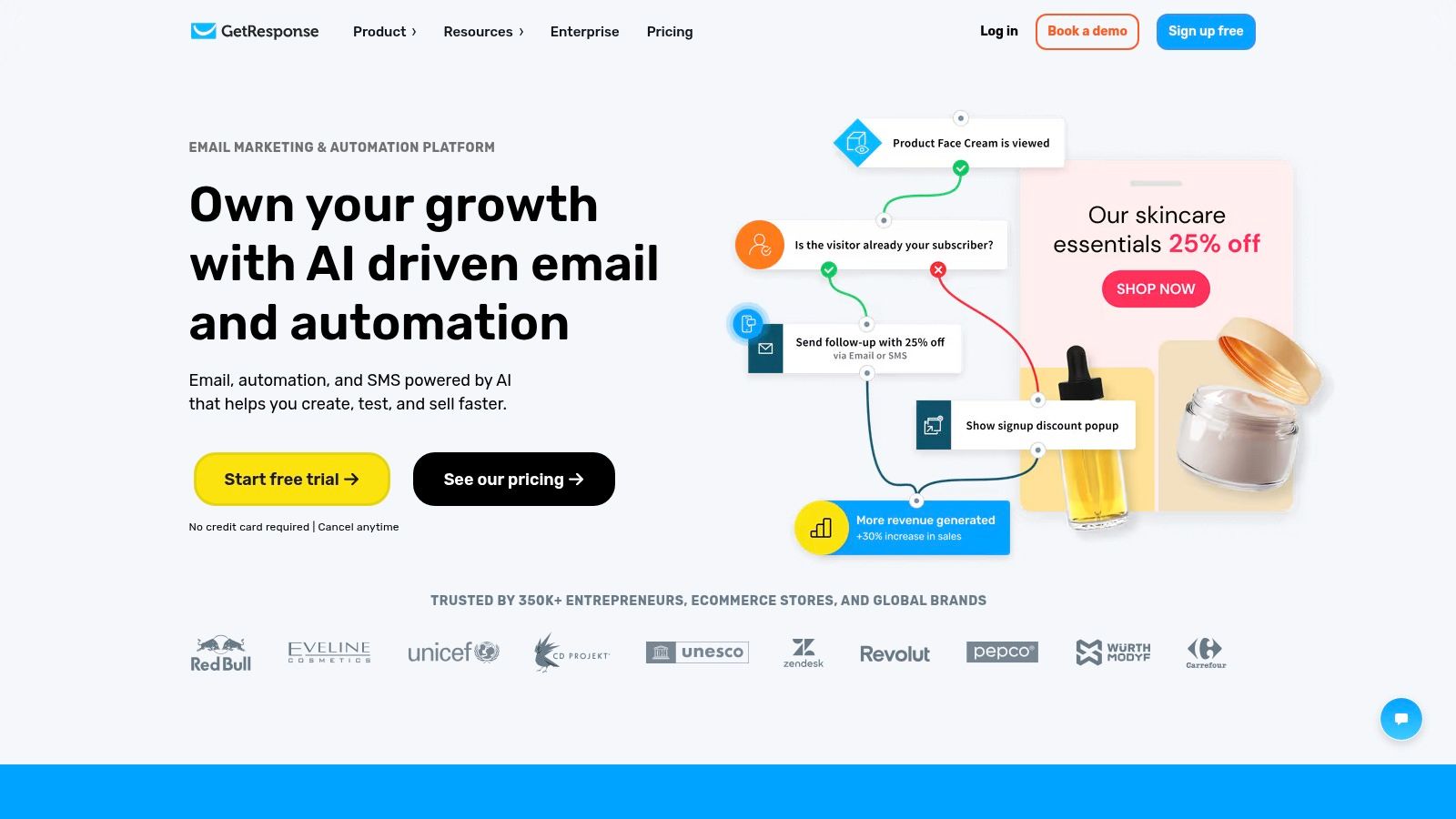
What makes GetResponse stand out is its emphasis on an all-in-one marketing ecosystem from the get-go. While the free plan is limited, it provides a functional landing page builder alongside email sending, allowing you to create a simple lead capture system. Upon signing up, you also receive 14 days of premium feature access, which is a great opportunity to test its more advanced automation and conversion funnel tools before deciding if an upgrade is worthwhile for your business.
Key Details & Limitations
- Free Plan: Up to 500 contacts and 2,500 emails per month.
- Best For: Marketers and small businesses wanting to test a platform with integrated landing pages and marketing funnel capabilities.
- Pros: Includes a free landing page builder for quick lead capture, a generous 14-day premium feature trial is included with the free plan, and it offers solid integrations with popular tools.
- Cons: The free plan includes GetResponse branding on all assets, and several key features like automation become inaccessible after the 14-day trial ends.
Website: https://www.getresponse.com
8. EmailOctopus
EmailOctopus stands out as a top Mailchimp free alternative by focusing on simplicity and affordability. It's designed for users who need a clean, no-fuss email marketing tool without a steep learning curve. The platform offers a straightforward drag-and-drop editor and essential features, making it incredibly fast to set up and send campaigns, which is perfect for small businesses and creators who value efficiency.
What makes EmailOctopus unique is its dual offering. You can use its standard "Starter" plan, which is generous on its own, or opt for the "Connect" plan. The Connect plan leverages Amazon Simple Email Service (SES) for sending, drastically reducing costs for users comfortable with a slightly more technical setup. This flexibility allows businesses to choose the path that best fits their budget and technical skills while still enjoying a simple user interface.
Key Details & Limitations
- Free Plan: Up to 2,500 subscribers and 10,000 emails per month on the Starter plan. Reports are only stored for 30 days.
- Best For: Users who prioritize a simple interface and cost-effectiveness, especially those willing to use Amazon SES for ultra-low-cost sending.
- Pros: Very generous free subscriber and email limits, clean and intuitive user interface, and an extremely affordable "Connect" option via Amazon SES.
- Cons: The free plan includes EmailOctopus branding in emails, and the Connect option requires a separate AWS account and setup, which may involve additional costs from Amazon.
Website: https://emailoctopus.com
9. Sender (Sender.net)
Sender emerges as a powerful Mailchimp free alternative by offering one of the most generous free plans on the market. It is specifically designed for small businesses and freelancers who need a substantial subscriber and email limit from day one without incurring costs. The platform provides a comprehensive suite of tools that go beyond simple newsletters, allowing users to build a solid marketing foundation.
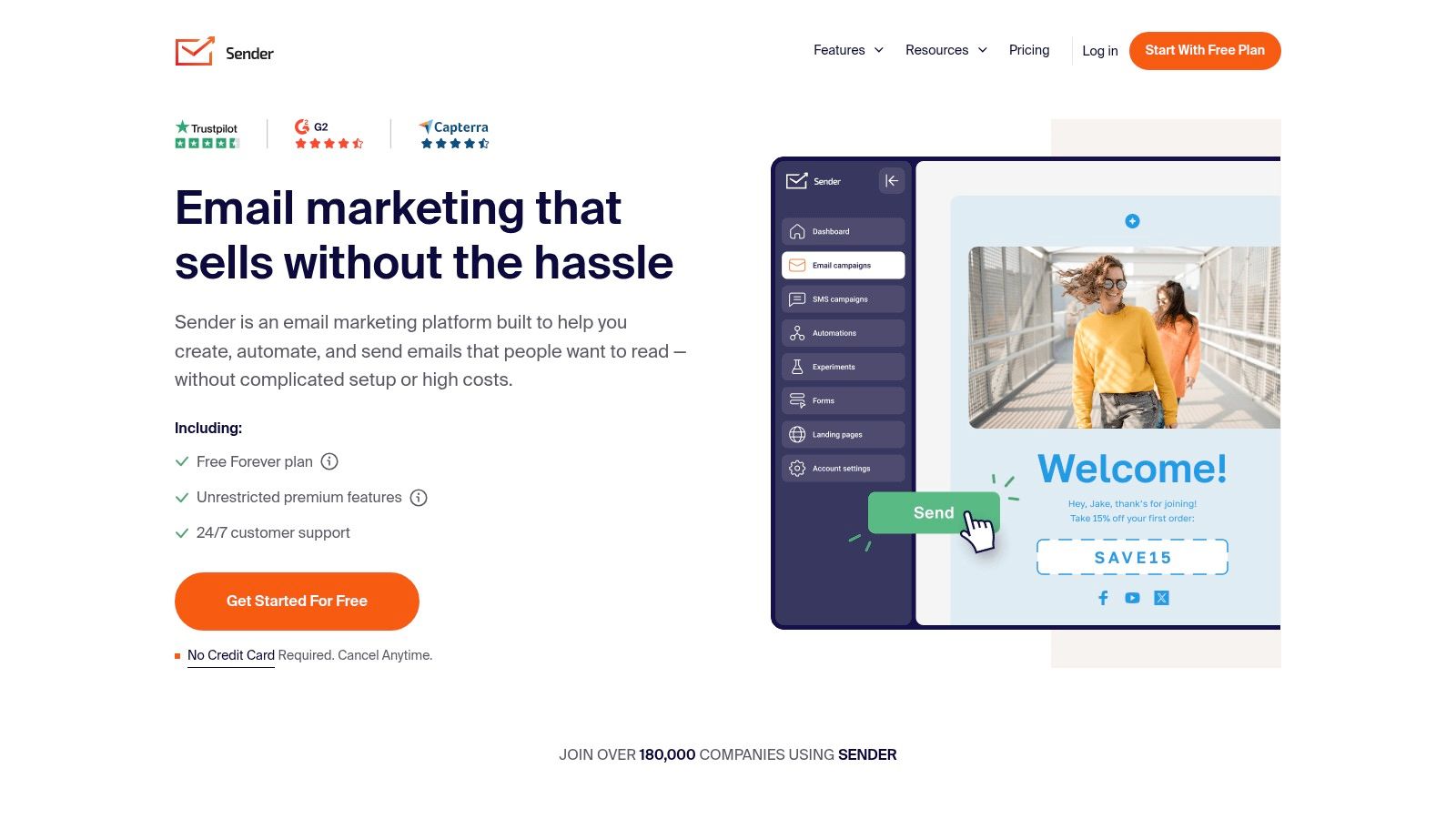
What makes Sender a standout option is its inclusion of key marketing automation and transactional email features, which are often locked behind a paywall on other platforms. Users can create welcome series, abandoned cart reminders, and other automated workflows. The ability to also build landing pages and pop-up forms makes it an excellent all-in-one solution for those looking to maximize their marketing efforts on a tight budget.
Key Details & Limitations
- Free Plan: Up to 2,500 subscribers and 15,000 emails per month.
- Best For: Startups, e-commerce businesses, and freelancers needing a high-volume free plan with automation capabilities.
- Pros: One of the largest free subscriber and email allocations available, includes crucial features like automation and transactional emails, and has a reputation for good deliverability.
- Cons: Sender branding is present on all assets created with the free plan, and more advanced user management or administrative features require upgrading to a paid tier.
Website: https://www.sender.net
10. Zoho Campaigns
For businesses already invested in the Zoho ecosystem, Zoho Campaigns presents itself as a logical and powerful Mailchimp free alternative. Its primary strength lies in its seamless, native integration with other Zoho applications, particularly Zoho CRM. This connection allows for sophisticated email marketing strategies based directly on customer data and sales pipeline stages, creating a unified marketing and sales front that is difficult to replicate with third-party tools.
What makes Zoho Campaigns particularly attractive is its generous "Forever Free" plan. It offers a higher contact limit than many competitors, making it an excellent choice for businesses with a growing but not yet monetized audience. The ability to have up to five users on the free plan is also a significant benefit for small teams collaborating on marketing efforts, a feature rarely seen in free-tier products.
Key Details & Limitations
- Free Plan: Up to 2,000 contacts and 6,000 emails per month for up to 5 users.
- Best For: Businesses already using Zoho CRM or other Zoho suite applications who need a deeply integrated email marketing solution.
- Pros: High contact limit on the free plan, multi-user support, and unparalleled integration within the Zoho ecosystem. Pay-as-you-go credits offer flexibility.
- Cons: The interface can feel less intuitive than more modern platforms, and many of the more advanced automation and segmentation features are reserved for paid tiers.
Website: https://www.zoho.com/campaigns
11. Mailjet (by Sinch)
Mailjet, now part of Sinch, distinguishes itself as a powerful Mailchimp free alternative for users who need both marketing campaigns and transactional emails under one roof. It is particularly well-suited for developers or tech-savvy marketers who appreciate its robust API and SMTP relay capabilities. This dual-focus allows businesses to manage everything from newsletters to password reset emails from a single, unified platform, streamlining their communication efforts.
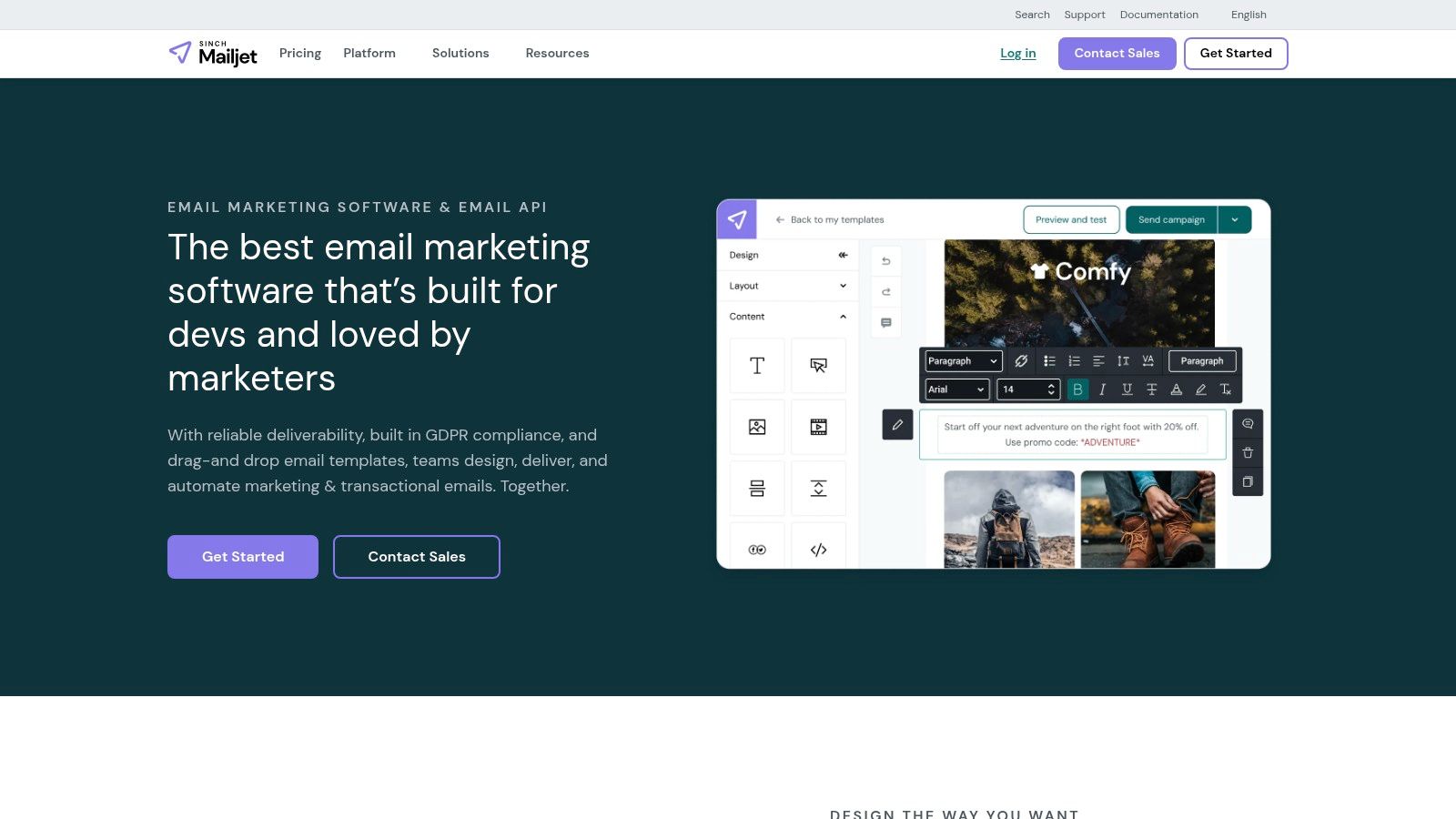
The platform's free plan provides a solid entry point, offering access to its core features like the intuitive email editor and basic analytics. While it has a strict daily sending limit, it’s sufficient for sending smaller, targeted campaigns or for handling the transactional email needs of a new application. This makes it an excellent choice for those testing a new project or managing low-volume, consistent communications.
Key Details & Limitations
- Free Plan: Up to 1,000 subscribers, 6,000 emails per month, with a daily sending cap of 200 emails.
- Best For: Developers, startups, and businesses needing a unified solution for both marketing and transactional emails.
- Pros: Strong API and SMTP relay for seamless integration, combines marketing and transactional email services, and provides good deliverability tools.
- Cons: The 200-email daily limit on the free plan is restrictive for larger campaigns, and the subscriber cap is low compared to some competitors. Advanced features and support are reserved for paid tiers.
Website: https://www.mailjet.com
12. SendPulse
SendPulse positions itself as a multichannel marketing automation platform, making it a powerful Mailchimp free alternative for businesses planning to expand beyond just email. While it offers a solid email marketing foundation, its true strength lies in integrating various communication channels like SMS, web push notifications, and chatbots into a unified strategy. The platform is designed for users who anticipate needing a more holistic marketing toolkit as they grow.
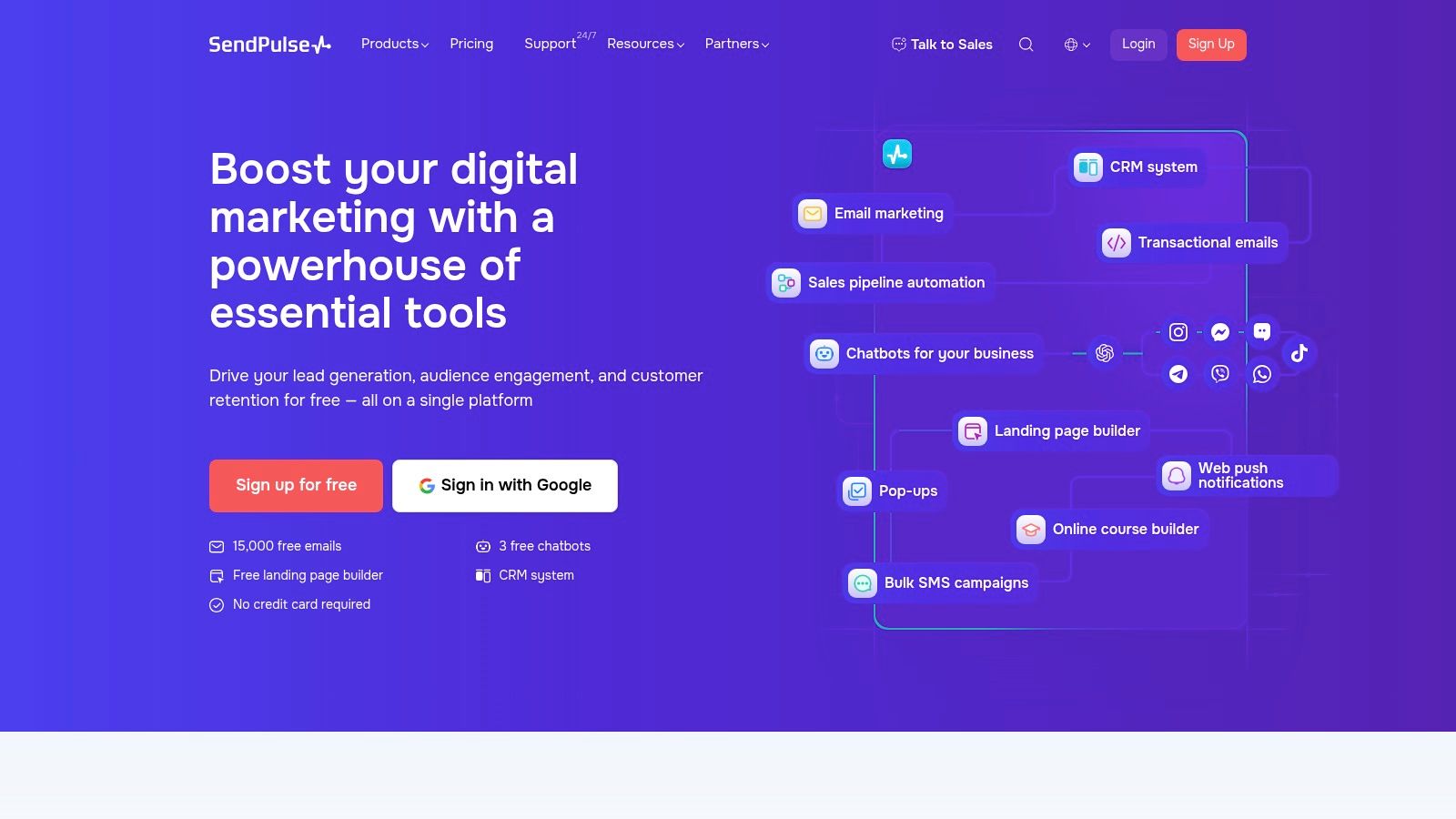
The free plan is particularly generous with its email sending allowance, which is a major draw for users with small but highly engaged lists who send frequent updates. You gain access to a drag-and-drop editor, a library of pre-made templates, and basic automation features. This combination allows you to test out different campaign types and get a feel for a multichannel approach without any initial investment.
Key Details & Limitations
- Free Plan: Up to 500 subscribers and 15,000 emails per month.
- Best For: Small businesses and marketers who want an all-in-one platform to test email, SMS, and web push notifications.
- Pros: Very high monthly email sending limit on the free tier, a broad suite of integrated marketing tools, and a user-friendly interface for building campaigns.
- Cons: The free plan includes SendPulse branding, and more advanced features like A/B testing and complex segmentation are reserved for paid plans.
Website: https://sendpulse.com
12 Mailchimp Free Alternatives — Feature Comparison
| Product | Core features | UX / Quality | Value / Price | Target audience | Unique selling points |
|---|---|---|---|---|---|
| MailerLite | Drag‑&‑drop, landing pages, basic automations, forms | ★★★★☆ | 💰 Free: 12,000 emails/mo (≤500 subs) | 👥 SMBs, newsletter creators | ✨Easy onboarding, 🏆good deliverability |
| Brevo (Sendinblue) | Email, SMS, chat, transactional, basic automation | ★★★★☆ | 💰 Free: 300 sends/day, large contacts storage | 👥 Businesses needing multi‑channel | ✨Multi‑channel + email support on Free |
| HubSpot (Marketing Hub) | Email + native CRM, forms, reporting | ★★★★☆ | 💰 Free: 2,000 emails/mo (2 users) | 👥 Sales/marketing teams using CRM | 🏆Integrated CRM & reporting out of box |
| Klaviyo | Ecommerce flows, segmentation, analytics, SMS | ★★★★★ | 💰 Free: 250 profiles, 500 emails/mo + 150 SMS credits | 👥 Ecommerce stores & merchandisers | ✨Deep ecommerce integrations, strong attribution |
| Omnisend | Email + SMS + push, templates, automations | ★★★★☆ | 💰 Free: 250 contacts, 500 emails/mo | 👥 Ecommerce & small shops testing workflows | ✨All core features available on Free |
| AWeber | Templates, landing pages, one workflow on Free | ★★★★ | 💰 Free: 500 subs, 3,000 emails/mo | 👥 Beginners, solo creators | ✨Simple UI, strong educational resources |
| GetResponse | Newsletters, funnels, landing page builder | ★★★★ | 💰 Free: 500 contacts, 2,500 msgs/mo + 14‑day trial | 👥 Marketers needing funnels & pages | ✨14‑day premium trial, landing page tool |
| EmailOctopus | Simple editor, Amazon SES Connect option | ★★★★ | 💰 Free: 2,500 contacts, 10,000 emails/mo (or SES pay) | 👥 Cost‑conscious senders & startups | ✨Very low‑cost via SES, simple setup |
| Sender (Sender.net) | Automations, landing pages, transactional email | ★★★★☆ | 💰 Free: 2,500 subs, 15,000 emails/mo | 👥 Startups, freelancers | ✨Generous free limits, good deliverability |
| Zoho Campaigns | Email, forms, multi‑user Free, Zoho integrations | ★★★★ | 💰 Free: 2,000 contacts, 6,000 emails/mo | 👥 Zoho ecosystem users | ✨Deep Zoho app/CRM integration |
| Mailjet (by Sinch) | Marketing + transactional, API/SMTP, editor | ★★★★ | 💰 Free: 6,000 emails/mo (200/day), 1,000 contacts | 👥 Dev teams + SMBs needing APIs | ✨Developer‑friendly APIs, transactional focus |
| SendPulse | Email, web push, SMS, chatbots, templates | ★★★★ | 💰 Free: up to 15,000 emails/mo (limits apply) | 👥 Growing businesses wanting multichannel | ✨High free email allowance, broad toolset |
Final Thoughts
Navigating the landscape of email marketing platforms can feel overwhelming, especially when you're looking for robust Mailchimp free alternatives that don't compromise on essential features. As we've explored, the "best" free plan is not a one-size-fits-all solution; it’s a strategic choice that hinges entirely on your unique business needs, growth stage, and technical comfort level.
The journey away from Mailchimp's increasingly restrictive free tier opens up a world of specialized, generous, and powerful tools. From the user-friendly interface and automation capabilities of MailerLite to the all-in-one sales and marketing suite offered by Brevo, the options are more diverse than ever. Each platform we've detailed offers a distinct value proposition, catering to different priorities.
Key Takeaways: Matching the Tool to Your Goal
Making the right decision requires a clear understanding of your primary objective. Let's distill the core strengths of the platforms we've covered to help guide your final choice:
-
For Simplicity and Generous Features: If your priority is a clean, intuitive interface with a high free subscriber limit and solid automation, MailerLite and Sender are exceptional starting points. They provide a gentle learning curve without skimping on the features you need for growth.
-
For All-in-One Marketing and Sales: Businesses seeking to integrate email with a broader CRM, SMS, and sales pipeline will find immense value in the free offerings from HubSpot and Brevo. These are not just email tools; they are comprehensive platforms designed to scale with your customer relationships.
-
For E-commerce Specialization: If you're running an online store, particularly on Shopify, Klaviyo and Omnisend are the undisputed leaders. Their deep e-commerce integrations, pre-built automations for cart abandonment, and sophisticated segmentation are specifically engineered to drive sales and increase customer lifetime value.
-
For Deliverability and Foundational Strength: Veterans like AWeber and newcomers like EmailOctopus (with its AWS integration) focus heavily on reliable deliverability. If getting your emails into the primary inbox is your paramount concern, these platforms offer a solid foundation.
Your Actionable Next Steps
Before you commit to migrating your list, take these final steps to ensure a smooth and successful transition. This isn't just about picking a new tool; it's about adopting a new strategic partner for your marketing efforts.
-
Define Your Non-Negotiables: Create a short list of 3-5 "must-have" features. Is it advanced automation, a specific integration (like Notion or Shopify), a high subscriber limit, or a visual workflow builder? Use this list to immediately filter out unsuitable options.
-
Run a Small-Scale Test: Don't just rely on reviews. Sign up for the free plans of your top two contenders. Import a small, segmented list of internal team members or trusted contacts. Build and send a test campaign to evaluate the editor, check the analytics dashboard, and experience the workflow firsthand.
-
Audit Your Integrations: Consider the complete ecosystem. How will this new tool connect with your website builder, your CRM, and other essential software? A tool like NotionSender, for example, can bridge gaps by allowing you to manage your email content pipeline directly from your Notion workspace, adding a layer of efficiency regardless of which email service provider you choose.
The search for Mailchimp free alternatives is ultimately an opportunity to re-evaluate your email marketing strategy. It’s a chance to find a platform that not only saves you money but also better aligns with your business goals, empowers you with superior features, and provides a runway for future growth. The perfect tool is out there waiting to help you connect with your audience more effectively.
Ready to streamline your content creation process no matter which email tool you choose? Manage your entire email campaign workflow from idea to final draft directly within Notion. NotionSender allows you to write, manage, and collaborate on your emails in your favorite workspace, then seamlessly export the clean HTML to your new email marketing platform. Try NotionSender today and supercharge your content pipeline.