A Project Kickoff Meeting Agenda Template Built for Success
A good project kickoff meeting agenda template is probably your single best defense against a project going off the rails. It’s the tool that provides the structure you need to get everyone aligned, nail down the scope, and set crystal-clear expectations right from day one. Think of it less as a meeting plan and more as a strategic launchpad for the entire project.
Why Most Project Kickoffs Fail (And How Yours Won't)
Let's be real for a second: a bad kickoff meeting can poison a project before a single line of code is written or a single task is completed. We’ve all been there. The meeting that just…drifts. No real purpose, no clear decisions, and everyone walks away with more questions than answers. You leave feeling completely confused about what you're supposed to do next.
This isn't just a minor annoyance; it's a direct route to scope creep, blown deadlines, and a team that's already frustrated on day one. A project that starts in chaos rarely finds its way to a smooth finish.
The fix isn't more meetings. It's one incredibly effective kickoff, and the engine that powers it is a smart, well-structured agenda. A high-quality project kickoff meeting agenda template is your guide, making sure every critical conversation happens, in the right order.
The True Cost of a Poor Kickoff
At its core, a kickoff failure is an alignment failure. When people leave that first meeting without a shared vision of the "why," the "what," and the "how," tiny misunderstandings start to fester. Before you know it, they've snowballed into massive problems.
This initial disconnect is a huge reason why projects fail, and it leads to all sorts of issues down the line:
- Vague Objectives: Team members start working on tasks without really understanding how they tie into the bigger picture. You end up with a lot of wasted effort.
- Unclear Roles: When there's ambiguity over who owns what, you get bottlenecks and duplicated work. It's the classic, "Oh, I thought they were handling that" scenario playing out over and over.
- Scope Creep: If you don't set clear boundaries from the very beginning, it's way too easy for new requests and "nice-to-have" features to sneak in, completely derailing your timeline and budget.
A project kickoff isn’t just a box to check. It's the moment you build the psychological and structural foundation for everything that comes next. It’s where a group of individuals starts to become a real team with a shared mission.
Your Blueprint for a Flawless Start
This is exactly where a solid template becomes your secret weapon. It’s so much more than a simple checklist; it's a framework designed to spark a strategic conversation. When you follow a proven structure, you're not just presenting information—you're guiding a session focused on getting everyone on the same page, for real.
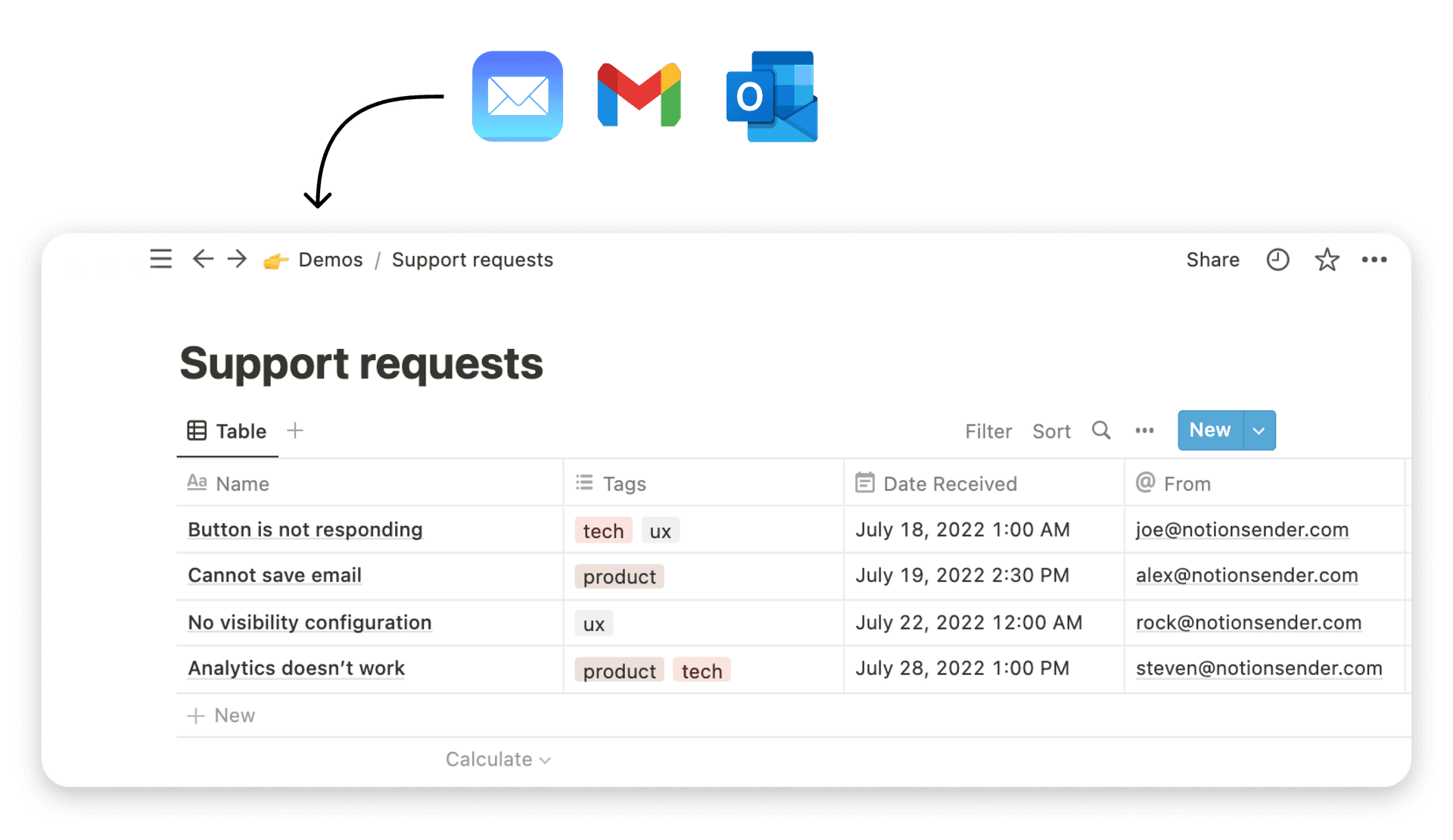
Further down, I'll share a downloadable template you can grab and use right away. We’ll also dig into how you can take this whole process to the next level by integrating it into a tool like Notion and using NotionSender to turn your kickoff into the central hub for your entire project. This approach doesn't just prevent failure—it actively builds momentum from the get-go.
The Anatomy Of A High-Impact Kickoff Agenda
A truly effective agenda is so much more than a checklist. Think of it as a strategic roadmap that guides the conversation from a state of ambiguity to one of absolute clarity. When you break down a solid project kickoff meeting agenda template, you see a deliberate sequence of components, and each one has a specific job to do. It’s not about just listing topics—it’s about understanding the why behind each one.
This structure is what turns an average meeting into a genuine launchpad for the project. From the simple act of building rapport during introductions to defining what "done" actually looks like, every single piece matters. The ultimate goal here is to methodically eliminate the assumptions that so often send projects off the rails.
A structured kickoff is the fastest way to steer a project away from chaos and get it aimed squarely at a successful launch.
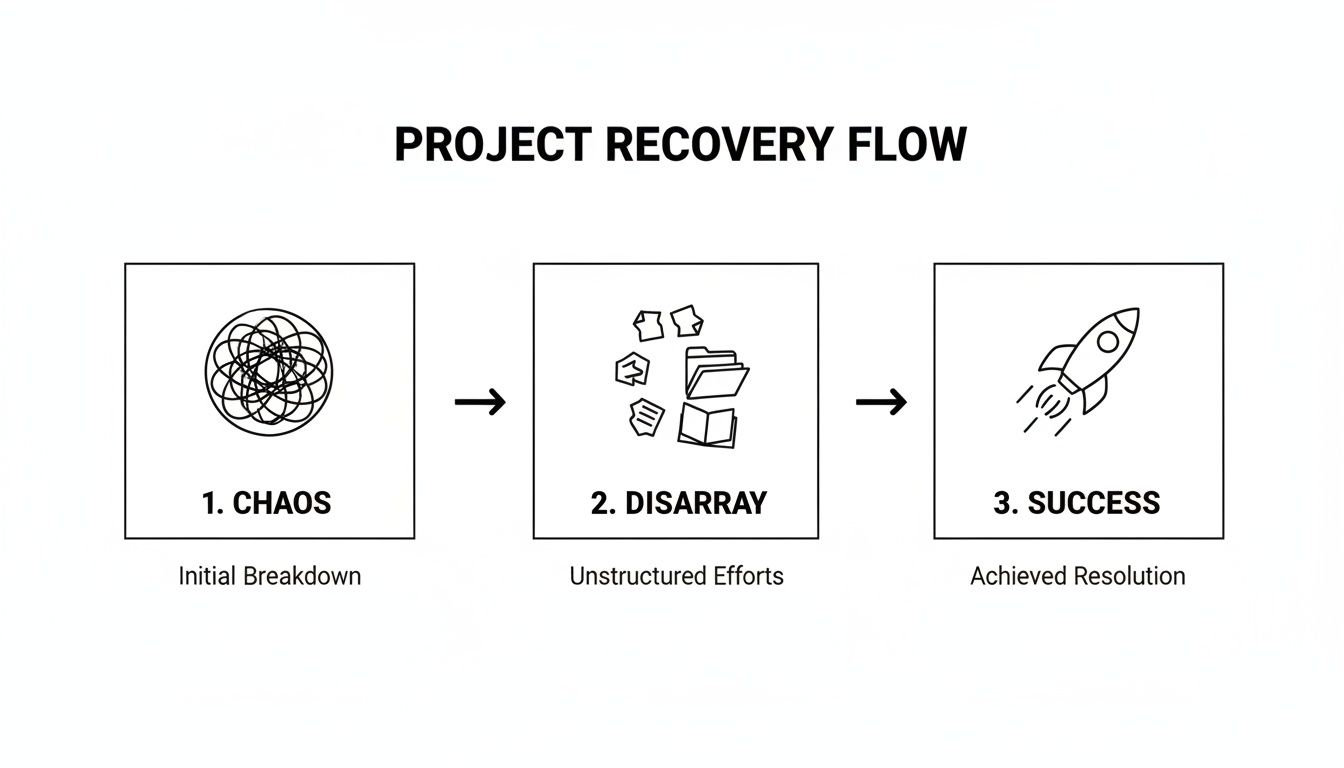
This just goes to show that getting from disarray to success isn't an accident. It requires a clear, intentional process, and a well-crafted agenda is your first and most important tool.
Let's unpack the key sections you'll find in the template. We've laid out the essential parts of a 60-minute kickoff, explaining what each section is for and how much time you should probably set aside for it.
Anatomy Of The Kickoff Agenda Template
| Agenda Section | Core Objective | Suggested Time |
|---|---|---|
| Introductions & Icebreaker | Build rapport and ensure everyone knows who's who. | 5 minutes |
| Project Vision & Objectives | Align the team on the "why" and define what success looks like. | 10 minutes |
| Scope & Deliverables | Clearly define what's in—and out—of the project's boundaries. | 15 minutes |
| Roles & Responsibilities | Clarify ownership and decision-making authority for every team member. | 10 minutes |
| Timelines & Milestones | Review the high-level schedule and agree on key project checkpoints. | 10 minutes |
| Communication & Tools | Establish how the team will communicate, where, and how often. | 5 minutes |
| Risks & Open Questions | Surface potential roadblocks and create a space for any final questions. | 5 minutes |
Now, let's dive a little deeper into what makes each of these sections tick.
Lay Out The Core Project Vision And Objectives
This isn't just about some fluffy "mission statement" talk. This section is the anchor for every single decision that will be made from this point forward. The first real meat of your agenda needs to be dedicated to articulating the why. What business problem are we actually trying to solve? What does success look like six months from now?
For instance, a marketing agency's objective might be to "Increase Q3 leads by 20% through a new targeted social media campaign." On the other hand, a software team’s goal could be to "Launch the beta version of our new mobile app with 99% uptime by October 1st." Getting this specific right at the start is your best defense against misalignment down the road.
A project without a clear vision is like a ship without a rudder. Everyone is busy, but no one is moving in the same direction. Your agenda’s first job is to set the course.
Define The Scope And Key Deliverables
Here’s where you draw the lines in the sand. This section must explicitly state what is in scope and—just as important—what is out of scope. I can't tell you how many times I've seen ambiguity here lead directly to scope creep, where a series of small, seemingly harmless requests gradually bloats a project into a monster.
To make this real and tangible, your agenda should spark a direct conversation about:
- Key Deliverables: What tangible things will this project produce?
- Acceptance Criteria: How will we know, objectively, when a deliverable is complete and meets our expectations?
- Exclusions: What specific features, tasks, or ideas will we not be addressing in this project? This can be the most powerful part of the discussion.
Clarify Everyone's Roles And Responsibilities
Confusion over who owns what is an absolute project killer. It's that simple. Your agenda needs to force a conversation that assigns clear ownership to every major part of the project. A simple way to frame this is by using a RACI (Responsible, Accountable, Consulted, Informed) model, even if you just use it as a mental framework for the discussion.
The goal is for every single person to leave that meeting knowing their specific role and exactly how they contribute to the project's success. For example, is the designer responsible for creating the wireframes, while the product manager is accountable for the final sign-off? Spell. It. Out.
Set The Timelines And Major Milestones
A project timeline is your roadmap. It breaks down a huge, intimidating goal into a series of manageable phases and checkpoints. Your agenda should set aside time to review a high-level timeline, calling out the major milestones and any critical dependencies you already know about.
This isn't about mapping out every single task for the next six months. It’s about getting everyone to agree on the key checkpoints that will signal real progress. Think in terms of, "Milestone 1: Finalize UI mockups by EOD Friday." This creates shared accountability and makes the whole project feel much more achievable. While our template is a great start, tools like a Meeting Agenda Generator can help you quickly customize agendas for all sorts of different projects.
Establish Your Communication Protocols
Finally, the agenda should formalize how the team is going to communicate. This one simple step can save you from endless email chains, missed updates, and a lot of frustration.
Take a few minutes to define the "rules of engagement":
- Meeting Cadence: Are we doing a daily stand-up? A weekly check-in?
- Primary Channels: Is Slack for quick questions and email for formal updates? Where do we store official documents?
- Status Reporting: Who is responsible for sending progress reports, how often will they go out, and who needs to be on the list?
Answering these questions in the kickoff sets a rhythm for the entire project, ensuring information flows smoothly and everyone stays in the loop from day one.
Get Your Free Project Kickoff Meeting Agenda Template
Okay, enough theory. Let's get to the good stuff—a practical, ready-to-use template you can grab for your next project kickoff.
I've built this template to be super flexible because let's be real, a startup's app launch is a world away from a corporate website redesign. The goal here is to give you a rock-solid starting point, not a rigid script. You can grab it in a few different formats, so just pick whatever slots best into your team's workflow.
Choose Your Preferred Format
You've got three options to get started. Whether you just need something to quickly copy-paste or you're looking for a more integrated system, I've got you covered.
- Simple Text Version: Perfect for dropping straight into an email or a basic document. No fuss.
- Google Doc Template: A classic for a reason. It's instantly shareable and makes collaborating with your team or clients a breeze.
- Duplicate-Ready Notion Template: This is where things get interesting. This isn't just a document; it's a mini-system.
The best template isn't the one you download—it's the one you adapt and make your own. Use this as a starting point and tweak it to perfectly fit your project's unique demands.
The Notion version is my personal favorite. It comes pre-built with integrated databases for tracking action items, key decisions, and even who attended the meeting. This turns your agenda from a static, one-and-done document into a living, breathing part of your project command center.
Down the line, we'll even get into how you can connect tools like NotionSender to automate sending out your agenda and follow-ups directly from your workspace. It's a game-changer. If you're curious, you can get a sneak peek at how to create and send emails from Notion to see just how powerful that integration can be.
How to Run a Kickoff Meeting People Actually Value
<iframe width="100%" style="aspect-ratio: 16 / 9;" src="https://www.youtube.com/embed/So8aseCO3hY" frameborder="0" allow="autoplay; encrypted-media" allowfullscreen></iframe>
Having a solid project kickoff meeting agenda template is a great start, but it’s how you run the meeting that really counts. Your job as the facilitator is to turn that document into a dynamic, decision-driving conversation. You're not just trying to get through the agenda points; you want everyone to walk away feeling energized, aligned, and totally clear on what happens next.
This all starts long before anyone even joins the call. The single most important thing you can do is circulate the agenda at least 48 hours in advance. This isn't just a courtesy—it’s a strategic move. It gives people time to actually read it, think about it, and come prepared with thoughtful questions. Suddenly, your meeting shifts from a one-way presentation into a real working session.
That simple act has a huge ripple effect. Research shows that a staggering 48% of organizations don't consistently baseline their project schedules, which is a major reason things go off the rails. A good kickoff, fueled by a prepped team, forces those crucial conversations about timelines and resources right at the start. It's no surprise that professional project management can boost success rates by 33%, and just having strong communication can prevent nearly 49% of project failures.
Mastering Meeting Facilitation
Once the meeting starts, your main job is to guide the energy and the conversation. Kick things off by restating the project's core purpose. This grounds everyone in the "why" and immediately focuses the room on the shared goal.
As you move through the agenda, you have to be the guardian of the clock. It's totally normal for conversations to meander, but you need to gently bring them back. A phrase I love to use is, "That's a great point for a deeper dive. Let's add it to our 'parking lot' and make sure we circle back after this call." It validates their contribution without derailing the meeting's momentum.
Your kickoff should be the most productive hour of everyone's week. Protect that time fiercely by staying on schedule and focusing on decisions, not just discussions.
Another non-negotiable? Assigning roles for note-taking and action items right from the get-go. Never assume someone will just start typing. Appoint a dedicated scribe whose only job is to capture key decisions, open questions, and every action item—complete with owners and due dates. This simple step is your insurance policy against things falling through the cracks.
Capturing Action and Ensuring Follow-Through
The last five minutes of your kickoff are arguably the most important. This is where you turn all that talk into tangible action. Use this time to quickly recap the major decisions made and then review every single action item out loud.
For each action item, confirm three things:
- The specific task: What exactly needs to be done?
- The owner: Who is responsible for getting it done?
- The due date: When does it need to be finished?
Calling this out publicly creates instant accountability. It's one thing to see your name on a slide; it's another to hear it confirmed in front of the team.
This becomes even more powerful when you plug it into your project management tools. For example, with NotionSender, you can automate this entire follow-up process, turning your Notion meeting notes directly into emails and trackable tasks. For a deeper look, check out our guide on 7 ways to use Notion to send emails and more. A great kickoff isn't just about the meeting itself—it's about ensuring that momentum carries forward long after everyone has logged off.
Automate Your Kickoff Workflow with Notion and NotionSender
A great project kickoff meeting agenda template is just the start. Its real power comes alive when you plug it into a smarter, automated workflow. Let's be honest, manually emailing agendas, chasing down RSVPs, and then trying to transfer meeting notes back into your project space is a huge time-sink. It creates friction right when you need to be building momentum.
This is where you can ditch the busywork and build an efficient, integrated kickoff process right inside your project hub using Notion and NotionSender.
Imagine moving from static documents to a dynamic system where communication and planning live together. That's the goal here.
Picture this: you're a freelancer onboarding three new clients this week. Instead of wrestling with separate email chains and manually updating some dusty spreadsheet, you can build a clean, repeatable system directly within Notion.
Set Up Your Automated Kickoff Hub
First things first, let's turn your Notion project database into an email command center. With NotionSender, you can generate a unique email address for your "Projects" database. This one simple action is the key to making this whole workflow click.
Now, anytime you send an email to that special address, everything—the content, attachments, sender info—gets automatically captured as a new page in that database. All your kickoff communication can now live right alongside your project tasks and notes, without you ever having to copy and paste a thing. If you want to see this in action, you can check out how to create and send emails from Notion.
The whole point is to kill manual data entry. Kickoff communication shouldn't live in an email silo; it should be an active part of your project's history from day one.
Send Agendas and Capture Replies Seamlessly
Okay, with your Notion database connected, you're ready to send out the kickoff agenda. Just compose an email like you normally would, attach the agenda (or paste it in), and send it to your unique NotionSender address. The trick is to put your client and team members in the BCC field.
This is where the magic happens. When people reply to your email with questions or to RSVP, their responses are automatically threaded into the original Notion page.
- No more lost RSVPs. You can see at a glance who has confirmed, right in your project dashboard.
- Centralized questions. All pre-meeting queries are collected in one spot, so you can walk into the meeting prepared.
- Automatic documentation. The entire pre-kickoff conversation is logged for future reference without any effort.
This system directly tackles a common source of project failure. It’s shocking, but only 52% of organizations consistently create a formal scoping document—a core part of any kickoff. This kind of oversight is a big reason why a staggering 67% of projects fail. By integrating your agenda directly into Notion with email automation, you ensure that key documents get distributed and tracked, which can seriously cut down on communication breakdowns.
Want to take it a step further? A Notion Speech To Text integration can be a game-changer for capturing meeting notes and action items hands-free. This frees you up to actually lead the discussion, knowing all the important details are being recorded automatically. When you build a connected system like this, you're not just running a meeting; you're creating a reliable, time-saving engine for every single project you launch.
Common Kickoff Questions Answered
Even with the best agenda template in hand, a few questions always seem to surface during kickoff planning. Knowing how to handle these common scenarios can be the difference between a smooth launch and a bumpy start. Here are my go-to answers for the questions I hear most often from project managers.
Who Should I Invite to a Project Kickoff Meeting?
Be ruthless with your invite list. The goal is to get all the key decision-makers and doers in the room without creating a passive audience. A crowded meeting is an unfocused meeting.
Your non-negotiable invite list should include:
- The Project Manager: That's you, guiding the ship.
- Key Team Members: The designers, engineers, and creatives who are actually building the thing.
- The Primary Client Contact: Your main point person and the key decision-maker on their side.
- Executive Sponsors: Whoever holds the budget or provides the high-level strategic sign-off.
For bigger projects, it's a good idea to bring in the leads from each critical department. But seriously, avoid inviting anyone who doesn't have a direct, active role. It just slows everything down.
What Is the Difference Between Internal and External Kickoffs?
This is a critical distinction. Think of the internal kickoff as your team’s private dress rehearsal. It’s where you get your story straight, align on the plan, and hash out any internal questions before you ever sit down with the client. It’s all about presenting a confident, united front.
The external kickoff is the main event. This one includes the client or other key external stakeholders. The focus here shifts to building rapport, confirming the project’s goals and scope, and hammering out clear expectations for communication.
My personal rule is to always hold an internal kickoff first. Walking into a client meeting when your own team isn't 100% on the same page is a recipe for confusion. It completely undermines your credibility from day one.
How Long Should a Kickoff Meeting Actually Be?
Time is everyone's most valuable asset, so respect their calendar. For most projects, 60 to 90 minutes is the sweet spot. That’s usually enough time to cover all the essentials without anyone succumbing to meeting fatigue—which is a very real productivity killer.
Of course, this isn't a hard and fast rule. A super simple, straightforward project might only need 45 minutes. On the other hand, a highly complex initiative with multiple departments could easily justify two hours. The key isn't the exact duration; it's having a tight agenda and a strong facilitator who can keep the conversation moving. Always, always state the meeting length clearly in the calendar invite.
Ready to turn all those kickoff notes into immediate action? With NotionSender, you can send agendas, capture email replies, and track your follow-ups right inside your Notion workspace. It cuts out the manual work and keeps your project's momentum going strong from the very beginning. Learn more and get started for free at notionsender.com.