Notion App Mac: Master Your Workflow in 2026

Your Mac probably already holds your real work. Client emails land there. Meeting notes start there. Screenshots, drafts, task lists, and half-finished ideas pile up there. The problem isn't lack of tools. It's that the work is split across too many places, and every switch between browser tabs, mail, chat, docs, and project boards costs attention.
That's where the notion app mac setup starts to matter. Used well, the Mac app stops being just a note-taking window and becomes the place where work gets captured, sorted, and moved forward with less friction. The difference isn't cosmetic. It's operational.
Your Mac Is a Command Center Not a Filing Cabinet
A lot of people use their Mac like a storage locker. They collect information, stack apps in the Dock, leave browser tabs open as reminders, and hope they'll remember what matters later. By midweek, the desktop is cluttered, Mail is unreadable, and the browser has become a fragile system of "don't close this tab or I'll lose something important."
That setup breaks down fast when work gets busy. A freelancer has feedback in Gmail, a proposal draft in Pages, reference material in Safari, and a task list somewhere else. A project manager jumps between Slack, Calendar, docs, and a status tracker while trying not to miss follow-ups. The bottleneck isn't effort. It's fragmentation.
Notion fits this problem well because it gives you one place to collect notes, tasks, project databases, docs, and operating procedures. It has also grown far beyond an early-adopter tool. Notion said it passed 100 million users worldwide by September 2024, up from 1 million in 2019, and that over 50% of Fortune 500 companies now have teams using it in some form, according to Notion's official milestone announcement.
That scale matters for a practical reason. You're not building your workflow around a niche app that might disappear. You're using a workspace that individuals, startups, and large companies already depend on.
Your best Mac workflow isn't a stack of disconnected apps. It's a system where capture, planning, and execution happen in one place.
For day-to-day use, that means fewer "where did I put that?" moments. It also means your notes can sit beside your task database, your client hub, your weekly review, and your meeting log instead of living in separate tools. If you want a few smart ways to tighten that setup, these practical Notion usage tips are a good companion once your Mac workspace is in place.
Why Use the Native Mac App Over the Web Version
The browser version works. For casual use, that's enough. For serious work, it usually isn't.
The native app reduces the little points of friction that add up over a long workday. You open one dedicated workspace instead of stuffing another tab into an already overloaded browser. You keep work separate from research, social tabs, and whatever else is competing for your attention. That separation sounds minor until you use it for a week and realize you're switching contexts less often.
There's also a durability advantage. Notion's broader business position suggests it's not a fragile ecosystem bet. The platform generated $400 million in annual revenue in 2024 and carried a $10 billion valuation, according to this compiled Notion stats overview. For professionals building internal systems, templates, and documentation inside Notion, that kind of stability matters.
The browser has built-in distractions
A browser is optimized for jumping around. That's good for research and bad for focus.
Even disciplined users fall into tab drift. You open Notion to check a task, see another tab with an article you meant to read, bounce into email, and come back ten minutes later trying to remember what you opened Notion for in the first place. The app cuts off that pattern.
The native Mac app gives Notion its own space. That changes behavior. It feels more like opening your operating workspace than visiting a website.
The app handles focus and continuity better
The desktop experience is better when you're doing long sessions inside project pages, databases, and meeting notes. You don't have the browser chrome pulling attention upward. You also don't have tab overload turning your workspace into visual noise.
Here’s the quick comparison that matters most in daily use:
| Feature | Notion Mac App | Notion Web Version |
|---|---|---|
| Focus | Dedicated workspace with fewer browser distractions | Shares space with all your tabs |
| Offline behavior | Built for desktop use with offline-capable workflow support | More dependent on browser session and connection state |
| System integration | Better aligned with menu bar access and keyboard-driven workflow | Limited to what the browser exposes |
| Window management | Easier to treat as a separate work surface on macOS | Often buried among browser windows |
| Context switching | Lower, because work stays in one app | Higher, because work competes with everything else in the browser |
Native app use makes more sense for structured work
If your Notion setup is simple, the web version may be fine. If your workspace includes project databases, recurring notes, task triage, editorial planning, CRM entries, and internal docs, the app becomes much easier to live in.
Practical rule: Use the browser for quick access on a borrowed machine. Use the Mac app for your real operating system.
One more trade-off is worth being honest about. The native app won't magically fix a messy workspace. If your databases are bloated or your information architecture is sloppy, the Mac app won't rescue that. What it will do is give you a cleaner, more stable environment for running a good system.
That distinction matters. The app is not the workflow. It's the best container for one.
Installing and Configuring Notion on Your Mac
You install Notion once, but you live with the setup every day. On Mac, a few decisions in the first ten minutes decide whether the app feels fast and predictable or slightly off in a hundred small moments.

Choose the build that matches your Mac
Start by checking your Mac model in About This Mac. If the chip is listed as Apple Silicon, install the Apple Silicon version. If it shows Intel, use the Intel build.
That sounds minor. It is not. On Apple Silicon, the native build usually feels better during long sessions with large databases, multiple open pages, and heavy search use. On older Intel Macs, Notion can still work well, but it pays to keep the workspace cleaner and avoid loading every database view at once.
If you capture ideas by voice during meetings or while reviewing documents, pair your setup with private voice-to-text on macOS. It fits well with a Mac-based Notion inbox and keeps quick capture inside your normal workflow.
Set the behaviors that affect daily use
After sign-in, skip the urge to build pages immediately. Configure the app so it behaves the way you work.
I recommend checking these first:
- Link handling: Choose whether Notion links open in the desktop app or in the browser. If Notion is your main workspace, opening links in the app reduces friction.
- Startup page: Keep your dashboard, inbox, or task hub one click away so the app opens into useful context.
- Keyboard habits: Get used to search, quick page switching, and new-page shortcuts early. Mac users who stay on the keyboard move faster in Notion.
- Permissions and integrations: If you plan to route emails, automate page creation, or connect external tools, keep the NotionSender API documentation for setup and workflow mapping handy.
Build a clean home base before importing anything
A fresh install is the right moment to set structure. Do not import years of notes into a blank sidebar and hope it sorts itself out later.
A practical starting layout looks like this:
- Inbox
- Today
- Projects
- Meeting Notes
- Reference
That structure is simple on purpose. It keeps the sidebar readable, gives new information a clear landing spot, and makes Mac window management easier because you always know which page should stay pinned or open in a second window.
If your end goal is a Mac command center, not just a notes app, configure for capture first and organization second. The faster you can drop in a task, note, or email-derived action item, the more useful Notion becomes once the rest of your workflow comes online.
Mastering Mac-Specific Features and Shortcuts
The specific advantage of the notion app mac workflow shows up when you stop treating it like a website in a desktop shell. The Mac app has behaviors that are much closer to an operating tool than a browser tab. That is where the speed gains come from.
Notion's desktop architecture supports a "distraction-free interface" and lets you access search and AI features from the menu bar outside the main application window, as described in Notion's desktop help documentation. In practice, that means less jumping between windows just to capture or retrieve something.

Use menu bar access for fast capture
One of the most underrated Mac advantages is global access. When Notion is reachable from the menu bar, you don't need to fully switch into the app every time a thought appears or you need to find a page.
This is useful in very ordinary moments:
- You're on a Zoom call and need to open a meeting note quickly.
- You're reviewing a PDF and want to save an action item.
- You're writing an email and want to pull up a client record without changing your whole workspace.
Those micro-saves matter. They keep you from breaking concentration.
A simple rule helps here. Keep one destination page or database ready for rough capture. Call it Inbox, Quick Notes, or Unsorted. The exact name doesn't matter. What matters is having one place where fast input goes before you organize it.
When capture is slow, people stop capturing. The best systems reduce the distance between thought and storage.
Customize shortcuts you can remember
A few Notion shortcuts are generally known. Power users on Mac rely on a smaller set they can fire without thinking.
The strongest shortcut setup usually includes:
- Search workspace fast: This becomes your retrieval layer. Instead of browsing through nested pages, search becomes the first move.
- Create a new page quickly: Good for meeting notes, ad hoc briefs, and project logs.
- Switch between key views: Useful if you maintain separate dashboards for planning, execution, and reference.
- Use slash commands fluently: Faster page building reduces drag when you're documenting while working.
The point isn't to memorize everything. It's to remove repetitive hand movement from your core workflow.
Work in multiple windows on purpose
Many Mac users never take full advantage of multiple Notion windows. They keep one crowded window open and stack every page inside it. That works until a project gets complex.
A better setup is role-based:
- One window for your daily dashboard
- One for the active project
- One for reference material or notes
That arrangement works especially well on larger screens or when using Stage Manager or a second display. It also makes side-by-side work easier when you're moving from planning to execution.
Here’s a useful demo if you want to see some of those desktop behaviors in action:
<iframe width="100%" style="aspect-ratio: 16 / 9;" src="https://www.youtube.com/embed/khKTHPuhOu8" frameborder="0" allow="autoplay; encrypted-media" allowfullscreen></iframe>
Pair Notion with voice capture when typing is too slow
On Mac, some of the best productivity gains come from reducing friction before information even reaches Notion. If you think faster than you type, using private voice-to-text on macOS can speed up rough capture for meeting recaps, idea dumps, or quick task lists before you clean them up inside Notion.
That combination works well for people who document while moving between calls, planning sessions, and admin work. Capture by voice first. Structure in Notion second.
Tabs are useful, but don't overuse them
Built-in tabs can help when you're comparing two pages or bouncing between related work. They become less useful when every page turns into another open tab that you never close. At that point, you've recreated browser sprawl inside the app.
Use tabs for active comparison, not passive hoarding.
A good standard is this:
- Keep tabs for pages you're using right now.
- Open a new window for a major work context.
- Rely on search for retrieval instead of keeping everything visibly open.
That balance keeps the Mac app fast to move through and mentally lighter to use.
Optimizing Performance and Managing Offline Access
A MacBook running Notion, Mail, Calendar, Slack, and a browser at the same time exposes weak workspace design fast. The app usually slows down for one reason. It is being asked to render too much, too often.
That matters more on Intel Macs. Apple Silicon generally handles heavier multitasking with less friction, while Intel machines show lag earlier when a workspace is packed with linked database views, large embeds, and oversized dashboards. As noted earlier, Notion supports both Intel and Apple Silicon on current macOS versions. The practical difference is day-to-day responsiveness under load.
I treat performance tuning as workflow design, not just app maintenance. A cleaner workspace speeds up search, reduces context switching, and lowers the odds that inbox triage gets stuck because your main dashboard takes too long to load. That is part of the broader workflow automation benefits argument. Systems work better when each step asks less from you and less from the machine.
What actually causes the Mac app to feel slow
In practice, four things create most of the drag:
- Dashboards with too many live views: Every filtered view adds rendering work.
- Databases that mix active work and archives: Current tasks compete with years of closed items.
- Pages loaded with embeds and synced blocks: They look polished, but they cost speed.
- Too many open app surfaces: Tabs and windows are useful until they become background clutter.
On Intel, I would be stricter here. Keep the homepage light. Push archive material into separate views or pages. Open the pages you need for the current block of work, then close the rest.
Field note: If one page feels heavy, fix the page before blaming the Mac.
Build for operational speed
Notion pages that look impressive in a screenshot often perform poorly during a real workday. A command center should open quickly, surface the next action, and stay out of the way.
Use this standard:
| Slow setup | Faster setup |
|---|---|
| One homepage with many linked databases | A small home page with links to focused project pages |
| One database for everything | Separate active, waiting, and archive layers |
| Covers, widgets, and dense embeds everywhere | Plain layouts on pages you touch all day |
This also improves email handling. If your task database, project database, and client pages are clean, email captured into Notion lands in a workspace that stays usable instead of turning into another pile. If you want the next step after capture, this guide on create and send email from Notion shows how to keep communication inside the same operating system instead of splitting work between apps.
Offline access works well, with one rule
The Mac app is reliable offline for pages the app has already loaded locally. That makes it useful on flights, trains, weak hotel Wi-Fi, or client sites with unstable networks.
The rule is simple. Preload what you need before you lose connection.
Open these first:
- Today’s task view
- Current project pages
- Meeting notes you expect to reference
- Any documents you may need to copy from or edit
That 30-second habit prevents the usual offline frustration. You are not hoping the app will fetch a page later. You are giving it the pages in advance.
A fast reset before you redesign the workspace
If Notion starts dragging, do the simple fixes in order:
- Close extra windows and tabs.
- Remove heavy linked views from the page causing trouble.
- Move old records out of active databases.
- Quit and reopen the app.
- Test the exact workflow that felt slow.
If the lag is still there, the structure needs work. Separate capture from execution. Keep active work small. Archive aggressively. On a Mac, especially an Intel Mac, that discipline does more for speed than cosmetic cleanup ever will.
Advanced Workflow Integrating NotionSender for Email Management
The inbox often acts like a hidden task manager. Client approvals arrive by email. Change requests arrive by email. Invoices, meeting confirmations, content feedback, and revision notes all arrive by email. Then they stay there, disconnected from the actual project workspace.
That split is one of the biggest reasons a Notion setup feels incomplete. The project lives in Notion. The decisions that shape the project live in Mail. Someone has to keep copying information from one place to the other.

A practical Mac workflow for email capture
Take a freelance designer working from a MacBook. A client sends feedback on branding revisions. The email includes a subject line that identifies the project, a few bullet points of requested changes, and an attachment.
Without a connected workflow, the designer has to:
- Read the email
- Open Notion
- Find the project page
- Create a task or note manually
- Copy the relevant text
- Add the attachment or link
- Hope nothing important gets missed
That process isn't difficult. It's just repetitive, and repetition creates errors.
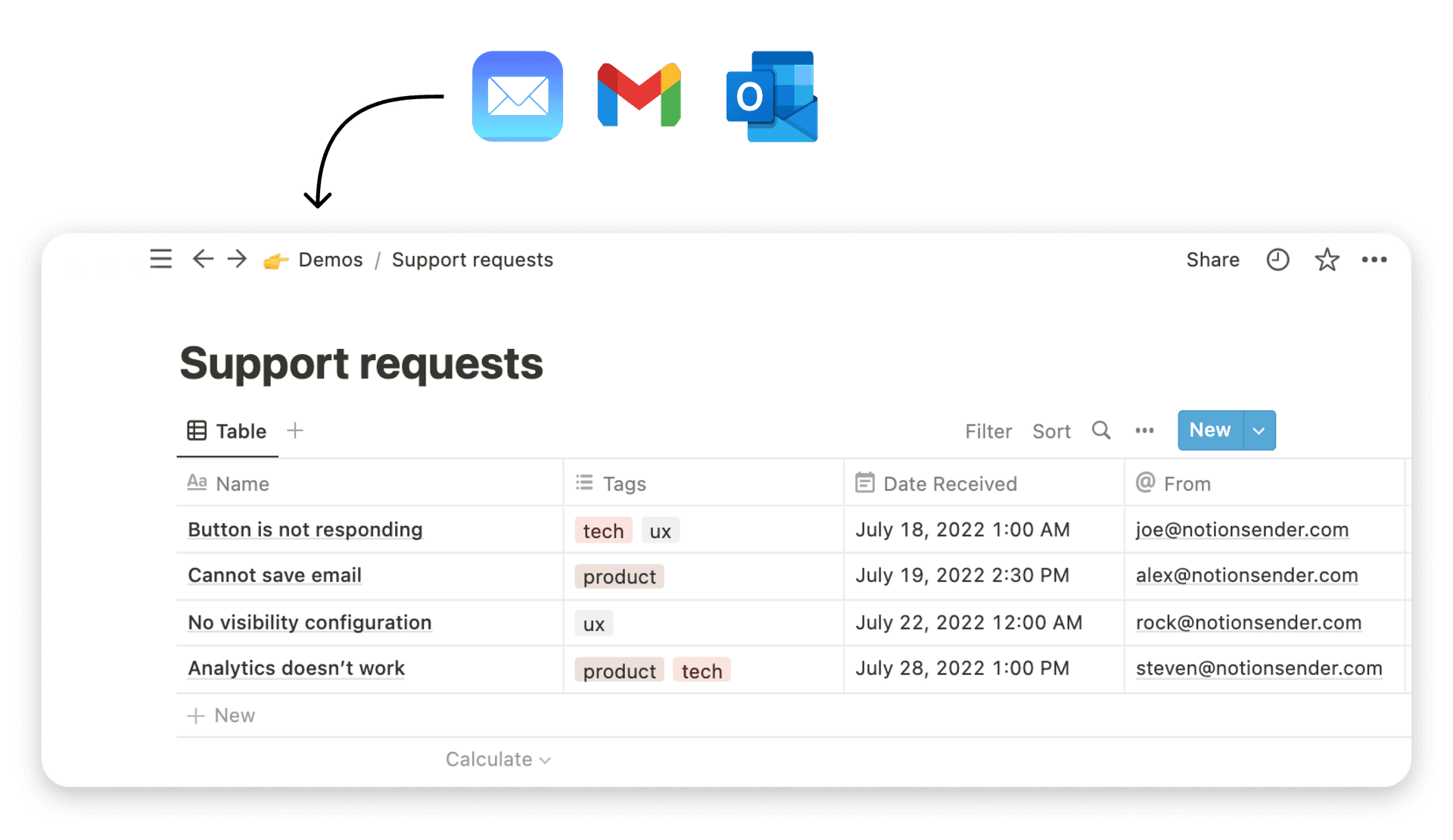
With a tighter setup, the email can be routed into the right Notion workspace so it becomes structured information instead of inbox residue. That turns a loose message into something operational. A project manager can review it in the same environment where tasks, timelines, and status live.
Why this matters more on Mac
The Mac app improves this kind of workflow because it supports a desktop-first rhythm. You can keep Notion open in one window, Mail in another, and move quickly without burying either inside a browser stack. The native app also fits better with keyboard-first behavior, which matters when you're triaging a lot of communication.
This isn't just convenience. It's cleaner execution.
If you manage active client work, you already know the pattern. A message that sits in the inbox too long stops feeling like project input and starts feeling like inbox clutter. Once that happens, follow-up gets weaker.
Email shouldn't be a second brain. It should be an intake channel.
What a good email-to-Notion setup changes
A structured flow from email into Notion helps in a few specific ways:
- Project context stays attached: Feedback lands near related tasks, notes, and deliverables.
- Handoffs get cleaner: Team members can review communications without digging through someone else's inbox.
- Follow-up becomes visible: Once email-derived items live in a database, they can be assigned, tagged, and reviewed.
- Administrative work shrinks: Less copying and pasting means less mechanical overhead.
This is the same broad logic behind many workflow automation benefits. The payoff isn't only speed. It's consistency.
A useful pattern for different roles
Different professionals can run the same basic idea with different database designs.
| Role | Useful destination in Notion | Typical email content |
|---|---|---|
| Freelancer | Client project database | Feedback, approvals, file requests |
| Project manager | Action tracker or delivery board | Status updates, dependencies, decisions |
| Marketer | Campaign database | Creative review, asset requests, launch notes |
| Small business owner | Operations workspace | Invoices, vendor communication, scheduling |
The important part is not the exact database name. It's deciding where incoming email should become action.
Keep the workflow simple enough to trust
The best automated workflows are boring. They don't require constant checking, and they don't depend on perfect memory. If someone on your team has to remember a six-step routine every time an important email arrives, the process won't hold.
A strong pattern looks more like this:
- Important email arrives.
- It is routed into the correct Notion destination.
- The information appears in structured form.
- The item gets reviewed during normal work inside the Mac app.
If your current setup still requires manual duplication, you're maintaining two systems. One is your inbox. The other is your workspace. That division usually creates drag.
For teams that want to go further and handle outbound communication from inside their workspace as well, this guide on how to create and send email from Notion is a useful next step.
Your Centralized Mac Workspace Awaits
The best version of the notion app mac workflow isn't complicated. It's deliberate.
Use the native app because it reduces distraction and fits macOS better than the browser. Install the correct build for your machine so the app feels stable from the start. Lean on menu bar access, shortcuts, and multiple windows so capture and retrieval happen faster. Keep the workspace light enough to stay responsive, especially if you're managing larger databases on older hardware.
Then fix the bigger operational gap. Don't let email stay outside the system where the work happens.
When your Mac becomes the place where notes, tasks, project records, and communication all connect, Notion stops being a repository and starts acting like an operating layer. That's the shift many users desire. Less juggling. Less searching. Fewer dropped details. More work moving forward from one clean center.
Frequently Asked Questions About the Notion Mac App
Is the Mac app better than using Notion in Safari or Chrome
For most power users, yes. The app gives Notion its own workspace, reduces browser distraction, and fits better with keyboard-driven Mac workflows. If you only check pages occasionally, the browser may be enough. If Notion is where you run projects, the app is usually the better daily environment.
Should I install the Intel or Apple Silicon version
Install the version that matches your Mac's processor. You can confirm that in About This Mac. Using the correct build is the safest starting point for performance and compatibility.
Does the Notion Mac app work offline
It can support offline-capable work, but you should think of it as best for pages and materials you've already opened and worked with recently. If you know you'll be without a connection, open your essential dashboards and docs first. That makes offline use much more reliable.
Why does the app sometimes feel slow with large workspaces
Usually because the workspace is too heavy, not because something is broken. Large linked views, bloated dashboards, oversized databases, and too many active windows can all make the app feel sluggish. There's also a known lack of detailed official guidance for Mac users trying to optimize large databases or troubleshoot differences between Intel and Apple Silicon builds, as noted in this discussion of the current guidance gap.
What's the best way to keep the app fast
Keep operational pages simple. Archive old records out of active dashboards. Avoid using one homepage as a giant control panel for everything. If a page is slow, trim what it loads before changing anything else.
Can I use Notion as my main work hub on Mac
Yes, if you give it clear jobs. It works best when you define where quick capture goes, where active projects live, and where reference material belongs. Most failed setups don't fail because of the app. They fail because everything gets dumped into one space without a retrieval system.
How should I organize email-related work in Notion
Don't just paste emails into random notes. Route them into a project, operations, or task database where they can be reviewed and acted on. The more consistently email becomes structured data inside your workspace, the less likely important communication is to vanish into the inbox.
If you want your Mac workspace to handle email as cleanly as it handles notes and projects, NotionSender is worth a look. It helps turn incoming and outgoing email into part of your Notion workflow instead of leaving communication trapped in a separate inbox.