Notion Website Builder: A Step-by-Step Guide (2026)

You already have the raw material for a website sitting in Notion.
Maybe it’s a freelance service page, a consultant bio, a startup landing page, a portfolio, or a small knowledge base for clients. The usual friction starts when you try to move that content out of your workspace and into something public. Suddenly you’re comparing WordPress themes, wrestling with a site builder, or waiting on a developer to make small edits.
That’s why the notion website builder approach keeps pulling people in. If your content, projects, and workflows already live in Notion, publishing from the same place feels natural. Notion’s website builder, launched around 2021, lets users publish any Notion page as a website with a single click, and Notion says this approach can reduce setup time from weeks to seconds while cutting costs by up to 90% for basic sites compared to hiring developers, with its overall user base exceeding 20 million active users as of late 2023 according to Notion’s guide to building a website with Notion.
The core opportunity isn’t just publishing a page. It’s building a site that stays connected to your actual business operations so updates happen in one place and your public site never drifts away from your internal system. If you already organize work in Notion, these tips for getting more out of Notion will make that setup cleaner before you publish anything.
From Private Workspace to Public Website
A lot of people start with the wrong question. They ask, “Can Notion replace a full website platform?” The better question is, “What kind of website do I need right now?”
For many freelancers and small business owners, the answer is simple. You need a clear homepage, a services page, proof of work, a contact option, and an easy way to keep it updated. That’s where the notion website builder makes sense. It turns the content system you already use into the public site you’ve been putting off.
Why this works so well for small teams
Notion is already structured around blocks, pages, databases, and templates. Those aren’t just note-taking features. They’re the same building blocks you need for a lean website.
Here’s what makes it practical:
- One source of truth. Your public content lives in the same place as your drafts, operating docs, and project notes.
- Fast edits. You can update a headline, add a testimonial, or publish a new portfolio item without reopening a separate CMS.
- No-code publishing. You don’t need to touch hosting panels or theme files to get a basic site live.
That combination is why Notion has become a legitimate publishing option rather than a clever workaround.
Practical rule: If your site mostly communicates information and doesn’t rely on advanced web app behavior, Notion is often enough.
Where the shift happens
The moment a private workspace becomes a useful public website is when you stop formatting pages like notes and start structuring them like destinations. A homepage needs a clear first screen. A services page needs scannable sections. A contact page needs one action, not six.
That’s the mindset change. You’re not sharing a document anymore. You’re publishing a path for visitors to follow.
The best Notion sites I’ve seen aren’t trying to imitate giant custom websites. They lean into what Notion does well. Clear typography, simple hierarchy, easy maintenance, and connected content.
Choosing Your Publishing Method
Your first real decision is whether to publish directly from Notion or put a layer on top with a third-party builder such as Super, Potion, Feather, Popsy, or Simple.ink.
Both approaches work. They solve different problems.

Native publishing
Using Notion’s own publishing flow is the fastest route from draft to live page. You write the page, hit publish, and share it.
That’s a strong fit if you’re building:
- A personal profile with a short intro and contact details
- A project page for clients or collaborators
- A lightweight portfolio where polish matters less than speed
- A temporary landing page for a launch, event, or test offer
The advantages are obvious. It’s simple, direct, and tightly connected to your workspace. When you edit the page in Notion, the public version updates immediately.
The trade-offs show up when you want more control. Native publishing is limited in branding, navigation, SEO controls, and overall presentation. It works best when “good enough and live today” matters more than “fully customized and polished.”
Third-party builders
Third-party Notion website tools exist because many users want more than a public document. They want a site with custom navigation, better visual control, cleaner URLs, analytics, and stronger SEO settings.
Here’s the practical comparison:
| Method | Best for | Main strengths | Main limitations |
|---|---|---|---|
| Native Notion publish | Fast personal or business pages | Free, instant, easy updates | Limited branding, layout control, and advanced SEO |
| Third-party builder | Marketing sites, blogs, polished portfolios | Custom domain support, design flexibility, analytics, SEO features | Extra cost, another tool to manage, platform dependency |
If you’ve ever compared mainstream website builders, the same trade-off appears there too. This Squarespace versus Wix comparison is useful because it highlights a broader truth. Simplicity and control usually move in opposite directions.
Native Notion is the fastest way to publish. Third-party tools are the fastest way to make a Notion site feel less like Notion.
What breaks first
The decision gets easier when you think about scale and complexity.
If your site is mostly static pages, native publishing can hold up well. If your setup depends on larger databases, heavy filtering, or operational data, you need to be careful. For high-volume use cases, Notion can show performance degradation with databases containing hundreds of thousands of records, and teams processing over 100,000 email records should plan for architectural optimization rather than relying on Notion alone, as explained in this analysis of when Notion isn’t the right tool.
That doesn’t mean Notion is weak. It means you should use it for what it’s best at. Public pages, lightweight content systems, simple blogs, client-facing resources, and connected workflows. Not massive data-heavy applications.
A practical choice filter
Choose native publishing if your priority is speed, low cost, and minimal setup.
Choose a third-party builder if you need:
- Stronger branding with custom layouts and navigation
- Custom domain handling with a more polished front-end experience
- SEO controls beyond basic public page publishing
- Analytics and scripts for marketing visibility
Most first-time builders should start native, validate the site structure, then upgrade only if the limitations become painful.
Designing Web-Ready Pages in Notion
The biggest mistake people make with a notion website builder is publishing a page that still behaves like an internal note. Notion gives you the blocks. You still have to build the page with web behavior in mind.

Build the page top-down
A good Notion page for the web usually follows a simple sequence:
-
Clear first screen
Start with a strong headline, one short supporting line, and one primary action. Don’t bury the point in a paragraph. -
Trust-building section
Add client types, project outcomes, service categories, or selected work. Keep it tight. -
Offer details
Use headings, toggle blocks, or columns to explain services, packages, or process. -
Call to action
End with a contact form, booking link, or inquiry button.
That structure works for service businesses, consultants, creators, and small agencies because it makes decisions easy for the visitor.
Use blocks that translate well to the web
Notion pages look best when you stay inside its strengths.
Use these heavily:
- Headings for hierarchy and scanning
- Columns to create side-by-side layouts for benefits, features, or portfolio items
- Callouts to highlight proof, next steps, or short testimonials
- Dividers sparingly, to separate large sections
- Gallery and list database views for portfolios, case libraries, or resources
- Embeds for forms, videos, scheduling tools, or maps
Avoid turning the page into a wall of toggles and long paragraphs. That works in a workspace. It usually reads poorly on a public site.
Do this: Write shorter than you think you need to. Website visitors scan first and read second.
Don’t do this: Use your homepage to explain every detail of your business history. Give enough context to earn the click to the next step.
Treat databases like dynamic site sections
Notion offers a more dynamic approach than a static page builder. A database can power a blog, a portfolio, a resources library, a job board, or a changelog. You create the structure once, then publish items consistently.
Notion also supports project-style templates that help teams build and maintain sites as ongoing operational hubs. Its project management templates, including milestone tracking and Gantt chart views introduced by 2023, are associated with 30 to 40% improvements in on-time delivery for web projects according to Notion’s project milestones use case. I’ve found this especially useful when a site isn’t just a brochure but an active business asset with drafts, revisions, launches, and updates.
Keep the design disciplined
A lot of website design advice still applies, even inside Notion. This guide to website design best practices for small businesses is worth reviewing because the fundamentals don’t change just because the editor is different.
Use this quick checklist before you publish:
- One job per page. Your homepage introduces. Your services page explains. Your contact page converts.
- Consistent headings. Don’t jump from a giant title to tiny body text with no clear pattern.
- Limited width. Dense side-by-side layouts can get messy on smaller screens.
- Intentional database views. Hide properties that matter internally but clutter the public page.
- Real navigation. If visitors can’t tell where to click next, the page isn’t ready.
The best Notion sites feel simple because the creator removed friction, not because the tool did the work automatically.
Connecting Your Custom Domain
A custom domain is where your Notion page starts feeling like a real business website instead of a shared workspace link.

If you’re using a third-party Notion website builder, this process is usually guided inside their dashboard. If you’re using a more direct setup, your domain registrar still handles the connection. Either way, the logic is the same. You own the domain at one service and point it toward the place serving your site.
What the DNS part actually means
You don’t need to become a DNS expert. You just need to understand the role of a few records.
- The domain registrar is where you bought the domain.
- DNS records tell the internet where that domain should point.
- A record and CNAME record are common ways to connect the domain or subdomain to your site host.
Many get stuck because the interface looks technical, not because the task is hard.
A custom domain setup usually feels harder than it is. The risk is mostly psychological. Slow down and match the values exactly from your website tool.
The clean setup flow
Follow this order:
-
Decide your main address
Pick whether your primary site should live on the root domain or a subdomain. -
Add the domain in your site builder
Your tool will usually generate the exact records you need. -
Update records at your registrar
Copy the values carefully. Don’t guess or improvise. -
Wait for propagation
Changes can take time to appear across the web. -
Confirm SSL is active
Most modern builders handle secure certificates automatically once the domain resolves correctly.
This walkthrough can help if you want to see the process visually before touching settings:
<iframe width="100%" style="aspect-ratio: 16 / 9;" src="https://www.youtube.com/embed/kA0-xFwhH4A" frameborder="0" allow="autoplay; encrypted-media" allowfullscreen></iframe>
Common problems
Most connection issues fall into a short list:
- A conflicting old record is still active
- The wrong host field was edited
- The root domain and www version weren’t handled consistently
- You checked too early before DNS changes finished propagating
If you hit a problem, compare every field line by line against your builder’s instructions. In practice, the issue is usually one small mismatch.
A custom domain matters because it changes trust. Clients remember it more easily, share it more confidently, and take the business more seriously.
Capturing Leads with NotionSender
A Notion site becomes useful when it gives visitors a next step. It becomes a business asset when that next step feeds a working system.

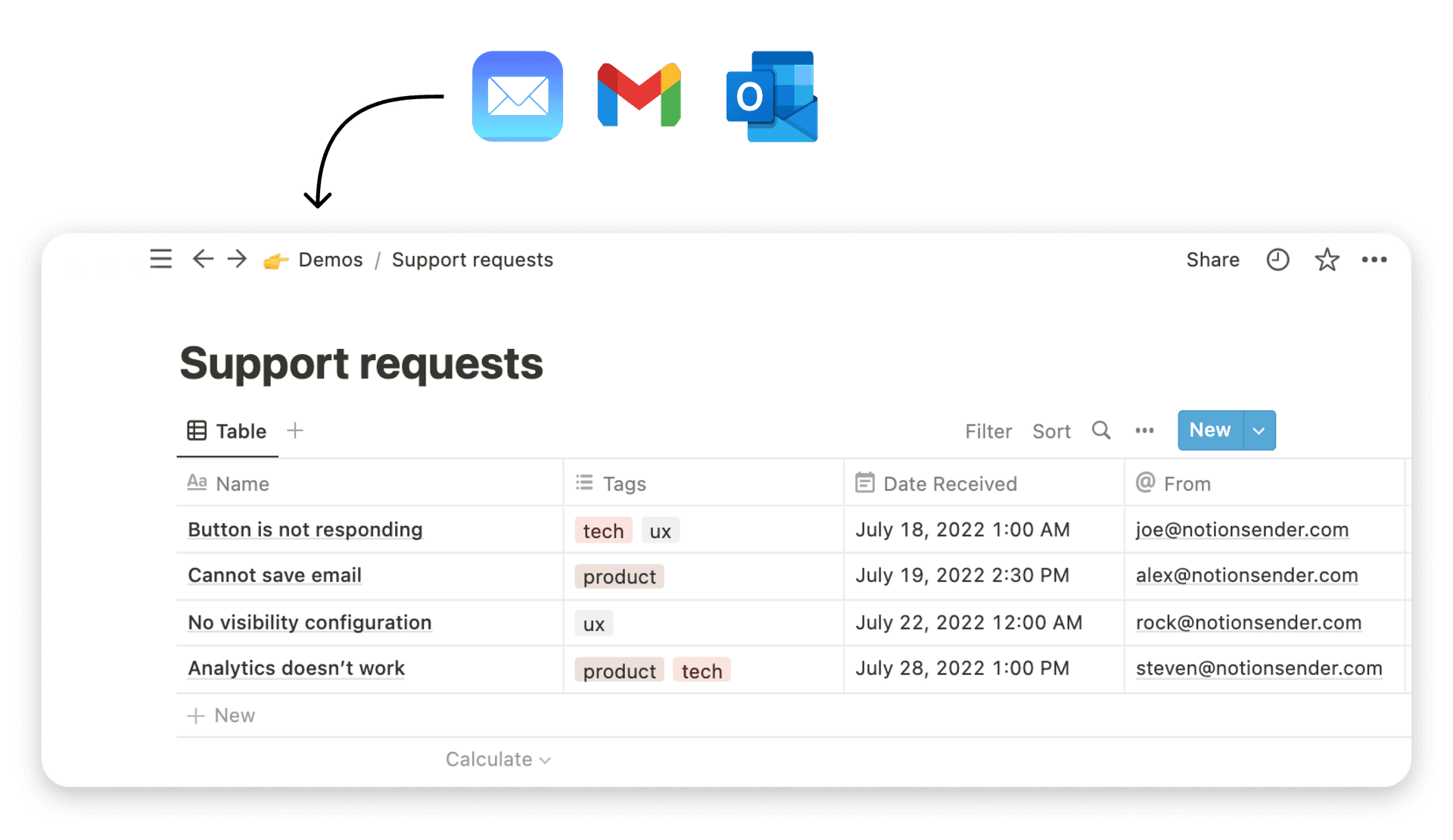
Here’s a practical setup I recommend for small businesses and freelancers. Keep the site simple, then connect lead capture to a Notion database so every inquiry lands in the same place you already manage work.
A straightforward lead flow
The stack is simple:
- Your public Notion site holds the homepage, service page, or landing page
- A form tool such as Tally collects inquiries
- A Notion database stores lead details
- An email workflow tool handles follow-up and response
Notion Sites are optimized for “quick, simple websites” and bundled workflows. They are useful for front-end presence but less suited to complex contact management portals, as discussed in this breakdown of how Notion grows through bundled workflows.
Example workflow that works well
Say you’re a freelance designer launching a one-page site.
A visitor lands on your homepage and sees a short service offer, examples of work, and a button that says “Request a quote.” That button opens an embedded Tally form asking for:
- Name
- Company
- Project type
- Budget range
- Short project summary
Once submitted, the form sends the entry into a Notion database called Leads. Inside that database, you can organize views like:
| View | Purpose |
|---|---|
| New inquiries | Fresh submissions that need review |
| Qualified leads | Good-fit projects worth following up on |
| Waiting on reply | Leads you contacted but haven’t heard back from |
| Booked calls | Leads that moved into the sales process |
That setup is already useful because the site and the CRM live near each other. But the true gain comes from automatic follow-up.
Where email automation changes the system
The handoff most guides ignore is what happens after someone fills out the form. If you’re copying emails manually, adding tags by hand, or writing every confirmation from scratch, your site is still acting like a brochure.
A better setup is to connect your lead database to an email workflow so each new entry can trigger the next action:
- Send a thank-you email confirming the inquiry was received
- Personalize the reply using database properties
- Create internal follow-up tasks inside your workspace
- Keep communications tied to the lead record
That’s the difference between a page that collects names and a site that supports sales operations.
If you want to build that workflow directly inside your workspace, you can create a NotionSender setup here.
A lead form without a response workflow is only half built.
Keep the front end simple
The temptation is to overbuild. Don’t start with a huge CRM portal, gated account system, or a complicated intake experience. A Notion-powered site works best when the public side stays clean and the heavier workflow happens behind the scenes.
For most service businesses, one embedded form, one lead database, and one automatic response path is enough to make the website start working for you instead of just sitting there.
Post-Launch Best Practices
Going live is the easy part. Keeping the site sharp is where attention often drifts.
Keep content tied to real operations
The strength of a Notion site is that updates happen where you already work. Use that. Refresh service descriptions when your offer changes. Archive old case studies. Publish new resources from the same database structure instead of rebuilding pages manually.
If your business uses email heavily, your site content and follow-up content should support each other. These email marketing tactics for improving open rates are useful once your site starts collecting actual leads.
Run a simple maintenance loop
Use a recurring check that covers:
- Page clarity. Is the main action still obvious on every core page?
- Link health. Do all forms, buttons, and booking links still work?
- Content freshness. Does the site reflect current services, pricing approach, or positioning?
- Mobile review. Do stacked columns and embeds still read cleanly on phones?
- Performance watch. If a page depends on large databases or too many embeds, simplify it.
Don’t chase complexity too early
A lot of site owners start adding more pages, more tools, and more scripts before the simple version is doing its job. Resist that. A smaller site with one clear path to inquiry usually performs better than a cluttered one with too many options.
The practical standard is simple. If someone lands on your homepage, can they understand what you do, trust you enough to continue, and know what to do next? If yes, the site is working.
Frequently Asked Questions
Is a Notion website good for SEO
It can be, within limits. For a simple business site, portfolio, or content hub, Notion can work well enough, especially when the structure is clean and the content is well written. If SEO is central to your growth strategy, third-party Notion website tools usually give you better control over metadata, URLs, indexing behavior, and analytics.
Can I build a full business website with Notion alone
Yes, if “full” means a practical small business site with pages for home, services, about, resources, and contact. No, if you need complex application logic, advanced user portals, specialized form handling, or heavy database operations. The notion website builder is strongest when the site is content-driven and operationally connected to your workspace.
What does it actually cost
The content side can be very low cost if you publish directly from Notion. Costs rise when you add a custom domain, a third-party publishing layer, analytics, form software, and email automation tools. The right way to think about cost isn’t “cheapest possible.” It’s “what setup saves me the most maintenance time while still looking professional.”
Is it secure to use Notion as a public site
It’s secure enough for public content when you understand what’s being published. The main risk is human error. If a page or subpage contains internal notes, private links, or database properties you didn’t mean to expose, publishing carelessly can create problems. Always review page permissions, visible properties, and linked databases before going live.
Should I use native Notion publishing or a third-party tool
Use native publishing if speed and simplicity matter most. Use a third-party tool if presentation, branding control, and marketing features matter more. Many people start with native publishing, validate the content and structure, then move to a more polished front end later.
If your website lives in Notion, your follow-up should too. NotionSender helps you turn a simple Notion site into a working lead system by connecting email workflows directly to your Notion databases, so new inquiries don’t just arrive. They move.