Notion Calendar vs Google Calendar: The 2026 Verdict

Your calendar looks organized. Your work often does not.
A lot of small business owners and freelancers live inside three separate systems at once. Meetings sit in Google Calendar. Project deadlines live in Notion, a spreadsheet, or a task app. Client context lives in email threads, docs, and old notes. The day feels busy, but the workflow stays fragmented.
That is why notion calendar vs google calendar is not a cosmetic comparison. It is a question about where work happens. Do you want a calendar that schedules time cleanly, or a calendar that carries project context with it?
The Modern Scheduling Dilemma
A familiar setup looks like this. A consultant books calls through Google Calendar, tracks deliverables in a spreadsheet, and keeps client notes in a separate app. Every meeting starts with a quick search for the latest brief, last email, and promised next steps.
The cost is not only missed details. It is constant context switching. You are not just checking your schedule. You are rebuilding the meaning of each event every time you open it.
Google Calendar became the default for this reason. It is simple, fast, and nearly everyone uses it. It launched on April 13, 2006 and had over 1 billion active users by 2023, helped by tight Gmail and Google Meet integration, according to this comparison from ONES on Notion vs Google Calendar.
Notion Calendar came from a different direction. It was introduced in late 2022 as part of Notion’s broader workspace push, and that same ONES comparison notes Notion’s ecosystem had grown to over 30 million active users by 2026 as a projection from industry reports, with Notion Calendar standing out for linking events to rich databases and improving workflow efficiency by up to 40% in complex team environments based on user benchmarks.
That difference matters more than feature checklists suggest.
Two tools with different philosophies
Google Calendar treats the event as the main object. You create a meeting, add guests, attach a location or video call, and move on.
Notion Calendar treats the event as one view of broader work. A calendar item can connect to a project page, a content brief, an invoice record, a task list, or a client database.
If your day is mostly meetings, Google Calendar feels lighter. If your day is mostly project work around meetings, Notion Calendar makes more sense.
Where the workflow gap shows up
This gap becomes obvious in service businesses. A coach, consultant, designer, or agency owner rarely needs just a place for appointments. They need a system that connects appointments to delivery.
If you are already reviewing tools for client delivery, content, and scheduling, this roundup of best online coaching platforms is useful because it shows how quickly scheduling becomes one piece of a larger operational stack.
Here is the practical framing:
| Workflow need | Google Calendar | Notion Calendar |
|---|---|---|
| Fast meeting scheduling | Strong | Good, but not its core advantage |
| Shared scheduling standard | Strong | Depends on your Notion setup |
| Project context inside events | Limited | Strong |
| Database-driven planning | Limited | Strong |
| Low-friction external collaboration | Strong | Mixed |
Google Calendar The Universal Standard
Google Calendar wins a lot of businesses before the comparison even starts. Clients use it. Contractors use it. Software vendors connect to it. Team members understand it.
That universality is not abstract. It changes day-to-day work because nobody needs training to read a Google Calendar invite, join a Meet link, or accept a recurring event.
Why Google Calendar remains the default
Google Calendar is built for speed and predictability. Add an event, invite people, pick a time, and move on. For meeting-heavy teams, that is the right priority.
Its practical strengths come from the surrounding Google ecosystem:
- Gmail integration: events can be parsed from email, which reduces manual entry.
- Google Meet links: video calls are easy to attach during scheduling.
- Recurring events: weekly check-ins and standing internal meetings are straightforward.
- Standard calendar views: day, week, month, and agenda views cover most planning needs.
- Cross-platform access: browser, Android, and iOS usage is established and familiar.

What it does well in real business use
For appointment scheduling, Google Calendar is hard to beat.
A sales consultant can move from email to meeting invite in seconds. A small team can share calendars without explaining database relations or custom properties. An operations manager can check availability across staff members quickly. This is why Google Calendar works best for front-stage scheduling when external people are involved.
Google also puts useful controls inside the calendar itself. The Jotform comparison notes 19 API automation actions, plus features like Focus time that can auto-decline meetings and mute notifications, and World Clock for timezone visibility, which makes Google Calendar particularly strong for meeting-heavy workflows that value low friction over custom structure.
Where Google Calendar starts to feel thin
The strength of Google Calendar is also its limit. Events stay relatively lightweight.
You can add descriptions, guests, links, and attachments, but the tool does not naturally become a project command center. If you run client delivery, content operations, or multi-step internal workflows, you end up using Google Calendar alongside:
- a task manager
- a notes system
- a CRM
- a project board
- an email archive
That is not a flaw if your work is simple. It becomes a problem when the calendar is supposed to reflect work status, not just booked time.
Google Calendar is best when the calendar itself is the product. It is weaker when the calendar needs to act like a layer on top of projects, tasks, and records.
Best fit for Google Calendar
Google Calendar is usually the right choice if your business needs these things first:
| Best use case | Why it fits |
|---|---|
| Client meetings | Many individuals can join and manage invites easily |
| Team availability | Shared calendars are familiar and reliable |
| Internal recurring meetings | Setup is fast and low maintenance |
| Timezone coordination | World Clock and Meet integration help |
| Mobile-first scheduling | Established mobile support matters |
Notion Calendar The Integrated Workspace
Notion Calendar makes more sense when you stop thinking of it as “another calendar app” and start thinking of it as a scheduling interface for your Notion data.
That shift changes who should use it. If your work already lives in Notion databases, Notion Calendar can pull deadlines, meetings, tasks, and project records into one place without forcing you to jump between tools every few minutes.
A calendar view with database depth
The core benefit is context. A calendar item can carry more than a title and a time slot.
The Jotform comparison describes Notion Calendar as strong in advanced database-driven event management and customizable views, including the ability to turn database entries into events with embedded notes, attachments, tasks, and timelines across formats such as kanban, list, table, gallery, and timeline. That is the part Google Calendar does not try to do.

What this changes in practice
A marketing manager can click a campaign deadline and see the underlying project page. A freelancer can open a client call and immediately access notes, files, task status, and next actions. A small agency can use one database for content production and view that same database as a calendar, board, or timeline.
That flexibility is a key advantage.
Instead of keeping a calendar separate from work, you place scheduling inside the same workspace where the work is tracked. If your team plans in Notion, writes in Notion, and tracks delivery in Notion, this can remove a lot of routine switching.
Where Notion Calendar is strongest
Notion Calendar is at its best when your calendar events need to connect to structured records.
That includes cases like:
- Editorial planning: one item links to draft status, owner, channel, and assets.
- Client work: meetings relate to proposals, invoices, deliverables, and notes.
- Project coordination: dates live alongside dependencies and documentation.
- Freelance operations: one place holds tasks, due dates, records, and communication history.
For businesses already building those workflows, this walkthrough on using Notion for communication and scheduling is relevant: https://www.notionsender.com/blog/post/7_ways_to_use_notion_to_send_emails_and_more_write_schedule_and_share
The trade-off you feel quickly
Notion Calendar asks more from the user. You need a decent Notion structure to get the benefit.
If your workspace is messy, the calendar reflects that mess. If your databases are clear, the calendar becomes more powerful than a plain scheduler.
Notion Calendar is not the easiest calendar to adopt cold. It is the most useful when Notion is already your operating system for work.
Head-to-Head Feature Showdown
Early in most evaluations, the wrong question gets asked. People ask which tool has more features. The more useful question is which tool reduces friction in the work you do.

Quick comparison table
| Category | Google Calendar | Notion Calendar | Practical winner |
|---|---|---|---|
| Event creation | Fast, familiar, excellent for meetings | Better when event belongs to a database item | Google for speed, Notion for context |
| Collaboration | Excellent for invites and shared scheduling | Strong inside Notion-based teamwork | Depends on where the team works |
| Views | Standard calendar layouts | Calendar plus board, list, timeline, table, gallery | Notion |
| Task integration | Basic with Google Tasks | Extensive with Notion databases | Notion |
| Mobile reliability | Strong | More limited for some users | |
| Ecosystem fit | Broad external support | Best inside Notion workflows | Depends on stack |
A short demo helps if you want to see interface differences in motion.
<iframe width="100%" style="aspect-ratio: 16 / 9;" src="https://www.youtube.com/embed/fLjadP76cFk" frameborder="0" allow="autoplay; encrypted-media" allowfullscreen></iframe>
Event creation and management
Google Calendar is faster for plain scheduling. Add a title, pick a time, invite guests, and include a Meet link. For many teams, that is enough.
Notion Calendar becomes stronger when an event is part of a larger workflow. The Jotform comparison notes that Notion Calendar enables transforming database entries into dynamic events with embedded notes, attachments, and tasks across multiple views, while Google Calendar prioritizes efficient scheduling with 19 API automation actions, Focus time, and World Clock visibility for low-friction meeting-heavy use.
If an event needs little surrounding information, Google Calendar is cleaner. If the event needs history, properties, files, and linked work, Notion Calendar carries more weight.
Sharing and collaboration
Google Calendar remains easier for traditional scheduling collaboration. Guests understand invitations immediately. Shared team calendars are routine. External partners rarely need explanation.
Notion Calendar collaboration is more powerful inside a Notion-centric team. A project manager can share database-backed timelines with relevant context attached. That is useful for internal work, but it is less universal for outside participants.
The practical distinction is simple:
- External scheduling: Google Calendar wins.
- Internal project visibility: Notion Calendar wins.
Reminders and notifications
Google Calendar handles reminders in a more expected way for mainstream users. It is designed around event prompting and participation.
Notion Calendar works, but reminders are not its main strength. Its value comes from seeing the event inside a broader task and project system, not from offering the cleanest standalone notification experience.
For professionals who also need cross-platform scheduling consistency across Microsoft and Google environments, this guide to seamless calendar syncing between Outlook and Google Calendar is useful, especially for businesses that are not fully standardized on one suite.
Views and customization
This is one of the clearest splits.
Google Calendar offers day, week, month, and agenda-style views. They are polished and reliable. They are structurally limited.
Notion Calendar shines because the same work can appear in multiple forms. A content pipeline can be a calendar this morning, a kanban board this afternoon, and a timeline during planning. The Jotform comparison specifically highlights views such as kanban, timeline, and list as part of Notion’s richer planning environment.
That matters for managers who plan in one shape and execute in another.
Integrations and automation
Google Calendar has wider default compatibility because so many tools are built around it. That is the practical advantage of being the standard.
Notion Calendar’s integration story is narrower but more extensive. It syncs with Google Calendar, and it becomes much more useful when the rest of your operational data lives in Notion. The difference is breadth versus depth.
Where Google integration wins
Google Calendar is easier to plug into scheduling links, inbox-driven workflows, mobile devices, and external apps. You feel that immediately in sales, support, and client-facing roles.
Where Notion integration wins
Notion Calendar wins when your event should not stand alone. It should sit next to:
- project status
- task ownership
- internal notes
- attachments
- deliverables
- client records
Interface and learning curve
Google Calendar is easier to learn because it does less. That is not an insult. It is the reason many teams stick with it.
Notion Calendar asks users to understand databases, views, and workspace structure. The payoff is greater flexibility. The cost is setup effort and a steeper learning curve.
In practice, the right tool is the one your team will maintain correctly. A perfect system that nobody updates loses to a simple one people use.
Real-World Workflows For SMBs and Freelancers
A freelance designer gets a client email at 8:15, books a kickoff for Thursday, turns the request into a project, and needs the due date, notes, and follow-up tasks to stay connected. That is where the calendar choice stops being about interface preference and starts affecting delivery.

The freelancer juggling multiple clients
Freelancers manage two layers of work at once. Clients see meetings, deadlines, and review calls. The business owner behind the work also has to track proposal due dates, revision windows, invoice reminders, and the blocks of focused time needed to finish the job.
Google Calendar is better for the client-facing layer. Invites are familiar, booking is straightforward, and mobile access is dependable.
Notion Calendar is better for the operational layer, especially when each event needs context. A kickoff can sit beside the project brief, task list, meeting notes, and payment status instead of living as an isolated appointment.
There is a real trade-off for mobile-first freelancers. Notion documents its app availability on its help page for Notion Calendar for desktop and mobile, which notes support for iPhone, Mac, and Windows rather than native Android or iPad apps. Detailed time blocking is also less flexible than dedicated calendar tools because Notion Calendar works best when dates are tied to records, not when you need to drag a full day into tightly managed work blocks. For freelancers who plan from a phone or tablet, Google Calendar remains the safer default.
The marketing manager running a campaign calendar
Marketing calendars break when dates lose their surrounding context.
A launch date is tied to copy, creative, approvals, owners, budget, and dependencies. If those details live in one system and the calendar lives in another, the team spends time checking status in multiple places.
Notion Calendar has an advantage here because campaign timelines can stay attached to the underlying work. A content lead can open a date and see the brief, current stage, owner, and files without jumping across tools. That reduces coordination overhead.
Google Calendar plays an important role. It is the better place for review calls, cross-functional meetings, and anything involving external partners. But for campaign execution itself, it acts as a meeting layer rather than the operating system.
The SMB owner balancing sales and delivery
Small business owners need two different scheduling behaviors.
Sales activity needs speed and compatibility. Discovery calls, estimate reviews, hiring interviews, and vendor meetings are easier to manage in Google Calendar because everyone knows how to accept, reschedule, and join.
Delivery work needs records. Install dates, onboarding steps, production deadlines, invoice checkpoints, and recurring admin work are easier to manage in Notion Calendar when each date belongs to a client, project, or service record.
For many SMBs, the practical setup is hybrid:
| Workflow layer | Better fit | Why |
|---|---|---|
| External appointments | Google Calendar | Faster for clients and partners to use |
| Internal delivery timeline | Notion Calendar | Dates stay attached to project records |
| Project review meetings | Either | Choose based on whether speed or context matters more |
| Admin follow-ups | Notion Calendar | Better when linked to tasks, owners, and status |
The workflow integration gap
This is the deciding factor for a lot of teams I work with. The problem is rarely calendar design. The problem is what happens before and after the event.
A client request starts in email. Then someone creates a project, assigns work, sets a date, and sends a follow-up. If those steps happen across disconnected tools, staff copy details by hand, miss status changes, and rely on memory for the next action. Google Calendar handles the scheduling step well, but the rest of the workflow lives elsewhere. Notion Calendar keeps more context in one place, but many teams still hit a gap once email enters the process.
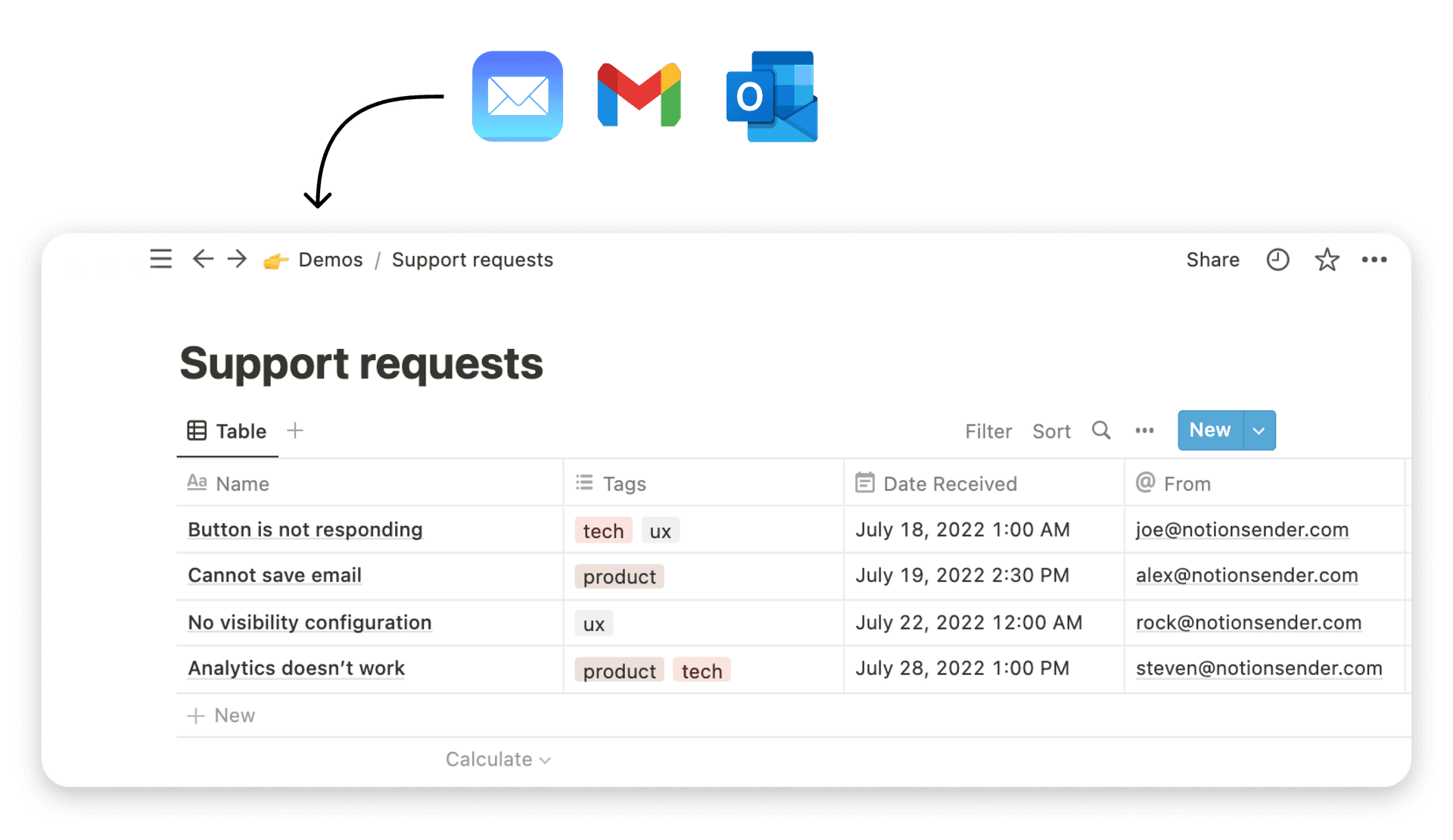
One example is this article on sending emails from Notion. It shows the missing layer clearly. For Notion users, the key upgrade is not just seeing dates in a calendar view. It is connecting outreach, follow-ups, and project records so scheduled work stays tied to the communication that created it.
The better calendar is the one that leaves fewer handoffs between your inbox, your task system, and your delivery workflow.
Supercharge Your Notion Calendar With NotionSender
If you choose Notion Calendar, the next bottleneck appears fast. The calendar can hold project context, but email still lives somewhere else.
That matters because a lot of scheduling work starts in the inbox. Client inquiries arrive by email. Meeting confirmations arrive by email. Scope changes, approvals, and invoice questions arrive by email. If those messages stay disconnected from your Notion workspace, the calendar is only partially integrated.
Where the gap shows up
A common workflow looks like this:
- A prospect emails asking for availability.
- You schedule a kickoff.
- You create a project page in Notion.
- You copy details from the email into the project record.
- You set dates manually.
- You follow up later from your inbox.
That process works. It also creates repeat admin work.
What a connected workflow looks like
A more integrated setup ties inbox activity to database records, then lets the calendar reflect those records.
For example:
- Lead intake: an inbound email becomes a structured Notion item for a client or project.
- Project kickoff: the related date appears in your calendar view with notes and status attached.
- Follow-up management: after a meeting, the same record can hold next actions and communication history.
- Invoice tracking: payment reminders and milestone dates can live beside project records instead of in separate tools.
NotionSender integrates here. It lets users send and receive emails within Notion, save emails into databases, schedule deliveries, and organize email-based information inside the same workspace where project and calendar data live.
Why this matters for calendar-heavy work
Notion Calendar becomes much more useful when events point to living records instead of static pages. Email is the missing input for those records.
If you run a service business, that means fewer moments where someone asks, “Where was that latest client note?” The answer can stay attached to the project item that also appears on the calendar.
For freelancers, this can make a client database more operational. For agencies, it can reduce the split between account communication and delivery planning. For consultants, it creates a cleaner thread from inquiry to booking to follow-up.
Google Calendar is complete on its own. Notion Calendar becomes complete only when it is connected to the rest of the workflow.
This highlights the integration gap. Google Calendar connects widely. Notion Calendar connects extensively, but it needs another layer to pull communication into the same system.
How To Choose The Right Calendar For You
Users do not need a universal winner. They need the right winner for their workload.
Choose Google Calendar if
Google Calendar is the better fit when your day is dominated by meetings, availability checks, and external scheduling.
It makes sense if these statements sound like you:
- Client-facing first: most of your calendar consists of calls, demos, appointments, and invites.
- Mobile reliability matters: you schedule and adjust plans on the go.
- Your team uses Google Workspace: Gmail, Meet, and shared calendars are central.
- You want low setup overhead: nobody has time to build and maintain a database structure.
Choose Notion Calendar if
Notion Calendar is the better fit when events are just one layer of broader project work.
It is the stronger choice if these statements match your setup:
- Your projects live in Notion: tasks, briefs, notes, and records are there now.
- You manage deadlines with context: every date needs files, owners, status, and dependencies attached.
- You run internal workflows, not just appointments: content, delivery, operations, and admin all need visibility.
- You want one workspace for planning and execution: not a calendar separated from the work itself.
Choose both if
A hybrid system is common and smart.
Use Google Calendar for external scheduling because it is universal and low-friction. Sync those commitments into Notion Calendar so internal work can sit next to project timelines, notes, and deliverables. For many SMBs, that combination is more practical than trying to force one tool to do everything.
The short verdict
For pure scheduling, Google Calendar still wins.
For integrated project planning, Notion Calendar is more capable.
For businesses that live inside Notion and want email, project records, and dates to connect cleanly, the best answer is not “Google or Notion.” It is “Google for appointments, Notion for operations, and a workflow layer that ties communication into the same system.”
If your team already runs projects in Notion, NotionSender can help close the gap between email activity and calendar-based planning by saving messages into Notion databases, supporting scheduled sending, and keeping client communication closer to the records your team uses.