Notion Life Planner: A Freelancer's Guide for 2026

You do not need another prettier template. You need one place where work lands.
If you are freelancing or running a small business, your day usually starts in one app and ends in five. Tasks live in a to-do list, deadlines sit in a calendar, client details hide in email threads, notes are buried in docs, invoices live somewhere else. Nothing is broken on its own, but the system as a whole leaks attention all day.
A good notion life planner fixes that when it is built like an operating system, not a scrapbook. The difference matters. A visual dashboard can feel productive and still fail the moment a client changes scope, an invoice arrives late, or a meeting note never makes it out of your inbox.
The version that holds up under real work is simple at the front, structured underneath, and connected to the tools you already use. That is how Notion becomes a planner for life and a control center for projects, clients, admin, and personal goals at the same time.
Why Your Jumble of Apps Is Holding You Back
The problem is not that you use many tools. The problem is that each tool owns a different slice of your attention.
A freelancer might track deadlines in Google Calendar, projects in ClickUp, notes in Apple Notes, finances in a spreadsheet, and clients in Gmail. A small business owner might do the same with different logos on the tabs. The result is familiar. You remember things by anxiety instead of by system.

That fragmentation creates three practical problems.
- Work gets duplicated: You copy the same meeting note into a doc, then into a task manager, then into a client update.
- Important context gets separated: The task says “send draft,” but the request is somewhere else.
- Review becomes harder than execution: Weekly planning turns into a scavenger hunt across apps.
A Notion life planner is not just a personal productivity choice. It is a business decision. A centralized workspace reduces the number of decisions you make just to find information.
Why Notion fits this role
Notion has moved far beyond note-taking. According to Nick Lafferty’s review of life planner growth in Notion, Notion’s user base grew from 20 million in 2022 to a projected 50+ million active users by 2026, reflecting its shift into a central productivity hub.
That matters because a planner only works when it can hold more than daily tasks. It has to connect projects, recurring admin, goals, notes, and reference material in one place.
What a unified planner changes
When this system is set up well, your planner becomes a single source of truth.
Instead of asking “where did I put that,” you ask better questions:
- What needs attention today?
- Which client project is slipping?
- What is waiting on me versus waiting on someone else?
- What personal commitments need space this week?
A planner should lower cognitive load. If it adds friction, the architecture is wrong.
The best setups do not try to organize every detail on day one. They create one trusted home for active work, then expand only when a real need appears.
Designing Your Planner's Architecture with PPV
Many Notion life planner setups fail before the first task goes in. The problem is not motivation. The problem is structure.
If you build pages first and relationships later, you end up with a workspace that looks complete and behaves badly. You click around, duplicate information, and slowly stop trusting it. A stronger approach is PPV, short for Pillars, Pipelines, and Vaults.

According to Notion Life Design’s explanation of the PPV methodology, PPV systems report 80-90% adherence rates after 30 days and outperform rigid apps by 35% in long-term goal retention.
Pillars give your planner boundaries
Pillars are the major areas your life and work already revolve around. For most freelancers and small business owners, that usually includes Business, Health, Finances, Relationships, and Personal Admin.
These are not projects. They are containers.
If you skip pillars, your planner turns into one giant pile of tasks. Every obligation looks equally important because there is no higher-level structure telling you what category of life it belongs to.
A practical rule is to keep pillars broad and stable. You should not rename them every month.
Pipelines move work forward
Pipelines are where active work happens. Think project workflows, task sequences, recurring processes, and scheduled next actions.
A freelancer’s pipeline might include:
- Lead to proposal: Inquiry, call booked, proposal sent, follow-up, won or lost
- Client delivery: Brief received, work in progress, review, revisions, final delivery
- Admin flow: Invoice sent, payment due, payment received, archive
Notion becomes more than a planner with pipelines. Pipelines let you connect daily tasks to larger outcomes, instead of managing disconnected checklists.
Vaults keep useful information out of your way
Vaults store what matters but does not belong in your face all day. Notes. SOPs. meeting records. templates. reference links. archived material.
A common mistake is mixing active tasks with passive information. The page starts to feel full, but nothing is actionable.
Use vaults for material you need access to, not constant visibility.
| PPV layer | What goes there | What does not |
|---|---|---|
| Pillars | Core life areas and responsibilities | One-off tasks |
| Pipelines | Projects, workflows, recurring execution | Random reference notes |
| Vaults | Notes, assets, archives, reusable knowledge | Daily action lists |
The trade-off often ignored
A flexible system can become an overbuilt system. That is the main PPV risk.
If you create too many pillars, too many statuses, or too many connected databases too early, maintenance starts replacing execution. The fix is simple. Build the minimum architecture that supports decisions.
If a category does not change how you prioritize, filter, or review work, it probably does not need to exist.
For most businesses, five strong pillars and a few clear pipelines beat an elaborate maze of dashboards.
Building Your Core Planner Databases
A useful Notion life planner does not start with widgets or aesthetic covers. It starts with databases that answer practical questions fast.
You need only a handful of core databases to run both work and life. For most freelancers and small business owners, I recommend four: Projects, Tasks, Goals, and Clients or Contacts.

According to Notion’s Total Life Planner template page, successful systems often apply GTD principles, use date-based filtered views, and weekly rollups. The same source notes that advanced task analytics can reveal peak efficiency windows like 9-11 AM, enabling an 18% output uplift for freelancers and marketers.
Start with Projects
Your Projects database tracks outcomes with a finish line. “Redesign website,” “Launch spring campaign,” and “Set up quarterly bookkeeping” are projects. “Reply to Sam” is not.
Use these properties:
- Project name
- Status Keep this simple. Proposed, Active, Waiting, Complete is often sufficient.
- Pillar Link each project to a life or business area.
- Client Useful if the project belongs to a person or company.
- Start date
- Due date
- Owner Even solo operators benefit from this when contractors enter the picture.
- Priority
- Related goal
- Archive checkbox
The archive checkbox matters more than users often think. It keeps your live views clean without forcing you to delete history.
Make Tasks the engine
The Tasks database should hold actions, not ideas about actions.
Good task examples:
- Send revised proposal
- Review landing page copy
- Pay hosting invoice
Bad task examples:
- Website
- Marketing
- Life admin
Use these properties:
- Task name
- Status
- Due date
- Project relation
- Client relation
- Priority
- Next action checkbox or a clear status field
- Context Home, desk, call, errand, admin
- Completed date
- Notes
The relation to Projects is what gives tasks meaning. Without that, a task list becomes noise.
Add Goals only when they help decisions
A Goals database is useful when you plan by quarter or year and want your projects tied to a result. It is not mandatory on day one.
Helpful properties include:
- Goal name
- Time horizon
- Status
- Pillar
- Related projects
- Success criteria
- Review date
Some people add too much detail here. Keep goals lean. If a goal does not guide project selection or weekly review, it is just decoration.
Keep Clients or Contacts practical
Your Clients database should support service delivery, not become a CRM monster.
Start with:
- Name
- Company
- Status
- Related projects
- Last contact date
- Next follow-up
- Notes
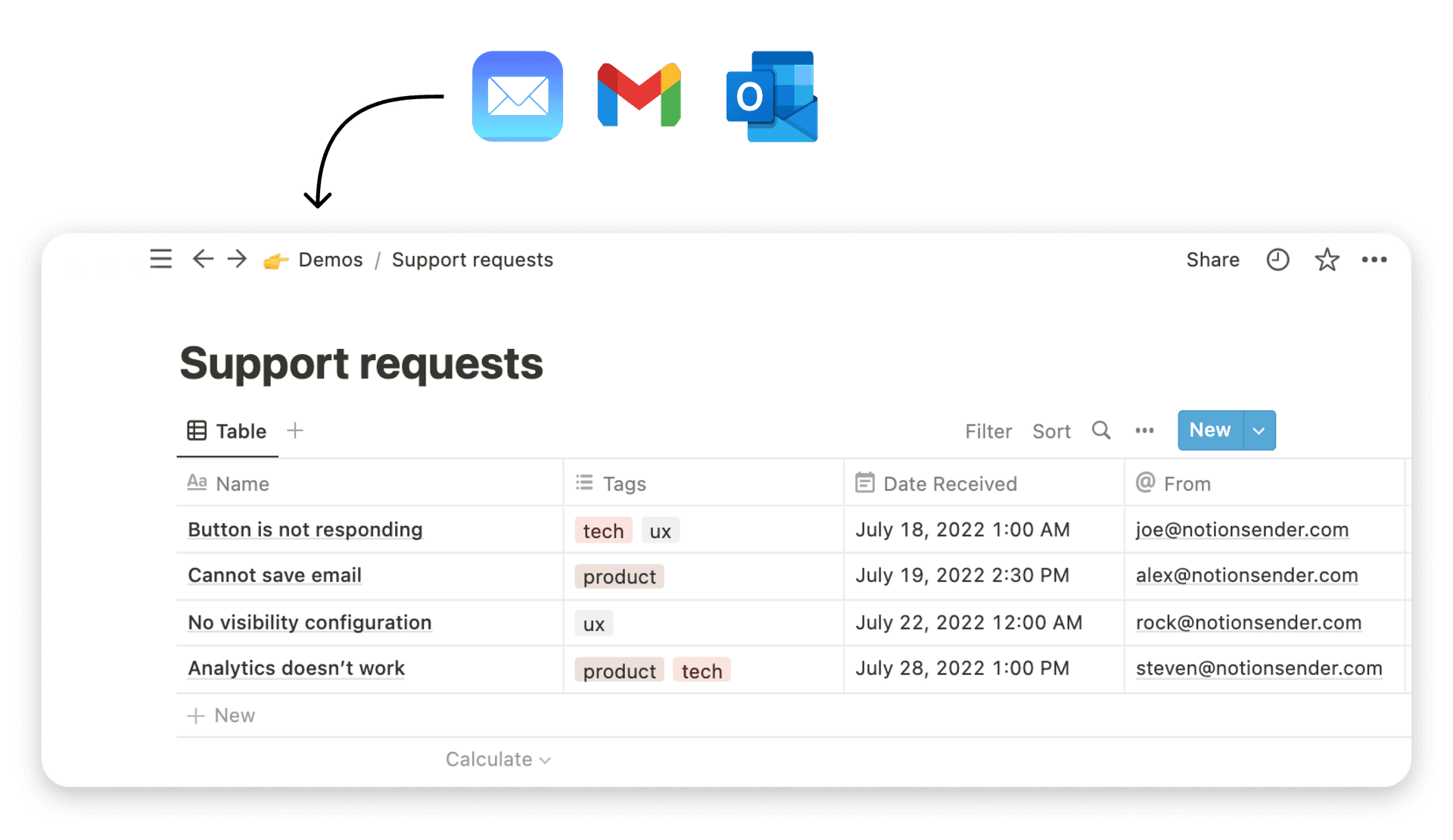
This database becomes far more useful once email enters the system. If you want a practical example of that workflow, this guide on saving emails to Notion shows the kind of capture process that prevents inbox details from disappearing.
A simple relationship map
Here is the structure I use most often:
- Goals connect to many Projects
- Projects connect to many Tasks
- Clients connect to many Projects and Tasks
- Tasks sit at the action layer and can roll up to everything above them
That creates a planner where one client email can become a task, a task can belong to a project, and the project can support a quarterly goal.
If you cannot tell what a task supports, the system is missing a relation or the task does not matter.
What works and what does not
What works:
- A small number of clear properties
- Status fields you will use
- One tasks database, not three separate ones
- Archiving instead of deleting
What does not:
- Building separate databases for every life area too early
- Tracking too many statuses
- Turning every note into a structured record
- Copying a template without trimming it
Your planner becomes reliable when capture is fast and review is obvious. Fancy layouts can wait.
Creating Dynamic Dashboards and Views
A database can be technically sound and still feel unusable. Users often do not need more data. They need better views of the same data.
A Notion life planner starts to feel helpful day to day at this point. The dashboard should not be a homepage full of decoration. It should answer, at a glance, what needs doing now, what is coming next, and what is drifting.
Build one command center
Create a main page called something plain like Command Center or Today. Then pull in linked database views from your Tasks, Projects, Goals, and Clients databases.
The key is not duplication. It is perspective.
Your dashboard can contain:
- Today view showing tasks due today or overdue
- This week view grouped by date
- Waiting view for delegated or blocked items
- Active projects view filtered to current work only
- Upcoming follow-ups view for client communication
- Goals snapshot showing progress-linked projects
This gives you one operational front end while the backend remains clean.
Use filters that match real decisions
The best filters are boring and useful. If you find yourself adjusting the same view every morning, the view is wrong.
Examples that hold up in practice:
- Today Due date is today, or overdue, and status is not complete
- Next seven days Date between now and the coming week
- Deep work Priority is high, context is desk, and no meeting required
- Client follow-ups Next follow-up is on or before today
A dated view is especially effective when combined with GTD-style weekly review habits. You process your inbox, assign dates only when necessary, and surface work in the right time window.
Use rollups and formulas for fast signal
Dashboards become more than lists with these features.
According to the tutorial on building advanced habit tracking in Notion, modern planners use per-habit analytics, daily progress bars, weekly line charts, and dynamic formulas that can visualize metrics such as 85% habit adherence.
You do not need that level of complexity everywhere. But the principle matters. Use formulas and rollups where they reduce decision time.
Practical examples:
- A project progress bar based on completed tasks versus total tasks
- A goal progress summary rolled up from linked active projects
- A client health glance showing last contact date and open tasks
- A habit tracker with a quick visual indicator instead of a full journal entry
Build statistics only where they change behavior. A graph that never affects action is just dashboard furniture.
Three views almost everyone should keep
Daily execution
This is the view you open first.
It should show only what is relevant today: overdue items, tasks due today, and perhaps one short list of high-priority work. Keep it narrow. If it turns into a full project browser, you will avoid it.
Weekly planning
This view is broader and calmer. Group tasks by day or sort by due date. Include active projects nearby so you can see whether the week is aligned with current commitments.
Many users plan only from tasks, which is a mistake. Plan from projects plus tasks. That is how you catch drift early.
Monthly review
At this point, your planner becomes strategic. Use it to check active goals, delayed projects, finance reminders, recurring admin, and life commitments that usually get crowded out by client work.
A strong monthly view keeps your planner from becoming a daily firefighting tool.
Automate Your Workflow with Email Integration
Most Notion life planner guides stop where real work begins. They show dashboards, habits, and pretty databases, then ignore the place where client information enters your business.
That place is your inbox.

The Notion template analysis on practical implementation gaps notes that existing content rarely addresses how to maintain complex systems or integrate external workflows, including how professionals capture client emails into project databases or automate invoice tracking.
That gap matters because email is often the trigger for work.
Where most planners break
A client sends a scope change. You read it, mean to update the project, and move on.
A meeting confirmation arrives with useful context. It stays in the inbox.
An invoice lands. You flag it, then forget to log it in your finance tracker.
None of these failures are dramatic. They are small breakdowns in capture. Over time, they make your planner less trustworthy because your planner is no longer where reality lives.
What email integration changes
When email feeds your Notion workspace, the planner becomes operational.
A few useful patterns:
- Client request to task Save a client email into a project-linked database, then turn it into a task with due date and owner.
- Invoice to finance log Capture billing emails into a finances database and connect them to the relevant client or project.
- Meeting recap to project record Store follow-up notes directly inside the project so context stays with execution.
- Sales inquiry to pipeline Route inbound messages into a lead or client onboarding workflow.
An external tool can significantly benefit your system here. If you want to see the sending side of that process, this walkthrough on how to create and send email from Notion shows the kind of loop that keeps communication and execution in the same workspace.
A short demo helps make that practical:
<iframe width="100%" style="aspect-ratio: 16 / 9;" src="https://www.youtube.com/embed/mDmc0yWFXw0" frameborder="0" allow="autoplay; encrypted-media" allowfullscreen></iframe>
A realistic workflow for freelancers
A clean setup often looks like this:
- Email arrives from a client with a revision request.
- The message is saved into a communications or project database.
- A task is created and linked to the active project.
- The client record updates with the latest contact date.
- The project dashboard reflects the change without manual copying across tools.
That sequence removes the common problem of handling communication in one place and delivery in another.
The trade-off to respect
Automation should capture and route. It should not think for you.
You still need a review habit. Someone has to decide whether an email becomes a task, a note, a finance entry, or nothing at all. The gain is not that the system eliminates judgment. The gain is that the system eliminates repetitive transfer work.
The right automation reduces copying, not accountability.
For busy operators, that is usually the difference between a planner you maintain weekly and one you trust daily.
Advanced Planner Customizations and Tips
Once the core system is stable, customization starts to pay off. At this stage, your Notion life planner becomes personal without becoming chaotic.
The mistake is adding advanced features because they look smart. Add them because they solve recurring friction.
A habit tracker that earns its place
One client wanted better consistency around workouts, sleep, and reading. We did not build a giant wellness dashboard. We added a compact habit database linked to a weekly review page.
The setup stayed useful because it showed only three things:
- Today’s check-in
- This week’s completion
- A simple visual trend
That was enough. The moment habits require too much logging, people stop recording them.
A content calendar for marketers
Marketing professionals usually need less journaling and more visibility across campaign work.
A board view works well here:
- Ideas
- Drafting
- Scheduled
- Published
Keep it connected to Projects if content belongs to a broader launch. Do not force every content item into a complex editorial system unless the volume justifies it.
A finance tracker for owner-operators
A simple finance database can hold income, expenses, invoice status, due dates, and client relation. That is often enough for planning purposes.
The win is not replacing accounting software. The win is seeing operational cash tasks inside the same planning system you already check every day.
Small tweaks that keep the system usable
These changes tend to matter more than flashy formulas:
- Archive checkbox: Hide completed projects and stale records without deleting them.
- Database templates: Create repeatable shells for new client projects, meeting notes, or onboarding steps.
- Default filtered views: Open the database to current work, not the full backlog.
- One inbox page: Capture first, sort later.
For more practical cleanup and maintenance ideas, these tips to get the most out of Notion are worth reviewing.
A planner stays useful when new information enters quickly and old information disappears from daily view.
The best customizations are usually the least glamorous. They remove friction from work you already do every week.
Your Centralized Hub for Productivity
A strong Notion life planner does one job well. It gives your work and personal commitments a shared operating system.
When the architecture is solid, your daily dashboard stays clear. When the databases are connected, tasks stop floating without context. When email flows into the same workspace, the planner stops being a static organizer and starts acting like a real control center.
That is the practical shift. Less hunting. Less copying. Fewer dropped details.
Start smaller than you think you need. Build the core databases. Create one daily dashboard. Add automation only where repetitive admin keeps stealing time. A planner built this way grows with the business instead of collapsing under it.
If you want your Notion workspace to handle email as cleanly as it handles projects, NotionSender helps turn your planner into a working communication hub. You can bring emails into Notion, organize them inside your databases, and keep client communication tied to the projects and records that matter.