Master Your Business with a Notion Digital Planner

So, what exactly is a Notion digital planner? It’s a completely custom system you build inside Notion to manage everything—tasks, projects, notes, you name it. It takes all those scattered spreadsheets, documents, and random note apps and pulls them into one clean, connected workspace. For freelancers and small teams, it's a game-changer.
Why Your Business Needs a Real Notion Planner

Let's be real. Juggling spreadsheets for finances, a separate app for tasks, and trying to find client info in a sea of email threads just doesn't work. It’s messy. Important details get lost, deadlines slip through the cracks, and you end up spending more time looking for information than actually doing the work.
This is where building a proper Notion digital planner comes in. It’s not just about getting organized; it's about creating a living, breathing system that actually fits how your business runs. You can finally ditch the rigid, one-size-fits-all software that never quite works for you.
From Digital Clutter to a Central Command Center
With Notion, you are the architect. That means every single part of your planner—from a client database to a project timeline—is built exactly how you need it. This is why it’s so effective for managing everything from complex projects to your weekly content calendar.
But the real magic is how everything connects. Think about a planner where:
- A client’s contact page links directly to every project you’re doing for them.
- Each project has a task list, and checking off a task automatically updates a progress bar.
- Your daily to-do list automatically pulls in tasks that are due today from all your different projects.
This creates a true single source of truth, so you're no longer hopping between five different apps to piece things together. A well-built Notion planner helps business leaders process information faster because everything is right where it needs to be.
To see just how different this approach is, let's compare it to the old way of doing things.
Traditional Planning Tools vs a Custom Notion Planner
This table breaks down the practical differences between relying on scattered traditional tools and building a unified digital planner in Notion.
| Feature | Traditional Methods (Spreadsheets, Docs, Notes) | Notion Digital Planner |
|---|---|---|
| Data Connection | Siloed and disconnected; requires manual cross-referencing. | Interconnected databases; link clients to projects, tasks to meetings. |
| Customization | Limited; you're stuck with the tool's intended use. | Fully customizable; build the exact dashboards and workflows you need. |
| Workflow Automation | None or very limited; requires third-party tools like Zapier. | Simple automations built-in; update statuses or send notifications. |
| Centralization | Decentralized; information is spread across multiple apps. | A true "single source of truth" for all business information. |
| Scalability | Becomes messy and hard to manage as the business grows. | Scales with your business; easily add new databases and views. |
| Visuals & Layout | Functional but often uninspiring and hard to navigate quickly. | Highly visual; use calendars, galleries, and kanban boards for clarity. |
The difference is clear. While traditional tools get the job done on a basic level, a Notion planner creates a cohesive system that grows with you.
A Notion planner is less of a tool and more of an operating system for your business. It adapts to your needs, scales as you grow, and provides clarity in a world of information overload.
The Power of a Unified Workspace
This isn't just a niche trend; it's a major shift in how people get work done. Notion's popularity has skyrocketed, hitting 20 million monthly active users by late 2024, with that number continuing to climb.
Why the massive growth? Professionals are tired of the digital chaos and are actively seeking all-in-one solutions. This is the real power of creating your own Notion digital planner—it’s your chance to turn that chaos into a clear, productive, and dare I say, enjoyable workspace.
Laying the Foundation of Your Planner

The secret to a Notion planner you'll actually stick with isn't a fancy template. It's building a solid foundation from the ground up. We're going to create the interconnected databases that will act as the engine for your entire system.
By building it yourself, you ensure the planner is tailored to your real workflow from day one. We’ll start with three core databases that I consider the bedrock of any professional workspace. Getting this part right is what gives you clarity, not just another place to dump notes.
Building Your Core Databases
First things first, create a new, blank page in Notion. Think of this as your "backend" area where the raw data lives. A simple title like "Core Databases" works perfectly. Inside this page, we'll build out three separate full-page databases.
It's no surprise that professionals are flocking to tools like this. The digital planner app market is on a rocket ship, expected to jump from USD 1.2 billion in 2024 to USD 3.5 billion by 2033. This explosion is fueled by small teams and solo pros who need flexible systems to manage everything. If you're curious, you can explore more data on the digital planner market and its massive growth.
Now, let's create the databases that will form your command center.
- Projects: This is for your big-picture goals. A project is any major outcome with multiple steps, like "Client Website Redesign" or "Q3 Marketing Campaign."
- Tasks: Here’s where all the individual, actionable steps will live. Every to-do, from "Draft homepage copy" to "Schedule client check-in," gets its own entry.
- Contacts: This acts as your simple, built-in CRM. It’s the home for all key information on clients, collaborators, and leads, keeping everything tidy and in one place.
Don't get bogged down trying to make them perfect right now. Just getting these three databases set up is a huge first step.
A well-structured Notion planner is built on interconnected databases. The real power isn't in the individual lists; it's in how they talk to each other to provide a complete picture of your work.
Adding Essential Properties
With the databases in place, it’s time to add some properties. Properties are just the columns in your database that hold specific bits of information—like a due date for a task or a status for a project.
Let’s add a few practical properties to your Tasks database to make it useful right away.
- Status: Use a
Selectproperty. I like to start with simple options like "Not Started," "In Progress," and "Done." This gives you a quick visual on where everything stands. - Due Date: Add a
Dateproperty. This is a non-negotiable for any planner, as it lets you build calendar views and see what’s coming up. - Priority: Create another
Selectproperty with "High," "Medium," and "Low." It's a simple but effective way to focus on what really matters each day.
Do something similar in your Projects database. Add a "Status" property with options like "Planning," "Active," and "Completed." This provides a fantastic bird's-eye view of your entire workload.
Connecting Your Databases with Relations
This is where the magic really happens. A relation is a special property that links an entry in one database to an entry in another. It’s how we’ll get our tasks and projects to communicate.
Head over to your Tasks database. Add a new property and choose the Relation type. Notion will ask you which database to connect to—select your "Projects" database. Now, every time you create a task, you can link it directly to its parent project.
Once that's done, pop over to your Projects database. You'll see that Notion has automatically created a corresponding relation property for you. Just like that, you can see all the individual tasks associated with any given project. This simple connection transforms your separate lists into a cohesive system, setting the stage for the powerful dashboards we'll build next.
Designing Your Daily Command Center
Now that you've built the foundational databases, it's time for the fun part: bringing it all together into a dashboard you'll actually want to use. This is where your Notion digital planner stops being a collection of lists and becomes a true command center for your day.
The whole point is to see what matters, right when you need it. When you open your planner in the morning, you should know exactly what's on your plate without having to click around and hunt for information. Let's start by building your main hub for daily action.
Create Your Daily Hub
Think of this as your mission control. It’s the one page that gives you an immediate, no-nonsense snapshot of your most important commitments.
First, create a new page and give it a simple heading like "Today's Focus." Underneath, we're going to pull in the good stuff using linked views of the databases we already made.
Add a linked view of your Tasks database. Now, here’s the magic: use the filter to create a simple rule that says, "Show tasks where the 'Due Date' is today." Just like that, you've got a to-do list that automatically updates every single morning.
You can add another linked view right next to your daily tasks. This time, filter it to show tasks where "Priority" is "High." This keeps your most critical work right in your line of sight, even if the deadline isn't for a few days.
Your dashboard should be a source of focus, not distraction. By filtering views to show only what's relevant for right now, you create a space that reduces overwhelm and encourages action.
Design a Weekly Overview
The Daily Hub is perfect for in-the-trenches work, but you also need a bird's-eye view. A Weekly Dashboard gives you that perspective. On a new page (or just below your daily section), create another linked view of your Tasks database, but this time, switch the display to a Board.
Set the board to group by the "Due Date" property, and then change the date range to "By week." This lays everything out in a clean, visual format. It's a fantastic way to spot overloaded days ahead of time and just drag and drop tasks to balance your workload.
To keep things neat and easy to update, get familiar with synced blocks. You could, for instance, put your top three weekly goals into a callout block, turn it into a synced block, and then drop it into both your Daily and Weekly dashboards. If you want to dive deeper into optimizing your setup, you can learn more about getting the most out of Notion with these additional tips.
Finally, don't skimp on the aesthetics. A Notion digital planner you enjoy looking at is one you'll stick with. Use callout blocks with custom icons for key reminders, or organize your linked databases into columns for a clean, newspaper-style layout.
Okay, your dashboards are built and looking sharp. Now for the fun part. We're going to plug your email directly into your new Notion planner, turning it from a static organizer into a true command center for your work.
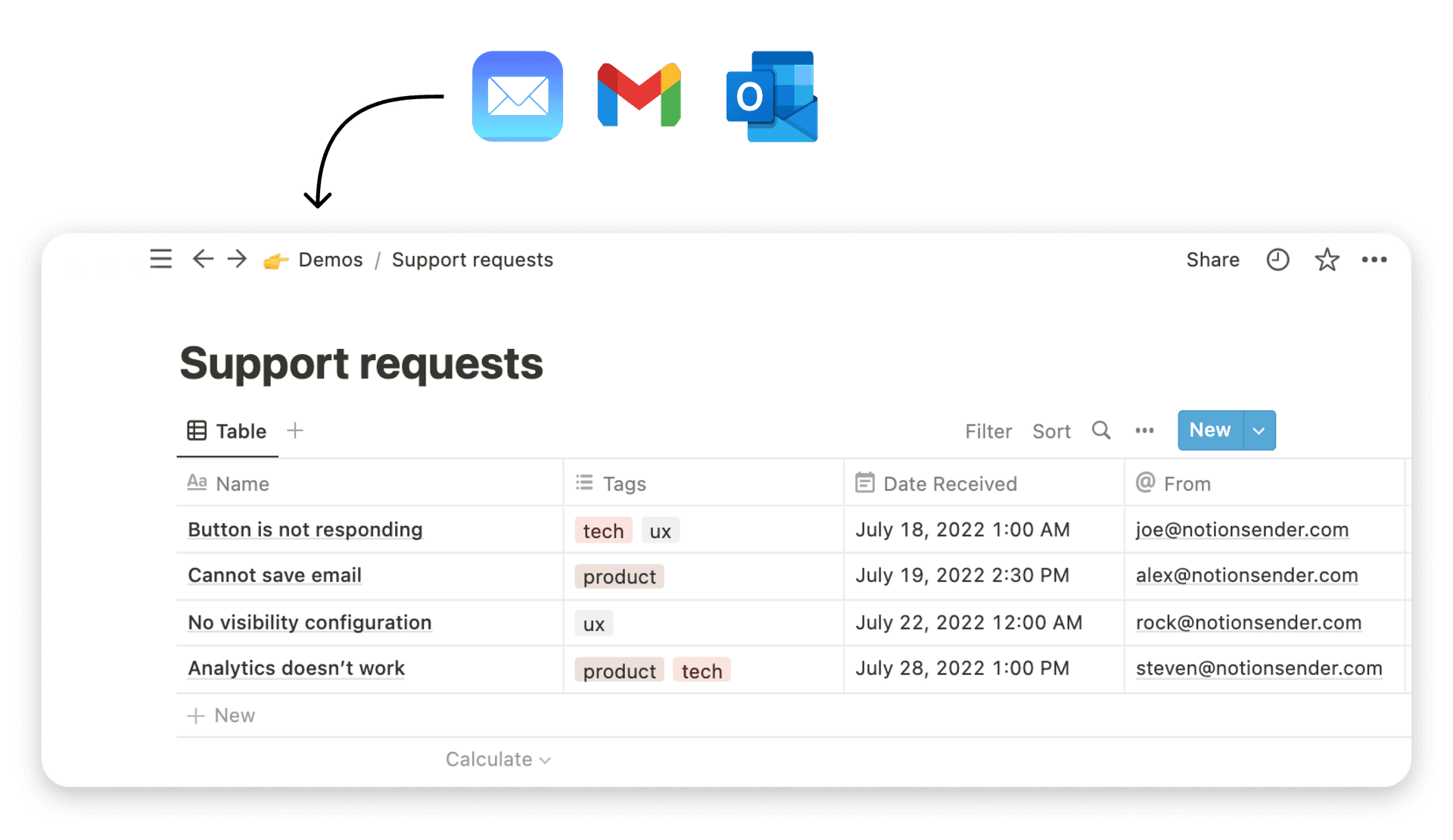
This is where the real magic happens. Imagine grabbing a new client request, an important invoice, or a promising lead straight from your inbox and dropping it right into your Notion tasks. That's what we're setting up with NotionSender. It completely closes the loop between your communication and your project management, saving you from the soul-crushing task of manual copy-pasting.
First, Create a Central Inbox
The first thing you need is a dedicated landing zone for all incoming emails. Hop over to your "Core Databases" page and create a new full-page database. Let's call it "Inbox." This will be the catch-all for everything you forward into Notion.
This idea of a central, integrated planner isn't just a niche trick; it's a huge reason why the digital planner market is booming. It grew from $2,549.73 million in 2021 and is on track to hit $7,047.01 million by 2033. For people managing projects, automatically piping email conversations into their planner is a massive time-saver for tracking follow-ups and keeping all communication in one place.
Inside your new Inbox database, you'll want to add a few key properties to get started:
- From (Email): An
Emailproperty to capture the sender's address. - Subject (Text): The
Titleproperty will work perfectly for the email subject. - Received (Date): A
Dateproperty to log when the email came in. - Status (Select): Create a
Selectproperty with options like "New," "In Progress," and "Archived."
This simple setup is all you need to get your planner ready to catch and sort emails on its own.
Generate Your Unique NotionSender Email
Now, let's get you connected. Head over to the NotionSender website and sign up. The process is straightforward and will walk you through connecting your Notion account.
When prompted, choose the "Inbox" database you just made. NotionSender will then generate a unique email address just for that database (it will be something like inbox.123abc@notionsender.com). This is your new secret weapon.
Any email you send or forward to this unique address will now automatically appear as a new item in your Inbox database. NotionSender's smart data extraction will populate the 'From', 'Subject', and 'Received' properties for you.
If you want to see a more detailed walkthrough of sending emails from Notion, check out our guide on email automation in Notion. It'll give you an even clearer picture of what you can do.
This is exactly how a powerful dashboard is built—by starting with solid, well-structured databases like the Inbox you just created.

As you can see, everything flows from those core databases. They power the daily and weekly views where you'll actually spend your time.
Put Your Integrated Planner to Work
With the connection live, you can start building some seriously powerful workflows.
Did a client just send an urgent email? Simply forward it to your NotionSender address. It instantly lands in your Inbox database. From there, you can link it to the relevant project, create a new task, and assign it a due date—all without ever leaving Notion.
Your email inbox goes from being a source of constant stress to a clean, actionable source of data. One last tip: before you start sending out automated replies or campaigns with NotionSender, it's a great idea to run your email template through a free email spam checker. This quick step helps ensure your important messages hit the inbox, not the junk folder, tying your whole professional workflow together.
Automating Your Business with Advanced Workflows
<iframe width="100%" style="aspect-ratio: 16 / 9;" src="https://www.youtube.com/embed/ZspKMh2WBsc" frameborder="0" allow="autoplay; encrypted-media" allowfullscreen></iframe>
Now that you’ve connected your email, your Notion digital planner can do more than just hold information—it can start doing the work for you. This is where you graduate from simple organization to real, hands-on automation that can genuinely save you hours every week.
These aren't just abstract concepts. They are the exact, practical workflows I've built into my own business. By setting up a few of these smart systems, you can all but eliminate manual data entry and keep your projects rolling forward with very little effort.
Tracking Invoices and Payments
If you’re a freelancer or run a small business, you know the constant headache of managing invoices. One of the best quick wins you can get with this setup is an automated invoice tracker.
It’s a surprisingly simple but powerful system. When a client emails you an invoice, just forward that email to the unique NotionSender address for your "Invoices" database. The system automatically logs the sender, the subject (which is often the invoice number), and grabs the PDF attachment.
From there, my workflow looks like this:
- The invoice is captured: NotionSender creates a new page in my Invoices database with the PDF already attached.
- I set a reminder: I quickly add the payment due date to the page properties.
- A task is created: I then link that invoice to a new item in my main "Tasks" database, something like "Pay Invoice [Client Name]," which ensures it shows up on my daily dashboard.
Just like that, a cluttered inbox becomes a clean, actionable accounts payable system. No more frantic searches for due dates or missing attachments.
Streamlining Meeting Management
Meetings are another part of the business that can be a huge time-sink. Instead of trying to manage scattered documents, email chains, and follow-up notes, you can run the entire process right from your Notion planner.
Here’s a workflow I rely on all the time:
- First, I'll draft the meeting agenda on a new page inside my "Meetings" database in Notion.
- Next, I use NotionSender to email the agenda page directly to all the attendees. This way, everyone is literally on the same page.
- As people reply with questions or feedback, I forward those emails straight back to the Notion meeting page. After the meeting, I can send a summary with all the action items directly from that same page.
This process keeps all communication and decisions tied to a single meeting. The entire conversation lives with the agenda itself, not spread across a dozen different email threads.
An automated workflow doesn't need to be complex to be powerful. By connecting key communication points to your planner, you create a system that organizes itself, reducing mental overhead and freeing you up for more important work.
Managing a Content Pipeline
For anyone creating content, from freelancers to marketing teams, getting a piece from idea to publication involves a lot of moving parts. NotionSender can bring some much-needed order to this process.
This visual approach is perfect for seeing exactly where every piece of content stands at a glance.
Think about a "Content Pipeline" Kanban board you might have in your planner. When you get an email from an editor with feedback on a draft, you can forward it directly to that content's card on your board. The email, attachments, and all, get logged right there alongside the brief, outline, and deadlines.
If you want to go even deeper and build more custom integrations, you can also explore the NotionSender API documentation.
Of course. Here is the rewritten section, adopting the requested human-expert tone and style.
Your Top Questions About Building a Notion Planner
Jumping into building your own Notion digital planner is exciting, but it almost always brings up a few questions. I see the same ones pop up time and again. People wonder about how it'll work with a team, if it's going to get clunky, or if it's just too complicated to even start.
Let's walk through some of those common hurdles. These are the practical, real-world answers I give to folks building out their own systems.
Is Building a Planner from Scratch Too Hard?
This is probably the biggest hesitation I see. It can look intimidating, but the secret is to not try and build Rome in a day. Start small.
Just focus on getting those core databases right—the ones we talked about earlier like Projects, Tasks, and Contacts. Once you get a feel for how they relate to each other, you can start adding new layers and dashboards. The whole point of building it yourself is that it grows with you. It ends up perfectly fitted to your workflow, not someone else's.
Can I Use a Notion Digital Planner with My Team?
Absolutely. In fact, Notion was designed for collaboration from day one. You can share the entire planner system, or just a single page, and then start assigning tasks and discussing project details right in the comments. This keeps every conversation tied directly to the work it’s about.
Here’s a pro tip for teams: create separate dashboards for each person using filtered database views. That way, everyone logs in and sees exactly what’s on their plate without getting bogged down by information that isn’t relevant to them.
When you bring in a tool like NotionSender, you can centralize all project-related emails, giving the entire team visibility into client conversations. Your planner stops being just a task list and becomes a true shared source of truth.
Why Use NotionSender and Not Just Basic Email Forwarding?
I get this question a lot, and it’s a great one because the difference is huge. Standard email forwarding is a pretty blunt tool. It just dumps the email's text and any attachments onto a blank Notion page, leaving you to do all the manual sorting and data entry.
NotionSender is much smarter because it was built specifically to understand how Notion databases work. It doesn't just copy text; it intelligently pulls out key info like the sender, subject line, date, and attachments, then automatically maps them to the right properties in your database. Your emails land in your system already organized and ready to be acted on. That's an automation superpower that simple forwarding just can't touch.
Will My Notion Planner Get Slow with Lots of Data?
It's true that a massive, poorly designed database can affect performance. But for a solo professional or a small team, a well-structured planner will run just fine. The key is to get really good at using filtered views on your main dashboards.
Instead of trying to load one giant, unfiltered database every time you open your "Today" page, you create linked views that only show a small slice of the data. For example:
- Tasks where the "Status" is not "Done".
- Projects marked as "Active".
- Tasks with a "Due Date" in the next 7 days.
This simple practice makes a world of difference. It keeps your daily workspace quick and responsive, making sure your system is a productivity tool, not a bottleneck.
Ready to turn your Notion workspace from a static page into an active command center? NotionSender is the bridge. Stop the endless copy-paste cycle and start automating your business communication.