Your Notion Event Planning Template: A 2026 Guide

You probably have the same event plan spread across six places right now. The run of show sits in one spreadsheet, vendor quotes live in your inbox, guest updates are buried in a thread someone forgot to forward, and the budget tracker breaks the moment a teammate sorts the wrong column.
That setup works until the event gets bigger, the timeline gets tighter, or a vendor misses a deadline and nobody can prove who confirmed what. A good notion event planning template fixes the obvious problem of scattered information. A great one fixes the harder problem, which is communication slipping outside the system.
Escape the Chaos of Event Planning Spreadsheets
Spreadsheets are fine for static information. Event planning isn't static. Dates shift, guest counts move, vendors revise quotes, and responsibilities change by the hour. Once communication starts happening in email, chat, and comments, the spreadsheet stops being a command center and turns into a partial record.

Notion became a serious home for event planning for a reason. By 2023, Notion reported over 20 million users worldwide, with project management templates, including event planning, accounting for approximately 35% of all template downloads according to Notion's event planning template gallery. That tells you something practical. Teams aren't just taking notes in Notion anymore. They're running operational workflows there.
Why spreadsheets break under event pressure
The typical spreadsheet stack creates the same problems again and again:
- Version drift: One person updates the vendor tab, another exports a CSV, and a third uses yesterday's file.
- No real context: A budget line shows a catering deposit, but not the email where the vendor changed headcount assumptions.
- Weak accountability: Tasks can be listed, but ownership, dependencies, and decision history are often unclear.
- Poor communication tracking: RSVP replies and vendor confirmations don't naturally belong in a spreadsheet.
That's why the shift to Notion matters. It can act as a single source of truth with databases, linked views, templates, and permissions that fit the way event teams work.
Practical rule: If a teammate has to ask, "Where does that live?" your system isn't centralized yet.
If you're comparing platforms before committing, it's worth reviewing broader lists of top free event planning tools to see where Notion fits best. For many small teams, Notion wins when the priority is flexibility. It loses when you need a rigid, purpose-built event platform out of the box.
The real upgrade is dynamic planning
Most template advice stops at pages, checklists, and dashboards. Useful, but incomplete. True power comes when your Notion setup doesn't just store information. It catches incoming information, routes it, and connects it to the right event record.
That means building a workspace where vendor replies, guest confirmations, contracts, tasks, and budget impacts all point back to the same event. Once that structure is in place, planning gets calmer fast. You spend less time hunting for updates and more time making decisions.
Start Fast with Pre-Built Notion Templates
Starting from zero isn't always smart. If your event is already on the calendar, the fastest route is often duplicating a good template and reshaping it instead of designing every property from scratch.
The Notion ecosystem provides three strong places to look: Notion's own template gallery, independent creators who publish event systems, and workflow-focused guides that show how teams use those templates. A practical companion is this guide with 10 tips to help you get the most out of Notion, especially if you're trying to keep your workspace from turning into a pile of duplicated pages.
How to judge a template quickly
A template looks impressive long before it proves useful. Ignore the banner image and inspect the structure.
Use this checklist:
- Look for databases, not long pages. A serious template should have separate data structures for events, tasks, and contacts instead of one scrolling document.
- Check whether views are purposeful. A calendar should show deadlines. A board should reflect status. A table should support cleanup and admin work.
- Test the relationships. If a task can't be linked to an event, assignee, or due date cleanly, you'll feel that weakness immediately.
- Review the property names. Good templates use plain language. Bad ones come with decorative labels that no team will maintain.
- Watch for dead sections. Many templates include areas that look useful but never get updated after week one.
Good templates usually share these traits
| What to inspect | What good looks like | What to avoid |
|---|---|---|
| Event overview | One master event record with dates, owner, budget, venue | Separate pages with repeated details |
| Task setup | Linked tasks with status, due date, assignee | Checklists buried inside event pages |
| Budgeting | Structured expense entries and totals | Manual text fields for spending |
| Guest handling | Attendee or RSVP database | Static invite list with no workflow |
| Reusability | Template buttons or database templates | One-off layouts built for a single event |
A template should reduce decisions, not add maintenance.
Make the first edits immediately
Once you duplicate a template, don't start filling it in right away. Clean it first.
Rename statuses to match your team. Delete views you won't use. Add your actual workflow labels for approvals, vendor stages, and event phases. If you keep someone else's naming conventions, your team will hesitate every time they update a record.
Then pressure-test one real scenario. Add a venue vendor, create three tasks, enter two expenses, and simulate an RSVP. That reveals whether the template supports actual work or just looks organized in screenshots.
Pre-built templates are best when time is short and your process is already understood. If your event work is growing or repeating, you'll get more value from building a structure you fully control.
Build Your Core Event Database from Scratch
A professional Notion setup starts with one database. Not five. Not a homepage full of disconnected widgets. One Events database that every other piece of the system can connect to.

Layout differs from structure. If your notion event planning template begins as a pretty page, you'll rebuild it later. If it begins as a database, you can scale it without losing control. That's one reason multi-view systems perform better in practice. A 2025 NotionApps study showed that users employing templates with multi-view databases, such as timeline, board, and calendar, achieve a 92% on-time event completion rate, as these views reduce coordination errors by an estimated 50%, as noted in NotionApps' event planner template analysis.
Start with the right properties
Create a database called Events. Every row is one event.
Use properties that answer operational questions fast:
- Event Name for the primary title
- Status with options like Planning, Confirmed, Live, Complete, On Hold
- Event Type for webinar, workshop, birthday, conference, launch, internal meeting
- Start Date and End Date
- Owner for the primary lead
- Venue as text or relation if you're tracking locations separately
- Budget Cap as a number
- Priority if your team handles multiple events at once
- Client or Brand if you're an agency or freelance planner
- Notes for high-level context only
Keep this database lean. It should summarize the event, not absorb every detail.
Build views that answer different questions
One database can serve very different users if the views are designed well.
Set up these views first:
-
Master Table
This is your admin view. Show every property, sort by start date, and use it for cleanup. -
Calendar
Useful for seeing event dates and timing conflicts across upcoming work. -
Board by Status
This is the simplest way to review pipeline health. You can spot stalled events immediately. -
Gallery
Good for client-facing or visual planning if you add a cover image, venue shot, or campaign creative. -
This Month
A filtered table or list for active events only. Teams use this more than the full database.
The best view is the one a teammate will actually open before asking you for an update.
Keep the event page itself focused
Each event page should act like a dashboard for that event, not a junk drawer. I keep the top of the page reserved for decisions and deadlines, then linked views underneath for tasks, budget lines, vendors, and guests.
A strong event page usually includes:
- An executive snapshot with status, owner, dates, and budget
- A milestone block for booking, launch, final confirmation, event day, wrap-up
- Linked database views filtered to that event only
- Reference files such as floor plans, decks, contracts, or briefs
Common build mistakes
Most messy systems go wrong in familiar ways:
- Too many text fields: If data should be sortable or filterable, make it a proper property.
- One page per event with subpages only: That feels tidy at first, but cross-event reporting becomes painful.
- No status discipline: If everything sits in a generic "In Progress" bucket, your board won't help.
- Overdesigned dashboards: Decorative icons don't compensate for weak structure.
A clean Events database gives you a stable center. Once that exists, every task, expense, guest, and communication can link back to it without duplication.
Layer on Task, Budget, and Guest Management
The jump from basic planning to dependable execution happens when you stop cramming everything into the event record and start using related databases. Notion becomes operational instead of decorative through this structural shift.

Think in layers. The event is the container. Tasks, expenses, and guests are separate systems with their own logic. Linking them keeps the workspace clean and makes reporting much easier.
Build a real task database
Create a Tasks database and add a relation property back to Events. Every task should belong to an event. If it doesn't, it probably shouldn't be in this system.
Useful properties include:
- Task Name
- Related Event
- Assignee
- Status
- Due Date
- Dependency or Blocker
- Category such as logistics, marketing, venue, speaker, production
- Priority
Inside each event page, add a linked view of Tasks filtered to that event. Then make multiple views within that block. A board by status works well for execution. A timeline or calendar helps for deadline compression near event day. A table view is still best for cleanup.
One practical rule matters here. Avoid giant master task boards that mix every event and every team member without filters. People stop trusting them.
Set up budget tracking with rollups
The cleanest budget system uses a separate Expenses database rather than a budget table inside the event page. Relate each expense to an event, then roll up those entries into your Events database.
Use fields like these:
| Property | Use |
|---|---|
| Expense Name | Short label for the line item |
| Event | Relation back to Events |
| Vendor | Optional relation if you track vendors separately |
| Category | Catering, venue, AV, travel, gifts, ads |
| Estimated Cost | Expected amount before confirmation |
| Actual Cost | Final number once paid |
| Payment Status | Pending, Partial, Paid |
| Invoice or Contract | Files and media |
| Due Date | Payment timing |
In the Events database, create rollups for total estimated spend and total actual spend. Then add a formula or comparison property to flag whether you're under, near, or over the budget cap.
This changes budget conversations. Instead of asking someone to update a separate summary page, the event record updates itself when an expense line changes.
Field note: Budget trackers fail when teams only log final costs. Track expected costs early, then replace them as invoices become firm.
Handle guests as a system, not a list
Guest management gets messy quickly because invitations, plus-ones, dietary notes, confirmations, and follow-ups all move at different speeds. A dedicated Guests or RSVPs database keeps that from collapsing into comments and colored cells.
Include properties such as:
- Guest Name
- Related Event
- Company or Group
- RSVP Status
- Ticket Type or Invite Tier
- Dietary or Accessibility Notes
- Seat or Table Assignment if needed
- Special Handling for VIPs, speakers, sponsors, media
For small events, one guest database works well. For more complex events, I prefer separating contacts from event attendance so one person can appear across multiple events without duplicate records.
A walkthrough can help if you want to see how people structure event systems visually. This demo is useful for layout ideas and implementation details:
<iframe width="100%" style="aspect-ratio: 16 / 9;" src="https://www.youtube.com/embed/7lIfD9IYHGg" frameborder="0" allow="autoplay; encrypted-media" allowfullscreen></iframe>
How the linked model changes daily work
Once tasks, expenses, and guests all point back to Events, your dashboard becomes much more useful:
- The event record shows live totals instead of hand-typed summaries.
- Team members work in their own filtered views without breaking the master system.
- Review meetings get faster because everyone is looking at the same data model.
- Post-event reporting gets easier because the history stays attached to the event.
This structure takes more setup than a single-page template. It also prevents the usual late-stage scramble where information exists, but no one can connect it.
Integrate Email to Automate Vendor and Guest Communication
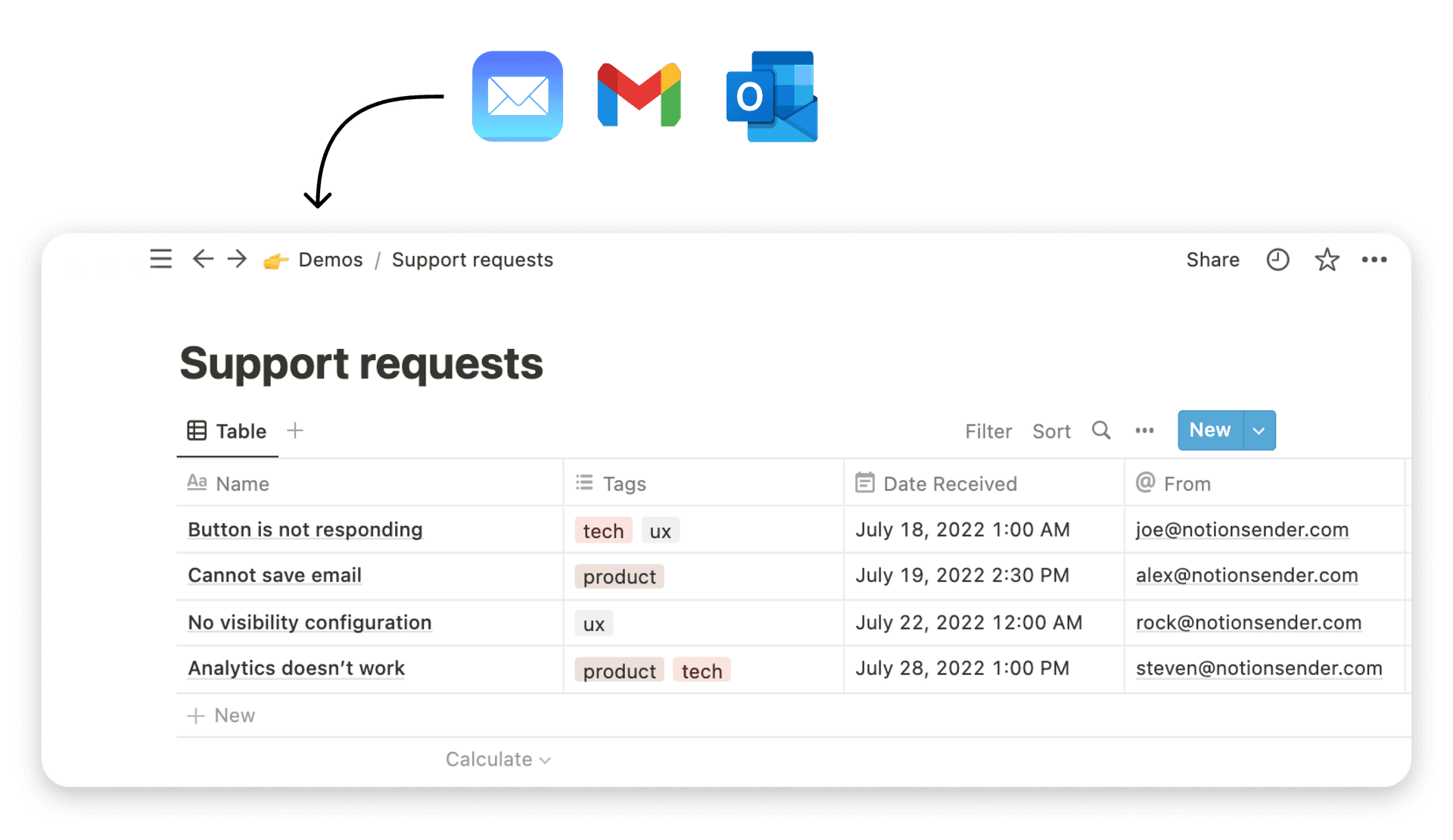
Most event systems break at the inbox. The plan lives in Notion, but the actual work of coordination happens in email. That split creates delays, duplicate outreach, missing approvals, and expensive misunderstandings.

This isn't a side issue. Event planning industry benchmarks reveal that vendor coordination consumes 35-40% of total planning time, with organizations implementing integrated email workflows reporting 48% faster vendor response times, according to the workflow discussion in this vendor communication analysis. If your notion event planning template doesn't account for communication, you're managing half the project in the dark.
What static templates miss
A standard template usually gives you a vendor list with fields for contact name, phone number, and contract status. Useful, but incomplete. The actual pressure points are different:
- Which quote is the latest one
- Whether someone followed up after a missed response
- Where the signed contract lives
- Whether a guest reply updated the attendee list
- Who on the team owns the next communication step
Inline comments inside Notion rarely solve this. They're fine for internal discussion, not external communication history.
Keep one rule for vendors. The latest truth should be visible from the vendor record, not hidden in somebody's inbox.
A better workflow for vendor communication
The strongest setup uses a dedicated Vendors database linked to Events, then routes communication into that database so each vendor record carries its own history.
A practical workflow looks like this:
-
Create a Vendor Master database
Track vendor name, service category, primary contact, contract status, payment status, and related event. -
Add workflow stages
Use statuses such as Researching, Awaiting Quote, Proposal Received, Confirmed, Contract Signed, Paid, Complete. -
Capture correspondence centrally
Each vendor record should hold the running context, including files, notes, and communication logs. -
Generate follow-up tasks from status changes
If a quote is late or a contract is unsigned, the task should appear in your task system instead of relying on memory.
If you want the mechanics of sending messages from inside your workspace, this guide on create and send email from Notion shows what that setup can look like in practice.
Use the same logic for RSVPs and guest updates
Guest communication benefits from the same approach. Instead of treating RSVP email as something separate from the event database, route it into the workspace so responses can be tied directly to attendance records.
That allows you to:
- Keep guest replies attached to the right event
- Review unanswered invitations in one place
- Flag special notes like dietary requests or guest substitutions
- Trigger internal follow-up when someone important responds late or asks for changes
Where teams usually go wrong
The most common mistake is trying to preserve the old process while adding Notion on top of it. People keep emailing from personal inboxes, pasting summaries into notes, and promising they'll update the database later. They won't, at least not consistently.
The second mistake is overbuilding automation before the data model is clean. If your event, vendor, and guest records aren't structured properly, automation just moves bad information faster.
A dynamic template works because communication becomes part of the operating system, not a separate stream someone has to remember to reconcile.
Scale Your Template for Multiple Events and Teams
A system that only works for one event isn't a system. It's a project file. The moment you're running overlapping launches, client events, or recurring workshops, structure matters more than style.
That pressure is common. According to a 2025 NotionApps survey, 62% of freelancers abandon rigid templates due to poor multi-event handling, as summarized in this discussion of scalable template structures. The fix isn't another prettier dashboard. It's a portfolio view built on relations, filters, and repeatable templates.
Build a portfolio dashboard
Create one top-level dashboard with linked views filtered from your core databases:
- Active events by owner so each teammate sees their load
- Upcoming deadlines across all events from the Tasks database
- Budget watchlist showing events that need review
- Vendor follow-up queue for overdue confirmations
- Guest response exceptions for VIPs or unresolved attendance issues
This is also where process standardization pays off. Add a reusable event kickoff template inside the Events database that preloads milestone tasks, default views, and standard sections. Teams stop reinventing setup every time.
For teams that want to extend the workspace with custom workflows, the NotionSender API documentation is useful background for planning how communication data can fit a broader operating model.
Scalable event operations depend less on one perfect template and more on consistent database rules.
Protect collaboration from becoming clutter
Share narrowly. Internal teams can work from filtered views. Contractors should usually see only the tasks, vendors, or event pages relevant to them. Clients often need a summary dashboard, not the raw operating system.
As your calendar fills up, communication load becomes a significant bottleneck. If your outreach process still depends on manual chasing, it helps to review broader strategies that streamline outreach with email automation. The principle applies directly to event planning. Repeated follow-ups should come from a system, not memory.
If your event planning workspace is organized but your communication is still scattered, NotionSender is worth a close look. It gives your Notion databases a practical way to send, receive, and organize email so vendor coordination, guest replies, and follow-ups stay tied to the records your team already uses.