Mastering Notion for iPad: Ultimate Productivity Guide

Your iPad probably has more power than your old laptop had a few years ago. Yet for a lot of people, it still ends up as a beautiful screen for email, PDFs, and a dozen disconnected apps that never quite turn into a system.
That’s usually the main problem. The device isn’t weak. The workflow is fragmented.
When notion for ipad is set up properly, it stops being just a note-taking app and starts acting like a control center. Notes, task lists, project tracking, reference material, and lightweight operations can all live in one place. Add touch-first navigation, a smart database structure, and a few iPad-specific habits, and the device starts feeling less like a companion and more like a machine you can run work from.
Unlocking Your iPad's True Potential with Notion
A lot of iPad owners work in a loop that creates friction all day. Notes live in one app. Tasks sit somewhere else. Files are scattered between cloud storage, email, and screenshots. The result is simple. You spend more time finding context than doing the work.
That’s where notion for ipad earns its place. It centralizes pages, databases, and project views in one workspace that’s built for quick capture and quick retrieval. On iPad, that matters more than it does on desktop because every extra tap feels expensive.
Notion’s mobile momentum also helps explain why more professionals are willing to rely on it away from a desk. Toolfinder reports that Notion is projected to reach 100 million users worldwide by 2026 and that its website sees more than 150 million visits per month, which reflects broad adoption that extends to mobile workflows like iPad use (Notion statistics from Toolfinder).
Why the iPad version changes the equation
The iPad is best when your system respects how you use it. You tap, drag, swipe, split the screen, sketch a thought, and move on. Notion fits that mode well when your workspace is designed for touch instead of copied from a desktop layout.
Three shifts make the biggest difference:
- One workspace instead of five apps: meeting notes, project status, content calendars, and personal capture can sit inside one structure.
- Fast interaction: touch gestures remove some of the menu hunting that slows desktop-style apps on tablets.
- Better continuity: if you work in short bursts between meetings, travel, or client calls, an iPad-friendly workspace lets you pick up where you left off.
Practical rule: If your iPad workflow depends on constant app switching, it isn't a system yet.
For small business owners and freelancers, this matters because the iPad often shows up in the in-between moments. Reviewing a proposal in a car, checking a campaign calendar from a café, logging client notes after a call, or updating a project board from a sofa. Those moments are where scattered tools break down.
If you're still deciding what should live on your device and what shouldn't, it helps to find your perfect productivity app before you build a heavier setup. But if you already know you want one workspace that can hold both documents and operations, Notion is one of the strongest candidates for turning an iPad into something useful.
Foundation First Your Notion iPad Setup
The fastest way to hate notion for ipad is to install it on an old device, skip the basic checks, and assume every lag or sync problem is normal. It isn’t.
The foundation matters more on iPad than on desktop because tablet workflows are less forgiving. If the app hesitates, loses edits, or fights your Pencil, you’ll stop trusting it.

Check compatibility before you do anything else
Notion states that its iPad app requires iPadOS 17.0 or later for optimal performance, and notes that users on unsupported hardware can run into real usability issues. In the same guidance, Notion indicates that 40% of users on unsupported hardware report sync failures, 25% experience Pencil lag over 500ms, and updating the latest compatible iPadOS resolves 95% of initial load crashes reported in early 2024 benchmarks (Notion system requirements).
That tells you exactly where to start.
- Open Settings > General > About and confirm your iPad model.
- Open Settings > General > Software Update and install the newest compatible version.
- If your iPad can’t run the required system version well, treat that as a hard limitation, not a tweakable issue.
Old hardware can still open apps. That doesn't mean it can handle modern database-heavy workspaces smoothly.
Set up for reliability, not just access
Once compatibility is clear, keep the initial setup boring and dependable.
Use this order:
- Sign in and open your main workspace first: don’t start by browsing templates. Open the pages you’ll use most often so the app begins caching the material you care about.
- Enable offline access in your account settings: this gives your iPad a better chance of keeping critical pages available when your connection drops.
- Pin down your top pages: create a small set of operational pages you return to daily, such as Inbox, Tasks, Projects, and Notes.
The best first version of a Notion iPad setup is not impressive. It's stable, obvious, and easy to open under pressure.
A lot of users make the same mistake here. They import a huge desktop workspace to iPad and expect it to feel natural. It won't. The homepage that works with a trackpad often feels cramped and noisy on a tablet.
Build a mobile-first home screen
Your iPad home in Notion should answer one question fast. What do I need to act on right now?
A practical layout looks like this:
| Area | What to put there | Why it works on iPad |
|---|---|---|
| Top section | Today, This Week, Inbox | Minimal scrolling |
| Middle section | Active projects only | Keeps decision-making tight |
| Bottom section | Reference links, archive, templates | Available, but out of the way |
Keep page titles short. Avoid wide databases as your landing experience. Favor linked views filtered to the exact information you need.
If you want extra ideas for streamlining the workspace after setup, these tips to get the most out of Notion are useful as a second pass, after the basics are working.
Basic settings that reduce friction
Once the app is running cleanly, tighten a few habits:
- Open key pages while online each day: that improves your odds of having current content available later.
- Duplicate essential pages: if you rely on a page during travel or site visits, keep a local-friendly backup version with less complexity.
- Test before relying on it: make a small edit, switch apps, go offline, then reopen Notion and confirm your workflow behaves the way you expect.
Trust is forged. Not in a perfect dashboard, but in a workspace that opens quickly, syncs cleanly, and doesn’t make you second-guess whether a note was saved.
From Touch to Stylus Mastering iPad Inputs
The biggest productivity gain on iPad doesn’t come from adding more pages. It comes from using the device the way it wants to be used.
Notion on iPad is quickest when you stop treating it like a shrunken desktop app. Touch, drag, press, and Pencil input each have a role. Once you know which input is best for which task, the app gets much faster.

The touch gestures worth memorizing
Some gestures save only a second or two. Over a day, that adds up.
On iPad, Notion supports touch behaviors that are especially useful for database-heavy work. Swipe left can help with quick actions like deleting or duplicating rows. Pinch-to-zoom gives you a faster overview of content. Long-press opens context menus without hunting for small targets. Drag-and-drop lets you reorganize blocks more naturally than cutting and pasting.
Use them in the places where they save the most friction:
- For task databases: swipe actions are faster than opening each row menu.
- For page cleanup: drag blocks into a better order instead of selecting and moving text manually.
- For review sessions: pinch out for overview, then back in when you’re editing details.
- For quick decisions: long-press is often the fastest path to duplicate, move, or edit.
Where Apple Pencil helps and where it doesn't
This is the part that trips people up. Apple Pencil is useful in Notion for selection, navigation, and marking your place. It is not a strong native drawing tool inside the app.
The verified limitation matters. Apple Pencil integration in Notion’s iPad app lacks native drawing, so users depend on workarounds. The same verified data says those workarounds have 75% efficacy, that embedding a drawing from a whiteboard website is 85% stable on iPadOS 17+, and that importing drawings such as PNGs from Apple Notes has 100% fidelity for files under 5MB. It also notes that trying to force native Pencil drawing can have a low success rate and may crash AI queries 15% of the time (Apple Pencil workflow reference).
That leads to a simple rule. Use Pencil for precision, not for pretending Notion is a sketch app.
If you need freehand thinking, draw somewhere else first. Then bring the result into Notion.
The two Pencil workflows that actually work
Import from Apple Notes when you need reliability
If you sketch process diagrams, annotate a client idea, or mark up a rough layout, draw in Apple Notes first. Then export or copy the result into Notion.
This works well for:
- meeting whiteboard snapshots
- hand-drawn workflow maps
- quick visual feedback for collaborators
- rough page wireframes
The reason it works is simple. Apple Notes is built for ink. Notion isn’t.
Use embeds when the sketch needs to stay editable
If the drawing is something you’ll revisit, use a whiteboard tool in Safari and embed it into a Notion page. It’s not elegant, but it’s closer to a living canvas.
This is best for project managers who need:
- timeline sketches
- swimlane drafts
- process flows
- campaign mapping during planning
The trade-off is stability. Embeds are practical, but they can be less dependable than imported static images.
Input choices by task
Here’s the simplest way to decide what to use.
| Task | Best input | Why |
|---|---|---|
| Reordering content | Touch drag-and-drop | Fastest and most natural |
| Selecting text precisely | Apple Pencil | Better control than finger taps |
| Sketching a process | Apple Notes first | More dependable ink workflow |
| Updating a database | Touch, sometimes keyboard | Fewer interruptions |
| Reviewing layouts | Pinch and long-press | Quick navigation without extra menus |
If you use an external keyboard, combine it with touch rather than trying to replace touch. Keyboard for text. Touch for structure. Pencil for precision.
The mistake that slows most users down
They expect one input method to do everything. It won’t.
Finger input is better for navigation and manipulation. Pencil is better for selecting and annotating. Keyboard is better for text volume. Once you assign roles that way, notion for ipad feels much less clumsy.
That’s also why many “Pencil in Notion” complaints are really workflow design problems. The hardware is good. The app is good at some things. It just isn’t a native handwriting canvas, and your system should respect that boundary.
Advanced Mobile Workflows Multitasking and Databases
The iPad becomes a serious work machine when Notion stops living alone on screen. Its true advantage comes from running it alongside the other app that holds your current context.

A marketing lead might keep Safari open on one side with campaign assets, analytics, or research, and Notion on the other with a content calendar and task database. A freelancer might review a client brief in Mail or Files while updating a project page in Notion. A project manager might use a meeting app in one pane and a decision log in the other.
In this scenario, the iPad starts outperforming the “open one app, close one app” habit that makes tablet work feel slow.
Split View and Slide Over that earn their keep
Split View works best when one app is a source and Notion is the destination. Don’t try to edit two complex apps equally at once. Use one to reference, one to capture.
A few combinations work especially well:
- Safari plus Notion: research, then turn findings into notes, tasks, or database entries.
- Mail plus Notion: review requests and log actions immediately.
- Files plus Notion: open contracts, briefs, or PDFs while updating project pages.
- Calendar plus Notion: review commitments and adjust workload or deadlines.
Slide Over is better for quick checks. Keep a compact task list, inbox, or meeting notes page available there if you like glancing at operational details without breaking the main screen.
A good iPad multitasking setup gives each pane a job. One app informs. The other app records decisions.
Build databases for touch, not for spreadsheets
A desktop database can be wide, dense, and property-heavy. On iPad, that usually feels miserable.
The fix is not to avoid databases. The fix is to design them for narrow screens and fast edits.
Start with properties that are easy to update with taps:
- Status
- Select
- Multi-select
- Date
- Checkbox
Rely less on long text fields unless they’re essential. If a property demands typing every time, it creates drag on a tablet.
A useful mobile database design often includes:
| Database element | Better mobile choice | Avoid when possible |
|---|---|---|
| Progress tracking | Status labels | Long typed updates |
| Prioritization | Select field | Notes buried in title |
| Scheduling | Calendar view | Date details hidden in body text |
| Ownership | Person property | Manual name entry in notes |
Create separate views for the iPad instead of forcing your desktop view to do everything. A board view for active tasks, a filtered list for today, and a calendar for deadlines usually cover most daily work.
A practical example for campaign management
If you run content or marketing operations, keep one database for deliverables and one for requests.
The deliverables database should hold:
- title
- status
- priority
- due date
- owner
- channel
The requests database should hold incoming ideas, approvals needed, and source notes.
Then use Split View. Safari on the left for research, ad previews, or landing pages. Notion on the right for converting that input into scheduled work. You’re not just collecting information. You’re turning it into action in real time.
For teams exploring more ways to connect work inside Notion, these ways to use Notion to send emails and more can help spark workflow ideas around communication-heavy processes.
Offline thinking that doesn't fall apart
Offline use on iPad is useful, but it works best when you plan for it. Notion caches recently viewed pages and database content from the last few days, which is enough for read access in many situations if you’ve opened the material recently, as noted earlier from the Toolfinder reference.
That means your offline strategy should be intentional:
- Open critical pages before travel or site visits.
- Keep those pages lighter than your full desktop dashboards.
- Duplicate essential operational references if you need a cleaner backup.
- Avoid making a mission-critical workflow depend on a page you haven’t loaded recently.
Here’s a walkthrough worth watching if you want another visual angle on working fluidly with Notion on iPad:
<iframe width="100%" style="aspect-ratio: 16 / 9;" src="https://www.youtube.com/embed/A4i5NikLP3c" frameborder="0" allow="autoplay; encrypted-media" allowfullscreen></iframe>
The theme across all of this is simple. Design for the screen you have. If you do that, notion for ipad becomes less of a compromise and more of a focused work environment.
Unifying Your Workspace with NotionSender on iPad
One gap remains in many iPad workflows. Email still lives outside the system.
That creates repeated manual work. You read a client message, copy details into a project page, paste the subject into a task, maybe save a note about next steps, and hope nothing gets missed. On a desktop, that’s annoying. On an iPad, it’s even more disruptive because every context switch costs more.

The before and after
Before an integrated email workflow, the process usually looks like this:
- read the email
- decide it matters
- copy the details manually
- create or update a Notion entry
- return to the inbox later and re-read the original message
That’s workable for a few messages. It breaks down when you’re handling client requests, approvals, invoices, intake forms, or campaign communication all day.
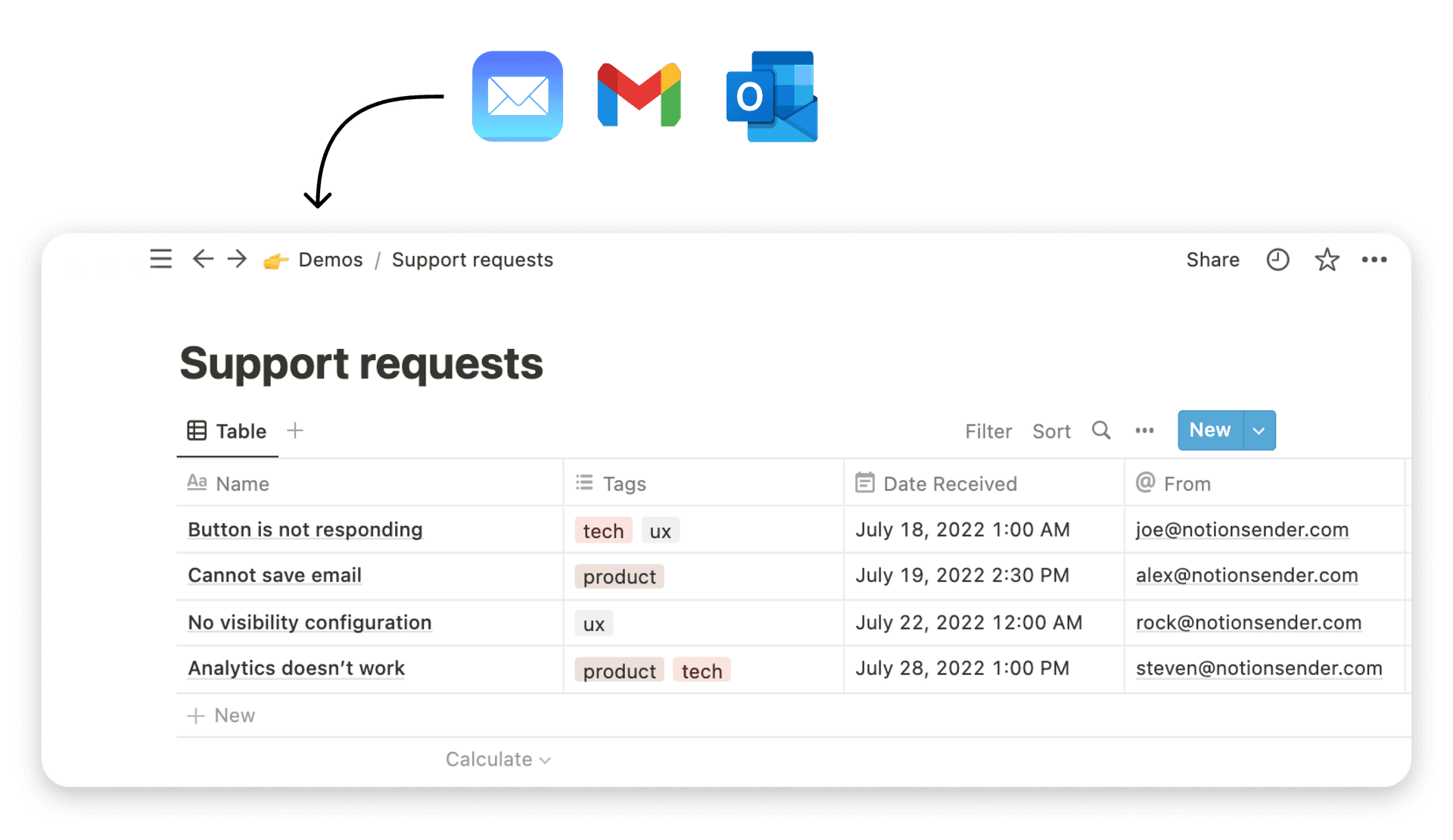
A cleaner option is to connect email directly into the workspace with NotionSender, so messages can become structured entries inside the database where the rest of the work already lives.
How this fits an iPad workflow
The iPad is strongest when actions are short and direct. That’s why an email-to-database workflow makes so much sense here.
A practical setup might look like this:
- Create a Notion database for Client Communications, Leads, Requests, or Approvals.
- Define the fields you need, such as sender, subject, status, project, and next action.
- Use your iPad as the processing station. Review the email, send it into the right database, then handle it from Notion instead of leaving it buried in the inbox.
This is especially useful for freelancers and project managers. The email stops being a loose message and becomes an object inside the system you already review.
When email lands inside your operating database, follow-up gets easier because the work is attached to context from the start.
Where it pays off in day-to-day operations
This kind of setup is practical in a few common scenarios.
Client management
A client sends a request from mobile while you’re away from your desk. Instead of flagging it and hoping to revisit it later, route it into your client database and assign the next action immediately.
Marketing approvals
Feedback on copy, assets, or launch timing often arrives by email. Saving that message into the campaign database keeps decision history close to the work itself.
Admin and invoicing
Invoice confirmations, receipt threads, and scheduling emails often create low-grade clutter. Once those messages become structured records in Notion, they’re easier to sort, search, and track.
What makes this effective on iPad
The value isn’t just convenience. It’s reduced fragmentation.
On iPad, the best systems minimize typing, tab switching, and repeated reading. An integrated email workflow does exactly that. You process the message once, place it in the right database, and work from there.
That’s the larger pattern behind a strong notion for ipad setup. Every useful improvement removes one more loop of manual handling. Email is often the last big one.
Conclusion Your iPad Is Now a Workstation
An iPad becomes a real work device when the workflow is tighter than the hardware is flashy. That’s the shift that matters.
With notion for ipad, the winning approach is straightforward. Start with a stable setup on compatible hardware. Build a mobile-first home screen. Use touch gestures for speed, Pencil for precision, and outside drawing tools when you need actual ink. Structure databases for taps, not spreadsheet sprawl. Then connect the rest of your working day so information doesn’t keep falling back into separate apps and inboxes.
That combination changes the role of the device. It stops being where you check things and starts being where you run them.
You don’t need to force the iPad to behave like a MacBook. You need to build a system that takes advantage of what the iPad does well. Once that clicks, Notion becomes more than a notes app on a tablet. It becomes the place where projects move, decisions get captured, and work keeps going even when you’re nowhere near a desk.
If you want to close the email gap in your Notion workflow, NotionSender is worth a look. It helps turn incoming and outgoing email into structured, usable data inside your workspace, which is exactly the kind of integration that makes an iPad setup feel complete instead of cobbled together.