Notion for Note Taking: Ultimate 2026 Guide

Your notes are probably not the problem. Your capture path is.
Most professionals already write things down. Failure happens earlier and later. Earlier, when the thought arrives while you are on your phone, walking between meetings, or staring at an inbox that needs decisions. Later, when the note exists somewhere in Notion but has no context, no project link, and no reliable way back into your work.
That is why notion for note taking works best when you stop treating it like a blank document tool and start treating it like a capture-to-retrieval system. Notion became a major force in this category after launching in 2016, and by 2022 it had reached a $10 billion valuation as an all-in-one workspace built around notes, databases, tasks, and wikis, according to Notion’s guide to Notion AI for docs. The platform is powerful. But power without structure turns into clutter fast.
For busy teams and solo operators, the better setup is simple: one central notes database, a low-friction mobile capture method, and a way to pull email into the same system so client communication and working notes live together.
From Digital Clutter to Organized Clarity
Digital clutter usually looks harmless at first.
A few meeting notes live in one workspace. Voice memos sit on your phone. Client decisions stay trapped in email. A good idea lands in a temporary page called “Quick Notes,” then disappears under a pile of newer pages. Nothing seems broken until you need one specific detail right now.
That is when a weak note system shows itself. You do not need more notes. You need a system that makes capture easy and retrieval obvious.
Notion is strong here because it combines documents, lightweight databases, task context, and internal linking in one workspace. Used well, it replaces the cycle of writing something down and then forgetting where you put it. Used poorly, it becomes a polished junk drawer.
What organized clarity looks like
A workable system does three things:
- Captures fast: you can save an idea, meeting takeaway, or client request before it slips away
- Adds context: each note belongs to a project, area, or reference category
- Surfaces later: the note appears again when you need it, without manual hunting
That last part matters most. Most broken systems fail because retrieval depends on memory. You have to remember the title, the folder, or the exact phrasing you used when you created the note. That is fragile.
If your current setup feels messy, it helps to study a simpler framework for how people organize research notes from chaos to clarity. The same principles apply inside Notion. Capture broadly, reduce friction, and give every note enough structure to be found later.
Tip: If a note has no project, no category, and no next use case, it will almost always become archive material by accident.
For freelancers, this might mean call notes linked to a client. For project managers, meeting notes tied to an active initiative. For small business owners, it often means one workspace that holds ideas, decisions, and operating knowledge in the same place.
That is where notion for note taking starts to earn its keep.
The Foundational Choice Pages vs Databases
The first important decision is not about templates. It is about containers.
In Notion, you can keep notes as standalone pages or store them inside a database. Both are valid. They are not equal.

When pages work
Pages are fast. You hit new page, type, and move on.
That makes them useful for:
- Personal memos: a short note you will probably never need to sort
- Standalone docs: a polished brief, SOP draft, or one-off memo
- Temporary working space: rough planning before something becomes structured
Pages feel lighter because they ask less from you. No properties. No filtering. No schema decisions.
The trade-off is simple. Pages stay isolated unless you manually organize them. That works for a while, then breaks under volume.
When databases win
Databases turn notes into structured records. That gives you properties, filtered views, sorting, and relationships to other databases.
For professional note taking, this matters because your notes are rarely independent. A meeting note belongs to a project. A project belongs to a client or department. A decision from last month should still show up when you review related work next week.
Here is the practical comparison:
| Option | Best for | Weakness |
|---|---|---|
| Pages | Quick, isolated writing | Hard to filter, connect, and review at scale |
| Databases | Ongoing notes with context | Slightly more setup and discipline required |
The trade-off many discover too late
A page-first setup feels good on day one. A database-first setup pays off on day ninety.
If you take notes for active work, use a database. If you write mostly personal, disposable notes, pages are fine. Many strong Notion workspaces use both, but they assign each one a job.
Use pages for published or reference-style documents. Use databases for notes that need metadata, relationships, or resurfacing.
Key takeaway: if you ever want to answer “show me all notes from this client,” “find every meeting note tagged onboarding,” or “surface open decisions from this quarter,” you want a database from the start.
The biggest mistake I see is storing everything as pages, then trying to bolt on organization later. Rebuilding after months of note accumulation is much slower than starting with one clean database and a few deliberate properties.
Designing Your Central Notes Database
A Notes database works best when it becomes the single place where new information lands first, then gets sorted later. That matters more than many desktop-first guides admit, because busy professionals do not capture ideas in neat batches at a desk. They grab a note after a call, forward an email they need to revisit, save a client detail from mobile, then try to find it again three days later.

I recommend one central database with enough structure to support retrieval, but not so much structure that capture slows down. The PARA-adapted database approach is a useful reference here because it connects notes through relations and rollups instead of leaving them as isolated pages. In the tutorial, that method is presented as improving retrieval speed, reducing note abandonment, and showing how too many properties can slow the database down, especially once the workspace grows: YouTube walkthrough of the methodology.
The minimum structure that holds up
The best Notes databases feel boring in the right way. You can add a note quickly, review it later, and find it again without remembering exactly where you put it.
Start with these properties:
- Title for the note name
- Status with values like Capture, Process, Organize, Archive
- Type for Meeting, Idea, Resource, Decision, SOP
- Project as a relation to your projects database
- Tags as a relation to a Tags database
- Created so recent notes stay easy to sort
- Source for Mobile, Desktop, Email, Web clipper
If you use PARA, add Root Tag as a rollup so each note can sit inside a broader bucket such as Projects, Areas, Resources, or Archives without forcing you to tag everything twice.
I keep the property count tight. More fields look organized, but they create hesitation during capture and clutter during review. That trade-off gets worse on mobile, where every extra choice adds friction, and it also shows up later when email becomes part of the system. If forwarding something into Notion requires five cleanup steps, people stop doing it.
Build for retrieval, not decoration
A good notes database answers practical questions fast.
Can I pull up every note tied to one client before a meeting? Can I see all open decisions for a project? Can I review everything captured from email this week because my inbox is where loose ends usually hide? Those are the tests that matter.
That is why I prefer properties that support filtering over properties that merely describe the note in a nice-looking way. “Project,” “Type,” “Status,” and “Source” earn their place. A stack of niche metadata usually does not.
If you want a few solid cleanup ideas before adding more complexity, the advice in these tips for getting more out of Notion is worth a quick read.
Views people use
The default “All Notes” view is rarely the one you work from. Useful views reduce scanning time and lower the chance that important notes disappear into a pile.
I set up these views first:
Capture Inbox
Filter for Status = Capture.
This is the holding area for fast entries from phone, desktop, and email. Review it once or twice a day and add the missing context only then.
Active Work
Filter for notes linked to open projects.
This becomes the working memory for current execution. Meeting notes, decisions, and reference material stay close to the project instead of drifting into a general archive.
Ideas
Filter for Type = Idea.
Ideas need separation from operational notes. If they live in the same view as meeting records and SOPs, they create noise.
Email Triage
Filter for Source = Email and Status = Capture or Process.
This view closes a gap that many Notion setups ignore. Email is still where approvals, requests, and useful context arrive. If those messages never make it into your notes system, your database becomes incomplete.
Archive
Filter for Status = Archive and keep it out of sight unless you need historical context.
Archive should reduce visual clutter, not function as deletion.
The missing link is usually email
In practice, the biggest difference between a notes database that feels tidy and one that becomes a real command center is whether it handles inbound email well. A lot of professionals already capture from mobile and desktop, but email stays trapped in the inbox, which means decisions and reference material never reach the same retrieval system.
That is why I treat Source as more than a label. It tells me how the note entered the system, what kind of cleanup it needs, and where friction is building. If too many notes pile up under Email, the process needs simplification. If Mobile captures are sparse, the entry path is probably too slow.
The same mindset behind how to automate repetitive tasks applies here. Remove avoidable manual steps, then keep the human effort for review and judgment.
The goal is simple: one place to capture, one place to process, and a structure that still works when the note starts on your phone and ends as a decision you need to retrieve months later.
Mastering Daily Workflows and Quick Capture
Most Notion systems fail in the first five seconds.
You think of something important, open the app on your phone, and run into friction. The keyboard covers the wrong controls. Creating a new page takes too many taps. Organizing the note feels like work, so you tell yourself you will do it later.
Then later never happens.

Research on Notion’s mobile note-taking experience found that users often leave for simpler alternatives because the biggest barrier is creating and organizing pages, not editing them. The same research also notes that 60-70% of professional communication now happens on mobile devices, which makes mobile-first capture much more important than most desktop-heavy guides admit, according to this analysis of improving the Notion note-taking experience.
Build for capture first, organization second
The fix is not more discipline. It is fewer decisions at capture time.
On mobile, use one fast entry path into your Notes database. Keep the first interaction as close as possible to “open, type, save.” If every note requires picking a project, type, and tag before you can write, you will resist using it.
A better habit:
-
Capture with minimal fields Title or body first. Status defaults to Capture.
-
Process later on desktop Add project links, tags, and note type during a short review block.
-
Let views surface what needs triage Your Capture view should make fresh notes obvious.
This principle also applies on desktop. Good note systems reduce decisions in the moment and move structure to a later review step.
Templates that remove repetitive setup
Recurring notes should never start from zero.
Create a few lightweight templates inside the Notes database:
-
Meeting note Include attendees, decisions, open questions, and next actions.
-
Daily log Keep sections for wins, blockers, follow-ups, and loose observations.
-
Idea capture Add prompts like problem, angle, audience, and next step.
-
Client call record Include summary, commitments, deadlines, and relevant links.
If your workload includes repeated admin and documentation patterns, it helps to think more broadly about how to automate repetitive tasks. The same mindset applies here. Every repeated note format should be templated before it becomes annoying.
Tags that help instead of distract
Bad tagging creates noise. Good tagging creates retrieval paths.
Use tags for themes that cut across projects, not for everything you can think of. “Onboarding,” “Content,” “Sales call,” and “Hiring” are useful because they help you regroup notes later. Hyper-specific tags tend to die from neglect.
A few durable rules:
- Prefer fewer tags with consistent use
- Use projects for ownership, tags for cross-cutting themes
- Review and merge duplicate tags regularly
Mis-tagged notes can create search misses. In the PARA-adapted methodology, workspace audits found that mis-tagged notes lead to 30% search misses, while rollups fixed 90% of those issues through auto-inheritance, based on the same benchmark tutorial discussed earlier.
A quick walkthrough helps if you want to see mobile-friendly setups in action.
<iframe width="100%" style="aspect-ratio: 16 / 9;" src="https://www.youtube.com/embed/iFt1CjS1RCU" frameborder="0" allow="autoplay; encrypted-media" allowfullscreen></iframe>
Tip: If mobile capture feels clumsy, your schema is probably too demanding at note creation time.
Practical Examples for Professionals
Monday starts on a phone, not a desktop. A client sends a late-night email, someone drops a voice note after a meeting, and a quick idea shows up while you are between calls. If those inputs do not land in the same system, retrieval breaks later, especially when more is at stake.
This is the ultimate test for notion for note taking. The system has to handle fast capture on mobile, messy inputs from different channels, and clean retrieval during work. Busy professionals do not need a prettier archive. They need a note system that keeps context attached to projects, people, and decisions.
Project manager
Project managers benefit from notes that answer one question quickly: why did this change?
A practical setup links meeting notes, decision logs, and follow-ups to the project record. Then each note can surface in the project view without forcing the PM to build a separate document trail every week. On desktop, that structure is straightforward. On mobile, the trade-off is speed versus detail. I have found that a short note with the right project relation beats a perfectly formatted note captured too late.
A lean PM workflow often includes:
- Decision notes tied to milestones or approvals
- Standup notes connected to active sprint work
- Risk notes tagged across several projects
- Email-based updates saved into the same project context when scope, timing, or approvals change
That last point matters more than many setups admit. Deadline changes and stakeholder decisions often live in email first, not in Notion.
Freelancer
Freelancers usually need client memory more than a full CRM.
Keep discovery call notes, proposal feedback, scope clarifications, and delivery notes in one Notes database related to each client. That gives you a clean client view during check-ins, renewals, or invoicing. It also reduces the common problem where the important detail exists, but only inside an old inbox thread or a note captured on a phone without context.
The trade-off is maintenance. If every note needs five properties before saving, mobile capture will fail. A better approach is to save the note fast with client relation and note type, then clean up only the records that become important later.
If you want practical examples of connecting communication with client workflows, this guide covers several ways to use Notion to send emails, schedule follow-ups, and share updates.
Small business owner
Owners usually get the most value from operational memory.
That includes marketing notes linked to campaigns, SOP drafts related to recurring processes, vendor conversations attached to operations, and rough ideas that later become offers or internal projects. The advantage is not just storage. It is continuity. A note from a customer conversation can turn into a team discussion, then into a documented process, without being retyped three times across different tools.
This is also where the missing email link starts to hurt. Small business work runs through inboxes. Approvals, vendor replies, customer requests, and finance context often stay there unless you deliberately pull them into your note system.
The setups that hold up over time are usually simple. Fast mobile capture. Minimal required fields. Clear relations to clients, projects, or areas of responsibility. Then retrieval becomes reliable because the note is connected to the work, not buried in a folder.
Key takeaway: the best professional note systems capture information where work happens, then make it easy to retrieve that context later from one place.
Automate Your Inbox with NotionSender
Most Notion note systems still have one major gap. Email stays outside the system.
That is a problem because inboxes carry the exact information professionals need to preserve: client requests, approvals, attachments, timelines, meeting logistics, invoice context, and informal decisions. When you leave those details in email, your notes database becomes incomplete. When you copy and paste them manually, the system becomes tedious.
Mainstream Notion note-taking guidance largely ignores this workflow. Research highlighted that current guidance overlooks how to automatically capture, categorize, and resurface emails as notes, even though that gap is a major productivity problem for business owners and project managers who run work through communication channels, according to this discussion of the email-to-notes gap.

Why email capture changes the system
Once emails can become structured notes, your database stops being a partial memory and starts becoming a full operating record.
That matters in a few common cases:
- Client communication becomes searchable alongside meeting notes
- Forwarded approvals can be stored next to the project they affect
- Attachments and context stay with the note instead of buried in threads
- Follow-up work can be processed from a capture queue instead of the inbox
This is especially important for people who live on mobile. A forwarded email is often the easiest way to preserve context quickly when typing a polished note would take too long.
A practical capture loop
A good email-to-Notion flow should do three things:
- Receive the message directly into the notes system
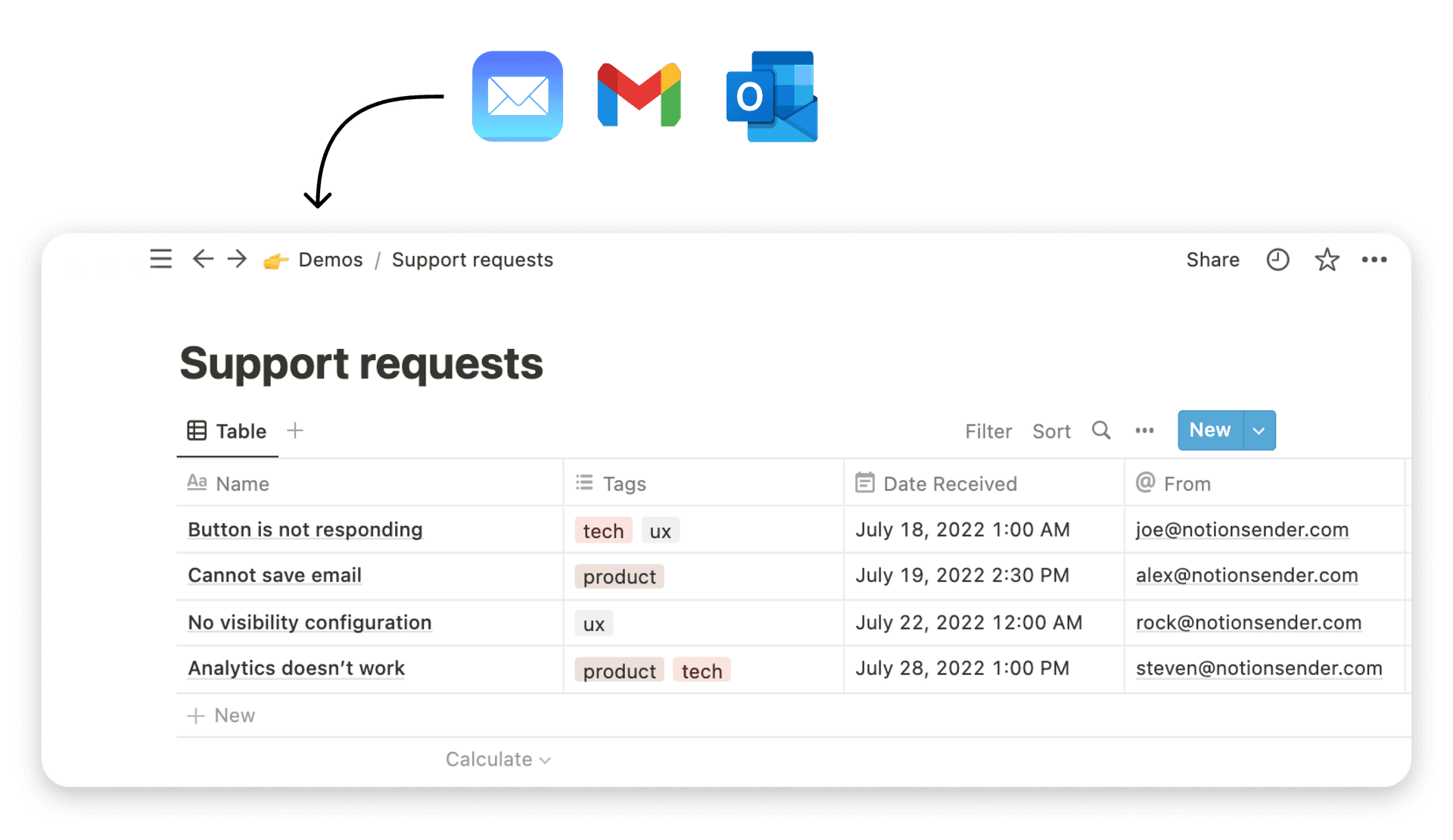
- Map useful fields into properties like sender, subject, and date
- Leave the note in a review queue for processing
That closes the gap between communication and organization. Instead of asking “did I save that email somewhere,” you only ask whether you processed the captured note yet.
If you want to see a practical walkthrough of storing messages this way, this internal guide is the relevant reference: https://www.notionsender.com/blog/post/saving-emails-to-notion
The deeper point is not the tool. It is the workflow. As soon as email enters the same note environment as meetings, projects, and reference material, your retrieval quality improves because context stops being split across systems.
Your New Central Command Center
Notion works for note taking when you stop chasing the perfect dashboard and start removing friction from the full cycle.
That cycle is straightforward. Capture quickly. Process deliberately. Connect notes to real work. Make retrieval easier than memory.
The strongest setup usually looks less glamorous than the template marketplace suggests. One central Notes database. A few carefully chosen properties. Views for capture, active work, and archive. Templates for repeated note types. A mobile path that does not ask too much in the moment. An email path that keeps communication from drifting outside the system.
That combination gives you something more useful than a tidy workspace. It gives you a reliable operating memory.
For project managers, that means decisions stay attached to projects. For freelancers, client context stops slipping across apps. For small business owners, ideas, operations, and communication finally live in one searchable place.
If your current setup feels busy but unreliable, simplify it. The best notion for note taking system is the one you will still use when your day gets messy.
If you want to close the gap between inbox communication and your Notion workspace, NotionSender is worth a look. It helps turn emails into structured items inside Notion, which makes it much easier to keep client requests, approvals, attachments, and follow-ups connected to the rest of your notes.