Notion Mail vs Superhuman: Which Is Right for You in 2026?

Your inbox probably isn't the actual problem.
The problem is the handoff. A client emails a revision request. You star it, promise yourself you'll add it to your project board later, then jump into Notion, Asana, or your notes app and recreate the context by hand. By the afternoon, you've got half the conversation in email, half the work in a task system, and no clean record of what happened.
That's the situation many users are trying to solve when they compare Notion Mail vs Superhuman. But the useful question isn't “Which email app is better?” It's “Which workflow philosophy matches the way your business runs?”
One tool treats the inbox as the center of execution. The other treats email as one input inside a larger workspace.
The Unwinnable War Between Your Inbox and Your Tasks
A project manager gets a vendor update, a change request from a client, and two internal approvals before lunch. None of those messages should stay as email. They should become tasks, project notes, owners, and due dates.
But that conversion step is where work leaks.
Freelancers feel it too. A prospect asks for a proposal tweak. A current client sends assets buried in a reply thread. An accountant asks for confirmation. You can answer fast, but if you don't capture the decision somewhere structured, you end up rereading the same thread three times this week.
That's why generic inbox advice only goes so far. Yes, labels help. Yes, snooze helps. If you want a practical refresher, these simple email management tips to boost your productivity are useful. But they don't solve the deeper split between communication and execution.
A lot of teams also try to patch the gap with meetings, voice notes, and ad hoc docs. That can help, especially if you're trying to boost personal productivity by capturing decisions faster. Still, if your system forces you to manually move information from inbox to workspace, friction comes back every day.
The inbox wins whenever your task system depends on your memory.
That's what makes Notion Mail and Superhuman interesting. They attack the same pain from opposite directions.
Superhuman says email should be processed with speed, precision, and as little drag as possible. Notion Mail says email should sit closer to your notes, projects, and operating system for work. One reduces inbox time. The other tries to reduce context switching.
If you choose based only on features, you'll miss the point. The better choice depends on whether your business lives in the inbox or beyond it.
Two Philosophies for Email Management
Early in any Notion Mail vs Superhuman evaluation, I look at product intent before feature lists. These tools were built in different eras for different jobs.
Independent comparison coverage notes that Superhuman was founded in 2014 and aimed at premium productivity for power users, while Notion Mail arrived much later as part of Notion's broader workspace ecosystem and was highlighted in 2026 coverage as a free Gmail-based option for existing Notion users (efficient.app's comparison). That history explains a lot of what feels different in daily use.

Inbox as a cockpit
Superhuman is designed around a simple premise. Email is a high-frequency operating environment, so every interaction should be fast.
That changes the product at every level. Keyboard actions matter more. Navigation matters more. The interface is tuned for people who spend large parts of the day inside the inbox and want to move through triage, replies, follow-ups, and scheduling with minimal drag.
This is why Superhuman tends to fit executives, sales teams, founders, and anyone whose work depends on quick response velocity. If your inbox is where revenue, introductions, and decisions happen, a speed-first client makes sense.
Inbox as a database
Notion Mail comes from a different worldview. Email isn't the cockpit. It's one stream of work entering a larger system.
That's why it feels closer to workspace thinking than classic inbox optimization. You're not just asking, “Can I clear this thread fast?” You're asking, “Where should this information live after I read it?”
For people already working in Notion, that shift matters more than raw speed. A project manager doesn't just need a fast reply box. They need context tied to deliverables, notes, owners, and status.
Practical rule: Choose Superhuman if your main goal is to process email faster. Choose the Notion path if your main goal is to preserve context after the email stops being an email.
For many readers, the better supporting habit is learning how to boost productivity with email management in a way that matches your actual workflow, not just your inbox style.
Why this distinction matters
Feature parity is not the true story here.
Notion Mail has been described in independent coverage as a Gmail wrapper with Notion-centric features, while Superhuman is framed as a tool for speed-focused professionals who want to spend less time in their inbox, as covered in the earlier comparison source. That sounds like a product description, but it's really a workflow decision.
If your work starts and ends in email, Superhuman's philosophy feels natural. If email is mostly intake for projects, deliverables, and knowledge capture, the Notion approach is more aligned.
Feature and Workflow Deep Dive
The fastest way to compare these tools is to stop thinking in terms of checkboxes and start thinking in terms of repeated actions. How do you triage? How do you draft? How do you find old context? How do you turn a message into work?
Here's the practical snapshot.
| Workflow area | Notion Mail | Superhuman | Better fit |
|---|---|---|---|
| Inbox processing | Good for users already anchored in Notion and Gmail | Built for speed-focused processing and keyboard-heavy use | Superhuman for high-volume triage |
| AI assistance | More limited, with emphasis on labeling and referencing Notion pages | Independent reviews describe summaries, follow-up generation, and drafting in your tone | Superhuman for reply acceleration |
| Organization model | Stronger when email needs to connect to workspace context | Stronger when inbox management itself is the main job | Notion Mail for project workflows |
| Writing flow | Works best when composition relates to stored project information | Works best when quick replies and follow-ups dominate | Depends on whether context or speed matters more |
| Cost posture | Free basic tier for Gmail users, with an optional Notion AI upgrade at $24 per month in one review | Premium positioning, with coverage describing business pricing at about $33/month annually after Grammarly's acquisition | Notion Mail for cost-sensitive teams |
| Best user type | Project managers, operators, and teams already living in Notion | Executives, founders, recruiters, and sales professionals who live in email | Split by workflow philosophy |

Speed and triage
Superhuman is strongest here.
Its entire value proposition is built around moving through email faster. In independent coverage, Superhuman's own comparison page claims it can save users 4 hours per person every single week (ClickUp's roundup). Whether that fully matches your experience depends on your volume and habits, but the framing is clear. Superhuman sells time savings.
Notion Mail isn't trying to win that same race. It can help you handle email inside a familiar ecosystem, but it doesn't feel built around shaving seconds off every action. For someone managing a flood of investor emails, leads, or hiring threads, that difference is obvious.
AI help and drafting
The AI gap matters if writing is your bottleneck rather than sorting.
Independent reviews report that Superhuman offers automatic email summaries, follow-up generation, and drafting in a user's tone, while Notion Mail is described as more limited, with AI more focused on labeling and referencing Notion pages, as noted in the same ClickUp coverage.
That means the practical winner changes by use case:
- For fast outbound communication: Superhuman usually fits better.
- For structured internal follow-through: Notion Mail's lighter AI can still be enough.
- For users who don't trust AI to draft client-facing replies: the advantage matters less than people think.
If your delay comes from deciding what to do with a message, integration beats drafting. If your delay comes from writing replies all day, drafting beats integration.
Organization after the reply
At this point, Notion Mail becomes more compelling.
Most email clients help you organize email as email. They give you labels, snooze, reminders, and search. Useful, but still inbox-native. Notion's broader model pushes toward organization that survives outside the inbox.
That distinction matters in project work. A client approval shouldn't vanish into an archive. A scope change shouldn't live only in a thread. The closer your email workflow is to your working database, the less re-entry work you create later.
If your team sends structured messages from a workspace rather than a standalone inbox, tools that support that model matter. One example is the ability to create and send email from Notion, which changes email from a disconnected conversation into part of an operational record.
My practical verdict on features
For pure inbox performance, Superhuman wins.
For turning email into trackable work, Notion Mail has the better underlying philosophy.
Neither result is universal. Sales and recruiting teams often care more about rapid response and follow-up motion. Operations and delivery teams usually care more about where information ends up after the reply is sent.
Integration Power What You Can Connect
It's often thought that “integrations” means app logos in a settings page. That's too shallow.
The question is what role email plays inside your system. Is email the hub that pushes information outward, or is email being absorbed into the workspace where the rest of your work already happens?

Superhuman as a connector model
Superhuman fits a connector model. You work from the inbox, then connect outward to the rest of your stack.
That works well when email is your control panel. You reply to a lead, schedule a meeting, check a thread, move on. The inbox stays central, and other tools support the flow around it.
For high-volume sales or founder workflows, that's often enough. The value comes from reducing friction at the decision point. You don't need every message to become a formal record. You need to move quickly and keep momentum.
The Notion path as a native model
The Notion-centric approach is different. It's less about connecting from the inbox to the workspace and more about making email part of the workspace itself.
That sounds subtle, but in practice it changes everything. If a client message becomes part of the same environment as your roadmap, project database, meeting notes, and approvals, you stop copying details across systems. You preserve source context where work is managed.
This is also where a tool like saving emails to Notion becomes more than a convenience. It removes the manual step where people usually lose information, skip documentation, or create duplicate records.
Native integration is less exciting in a demo than keyboard shortcuts. It's more valuable a month later, when nobody has to ask where the final client instruction went.
What works and what doesn't
For small teams, the connector model works when:
- Email is the main action surface
- Work moves fast and doesn't require much shared documentation
- Individuals own threads end to end
The native model works better when:
- Several people touch the same client or project context
- Decisions need to live beyond the inbox
- Email regularly becomes tasks, records, or deliverables
This is why project managers often outgrow inbox-first tools even when they like the speed. Fast triage doesn't fix fragmented operations. It just helps you fragment them faster.
Cost vs Value The True Price of Productivity
Price only matters after you define the job.
A founder clearing 150 messages before noon is buying different value than an operations lead who needs every client instruction to end up in the right system. That is the core split in Notion Mail vs Superhuman. One tool is priced around inbox speed. The other creates value when email is part of a broader workspace process.
The cost gap is real. Notion Mail offers a free entry point for Gmail users, with paid AI capabilities layered on top, as documented on Notion's pricing page. Superhuman sits in the premium tier and is easier to justify when email is tied directly to revenue, responsiveness, or executive throughput.
Premium speed pays for itself when delay is expensive
Superhuman earns its price in teams where the inbox is the work surface, not just the place where work arrives.
That usually includes:
- Sales teams working active pipelines and follow-up sequences
- Executives and founders handling approvals, introductions, and high-stakes replies
- Recruiters, investors, and deal operators who win by responding fast and staying on top of thread volume
In those roles, shaving time off every message can produce a real return. A faster triage loop means quicker replies, fewer dropped threads, and less context-switching during the day. I have seen this pay off most clearly in outbound and relationship-driven work, where inbox speed affects outcomes the same week.
Workspace value wins when email is only one step in the process
Notion Mail works on a different economic model.
Its value shows up after the reply. The gain is not just faster handling of one message. It is fewer manual transfers, fewer missed handoffs, and less time spent reconstructing what was decided. That matters more in project-based businesses than people expect.
For project managers, agency owners, and small operations teams, the expensive part of email is usually downstream rework. A client sends a scope change. Someone reads it, someone else acts on it, and a third person cannot find the original context two days later. If your team keeps paying that tax, a polished inbox alone will not fix the problem.
Ask which bottleneck costs more
The useful ROI question is simple: Are you losing time inside the inbox, or after the inbox?
Choose Superhuman if the bottleneck is message volume, response speed, and daily communication load on a single operator. Choose the Notion path if the bottleneck is turning email into shared execution without losing context.
That is why the pricing conversation is really about workflow philosophy. Superhuman charges for faster triage. Notion Mail creates value by reducing coordination waste. For high-volume sales, premium speed can be the cheaper option. For project delivery, client operations, and cross-functional work, lower software cost plus better system fit usually wins.
Who Should Use Notion Mail vs Superhuman
At 8:15 a.m., a sales rep opens the inbox to clear follow-ups before prospects go cold. At the same time, an operations manager opens email looking for three client approvals that need to become tasks, deadlines, and status updates for the team. Both people want to handle email better. They do not need the same system.

This illustrates the core difference between Notion Mail and Superhuman. Superhuman fits businesses where the inbox is the work. Notion Mail fits businesses where email starts the work, then that work has to live somewhere shared and structured. The right choice depends less on taste and more on where value gets created after a message arrives.
The project manager
Notion Mail is usually the better fit.
Project managers rarely win by replying a few minutes faster. They win by keeping decisions attached to the project, assigning the next step quickly, and making sure nobody has to hunt through old threads to understand what changed. If email is feeding timelines, approvals, scope updates, and team coordination, a workspace-centered system is more useful than a faster standalone inbox.
I see this pattern a lot in agencies and client delivery teams. The pain is not reading the message. The pain is turning that message into visible work without losing context.
The freelance consultant
This role splits cleanly by business model.
Choose Notion Mail if client communication needs to connect to proposals, project notes, deliverables, and ongoing account history inside Notion. That setup reduces the manual copying that eats time during delivery.
Choose Superhuman if your income depends on replying fast, booking calls, handling a constant stream of leads, or staying on top of many live conversations by yourself. In that workflow, inbox speed is not a luxury. It affects pipeline movement.
A simple test helps. If missed context creates more problems than delayed replies, choose Notion Mail. If delayed replies cost more than scattered context, choose Superhuman.
The small business owner
Small business owners often buy for personal efficiency when the underlying problem is team coordination.
If email contains customer issues, approvals, vendor updates, hiring conversations, and finance-related requests that other people need to act on, Notion Mail usually creates more lasting value. It keeps work tied to a shared system instead of one person's inbox habits. That matters once the business starts relying on handoffs.
Superhuman still makes sense for founder-led sales, partnerships, and relationship-driven communication. Owners who spend large parts of the day selling or recruiting often get clear value from a faster inbox. Owners who spend more time translating email into operating decisions usually benefit more from the Notion approach.
The marketing professional
Marketing teams sit on both sides of this decision.
Content leads, campaign managers, and brand teams often need email to feed briefs, approvals, asset requests, edits, and launch coordination. Notion Mail matches that workflow well because the thread is only one piece of a larger production system.
Partnership managers, outbound marketers, and demand gen operators may prefer Superhuman. Their work rewards quick responses, fast follow-ups, and tighter inbox control. In those roles, communication speed can matter more than long-term recordkeeping.
The question is practical. Does the message need to become a tracked work item, or does it need an immediate response that keeps momentum alive?
The high-volume sales user
Superhuman is the stronger choice.
Sales work rewards fast triage, rapid replies, and consistent follow-up. A rep handling a large book of conversations needs to move through the inbox with as little friction as possible. If opportunities are won or lost inside email itself, an inbox-centric tool matches the job better than a workspace-centric one.
This is one of the clearest decisions in the comparison.
The operator who already lives in Notion
Notion Mail makes more sense over time.
If your company already runs projects, docs, requests, and internal coordination in Notion, keeping email closer to that system usually reduces manual handoff work. The inbox may feel less specialized than Superhuman, but the workflow is often cleaner once messages need to become tasks, records, or shared updates.
That is why this choice is really about workflow philosophy. Superhuman is strongest for people who need to process and respond inside the inbox at high speed. Notion Mail is stronger for teams that treat email as intake for work that continues in a broader operating system.
Making Your Choice and Next Steps
The best way to decide between Notion Mail vs Superhuman is to ignore the feature race and look at where your work happens.
Choose Superhuman if:
- Your inbox is your main workspace
- You handle high message volume every day
- Fast replies and follow-ups matter more than long-term project capture
- You're comfortable paying for speed
Choose Notion Mail if:
- Email is mostly intake for projects, tasks, and records
- Your team already works inside Notion
- You want less copying, forwarding, and manual context transfer
- You care more about system coherence than inbox polish
If you're still unsure, run a simple test for a week. Count the moments when you think, “I need to answer this fast,” versus “I need to turn this into organized work.” Your answer is in that ratio.
For a Superhuman path, start by auditing how much of your day is true inbox execution. For a Notion-centered path, start by creating a database for inbound requests, approvals, or client communication and defining what each message should become after it lands.
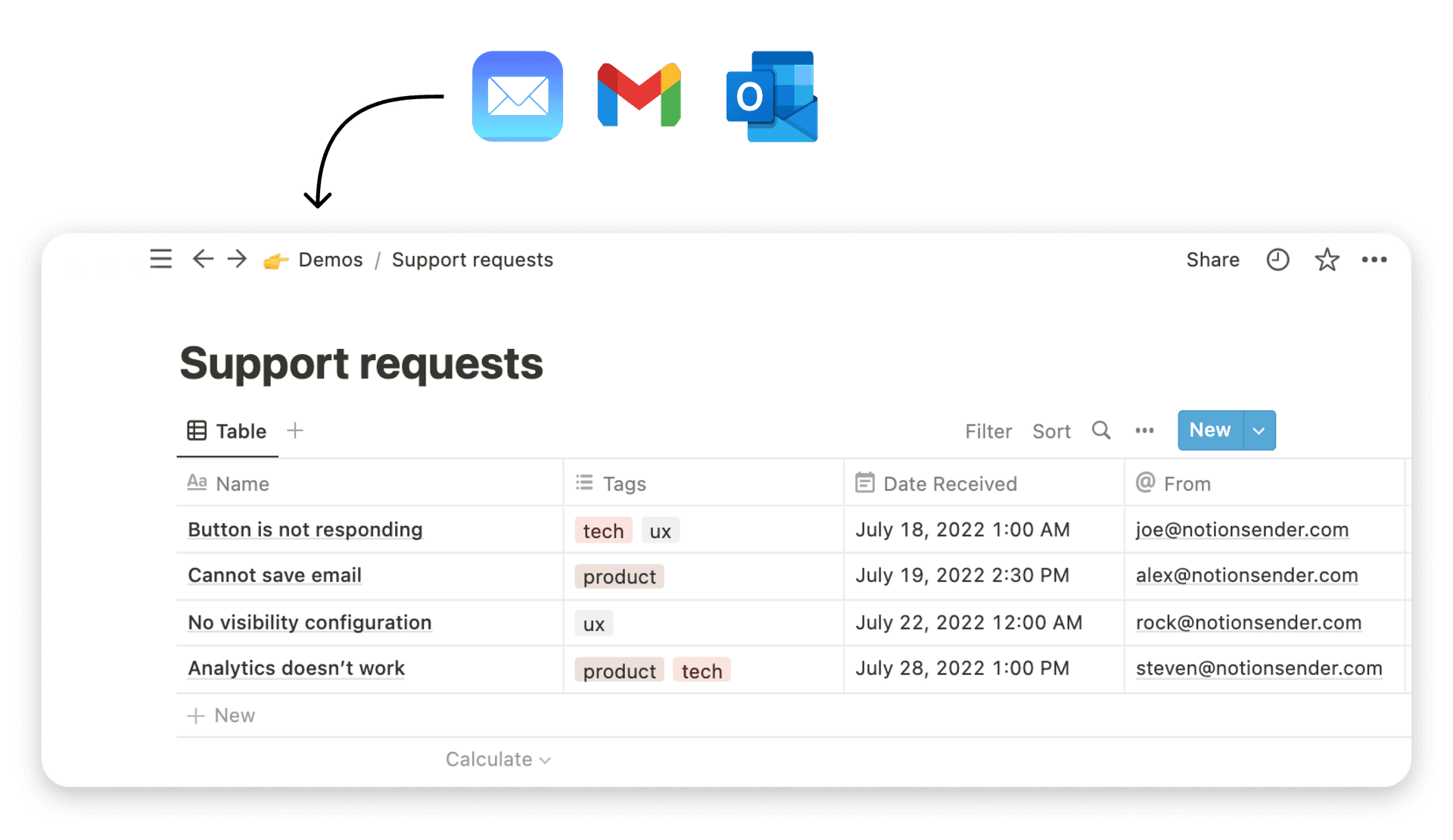
If your workflow lives in Notion and you want email to become part of that system, NotionSender is one option to look at. It lets teams send and receive emails inside Notion databases, which can be useful when you want client communication, project tracking, and structured records to stay in one workspace.