Ultimate Notion Student Planner: Master Your Academics

Monday starts before you even sit down for class. A professor posts a syllabus update in the LMS, your lab partner sends a message about meeting times, and an assignment detail arrives by email while you are still trying to find last week’s notes.
That kind of stress usually has less to do with workload than with scattered information. Course materials live in different tools, deadlines change in different places, and your brain ends up doing the job your system should handle.
A notion student planner works best as a central workspace for school. It brings your classes, assignments, notes, reading plans, and schedule into one connected system, so you are not checking five apps just to answer one question: what do I need to do next?
Notion grew quickly among students during the shift to online and hybrid learning, and student planner setups became popular for a simple reason. Connected databases let you tie a lecture note to a course, tie that course to an assignment, and see the deadline on your weekly view without copying the same information over and over. That structure feels less like a stack of sticky notes and more like a control panel.
Many student planner guides stop at self-entered tasks. They help you organize what you already know, but college life includes another stream of information that is easy to overlook. Email carries professor announcements, due date changes, rubric clarifications, office hour replies, and submission confirmations. If those details stay trapped in your inbox, your planner is always a step behind.
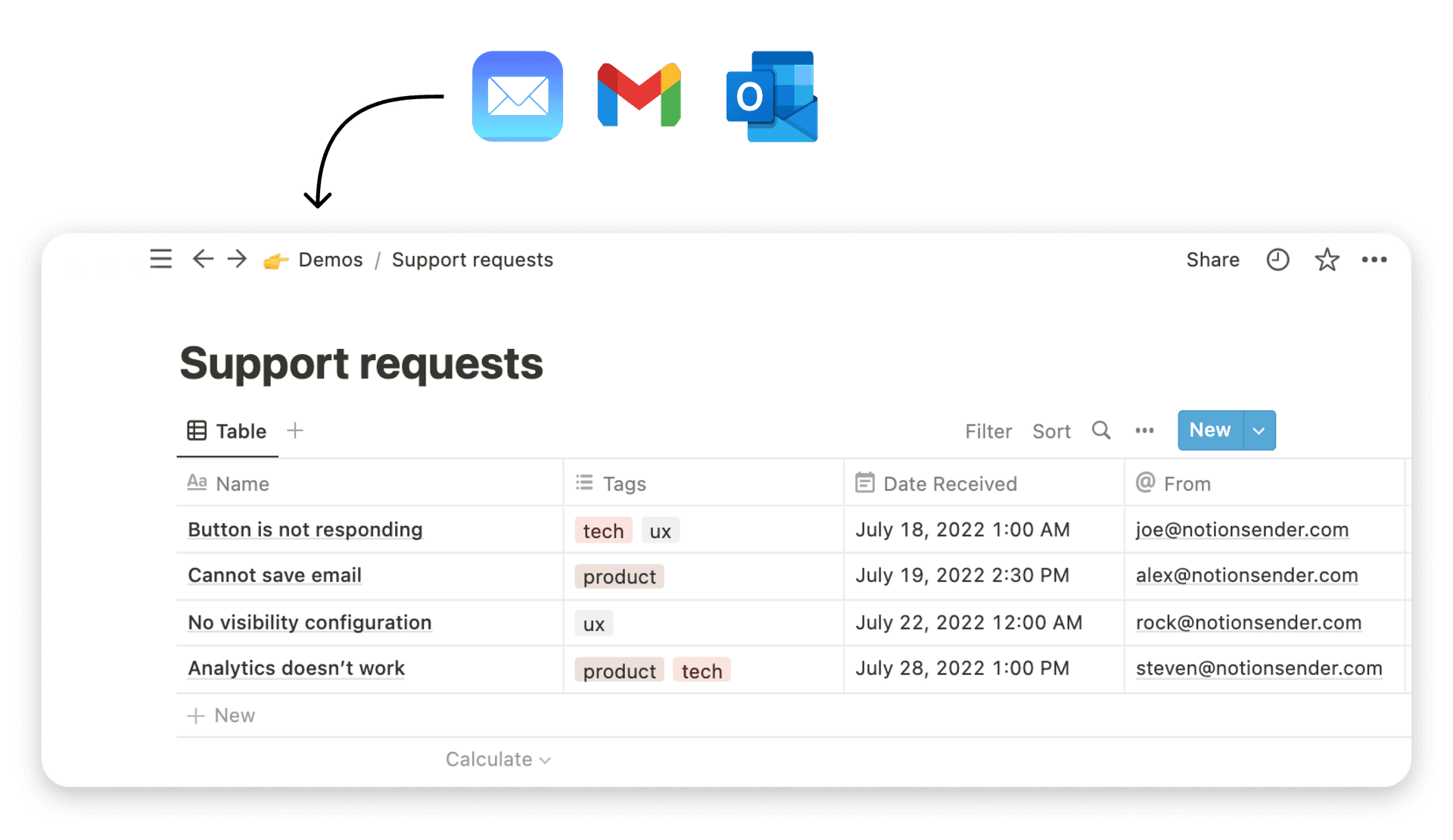
That missing piece is what makes this guide different. Along with building the planner itself, you will set up a workflow that pulls academic email into the same system with tools like NotionSender. The result is a planner that does more than store deadlines. It helps you capture the updates that usually slip through the cracks, alongside your notes, tasks, and schedule (free student planner template collection).
From Campus Chaos to Digital Command Center
A lot of first-year students build organization systems backwards. They start with a cute dashboard, add a few icons, maybe a quote, and then wonder why they still miss deadlines.
The problem isn’t usually motivation. It’s fragmentation.
You might have a chemistry lab due Thursday, a discussion post due Friday, and a campus job asking for your next availability. None of those tasks feel impossible alone. They become stressful when each one arrives in a different format. One is on the syllabus. One is buried in the LMS. One came from email. By midsemester, your brain becomes the backup system for everything your tools failed to connect.
Most student planner templates overlook a critical workflow gap: managing email-based communications like professor messages and assignment submissions. Students lose time manually transferring information, increasing the risk of missed deadlines.
That’s why I like thinking of a notion student planner as an academic command center instead of a planner. A planner is where you look up dates. A command center is where decisions happen.
Here’s the difference in practice:
- Chaos mode: You check your inbox, then your LMS, then your notes app, then your calendar, and still feel unsure what matters most.
- Command center mode: You open one dashboard and see today’s classes, urgent assignments, linked notes, and the messages that need action.
The best part is that Notion isn’t locked into one school-specific setup. Students use it for weekly planning, thesis tracking, exam prep, note systems, and even job hunt organization because the workspace can connect all of those pieces without forcing you into separate tools.
A strong system should also handle incoming information, not just your own plans. That’s the missing superpower most students need. If your planner can’t capture the professor email that changes an assignment requirement, it’s only half built.
Laying the Foundation Your Core Databases
A good Notion planner starts the same way a good dorm setup does. You do not begin with decorations. You start with the furniture you will use every day.
That principle matters in Notion because too many pages and databases create friction fast. Students usually do better with a small set of databases they can keep updated all semester. Four core databases are enough for most setups: Courses, Assignments, Notes, and Schedule. If you want a fifth later, add it after these four are working consistently.

These databases work like the main rooms in your academic command center. Each one has a clear job. That clarity is what keeps your planner useful in week two and in finals week.
Courses database
Your Courses database is the anchor for everything else.
Create one page per class. If you are taking Biology 101, Intro to Sociology, and Calculus II, each course gets its own entry. That course page becomes the place you check when you need the professor’s contact info, the syllabus, office hours, or the Zoom link you can never find five minutes before class.
Good properties to include:
- Course Name
- Professor Name
- Professor Email
- Meeting Days
- Location or Zoom Link
- Syllabus
- Office Hours
- Semester
- Relation to Assignments
- Relation to Notes
The email fields matter more than many students expect. Later, when you bring professor messages and course announcements into your workflow with NotionSender, having clean course records makes it much easier to connect an email to the right class instead of manually sorting everything in your inbox.
Assignments database
Your Assignments database is your action center.
Every deliverable goes here. Homework, essays, quizzes, exam prep tasks, lab submissions, discussion posts, reading responses, and project milestones all belong in one database. Students often split these across random pages or a weekly checklist, then wonder why deadlines sneak up on them. One assignments database fixes that because the same item can show up in a calendar view, a by-course view, and a priority view without creating duplicates.
Use properties that help you decide what to do next:
| Property | Why it matters |
|---|---|
| Assignment Name | Gives each task a clear label |
| Course | Links it to the right class |
| Due Date | Powers calendar and urgency views |
| Status | Lets you track To Do, Doing, Done |
| Priority | Helps when everything feels urgent |
| Type | Essay, exam, reading, lab, discussion |
| Notes Link | Connects prep material to the task |
A practical tip. Break large assignments into separate entries if they have real stages. “Research paper” is too vague to guide your day. “Choose topic,” “find sources,” “write draft,” and “submit final” are much easier to act on.
Notes database
Your Notes database holds the material you will need when class gets busy and your memory gets unreliable.
Keep lecture notes, reading notes, study guides, review sheets, and concept summaries here. Loose pages can work at the start of the semester, but they become hard to search once every class starts producing documents. A database gives your notes structure, which means you can filter by course, topic, or date when exams arrive.
Use these properties:
- Title
- Course
- Topic or Unit
- Class Date
- Related Assignment
- Tags
Here is the simple rule I give new students. If a note will help you complete work later, connect it now. Linking a note while it is fresh takes ten seconds. Hunting for it during a late-night study session takes much longer.
Schedule database
Your Schedule database handles time-based commitments.
That includes classes, labs, office hours, club meetings, work shifts, tutoring sessions, and study blocks. Keep this separate from assignments because events and tasks are different kinds of information. A chemistry lab at 2 p.m. is something you attend. A lab report due Friday is something you complete. They can relate to each other, but they should not live in the same place.
Useful properties:
- Event Name
- Day
- Start Time
- End Time
- Course
- Location
- Recurring
- Category
If you want one extra database later, add Resources for textbook links, article databases, file hubs, and portals. Wait until the first four are stable first.
A strong foundation is boring in the best way. You open the planner, you know where things go, and your system keeps up with real school life, including the emails and updates that usually fall through the cracks.
Connecting the Dots with Relations and Rollups
A planner starts to feel like a real command center when one update shows up everywhere it matters.
That is what relations and rollups do.
If the words sound technical, strip them down to their job. A relation connects one database item to another. A rollup pulls information through that connection so you can summarize it somewhere else. Relations are the wiring. Rollups are the little status screens that show what is happening.

One assignment, several useful links
Say you have a history paper due next Friday.
Without connected databases, that paper often ends up scattered across your system. The deadline sits in one place. Your source notes live somewhere else. Your study block is buried in a calendar. Then your professor sends an email changing the citation requirements, and that update stays trapped in your inbox unless you manually copy it over.
A connected Notion setup fixes that.
One Assignments entry called “History Paper” can link to:
- the Course “Modern Europe”
- the Notes page with source summaries
- the Schedule block for library research
- the email or course update you captured in your planner through your inbox workflow
Now the assignment is not just a task. It becomes the hub for everything related to that paper.
Open the course page, and you see the paper. Open the notes page, and the paper is there too. Open the email log, and the professor’s latest instructions are attached to the same assignment instead of getting lost under ten newer messages.
A clean setup that works for real classes
Keep the first round of connections simple:
- In Assignments, add a relation to Courses.
- Add a relation from Assignments to Notes.
- In Notes, keep the reverse relation back to Assignments.
- In Schedule, connect events and study blocks to Courses or specific Assignments.
- If you are bringing academic emails into Notion, relate those messages to the matching Course or Assignment.
That last step is the part many student planner guides skip. School work does not live only in tasks you create for yourself. It also lives in professor announcements, syllabus changes, feedback emails, office hour replies, and submission confirmations. If those messages never connect to your planner, your system stays only half complete.
For ideas on making Notion easier to use day to day, skim these tips for getting more out of Notion.
Rollups show the summary without extra typing
Once the links are in place, rollups save you from copying the same information into three different places.
For example, if Courses is related to Assignments, your course page can show:
- upcoming due dates
- the number of open assignments
- the number of finished assignments
- the next scheduled work session for that class
That means your Biology page can tell you, at a glance, whether the class is under control or starting to pile up.
You can do the same with academic email. If your email records are connected to a course, a rollup can show how many unread announcements are tied to that class, or surface the latest message date so you know which course just changed something. That is a practical difference during a busy week. You stop checking five apps to answer one question.
Common mistakes that make the system feel harder than it is
Students usually run into trouble for predictable reasons:
- Too many relations too early. If every database links to everything else, the planner gets noisy.
- Adding rollups before the structure is clear. Build the connection first, then summarize it.
- Vague property names. “Class,” “Course,” and “Course Link” can turn into a guessing game.
- Ignoring email as a data source. A planner that tracks only self-made tasks misses a big part of academic life.
Here is the mental model to keep: relations connect, rollups summarize.
Once that clicks, Notion feels much less like a pile of pages and much more like a system that keeps your classes, deadlines, notes, and inbox updates in sync.
Designing Your Dashboard for Daily Action
It’s 8:12 a.m. You open your laptop before class and need three answers fast. What has to get done today, what deadline is creeping up, and whether any professor changed the plan overnight. A good dashboard gives you those answers in one screen.
Your databases already hold the information. The dashboard decides what you see when you’re under time pressure. That difference matters more than many students expect. A cluttered homepage turns planning into sorting. A focused homepage turns planning into action.

A strong notion student planner dashboard should answer three questions quickly:
- What do I need to do today?
- What’s due soon?
- What needs my attention right now, including new course updates from email?
That third question is the one many student setups miss. Your planner is only half useful if it tracks the tasks you entered yourself but hides the assignment change your professor emailed at 11:47 p.m.
Build the homepage around decisions, not decoration
A dashboard works like the front desk of your academic life. It should direct you, not distract you.
Start with views that help you make a decision in seconds:
- Today view: A filtered list of overdue items and anything due today.
- This week calendar: A calendar view for deadlines, exams, labs, and major class events.
- Kanban board: A board grouped by status, such as To Do, In Progress, Waiting, and Done.
- Today’s classes: A schedule view filtered to the current day.
- Recent course updates: A linked view of academic emails or announcements tied to your courses.
- Quick links block: Buttons or linked pages for syllabi, note templates, office hours, and your inbox page.
Notice what is happening here. You are not adding more information. You are narrowing the display so your brain does less filtering.
A layout that matches how a real school day feels
Put the most immediate decisions at the top.
I’d set it up like this. At the top, add a small header with the semester name, a one-line focus for the week, and a few quick-action buttons such as New Assignment, New Note, or Log Study Session. Right below that, place your Today view beside Today’s classes. Those are the two panels you will check first when the day starts.
Under that, add your This Week calendar and your Kanban board. Lower on the page, place reference material such as syllabi, campus links, and a view of recent email-based updates. That order mirrors how students work. First you triage. Then you move through the day. Then you zoom out and plan ahead.
If you want more ideas for making Notion easier to use every day, this guide on getting the most out of Notion has solid workflow ideas that pair well with a student setup.
Add templates so every page starts half-finished
Blank pages slow people down. Good templates remove that friction.
Your Lecture Notes template might include:
- a notes section
- a key terms section
- a questions section
- a related assignment field
- a study summary block at the bottom
Your Assignment template might include:
- task overview
- professor instructions
- checklist
- linked resources
- submission notes
- a property that connects the assignment to the course and any related email thread
That last piece is easy to overlook. If a professor sends a clarification email about an essay, you want that message connected to the assignment page, not buried in your inbox where you will forget it exists.
Later, if you want to see another build style in action, this walkthrough is helpful:
<iframe width="100%" style="aspect-ratio: 16 / 9;" src="https://www.youtube.com/embed/Pt0FTHW6nNo" frameborder="0" allow="autoplay; encrypted-media" allowfullscreen></iframe>
Use visual cues that reduce stress
Students keep using systems that make progress visible. That does not require fancy widgets or a dashboard stuffed with charts. It usually comes down to a few simple signals:
- a checkbox count for today’s tasks
- a board that shows what is stuck in progress
- a calendar that reveals busy days before they become a problem
- a recent updates view that surfaces new course emails and announcements
Visual progress matters because it answers a calming question: “Am I on track?” When your homepage shows completed work, upcoming deadlines, and fresh course messages in one place, you spend less time guessing and more time doing.
One practical rule helps here. If a widget does not help you choose your next action, remove it. The best student dashboard feels clear at 8 a.m. and still feels clear during finals week.
If your homepage makes you feel behind every time you open it, redesign it. A good dashboard lowers friction and helps you act fast.
Automate Your Academic Inbox with NotionSender
Monday at 7:12 a.m., your phone lights up with three messages before you even get to class. One professor changes the quiz room. Another posts a syllabus update. Your lab partner forwards a submission note you were supposed to see last night. None of those items started as tasks in your planner, but all of them can change your week.
That gap is why many student systems break. They organize the work you already entered, yet academic life keeps sending new instructions through email. If those updates stay trapped in your inbox, your planner slowly stops matching reality.

A strong Notion setup needs an intake lane for outside information, not just a place to store assignments. That is the missing piece in many planner tutorials. They show you how to track your own tasks, but college work also arrives as announcements, clarifications, confirmations, and last-minute changes.
Why email creates so much academic friction
Email works like the campus bulletin board, your professor’s office door, and your group chat all stacked into one feed. Important updates sit right beside club newsletters, automated receipts, and random campus notices.
The problem is not reading email. The problem is translating email into action.
A planner says, “Draft due Thursday.” An email says, “Use the revised prompt.” A course page says, “Submit by 11:59 p.m.” A follow-up message says, “Upload to a different folder.” If those details never make it into your system, the task in Notion looks complete while the actual assignment has changed.
Use NotionSender as your intake desk
NotionSender for routing academic emails into Notion helps turn your inbox into a controlled entry point instead of a second planner you have to monitor all day.
The easiest way to understand it is to treat your Academic Inbox database like the front desk of your command center. Every useful message arrives there first. Then you decide where it belongs.
That keeps your workspace clean because email capture and task planning stay connected, but they are not mixed together too early.
A student-friendly workflow that stays simple
Use a setup like this:
-
Create an Academic Inbox database
Make it separate from Assignments at first. This lowers clutter and gives incoming messages a holding area. -
Add a few properties only
Start with Course, Message Type, Received Date, Status, and Related Assignment. You can always add more later. -
Send only academic email into it
Good examples include professor announcements, deadline changes, syllabus revisions, feedback emails, office-hour follow-ups, and submission confirmations. -
Process the inbox once or twice a day
Morning and late afternoon usually work well. You do not need to react to every message the second it arrives. -
Convert each message into the right next step
Link it to a course, update an assignment, create a task, attach a file, or archive it if no action is needed.
That last step matters most. Capturing email is only half the job. Processing it is what keeps your planner trustworthy.
What this looks like in real life
Say your history professor emails the class with a revised essay prompt and a note that sources must come from the new reading packet.
If that email stays in Gmail, you have to remember two things later. First, the prompt changed. Second, your research plan needs to change with it. That is a lot to trust to memory during a busy week.
If the message lands in your Academic Inbox database, you can open one page and do all the follow-up work there. Link the email to the essay assignment. Add a task for updating your outline. Attach the new packet. If you are building the paper inside Notion, you can even connect it to your ultimate paper outline template so the writing workflow reflects the updated instructions.
Now the email is not just something you saw. It becomes something your system can use.
Keep the automation narrow and useful
Students sometimes overbuild this part. They try to automate every decision and end up with a messy database full of low-value messages.
Keep your rule simple. Automate intake. Review with intention.
That balance works well because school is full of judgment calls. A tool can move information into the right place faster. You still decide what matters, what becomes a task, and what can be archived. That is how your Notion student planner turns from a nice-looking dashboard into a real academic command center.
Productivity Power-Ups and Advanced Tips
Once your notion student planner is stable, small upgrades make a big difference. These aren’t essential on day one. They’re the tweaks that make the system feel like yours.
Add smart friction reducers
A few upgrades I recommend:
- Deadline countdowns: Use a formula so assignments display “Due today,” “Tomorrow,” or “In 3 days.” That reads faster than a raw date.
- Recurring study habits: Template buttons work well for weekly review blocks, reading sessions, or problem-set practice.
- Mobile capture: Keep a quick-add page for random thoughts, reading ideas, and things a professor says before class ends.
- Embedded helpers: A Pomodoro timer, calculator, or campus map can live on the dashboard if you’ll use it.
Build support for writing-heavy classes
If you write lots of essays, create a mini workflow inside your planner. One page for the assignment prompt. One linked note for research. One checklist for drafting and revision.
If you need help shaping those writing projects, this ultimate paper outline template is a useful companion resource. It pairs well with a Notion notes-and-assignment setup because it gives your paper a structure before you start drafting.
Use advanced features carefully
If you like experimenting, you can connect outside tools or build more customized workflows through the NotionSender API documentation. That’s more relevant if you enjoy technical setups or want highly customized intake flows.
Keep the planner harder to break than to use. Fancy features are only worth it if they reduce effort during a busy week.
A final upperclassman tip. Review your dashboard once a week. Delete views you never open. Archive dead pages. Rename confusing properties. The best system isn’t the most impressive one. It’s the one you’ll still trust in the middle of midterms.
Conclusion Your New Academic Command Center
A good notion student planner doesn’t make school easy. It makes school visible.
That matters more than students realize. Stress gets heavier when your work feels vague, scattered, and easy to forget. Once your classes, assignments, notes, and schedule live in one connected workspace, you stop relying on memory for basic survival. You can see what’s due, what supports it, and what needs attention next.
The biggest shift is mental. You stop feeling like your semester is happening to you. You start running it.
Keep your setup simple at first. Use the core databases. Build clean relations. Design a dashboard you’ll use. Then refine it as your semester shows you what you need. Some students will want a minimalist workspace. Others will want habit trackers, exam prep pages, and writing systems. Both can work.
Your planner doesn’t need to look perfect. It needs to help you show up, follow through, and recover quickly when the week gets messy.
Build the system that matches the way you study, not the one that looks best in a screenshot.
If you want to close the email gap in your academic workflow, try NotionSender. It helps turn scattered professor messages, deadline updates, and submission details into organized Notion records so your planner can become a real command center, not just a manual checklist.