Online Marketing Planner: Build a Centralized System in Notion

An online marketing planner should be the command center for everything you do—your campaigns, your content, all of it. The goal is to move away from the chaos of messy spreadsheets and a dozen different apps into one single, strategic workspace.
Why Your Marketing Needs a Centralized Planner

Let’s be honest. For too many teams, marketing is a mess of scattered spreadsheets, endless email chains, and a content calendar that feels like it’s on a different planet from your actual campaign strategy. This isn't just disorganized; it actively slows you down and makes it impossible to see the big picture.
When your plans are spread all over the place, you create silos. Your content creator can’t find the latest brief. Your social media manager is working off an old timeline. These little disconnects add up fast, leading to missed deadlines, inconsistent messaging, and a lot of wasted time. Trying to get a clear overview of your marketing funnel feels like a full-time job.
The Power of a Single Source of Truth
This is exactly where a centralized online marketing planner built in a flexible tool like Notion can completely change how you work. It’s not just about organizing files. It’s about building an interconnected system where strategy, execution, and communication all live together.
By bringing everything into one hub, you can finally:
- Connect Strategy to Daily Work: Link your big campaign goals directly to individual blog posts, emails, and social media updates. Every task has a purpose.
- Make Teamwork Effortless: Everyone on the team can see project statuses, deadlines, and who’s responsible for what. No more pinging people for constant updates.
- Standardize Your Workflows: You can automate things like creative brief submissions and turn unpredictable processes into smooth, repeatable systems.
A centralized planner turns your workspace from a messy file cabinet into a real command center. Your team can move faster and make smarter decisions because all the context they need is right there with the work itself.
At the end of the day, a good planner solves the problem of disconnection. A marketing manager can see not just what blog post is scheduled, but also which campaign it supports, click to review the brief, and even track guest post submissions for that topic—all from one dashboard.
That’s the kind of integration that helps small businesses and freelancers punch way above their weight. In this guide, we're going to build that exact system from the ground up.
Alright, enough theory. Let's get our hands dirty and start building. This is the fun part—turning a blank Notion page into the powerful online marketing planner that will become your single source of truth. We're not just making a few to-do lists; we're architecting an interconnected system from the ground up.
The whole setup is built on three core databases. I like to think of them as the pillars holding up your entire marketing strategy. When you link them together, you get a complete, 360-degree view of everything that's happening.
The Three Core Databases
The real magic happens when these databases start talking to each other. A single blog post can be tied directly to a larger campaign, and both can be traced back to the creative brief that kicked the whole thing off. No more digging through folders to find out why a project was started.
These are the three foundational pieces you'll build:
- Content Calendar: Your day-to-day command center. This is where every blog post, social media update, and newsletter will live, from idea to publication.
- Campaign Tracker: This is your 10,000-foot view. It tracks the big-picture marketing initiatives, like a "Q3 Product Launch" or your "Black Friday Sale."
- Creative Briefs Repository: The starting point for every great idea. This database standardizes how you and your team outline new marketing assets, ensuring nothing gets lost in translation.
Before we dive in, here’s a quick overview of how these components fit together.
Core Components of Your Notion Marketing Hub
This table breaks down the three essential databases you're about to create, their main purpose, and the key properties you'll need to make them work together seamlessly.
| Database Component | Primary Function | Key Properties To Include |
|---|---|---|
| Content Calendar | Manages the creation and scheduling of individual content pieces. | Status, Publish Date, Owner, Channel, and Campaign (Relation) |
| Campaign Tracker | Tracks high-level marketing initiatives and their performance. | Timeline, Goal, KPIs, and Content (Relation) |
| Creative Briefs Repository | Standardizes the intake and definition of new marketing project requests. | Project Type, Objective, Target Audience, and Status |
Understanding these relationships is the first step toward creating a truly scalable system. If you want to explore the broader principles behind this kind of setup, the guide to building a Notion digital planner offers some great insights.
Designing the Content Calendar
Let's begin with the most hands-on part of the system: the Content Calendar. Go ahead and create a new full-page database in Notion and give it that name. Now, we'll add the properties that will hold all the vital info for each piece of content.
Don't just add fields randomly. Think strategically about your workflow. Here are the properties I always include for a rock-solid content pipeline:
- Status (Select): This is non-negotiable for tracking progress. I use simple tags like
Idea,Drafting,In Review,Scheduled, andPublished. This property is what makes Kanban boards so useful. - Publish Date (Date): Obvious but essential. This property powers the calendar view, giving you that bird's-eye view of your schedule.
- Owner (Person): Who's responsible for this? This is critical for teams, as it makes it crystal clear who's driving each item forward.
- Channel (Multi-select): Where is this going live? I use tags like
Blog,Newsletter,LinkedIn,Twitter, andYouTube. - Campaign (Relation): Here's the connective tissue. Add a Relation property and link it to the "Campaign Tracker" database we're about to create.
Pro Tip: Immediately create a Kanban board view for this database, grouped by the "Status" property. It gives you a visual drag-and-drop pipeline, which is incredibly satisfying for tracking work from "Idea" all the way to "Published."
Structuring the Campaign Tracker
Next up, create your "Campaign Tracker" database. This is your zoom-out view, where you can see how all the daily tasks connect to the bigger strategic goals. Each entry here will be a major marketing push.
For this database, these are the properties that matter most:
- Timeline (Date): Be sure to use the "End date" toggle so you can set a clear start and end for your campaign. This is what you'll need to create Gantt chart views later.
- Goal (Text): A simple text field to state the main objective. Be specific: "Generate 200 new MQLs" or "Increase Q3 revenue by 15%."
- KPIs (Text): Jot down the Key Performance Indicators you'll be watching, like
Email Open Rate,CTR, orConversion Rate. - Content (Relation): This is the other half of the relation we just made. It will automatically populate with all the content pieces you've linked to that specific campaign.
With this structure, you're guaranteeing that every single piece of content serves a larger purpose. No more "random acts of marketing."
Creating the Creative Briefs Repository
Last but not least, build the "Creative Briefs" database. Think of this as the official front door for all new marketing requests. When someone on your team has an idea for a video or a new landing page, they have to fill out a brief here first.
A solid brief is your best defense against scope creep and miscommunication. Once you approve a brief, it becomes the definitive guide for that project. For more ideas on how to build out your databases, our guide on the 7 ways to use Notion to send emails has some great examples you can adapt.
You can even create a template button in Notion to pre-populate a new brief with all the essential questions, saving time and keeping everything consistent.
And there you have it. With these three interconnected databases, the foundation of your online marketing planner is officially in place.
Alright, you've laid the groundwork for your marketing planner. The Content Calendar, Campaign Tracker, and Briefs are all in place. But right now, it's a bit of a closed system. It’s time to knock down the walls and connect your planner to the outside world, turning it from a static database into a living, breathing command center.
This is where NotionSender comes in. It's the bridge between all your meticulous planning in Notion and the constant flow of communication happening in your inbox.
The whole idea is to finally stop the endless, productivity-killing dance between your Notion workspace and your email client. Imagine every guest post pitch, influencer reply, or partnership request landing directly inside the right database, right where you're already managing the work.
Giving Your Notion Databases an Email Address
First things first, we need to give your Notion databases a way to actually receive emails. With NotionSender, you can generate a unique, secure email address for any database you have. Think of it as a private digital mailbox just for your Campaign Tracker or your Content Calendar.
This sounds simple, but the impact is massive.
Let's say you're in the middle of a big link-building campaign. Instead of having outreach replies cluttering up your personal inbox (or a shared one), you just give everyone your Campaign Tracker's unique email address. Bam. Every single response automatically creates a new entry in that database, ready for you and your team to act on.
This is how your marketing hub starts to feel less like a collection of databases and more like a real, connected process.

This flow is the key. Ideas move smoothly from concept (Briefs) to strategy (Campaigns) and finally to your public-facing schedule (Calendar), with communication tied in at every stage.
The Real Magic: Smart Data Extraction
Getting emails into Notion is one thing. But this is where the process gets really smart. NotionSender's Smart Data Extraction doesn't just dump the raw email content into a single field. It intelligently reads the email and maps the information to the specific properties you've already set up in your database.
This means crucial details like the sender's name, their email address, the subject line, and any attachments are automatically sorted into the right Notion properties. No manual entry needed.
Here’s a real-world example:
- You have a "Guest Posts" database for managing inbound pitches.
- On your "Write for Us" page, you ask writers to email their ideas to your database's unique NotionSender address.
- When a writer sends their pitch, NotionSender gets to work, instantly creating a new page in your "Guest Posts" database.
From there, it automatically fills out the properties you care about:
- Title: The email's subject line ("Guest Post Idea: 5 Ways to Boost SEO") becomes the page title.
- Writer: The sender's name is dropped into your "Submitter Name" property.
- Contact: The sender's email address populates the "Email" property.
- Submission: Their attached Google Doc or PDF is added right to the page.
Suddenly, your marketing planner is an automated intake machine. You've completely cut out the tedious copy-and-paste grunt work, freeing you up to spend your time actually evaluating the quality of the pitches.
There's a reason email is still the king of professional communication. With the global user base set to hit 4.6 billion in 2025 and grow to 4.89 billion by 2027, its importance isn't fading. And considering 99% of us check our email daily, plugging this channel directly into your planner means you're operating where your partners, customers, and audience are most active. You can check out more data on this in Omnisend's deep dive on email marketing stats.
How You Can Use This Today
You can apply this email integration across pretty much all of your marketing efforts. The goal is always the same: funnel unstructured, external communication into a structured, actionable format inside your online marketing planner.
Here are a few ideas to get you started:
- PR & Outreach: Create a database for media contacts. When a journalist replies, their email lands in Notion, automatically linked to their contact record.
- Content Marketing: Running a user-generated content campaign? Have users submit their stories or photos to a dedicated NotionSender email, which populates your content library automatically.
- Partnerships: Funnel all affiliate applications or collaboration requests directly into a "Partners" database to review and track them systematically.
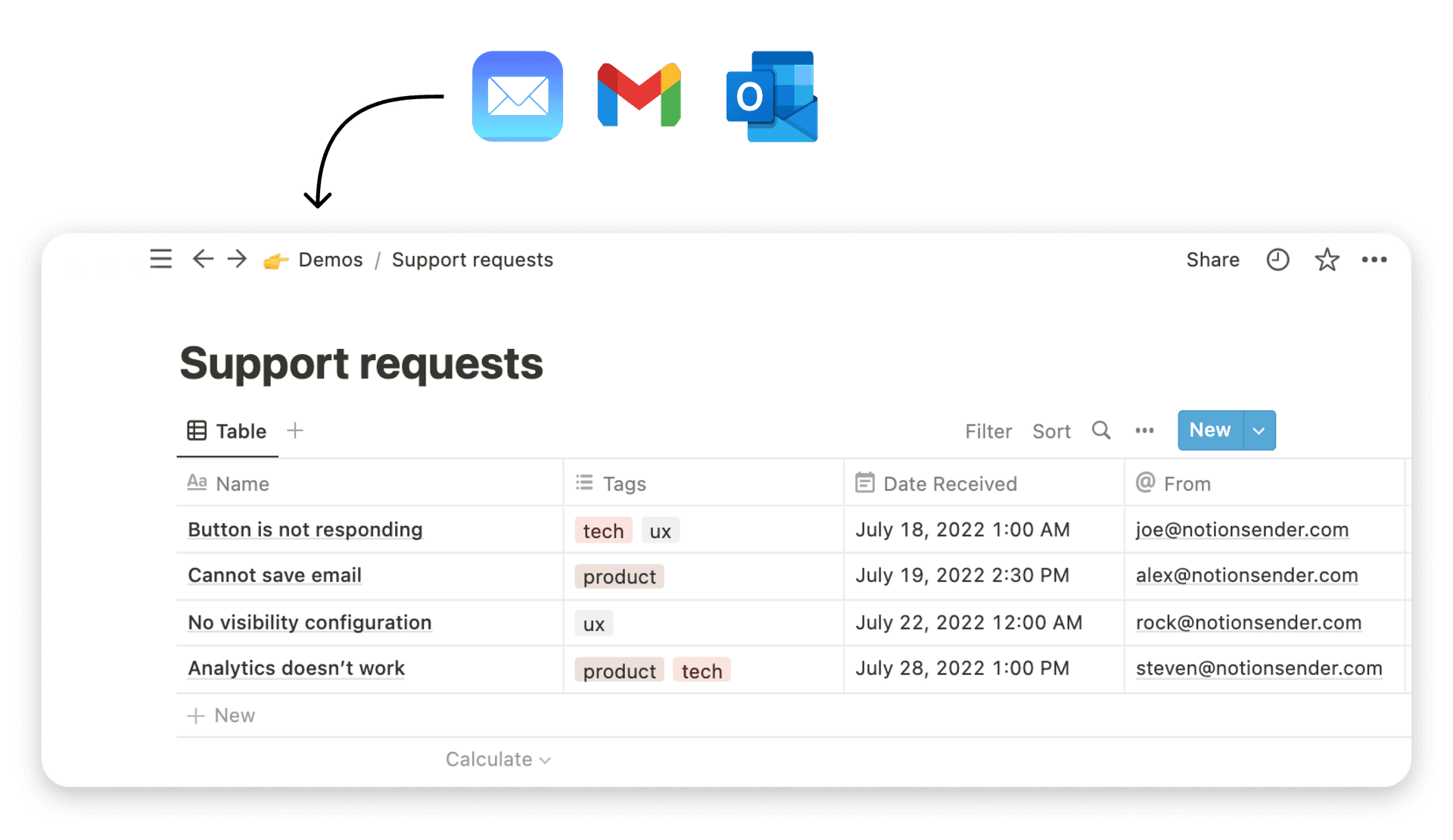
You can see how distinct pieces of information get neatly organized into properties like "From," "Subject," and "Status," making every incoming message immediately useful and easy to act on.
By wiring your planner into your most important communication channel, you build a marketing engine that's not just organized, but also incredibly responsive. If you want to go deeper, we have a full guide on how to create and send email from Notion that builds on these ideas.
Next up, we'll flip the script and look at automating your outbound emails directly from your new marketing hub.
Automating Your Marketing Communications from Notion
<iframe width="100%" style="aspect-ratio: 16 / 9;" src="https://www.youtube.com/embed/mDmc0yWFXw0" frameborder="0" allow="autoplay; encrypted-media" allowfullscreen></iframe>
We've already set up your Notion workspace to pull in information from the outside world. Now it's time for the really powerful part: sending emails out automatically, right from your online marketing planner. This is when your planner stops being just a record of your work and starts doing some of the work for you.
By connecting NotionSender with your existing databases, you can build workflows that take care of all those repetitive emails. Think of the time you'll get back when you don't have to manually send status updates or follow-ups. The goal is to make sending an email just another seamless part of your marketing process, not a separate task.
Triggering Emails Based on Actions
The whole idea is beautifully simple: when you do something in your Notion planner, an email gets sent. It could be changing a status property, checking a box, or clicking a button. You’re no longer just tracking your work; your actions in Notion are making things happen in the real world.
For example, think about the Content Calendar we built. When a writer finishes a draft, you probably change its status from "Drafting" to "In Review." With this setup, that one little change can instantly fire off an email to your editor, letting them know a new article is ready for their eyes.
That's the kind of automation that keeps projects chugging along without you needing to constantly jump back and forth between Notion and your inbox.
A Real-World Scenario with Creative Briefs
Let's look at a concrete example using your Creative Briefs database. Say a team member submits a new brief for an upcoming social media campaign. You review it, think it's brilliant, and change its status from "Submitted" to "Approved."
This is a perfect trigger for a simple but effective workflow:
- The Trigger: A brief's status changes to "Approved."
- The Action: NotionSender automatically sends a personalized confirmation email.
- The Recipient: The email is sent to the "Submitter" of the brief, using the email address you already have stored as a property.
The email can be simple: "Great news! Your creative brief for the 'Summer Sale Social Campaign' has been approved. We'll be kicking off production this week."
This isn't just about saving yourself five minutes. It provides instant feedback, keeps everyone in the loop, and creates a professional, organized process that gives your team and clients real confidence.
Using Template Expressions for Personalization
Nobody likes getting generic, robotic emails. To make your automated messages feel genuine, you'll want to personalize them. This is where NotionSender's template expressions are incredibly useful.
Template expressions are little placeholders that look like {{Page.property}}. They pull data directly from your Notion database properties and drop it right into your emails. This lets you craft dynamic email templates that feel like they were written by hand every single time.
Let's go back to our "Approved" creative brief. Instead of that generic message, we can use template expressions to pull in specific details from the brief itself.
Email Subject:
Re: Your Creative Brief "{{Page.Project Name}}" Has Been Approved!
Email Body:
Hi {{Page.Submitter Name}},
I'm excited to let you know that we've approved the project: **{{Page.Project Name}}**. We're aligned with the objective to **{{Page.Objective}}** and will target the **{{Page.Target Audience}}** as outlined.
Next steps will be assigned by {{Page.Project Lead}} before the end of the day.
Best,
The Marketing Team
This email goes out automatically, but it’s packed with personal details that make it far more valuable. You can set up these kinds of rich, automated workflows for almost any part of your marketing planner. If you're curious about the more technical side of things, you can dig into the syntax and other possibilities in the NotionSender API documentation.
Building Powerful Workflows with Notion Buttons
To make these automations even slicker, you can use Notion's built-in Button feature. Instead of having to manually change a status property, you can create a button inside your database that triggers multiple actions at once.
Imagine you're running a PR outreach campaign from your Campaign Tracker. You need to send a follow-up email to a few journalists who haven't gotten back to you.
You can create a button right on that contact's page labeled "Send Follow-Up." With one click, that button can do two things:
- Change the Status: It updates the contact's "Status" property from "Pitched" to "Follow-Up Sent."
- Send the Email: It triggers a pre-written NotionSender email template with a polite follow-up message.
One click. Your database is updated, and the email is on its way. This is the ultimate goal of an efficient online marketing planner—a system where tracking your work and doing your work become the same thing. By removing that friction, you free up your time and mental energy for the creative, strategic thinking that really moves the needle.
Alright, your marketing machine is planned out. But a plan is just a wish list if you can't see what's actually working. Let's build the final, crucial piece of your online marketing planner: a dashboard that tracks your results.

This is where your Notion workspace stops being just a to-do list and becomes the strategic brain of your marketing operations.
The best part? We’ll build this right into the Campaign Tracker you already created. No more exporting CSVs to a separate spreadsheet. You'll see your performance data right alongside the projects you're managing.
Adding Core Metric Properties
First things first, jump back into your Campaign Tracker database. We're going to add a few new properties to hold the performance data for each campaign. Think of these as the fields you'll fill out once a campaign wraps up or during your weekly check-ins.
Go ahead and add these as Number properties:
- Email Open Rate: The percentage of people who opened your emails.
- Click-Through Rate (CTR): The percentage who clicked a link in that email.
- Leads Generated: A simple count of new leads from this specific campaign.
- Conversion Cost: How much you spent to get each new lead or customer.
By adding these directly to your campaign pages, you’re creating a permanent report card. It makes it dead simple to look back six months from now and see how that "Summer Sale" really did compared to your "Black Friday" push.
Don't get lost in vanity metrics. A high open rate feels good, but knowing which campaign brought in the most qualified leads for the lowest cost is what actually grows the business. Focus on data that tells you what to do next.
Visualizing Performance with Rollups and Formulas
This is where the Notion magic happens. Let's say you have a separate "Marketing Goals" database where you've set your targets for the quarter. We can connect the two.
Create a Relation property in your Campaign Tracker that links to your Goals database. Now, you can use Rollup properties in the Goals database to pull all that data together automatically.
For example, you can create a rollup to see "Total Leads Generated" for Q3. It will instantly sum up the Leads Generated property from every single campaign you've linked to your "Q3 Goals" page. No manual math required.
Of course, to really know if your efforts are paying off, you have to connect these numbers to the bottom line. Understanding exactly how to measure marketing ROI is what turns these metrics from interesting data points into a clear picture of business impact.
Creating Summary Views for Actionable Insights
Now for the final touch: a dedicated dashboard view.
Inside your Campaign Tracker, create a new table view and call it something like "Performance Dashboard." Here, you can hide all the day-to-day operational columns like "Tasks" or "Timeline." Keep it clean. Only show the campaign name and your new KPI properties.
Sort this table by "Leads Generated" in descending order. Boom—you can instantly see your biggest winners.
Add a filter to show only campaigns from the "Current Quarter." Now you have a focused view that tells you exactly what's working right now, so you can double down on your most effective strategies.
It’s natural to have a few questions when you’re setting up a new system. Here are some of the most common ones we see when people start building their online marketing planner with Notion and NotionSender.
Let's clear up any confusion so you can get the most out of your new, integrated marketing hub.
Can I Use This Planner for Social Media Content Too?
Yes, definitely. The Content Calendar template is designed to be channel-agnostic from the start. All you have to do is add a new "Platform" property to the database.
I recommend using Notion's Multi-select property for this. Just add your channels as options: Blog, Twitter, LinkedIn, Newsletter, or Instagram. Now you can plan everything in one place.
Pro-tip: For a cleaner workflow, set up different database views for each platform. You could create a "Social Media Schedule" view that's filtered to only show posts tagged with
How Secure Is Connecting My Email Through NotionSender?
Security is a huge priority. When you connect NotionSender, you aren't giving it access to your main business or personal email account. It works differently.
Instead, NotionSender generates a unique, random email address for each database you connect. Think of it as a secure, one-way street for information. It’s built only to bring specific emails into Notion, not to access your entire inbox. This approach keeps your sensitive data private while still letting you centralize key communications in your planner.
What if My Team Already Uses Another Project Management Tool?
Moving a team to a new tool can feel like a massive project, but the efficiency you gain from a single, unified system is almost always worth it. My advice is to skip the "hard switch" and go for a phased approach.
Start small. Try using the new online marketing planner for just one upcoming campaign. Let the team see for themselves how much easier it is when the strategy, content, email briefs, and reporting are all in one place. Once they realize how much time they're saving by not jumping between different apps, they’ll likely be the ones pushing to adopt it more widely.
Is This System Suitable for a Solo Freelancer?
Absolutely. This setup is a game-changer for freelancers. It gives you a professional, scalable way to manage multiple clients and projects without the headache and high cost of juggling five different software subscriptions.
You can create a separate planner for each client or manage them all from a single master dashboard. Using Notion's powerful filtering, you can instantly zero in on one client's work at a time. The automation features, in particular, will save you countless hours on admin, freeing you up to focus on what you do best.
Ready to turn your Notion workspace into a powerful, automated marketing hub? Start centralizing your communications and streamlining your workflows with NotionSender. Get started for free today.