Project Management Docs Template: A Notion System Guide

Your project probably doesn’t feel broken because of one big failure. It feels broken because information keeps slipping between tools.
The brief lives in Notion. Tasks are partly in a board, partly in someone’s head. Approval happened in email. Meeting notes are in a doc nobody linked back to the project. A client asks why a decision changed, and the team spends twenty minutes searching inboxes instead of answering the question.
This is why a good project management docs template matters. It’s not about making prettier documents. It’s about building one operating system for the project so scope, tasks, decisions, risks, and communication stay connected.
For small teams, freelancers, and client-facing operators, that system has to stay lean. Overbuilt enterprise templates often collapse under their own weight. Smaller teams usually need fewer documents, tighter links between them, and a setup people can maintain without a PMO. That gap is well recognized in project management content, especially for ad-hoc environments where teams abandon heavy documentation because it creates more overhead than clarity, as noted by Rebel's Guide to PM on essential project documents.
Why Your Scattered Docs Are Killing Project Momentum
Scattered documentation slows a project in ways that are easy to miss at first. Nobody notices the cost of fragmentation when work is quiet. They notice it when a deadline is close, a stakeholder changes direction, or a teammate is out and nobody can find the latest decision.
A project breaks down fast when these five things live in separate places:
- Scope decisions sit in email threads nobody has tagged.
- Tasks get tracked in a board with no reference to the brief.
- Meeting notes exist as isolated pages with no owner or follow-up.
- Files and approvals stay trapped in inboxes.
- Risks and issues get discussed verbally, then forgotten.
That setup creates duplicate work because people keep reconstructing context. It also creates version confusion. The team starts asking which file is current, which task list matters, and whether the client approved the latest change.
Scattered docs don’t just make work messy. They force people to manage memory instead of managing the project.
Notion works well here because it doesn’t need to behave like a folder tree. Used properly, it becomes a Project HQ built on connected databases. The key difference is that each document becomes a record in a system, not a page that disappears into a sidebar.
That matters because one-size-fits-all template packs usually fail small teams. They assume every project needs the full stack of enterprise artifacts. In practice, smaller operations need a lean documentation model with only the pages that support delivery. The right project management docs template should reduce decision fatigue, not increase it.
A cleaner model starts with one rule. If a page affects delivery, ownership, communication, or approval, it belongs inside the system and should connect to the project record.
Blueprint Your Project Hub The Right Way
Most messy Notion workspaces come from one mistake. People start by designing pages when they should start by designing relationships.
A durable project hub works more like a small database application than a digital notebook. The structure matters first. Visual polish comes later.

Start with four connected databases
For most small teams, four databases are enough:
-
Projects This is the anchor table. Every task, meeting, doc, issue, and decision should relate back to a project.
-
Tasks This handles action. Every task should belong to one project, and when useful, one meeting or one document.
-
Documents This stores briefs, approvals, specs, status notes, client files, and reference material. It’s not a file dump. It’s an indexed record of project knowledge.
-
Meetings This tracks calls, workshops, standups, and decision sessions. Good meeting notes should produce tasks, decisions, and follow-ups.
This setup prevents data silos because each record can roll up to the project level. A project page stops being a static summary and becomes a live control center.
Why this structure holds up better than folders
Folders hide relationships. Databases expose them.
When teams build a workspace around folders, they usually duplicate information. The same milestone gets mentioned in the brief, repeated in meeting notes, added to a task board, and summarized in status updates. Then one copy changes and the others drift out of sync.
With relational databases in Notion, the project page can show:
- Open tasks linked to that project
- Recent meetings tied to the same workstream
- Current documents such as the brief, statement of work, or status report
- Known risks or issues if you add those as related records later
That logic aligns well with established project documentation frameworks. PMI-based template structures organized by PMBOK process groups treat documents like project charters, RACI matrices, and risk registers as foundational components, and organizations using standardized templates report improved outcomes through clearer expectations management, according to ProjectManagementDocs on project management templates.
Build the project database first
The Projects database should be the source of truth. Don’t overstuff it. It needs enough structure to describe the work, track ownership, and connect downstream records.
A practical starting set looks like this:
- Project Name
- Status
- Owner
- Client or Team
- Start Date
- Target Date
- Priority
- Project Type
- Linked Tasks
- Linked Docs
- Linked Meetings
That’s enough to support delivery without turning the project page into an intake form nobody wants to fill out.
Practical rule: If a property won’t help someone make a decision, filter work, or report progress, leave it out of version one.
Treat pages as interfaces, not storage bins
Inside each project page, use linked views instead of long written summaries. A good project home page usually needs:
- a top-level brief or overview
- a filtered task view for this project
- a meeting log filtered to this project
- a document view filtered to this project
- a short decisions or risk section
This gives every stakeholder a clean landing page without duplicating records.
For product teams, this structure also supports stronger handoff between planning and execution. If you want another perspective on role clarity, prioritization, and operating rhythm, Figr has a useful write-up on best practices for product managers that maps well to this kind of database-driven setup.
Keep the system lean enough to survive real work
A lot of teams build a beautiful workspace that collapses the first week the pace picks up. The cause is usually too many fields, too many statuses, or too many required documents.
Use these filters when deciding what belongs in the hub:
| Question | Keep it if the answer is yes |
|---|---|
| Does this help define scope? | Add it to the project brief or docs database |
| Does this create accountability? | Put it in tasks or RACI-related fields |
| Does this support communication? | Capture it in meetings or status docs |
| Does this record a decision or approval? | Save it in documents and relate it to the project |
If you follow that filter, your workspace stays operational instead of decorative.
Building Your Four Essential Notion PM Templates
Once the database structure is in place, templates become much easier to build because each one has a job. That’s the point of a modular system. You’re not trying to create one giant master document. You’re creating a set of repeatable records that work together.
That modular approach matters. Well-documented processes built from modular templates can improve project success rates by 20-30% over time, and projects using modular templates report 25% faster onboarding, according to ProjectManagementDocs on the benefits of project management templates.
The Projects database schema to copy
Start with the main database because every other template will connect back to it.
| Property Name | Property Type | Purpose |
|---|---|---|
| Project Name | Title | Main project record |
| Status | Select | Tracks phase such as Draft, Active, On Hold, Complete |
| Owner | Person | Primary accountable lead |
| Client | Text or Relation | Identifies the external client or internal team |
| Start Date | Date | Planned kickoff |
| Target Date | Date | Expected completion date |
| Priority | Select | Helps sort active work |
| Project Type | Select | Separates retainer work, internal work, launches, builds, etc. |
| Tasks | Relation | Links all related task records |
| Documents | Relation | Links briefs, approvals, files, reports |
| Meetings | Relation | Links calls and decision sessions |
| Summary | Text | One short plain-language description |
| Health | Select | Quick project signal for review dashboards |
This isn’t the only valid schema, but it’s reliable. It covers planning, reporting, and navigation without creating unnecessary admin.
If you want a broader view of common project template categories outside Notion, WeekBlast's project template guide is a useful reference for comparing document types before you decide what to include.
Template one, the project brief
The Project Brief belongs inside the Projects database as a page template. It should be short enough to read quickly and specific enough to guide decisions.
A practical project brief template includes these sections:
-
Objective What outcome the project is meant to produce.
-
Success criteria What has to be true for the project to count as done.
-
Scope What is included.
-
Out of scope This matters more than is often recognized. It prevents slow-motion scope creep.
-
Stakeholders Who approves, who contributes, who needs updates.
-
Key milestones A short list, not a full project schedule.
-
Dependencies External approvals, content, assets, vendor inputs, or client feedback.
-
Linked views Filtered tasks, documents, and meetings for this project.
The reason this works better than a long narrative document is that the brief becomes the front door for the project. Team members don’t need to scan five pages to understand what they’re working on.
Template two, the task template
A task record should answer four questions immediately: what is it, who owns it, when is it due, and what project does it support.
Use these properties in the Tasks database:
- Task Name
- Status
- Assignee
- Due Date
- Project as a relation
- Priority
- Task Type
- Blocked checkbox or status
- Related Doc as a relation when the task depends on a spec, approval, or file
- Related Meeting as a relation when the task came from a call
Inside the template page, include:
- a short task description
- acceptance notes or completion criteria
- linked references
- update log if the work is complex
The key design choice here is using Relation properties instead of multi-select labels for projects or stakeholders. A relation keeps the connection live. A label only imitates structure.
If a task comes from a meeting or client request, link the source directly. Teams move faster when nobody has to ask where the task came from.
Template three, meeting notes that produce action
Most meeting notes fail because they record conversation instead of outcomes.
Your Meetings database should include:
- Meeting Name
- Date
- Project relation
- Attendees
- Meeting Type
- Decision Summary
- Action Items relation to Tasks
- Next Check-In
Inside the meeting template, use a layout that forces clarity:
- Context
- Agenda
- Decisions made
- Action items
- Open questions
- Attachments or linked emails
This keeps meetings connected to execution. If a note doesn’t create a decision, task, or follow-up, it probably didn’t need to live as a formal record.
Template four, a simple risk register
A lot of small teams skip risk tracking because “risk register” sounds corporate. The simple version is enough.
Create a Risks database if your projects have enough moving parts, or a risk section inside Documents if they don’t. For a proper database, use:
- Risk Title
- Project relation
- Description
- Impact
- Likelihood
- Owner
- Mitigation
- Status
- Review Date
Keep the scale plain language if that helps. Low, Medium, High is usually enough for small teams. The point is to make risk visible early, not to score it with fake precision.
What works and what doesn’t
The patterns that hold up in real work are usually simple.
What works
- Short templates with clear required fields
- Relations between records instead of copied text
- One default template per database
- Project pages that show live filtered views
- Explicit out-of-scope language in the brief
What doesn’t
- Templates packed with optional fields nobody updates
- Separate task systems outside the project hub
- Meeting notes with no linked actions
- Status properties with too many stages
- Beautiful dashboards built before the underlying records are clean
A project management docs template should feel like a good form. It should guide the team into clarity without making them stop and think about where information belongs.
Mastering Template Versioning and Access Control
A Notion workspace can look organized and still be fragile. The warning signs usually show up later. Someone edits the master brief template in the middle of a live project. A teammate duplicates an old page instead of the current one. Another person “improves” a task template and breaks the property structure for everyone else.
That’s why governance matters early, even for a solo consultant.

Use a simple versioning rule
You don’t need a formal release process. You need consistency.
Name templates with a visible version number such as:
- Project Brief v1.0
- Task Template v1.1
- Meeting Notes v2.0
Minor edits can move from v1.0 to v1.1. Bigger structural changes can move to v2.0. Keep retired versions in a Template Archive page so older projects still have context, but new work always starts from the latest approved version.
Separate template builders from template users
Teams should not generally have universal edit rights to the database templates themselves. They should be able to create records from templates, fill them out, and update their assigned work. That’s very different from editing the template source.
A practical setup looks like this:
-
Workspace owner or system manager Maintains structure, properties, and templates
-
Project leads Can create project records and update live pages
-
Contributors Can edit assigned records and comment where needed
-
Clients or external collaborators Usually get view-only access to specific pages or shared views
Use Notion’s original source references when duplicating or updating important documents so you can track where a live page came from. If you’re maintaining programmatic workflows or syncing records across tools, the NotionSender API documentation is the right place to review the available integration options and field behavior before you lock in your permissions model.
Governance isn’t bureaucracy. It’s the small amount of structure that prevents your workspace from quietly breaking.
Connect Email to Notion with NotionSender Automation
Most project systems fall apart at one edge. Email.
The plan may live in Notion, but requests, approvals, clarifications, invoices, and stakeholder decisions still arrive in inboxes. That disconnect is a major gap in project management guidance. Existing resources rarely explain how to connect email templates, approval chains, and stakeholder communications with formal project documentation, even though email remains a primary coordination channel, as noted by Berkeley IT template resources.

A project hub becomes much more useful when email stops being a side channel and starts becoming part of the record.
Treat email like project data
Teams frequently make one of two mistakes with email:
- they leave everything in the inbox and rely on search
- they manually copy pieces of important messages into project docs
Both approaches create holes. Search is too reactive, and manual transfer is too inconsistent.
A better model is to define which email events deserve a home inside the project system. In practice, that usually includes:
- New client requests that should create tasks
- Approvals that should be saved as project records
- Status updates that should be sent from the same workspace where work is tracked
- Meeting coordination that should connect to meeting records
- Invoice or delivery notices that belong to a project trail
An email-to-database workflow makes sense.
Scenario one, turn inbound email into actionable tasks
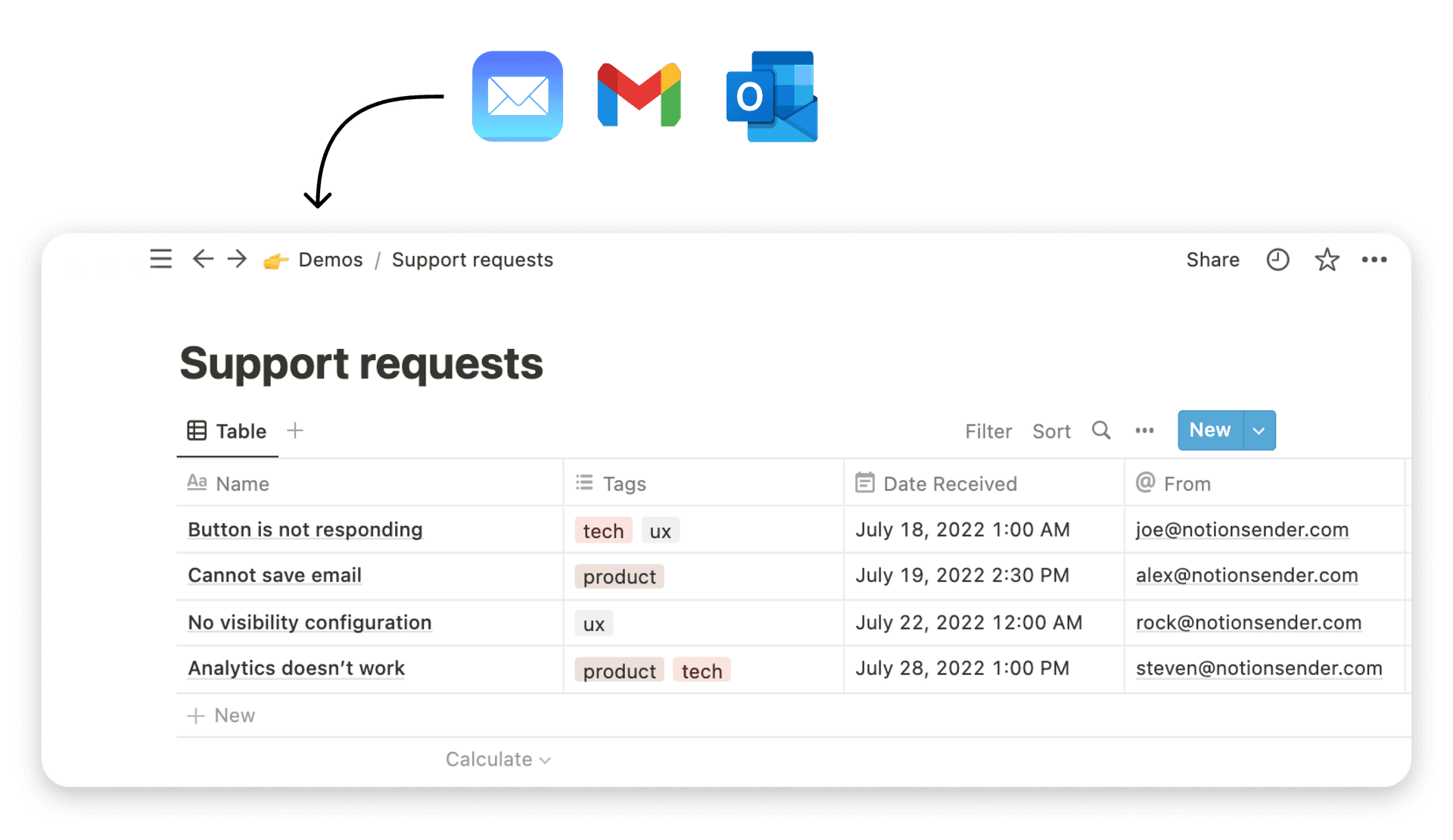
A common setup is mapping incoming client emails into the Tasks database.
For example, a client sends an email requesting revisions. Instead of forwarding it around or manually retyping the request into a board, you map fields like:
- email subject to Task Name
- sender to Requester
- message body to Request Details
- received date to Created On
- project identifier to Project relation
That gives the team an immediate task record with source context attached.
The advantage isn’t just speed. It’s traceability. When someone asks why the task exists, the originating request is already connected.
Scenario two, save approvals and key emails as project documents
Some emails shouldn’t become tasks. They should become part of the project record.
Examples include:
- client sign-off on scope
- confirmation of timeline changes
- stakeholder approval of deliverables
- budget-related direction
- legal or compliance notes
Those belong in the Documents database. Store them as records linked to the correct project, and tag them by document type such as Approval, Client Input, Scope Change, or Reference.
This prevents a common failure mode where a team “knows” approval happened but can’t quickly produce the exact message when the project shifts.
The inbox is a terrible archive for project decisions because it organizes communication by conversation, not by project truth.
Scenario three, send structured updates without leaving the workspace
Outgoing communication matters too. If your project status update lives in a Notion page but you still paste it manually into email, you’ve recreated the same fragmentation problem in reverse.
A cleaner workflow is to draft the update inside Notion using a status-report record, then send from that source. That way the sent message and the source document stay aligned. If your team handles this often, NotionSender is one option for sending and receiving email directly within Notion while saving emails into databases and mapping fields for structured records.
For a closer look at outbound workflows, the walkthrough on creating and sending email from Notion is the most relevant reference point.
A practical field-mapping approach
You don’t need complex automation to get value. Start with one high-friction workflow and map it cleanly.
| Email field | Suggested Notion property |
|---|---|
| Subject | Title or Task Name |
| Sender | Requester or Contact |
| Body | Notes or Request Details |
| Timestamp | Received Date |
| Attachment reference | Files or Related Document |
| Thread category | Document Type or Task Type |
| Project keyword | Project relation |
Once that works reliably, add a second automation.
A good first sequence for many teams is:
- inbound request becomes a task
- approval email gets stored as a document
- project update gets drafted and sent from the same workspace
That closes the communication loop. The project plan, the work, and the message trail stop living in separate systems.
A short walkthrough can help if you want to see the flow in action.
<iframe width="100%" style="aspect-ratio: 16 / 9;" src="https://www.youtube.com/embed/6EHbZfM5K-U" frameborder="0" allow="autoplay; encrypted-media" allowfullscreen></iframe>
What to avoid when setting up automation
Automation fails when the data model is weak.
Avoid these mistakes:
-
Dumping every email into one database Not every message deserves a record.
-
Skipping project relations If an email-derived record can’t connect to a project, it becomes noise.
-
Using vague statuses Records need a clear next state such as New, Triaged, Actioned, Archived.
-
Automating before naming conventions exist Project names, request types, and ownership rules should be stable first.
Done well, email automation doesn’t replace project management discipline. It supports it by reducing manual transfer and preserving context where the team already works.
From System to Habit Driving Team Adoption and Success
The technical build is only half the job. A workspace succeeds when people trust it enough to stop keeping private backup systems in their notes, inboxes, and desktop folders.
The best rollouts are usually small. One team starts using a clean project brief, linked task records, and meeting notes that generate action items. Then someone notices they no longer need to ask where the latest status lives. That’s when adoption starts to feel natural.

Give each role a view that feels useful immediately
A generic dashboard usually underperforms. Role-based views work better.
A contributor needs a My Tasks page with only assigned work, due dates, blockers, and linked source docs. A project lead needs a Project Overview with open actions, recent meetings, pending approvals, and risk visibility. A client-facing operator often needs a Comms and Deliverables view that connects what was promised to what is being shipped.
When each person opens Notion and sees a page that answers their daily questions, the system earns attention.
Use a review rhythm, not constant policing
Teams don’t maintain clean workspaces because a PM tells them to. They maintain them when the workspace is part of the operating rhythm.
A simple cadence works:
-
Weekly Review open tasks, overdue items, and active risks.
-
After each key meeting Convert decisions into tasks or document updates.
-
At project close Capture what changed, what caused friction, and what the next template version should handle better.
This is also where metrics become useful. If you’re measuring template effectiveness, define KPIs such as schedule variance below 10% and cost performance index above 0.95, and use post-project evaluation to improve the system over time. PMBOK-based templates have been shown to yield 28% higher success rates versus ad-hoc methods, according to Project-Management.com on measuring project success.
Show value early or the team will drift back
One team I’ve seen make this transition well didn’t launch with ten dashboards. They launched with three visible wins:
- one reliable project brief
- one task board linked to real project records
- one meeting template that always created follow-up actions
That was enough to change behavior. Once people stopped asking where things were, they were willing to add more structure.
Teams adopt documentation when it saves them time this week, not when it promises better process someday.
If your project management docs template setup feels heavy, reduce it. Adoption usually improves when the first layer is narrow, useful, and easy to repeat.
Your Fully Integrated Project Management Workspace
A strong project management docs template isn’t one document. It’s a connected system.
The useful version has a project hub that anchors work, tasks that relate back to real context, meeting notes that create action, documents that preserve decisions, and governance that keeps templates from drifting. Once email joins that system, the communication trail stops floating outside the project record.
That shift matters most for small businesses, freelancers, and lean teams. You don’t need a huge PMO-style document stack. You need enough structure to make scope clear, work visible, approvals traceable, and handoffs clean.
When that system is in place, Notion stops being a collection of pages and starts acting like operational infrastructure. Email integration strengthens that further by turning requests, approvals, and updates into structured records instead of inbox clutter. If keeping message history tied to project records is your next gap, the guide on saving emails to Notion is the most direct place to continue.
If you want to connect project documentation with the email trail your team already depends on, NotionSender gives you a practical way to send, receive, and save emails directly inside Notion databases so your project records stay complete.