10 Essential Sprint Planning Best Practices for High-Performing Teams in 2025

Sprint planning often feels like a necessary evil: a long, draining meeting that kicks off a frantic two weeks of work. But what if it could be different? What if your planning sessions became the strategic launchpad for predictable, high-impact sprints that consistently deliver value? The difference between a team that hits its goals and one that constantly misses deadlines often comes down to the quality of its planning. A well-executed sprint planning session isn't just a formality; it's the foundation for clarity, focus, and sustainable momentum.
This guide moves beyond generic advice to provide a deep dive into 10 proven sprint planning best practices. Each one is designed to be immediately actionable, helping you transform chaotic meetings into focused, efficient sessions that set your team up for success. We will explore everything from defining crystal-clear sprint goals and implementing capacity-based planning to leveraging collaborative backlog refinement.
We'll also cover how to integrate smart workflows with tools like NotionSender to streamline communication and updates, ensuring every sprint starts with confidence and a clear path to "done." For teams operating in a distributed environment, it’s also useful to consider the specific nuances involved. To further refine your approach, consider specific insights on the 10 Sprint Planning Best Practices for Remote Teams, which addresses the unique challenges of distributed collaboration.
1. User Story-Driven Planning
User story-driven planning is a fundamental practice that shifts the team's focus from completing technical tasks to delivering tangible value to the end-user. Instead of a backlog filled with generic items like "Build API endpoint," this approach breaks down requirements into user stories. Each story follows a simple, powerful format: "As a [user role], I want [functionality], so that [benefit]." This structure forces the team to constantly consider the "why" behind their work, ensuring every task directly contributes to a user's goal.
This method is central to many successful agile frameworks and one of the most effective sprint planning best practices for aligning development efforts with business objectives. It frames the conversation around user needs, fostering empathy and a shared understanding between developers, designers, and product owners.

Why It Works
This approach keeps the customer at the heart of the development process. Companies like Spotify and countless enterprise agile transformations rely on user stories to ensure their engineering teams build features people actually want. When a developer understands that their work on a "database migration" is really to "help a marketing manager access campaign reports faster," they can make better, more informed implementation decisions.
How to Implement It
- Define Clear Acceptance Criteria: For each story, list the specific conditions that must be met for it to be considered complete. For example, "When a user clicks 'Export,' a CSV file downloads immediately."
- Apply the INVEST Criteria: Ensure every story is Independent, Negotiable, Valuable, Estimable, Small, and Testable. This framework helps keep stories manageable and ready for a sprint.
- Use Story Mapping: Before planning, visually map out the user journey with stories. This helps identify gaps, dependencies, and priorities, creating a more coherent product experience.
2. Capacity-Based Planning
Capacity-based planning grounds the sprint commitment in reality by calculating the team's actual available work hours. Instead of relying solely on past velocity (story points), this approach accounts for holidays, paid time off, meetings, and other non-project work. The team starts by determining the total available person-days for the sprint and then commits to a scope of work that realistically fits within that capacity. This prevents overcommitment and reduces the risk of burnout.
This pragmatic method is one of the most crucial sprint planning best practices for setting achievable goals and building a sustainable pace. It shifts the conversation from "How many story points can we do?" to "What can we realistically accomplish with the time we have?" This fosters trust and transparency, ensuring the sprint goal is both ambitious and attainable.
Why It Works
This data-driven approach removes guesswork and wishful thinking from the planning process. Tech giants like Microsoft and IBM's agile coaching programs emphasize realistic capacity assessment to ensure predictable delivery. By acknowledging that not every hour is spent on new development, teams can create a more accurate forecast, leading to higher morale and more consistent sprint success.
How to Implement It
- Calculate Net Capacity: Start with the total possible workdays (e.g., 10 days x 5 people = 50 person-days). Subtract all known time off, holidays, and recurring meetings.
- Factor in a Buffer: Deduct a percentage (typically 15-20%) from the net capacity to account for unplanned interruptions, support tasks, and general administrative overhead.
- Track and Adjust: Use burndown charts to monitor progress against your planned capacity. After a few sprints, you'll have historical data to make your capacity forecasts even more accurate.
- Review Regularly: Re-evaluate your capacity assumptions whenever the team composition changes or at least once per quarter to ensure they remain relevant.
3. Sprint Goal Definition
Sprint goal definition is the practice of establishing a single, concise objective for the sprint. Rather than viewing the sprint as a random collection of backlog items, the sprint goal provides a cohesive mission that the entire team works toward. This shared objective guides the selection of user stories, provides focus, and empowers the team to make smart scope adjustments during the sprint without losing direction.
This approach is one of the most crucial sprint planning best practices because it transforms a list of tasks into a unified purpose. It answers the question, "Why are we doing this sprint?" and ensures that if nothing else gets done, achieving this one goal will make the sprint a success.

Why It Works
A clear sprint goal fosters alignment and flexibility. Companies like Atlassian and Google use sprint goals to rally their teams around specific feature launches or performance improvements. When a team has a goal like "Implement a streamlined one-click checkout process," they can make trade-off decisions about lower-priority stories that don't directly contribute to that outcome, ensuring they deliver the most critical value.
How to Implement It
- Co-create the Goal: The product owner and the development team should collaborate to define the sprint goal. This ensures shared understanding and commitment from everyone involved.
- Focus on Outcomes: Write the goal as a business outcome, not a list of outputs. For example, instead of "Complete stories X, Y, and Z," use "Allow users to save their payment information for faster future purchases."
- Keep It Visible: Display the sprint goal prominently in the team's physical or digital workspace. Reference it during daily stand-ups to keep the team focused on the objective. Proper communication is key; you can find helpful communication strategies to keep your team aligned in our guide on how to send effective emails on NotionSender.com.
4. T-Shirt Sizing with Estimation Workshops
T-shirt sizing is a relative estimation technique that moves the focus from assigning precise numerical points to gauging the complexity of work items. Instead of debating whether a task is a 3 or a 5, the team uses intuitive sizes like XS, S, M, L, and XL. This approach simplifies the estimation process, making it faster and less contentious, while still providing a valuable relative scale for capacity planning.
This method is one of the most effective sprint planning best practices for teams that find story points to be overly prescriptive or a source of friction. By abstracting complexity into familiar sizes, it encourages high-level discussion about effort rather than getting bogged down in minute details, fostering a more collaborative and less stressful planning environment.
Why It Works
This technique reduces the cognitive load of estimation and minimizes "analysis paralysis." Many startup engineering teams, and even large organizations like the UK Government Digital Service, have adopted t-shirt sizing to streamline planning. It's successful because it frames estimation as a conversation about relative complexity, not an exact science, which helps teams align quickly and move forward with confidence.
How to Implement It
- Create Reference Stories: Before you begin, define a clear, well-understood "benchmark" story for each t-shirt size (e.g., "This is our classic 'Medium' story"). This calibrates the entire team's understanding.
- Use Silent Estimation First: To avoid anchoring bias, have team members silently assign a size to a story before discussing it. This ensures all initial thoughts are independent and equally considered.
- Set a Timebox for Debate: Establish a rule that if the team cannot agree on a size within five minutes, the story is likely too large or poorly understood and needs to be broken down further.
5. Dependency Mapping and Risk Assessment
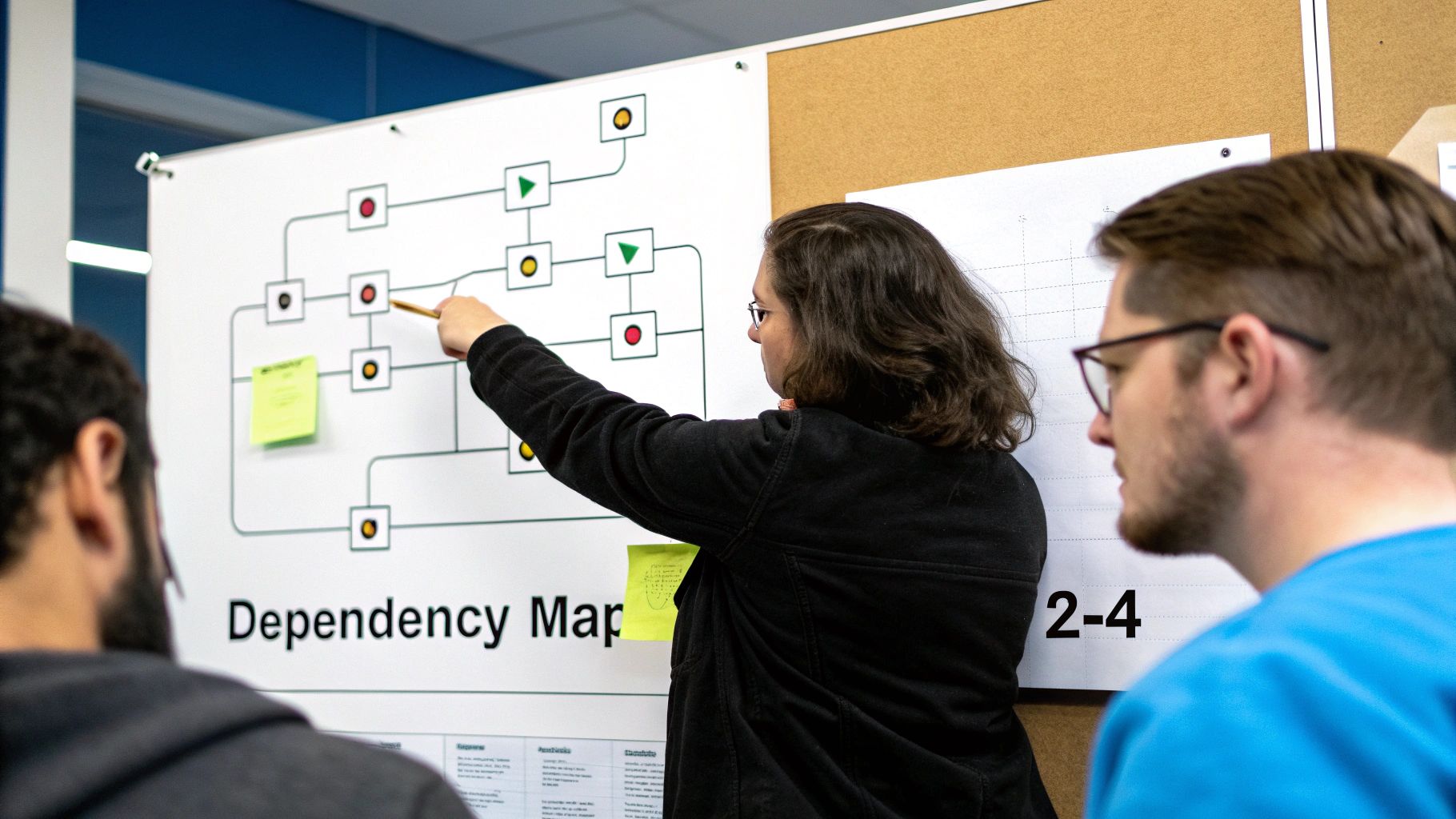
Dependency mapping is a proactive technique where teams identify and visualize potential roadblocks before a sprint begins. Instead of discovering that a crucial API isn't ready mid-sprint, this practice involves explicitly mapping which stories rely on other teams, external systems, or even each other. By assessing the risks associated with these dependencies, the team can sequence work intelligently and create contingency plans, preventing costly delays and frustration.
This methodical approach is one of the most critical sprint planning best practices for complex projects, transforming potential chaos into a predictable workflow. It ensures that the sprint goal is achievable by accounting for external factors beyond the team's direct control, fostering better cross-team communication and alignment.
Why It Works
This practice prevents sprints from derailing due to unforeseen blockers. Tech giants like Netflix and AWS rely heavily on dependency management to coordinate work across hundreds of microservices and autonomous teams. In these environments, a single feature might require collaboration from multiple teams, and mapping these touchpoints is essential for a successful release. It shifts the team from a reactive "firefighting" mode to a proactive, strategic mindset.
<iframe width="560" height="315" src="https://www.youtube.com/embed/7L_3IQ0xPEk" frameborder="0" allow="accelerometer; autoplay; clipboard-write; encrypted-media; gyroscope; picture-in-picture" allowfullscreen></iframe>
How to Implement It
- Create a Dependency Board: Use a physical or digital board to visually map connections between user stories and external factors. This makes dependencies visible to everyone.
- Conduct a Pre-Sprint Risk Huddle: A day or two before planning, hold a brief meeting focused solely on identifying potential risks and dependencies for the upcoming sprint's candidate stories.
- Assign Ownership: For each identified dependency, assign a specific team member to be the point person responsible for communication and resolution.
- Sequence with Buffers: Plan dependent tasks sequentially in the sprint, not in parallel. Add buffer time between them to account for potential handoff delays.
6. Collaborative Backlog Refinement Pre-Planning
Collaborative backlog refinement is a proactive practice where the team discusses, clarifies, and estimates upcoming user stories before sprint planning begins. Instead of using valuable planning time to understand the requirements of a story for the first time, this session ensures that when the team arrives at sprint planning, the backlog items are well-understood, estimated, and ready to be pulled into the sprint. This transforms sprint planning from a discovery meeting into a focused commitment session.
This approach is one of the most impactful sprint planning best practices for ensuring a smooth, efficient planning event. It removes ambiguity early, allowing for a more accurate sprint forecast and preventing the team from getting bogged down in lengthy debates over unclear requirements.
Why It Works
Effective backlog refinement is a key differentiator between high-performing and struggling agile teams. Distributed companies like GitLab and Automattic rely heavily on well-refined backlogs to enable asynchronous collaboration and predictable sprint outcomes. When a story is properly refined, the team has already answered the critical questions, identified dependencies, and agreed on a rough estimate, making the actual planning process significantly faster.
How to Implement It
- Establish a "Definition of Ready": Create a clear checklist that a user story must meet before it can be considered for sprint planning. This typically includes clear acceptance criteria, a user-facing value statement, and an initial estimate.
- Schedule It Consistently: Hold refinement sessions 7-10 days before sprint planning. Limiting them to 60-90 minutes maintains focus and prevents fatigue. The goal is to refine enough work for the next 1.5-2 sprints.
- Use a Shared Workspace: Centralize refinement notes, questions, and decisions in a collaborative tool. Leveraging a platform like Notion for this process can streamline documentation and ensure everyone has access to the latest information. Learn more about getting the most out of Notion for your team.
7. Time-Boxed Planning Sessions with Clear Structure
A time-boxed planning session enforces a strict time limit on the sprint planning meeting itself. This disciplined approach prevents endless debates and ensures the team makes decisions efficiently. Instead of letting planning drag on, the team adheres to a set duration, such as four hours for a two-week sprint, guided by a clear and pre-defined agenda. This keeps the meeting focused and respects everyone's time.
This method is a core tenet of the Scrum framework and stands out as one of the most impactful sprint planning best practices for maintaining momentum. It forces prioritization and concise communication, ensuring the team leaves with a clear, actionable plan rather than a sense of exhaustion from a marathon meeting.
Why It Works
This practice prevents "analysis paralysis" and keeps energy levels high. Companies known for their operational efficiency, like Buffer, often limit their sprint planning to just a couple of hours. The strict time constraint encourages the team to prepare beforehand and stick to the agenda, covering goal definition, story selection, and task breakdown without getting sidetracked. This focus ensures the meeting achieves its purpose: creating a realistic and committed sprint backlog.
How to Implement It
- Create and Share an Agenda: Distribute a detailed agenda at least a day in advance. A great way to coordinate this is by using automated workflows. For more details on this, you can learn how to use Notion to send and schedule emails with your team.
- Use a Visible Timer: Display a timer for all participants to see. This creates a shared sense of urgency and helps the facilitator keep the meeting on schedule.
- Establish a 'Parking Lot': Designate a space (a whiteboard or digital document) to "park" important but off-topic discussions. These can be addressed after the meeting, preventing scope creep and keeping the planning focused.
8. Team Velocity Tracking and Historical Trending
Team velocity tracking is a data-driven approach that moves sprint commitments from guesswork to informed forecasting. It involves measuring the amount of work a team completes in each sprint, typically in story points, and using that historical data to predict future capacity. Instead of relying on gut feelings, the team looks at its proven track record over several sprints to make a realistic commitment.
This is one of the most powerful sprint planning best practices for establishing a predictable and sustainable pace. By analyzing trends, teams can confidently answer the question, "How much can we get done?" This practice, popularized by Scrum pioneers like Ken Schwaber and Mike Cohn, builds trust with stakeholders by grounding plans in empirical evidence rather than wishful thinking.
Why It Works
This method provides an objective measure of a team's delivery capability. Major tech companies and financial firms like Fidelity rely heavily on velocity data to forecast release timelines and manage long-term capacity. When a team consistently delivers around a stable velocity, it creates a reliable rhythm that makes planning for future quarters far more accurate and less stressful. It transforms planning from an art into a science.
How to Implement It
- Establish a Baseline: Track velocity for at least 4-6 sprints before using the data to inform commitments. Early sprints are often too variable to provide a reliable average.
- Use a Moving Average: Base your sprint commitment on the average velocity of the last 3-4 sprints. This smooths out single-sprint anomalies and provides a more accurate picture of current capacity.
- Analyze Variances: In sprint retrospectives, discuss significant spikes or drops in velocity. Was it due to holidays, technical debt, or an unforeseen blocker? Understanding the "why" helps improve future predictability.
- Keep It an Internal Metric: Never use velocity to compare teams or measure individual performance. Its sole purpose is to help a team forecast its own work.
9. Cross-Functional Team Skill Mapping and Balanced Workload Distribution
This advanced technique moves beyond simply assigning tasks by focusing on the team's collective capabilities. Skill mapping involves creating a visual representation of each team member's competencies, from expertise to areas they are actively learning. During sprint planning, this map is used to distribute work in a way that not only leverages existing strengths but also intentionally creates opportunities for growth and knowledge sharing, preventing specialist bottlenecks.
This approach transforms sprint planning from a simple allocation exercise into a strategic talent development tool. It is one of the most effective sprint planning best practices for building resilient, adaptable teams where responsibility and knowledge are shared. This ensures the team can handle diverse challenges and avoids creating single points of failure.
Why It Works
This method mitigates the risk of overloading specialists and builds a more versatile team. Companies like Etsy and Zappos have used similar principles to encourage cross-training and foster a culture of shared ownership. When a team deliberately plans for skill development, it not only balances the current sprint's workload but also invests in its future capacity, making the entire development process more sustainable.
How to Implement It
- Create a Visible Skills Matrix: Develop a simple chart listing team members and key skills (e.g., Frontend, Backend, UX, QA). Use a color-coded system to mark proficiency: expert, competent, learning.
- Balance Workload Intentionally: Aim for each member to spend 70-80% of their time on tasks within their core skills and 20-30% on tasks that develop new ones.
- Promote Paired Work: Deliberately pair a team member learning a new skill with an expert on a specific story. This is an effective way to transfer knowledge organically.
- Address Gaps in Retrospectives: Use the team retrospective to discuss any skill gaps that emerged during the sprint and plan how to address them in future planning sessions.
10. Definition of Ready and Definition of Done Alignment
Establishing a shared understanding of what makes a story "ready" for a sprint and what makes it "done" is a cornerstone practice for high-performing teams. The Definition of Ready (DoR) is a checklist that ensures a user story has been sufficiently analyzed, estimated, and prepared before it can be pulled into a sprint. The Definition of Done (DoD) is a parallel checklist that confirms all required quality and completion steps have been met before a story is considered finished.
This alignment prevents teams from starting work on poorly defined tasks and eliminates ambiguity around what "complete" actually means. It is one of the most critical sprint planning best practices for ensuring a smooth workflow and delivering high-quality, predictable increments. By confirming every selected story meets the DoR during planning, teams reduce mid-sprint surprises and improve their forecasting accuracy.
Why It Works
This practice creates clear entry and exit gates for sprint work, which reduces waste and rework. Mature Scrum teams and large-scale frameworks like SAFe rely on explicit DoR and DoD to maintain consistency and quality. For example, a development team knows that a "done" story includes passing all automated tests and receiving a peer code review, preventing technical debt from accumulating. This clarity empowers the team to push back on stories that aren't ready, fostering a culture of accountability.
How to Implement It
- Co-create the Definitions: Involve the entire scrum team (developers, QA, product owner, scrum master) in creating and agreeing upon the DoR and DoD. This ensures universal buy-in and a shared sense of ownership.
- Keep It Actionable: A good DoR might include: "Story is estimated," "Acceptance criteria are defined," and "Dependencies are identified." A DoD could include: "Code is peer-reviewed," "All tests pass," and "Documentation is updated."
- Integrate into Your Tools: Use checklist features in tools like Jira or Azure DevOps to build your DoR and DoD directly into your user story templates, making it easy to validate them during planning and execution.
10-Point Sprint Planning Best Practices Comparison
| Method | 🔄 Implementation Complexity | ⚡ Resource Requirements | 📊 Expected Outcomes | 💡 Ideal Use Cases | ⭐ Key Advantages |
|---|---|---|---|---|---|
| User Story-Driven Planning | Moderate — requires PO/stakeholder involvement and training | Medium — time for well-crafted stories and refinement | Clear user-focused deliverables; easier prioritization | Customer-facing features; product-driven teams | High alignment with user value — ⭐⭐⭐⭐ |
| Capacity-Based Planning | Low–Moderate — needs setup for tracking capacity | Medium — historical data, simple tooling, ongoing adjustment | More realistic sprint commitments; fewer failed sprints | Teams with variable availability or significant support work | Improves predictability and morale — ⭐⭐⭐ |
| Sprint Goal Definition | Low — needs facilitation and shared agreement | Low — brief time to craft and communicate the goal | Increased focus, scope flexibility, better in-sprint decisions | Cross-functional deliveries; alignment across stakeholders | Strengthens focus and cohesion — ⭐⭐⭐⭐ |
| T-Shirt Sizing with Estimation Workshops | Low — intuitive but requires calibration sessions | Low–Medium — workshops and reference examples | Faster, less contentious estimates; coarser granularity | New teams, high-level planning, stakeholder-friendly contexts | Reduces debate and onboarding friction — ⭐⭐⭐ |
| Dependency Mapping and Risk Assessment | High — mapping, cross-team coordination, and scoring | High — time, cross-team input, and visualization tools | Fewer blockers, better sequencing, reduced rework | Microservices, multi-team programs, regulated/complex systems | Mitigates integration and dependency risk — ⭐⭐⭐⭐ |
| Collaborative Backlog Refinement Pre-Planning | Moderate — needs regular cadence and discipline | Medium — recurring sessions and product-owner time | Faster sprint planning; higher-quality, better-estimated stories | Distributed teams, large/complex backlogs | Speeds planning and improves estimate accuracy — ⭐⭐⭐⭐ |
| Time-Boxed Planning Sessions with Clear Structure | Low–Moderate — requires skilled facilitation and agenda | Low — disciplined meeting structure and visible timers | Efficient planning meetings and predictable overhead | Distributed or time-constrained teams needing discipline | Prevents over-planning and decision fatigue — ⭐⭐⭐ |
| Team Velocity Tracking and Historical Trending | Moderate — consistent tracking and analysis required | Medium — 6–8 sprints of data, dashboards/tools | Data-driven forecasts; improved release planning and trends visibility | Mature teams with stable composition and metrics focus | Empirical basis for commitments — ⭐⭐⭐⭐ |
| Cross-Functional Team Skill Mapping & Balanced Workload | Moderate–High — skills inventory and planning coordination | Medium — skills matrix, pairing, and training time | Reduced bottlenecks; improved resilience and knowledge spread | Teams with specialist bottlenecks or learning goals | Distributes knowledge and reduces single points of failure — ⭐⭐⭐⭐ |
| Definition of Ready & Definition of Done Alignment | Low–Moderate — co-creation and regular review needed | Low — documented checklists and validation gates | Fewer surprises, higher quality, less rework | Any Scrum team aiming for consistent delivery quality | Clarifies expectations and reduces scope ambiguity — ⭐⭐⭐⭐ |
Putting It All Together: Your Path to Flawless Sprint Planning
Embarking on the path to better Agile execution begins with refining its most foundational ceremony: the sprint planning meeting. We've explored a comprehensive toolkit of ten sprint planning best practices, moving from foundational concepts like User Story-Driven Planning and clear Sprint Goal Definition to more advanced techniques such as Dependency Mapping and Cross-Functional Team Skill Mapping. The common thread is a shift from reactive, chaotic planning to a proactive, structured, and collaborative process.
The true power of these practices is not in their individual application but in their synergy. A well-defined 'Definition of Ready' (DoR) makes Collaborative Backlog Refinement more effective. In turn, a refined backlog allows for more accurate Capacity-Based Planning and T-Shirt Sizing estimations. This interconnected framework transforms your planning sessions from dreaded, lengthy meetings into energizing, strategic kickoffs that set the entire sprint up for success.
Your Actionable Next Steps
Feeling overwhelmed by the sheer number of practices? Don't be. The key to sustainable improvement is incremental change. Instead of attempting a complete overhaul overnight, focus on targeted implementation.
- Choose Your Starting Point: Select one or two practices that address your team's most significant pain point. Is your team consistently overcommitting? Start with Capacity-Based Planning and Team Velocity Tracking. Are your planning meetings unfocused and disorganized? Implement Time-Boxed Planning Sessions with a strict agenda.
- Commit and Iterate: Introduce the new practice in your next sprint. Gather feedback during your retrospective. What worked well? What felt clunky? Adjust your approach for the following sprint. This iterative process of refinement is the essence of Agile itself.
- Measure the Impact: Track key metrics. Are your planning meetings getting shorter? Is your sprint commitment-to-completion ratio improving? Is team morale on the rise? Quantifying these changes provides the motivation to continue optimizing your process.
Mastering sprint planning is a continuous journey, not a final destination. Each refinement you make contributes to a more predictable, efficient, and empowered development cycle. It builds a culture of ownership and clarity, ensuring every team member understands the "what" and the "why" behind their work. For those looking to dive even deeper into the mechanics and nuances of the process, a great resource is available. For a comprehensive resource to further elevate your sprint planning process, explore guides on how to Master Agile Development Sprint Planning.
Ultimately, adopting these sprint planning best practices is about more than just checking boxes; it's about building a resilient system that enables your team to consistently deliver outstanding value and thrive in a dynamic environment.
Ready to streamline the administrative side of your sprint planning? NotionSender integrates directly with your Notion workspace, allowing you to automate meeting invites, distribute pre-planning materials, and send follow-up summaries directly from your backlog. Spend less time on coordination and more time on strategic planning by visiting NotionSender to see how it works.