Automate Content Creation: Boost Your Business in 2026

Your content process probably looks organized from the outside. Ideas live in one place, drafts in another, approvals in chat, and email distribution somewhere else entirely. The friction shows up in the handoffs. Someone copies a draft into an email tool, someone forgets a subject line, someone sends the wrong version, and the “system” turns back into manual work.
That's why the most practical way to automate content creation isn't to start with an AI writer. It's to build a reliable operating system inside Notion first, then connect creation and delivery so the same workspace handles both. When the database, template, review flow, and send action all live close together, teams move faster and make fewer mistakes.
The Foundation Your Automation Blueprint in Notion
Most failed automation projects don't fail because the tool is weak. They fail because the workflow is fuzzy. The strongest implementations start with a phased, workflow-first approach: identify high-volume, repeatable content types, map the current manual steps, then automate the parts that repeat, as outlined in this workflow-first guide to automated content creation.
That's the right order inside Notion too. Before you automate content creation, define the jobs your system needs to perform every week without debate.

Pick the content types that deserve automation
Don't start with your most creative work. Start with content that is frequent, structured, and annoying to produce manually.
Good first candidates usually include:
- Weekly newsletters: The format repeats, the sections stay similar, and the send cadence is predictable.
- Client status updates: These follow a template and depend on project data you already track in Notion.
- Follow-up emails: Sales, onboarding, and project communication often rely on reusable copy blocks.
- Social blurbs from long-form content: Not fully automated publishing, but draft generation and review routing work well.
If you want a useful outside perspective on this thinking, ClipCreator has a practical breakdown of how to automate content without turning your workflow into a patchwork of disconnected tools.
Practical rule: If a content task repeats on a schedule or after a status change, it belongs on your automation shortlist.
Build one master Content Pipeline database
Create a single Notion database called Content Pipeline. This becomes the command center. Avoid splitting your workflow across separate draft trackers, content calendars, and send sheets unless there's a strong operational reason.
Use properties that support both creation and delivery:
| Property | Type | Why it matters |
|---|---|---|
| Title | Title | The working name of the asset |
| Status | Select | Idea, Draft, Review, Approved, Scheduled, Sent |
| Content Type | Select | Newsletter, update, campaign, social, follow-up |
| Owner | Person | Clear accountability |
| Due Date | Date | Keeps review and distribution on time |
| Target Channel | Select | Email, blog, internal update, client communication |
| Audience Segment | Select or Relation | Helps tailor messaging |
| Subject Line | Text | Needed for email-ready records |
| Final Content | Long text | Approved body copy |
| CTA Link | URL | Optional, but useful for campaigns |
| Approval Needed | Checkbox | Prevents accidental sends |
This structure does two jobs. It tells your team where every asset stands, and it gives your automation layer fields it can use.
Map the human checkpoints before the automated ones
A lot of people rush into generation prompts and send actions. Slow down here. Draw the actual flow on a Notion page or in a simple board view:
- Idea captured
- Draft created
- Reviewed for clarity and brand
- Approved
- Distributed
- Response or engagement logged
That map matters because automation should follow your process, not invent one for you. If approval is mandatory for client-facing updates, keep it mandatory. If legal or billing emails need human review, bake that in now.
Create templates that reduce thinking
Inside the database, build reusable Notion templates for each content type. A newsletter template might include sections for intro, highlights, CTA, and closing note. A client update template might include completed work, open items, blockers, and next steps.
The best templates don't just speed up writing. They standardize inputs so later automations have cleaner data to work with. That means fewer broken sends, less off-brand copy, and far less cleanup when you scale.
Activating Your Workflow with NotionSender
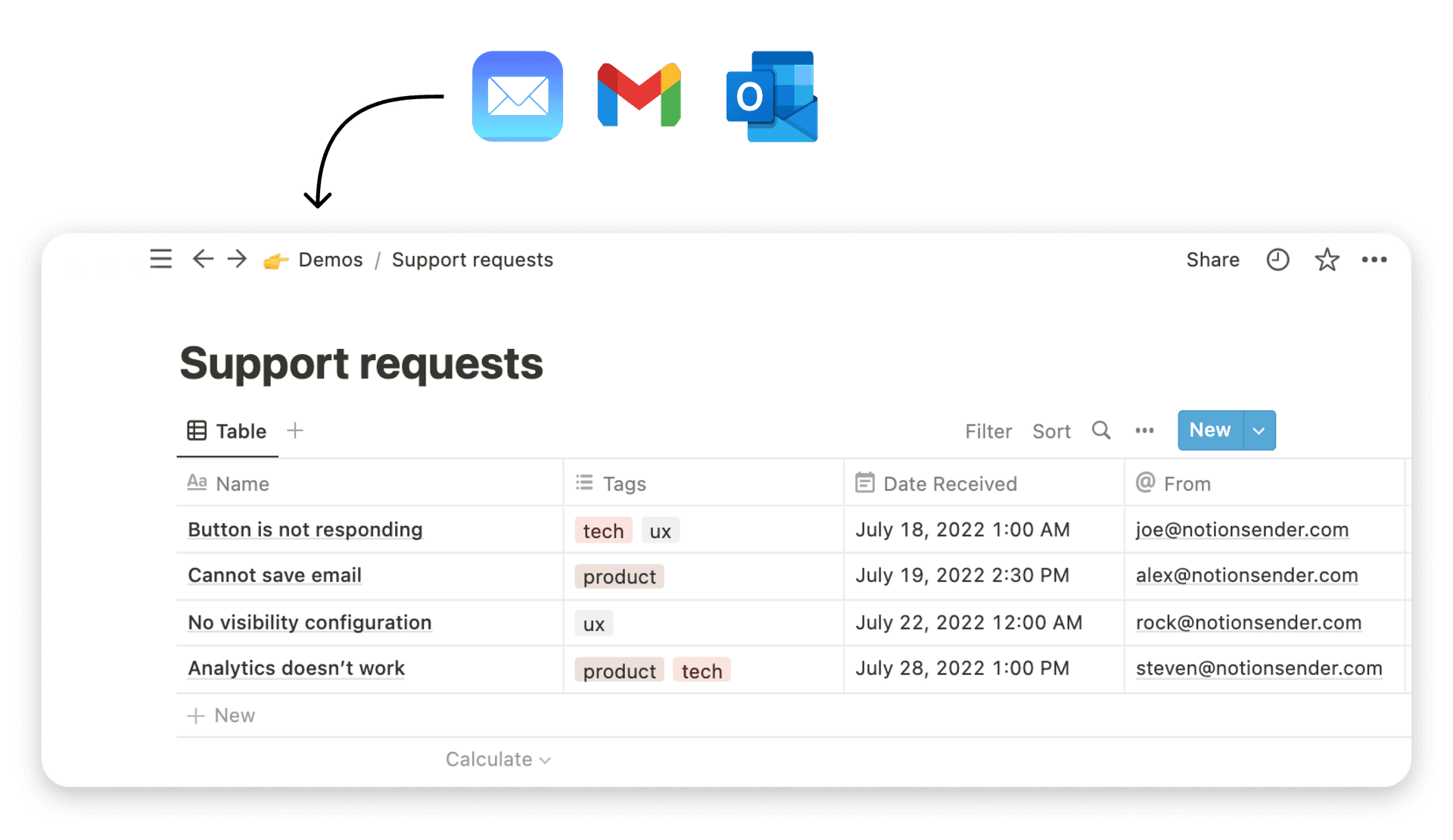
Once the database is structured, the next move is simple: turn records into sendable messages. This is the point where Notion stops being just a planning tool and starts acting like an operational hub for outbound communication.
That shift matters more now because AI-assisted creation is moving into the mainstream. One projection says nearly 94% of marketers plan to use AI for generating blog posts, emails, videos, and images by 2026, while non-AI blog creation dropped from 65% to 5% over two years, according to these content marketing statistics. More teams are producing drafts faster. Fewer teams have a clean system for shipping them.

Configure the first outbox carefully
Start with one use case. A weekly newsletter is ideal. A client update flow is a close second. Don't wire up five content types at once.
The setup is usually easiest when you think in terms of field mapping:
- Recipient field: Which Notion property contains the email address
- Subject field: Which property becomes the subject line
- Body field: Which long-text property contains the approved message
- Send trigger: What status change or condition authorizes delivery
If you're working with custom workflows or want to validate the structure before rolling it out more widely, review the NotionSender API documentation and match your database properties to the exact send logic you want.
Treat property mapping like production infrastructure
Small mistakes create big confusion. If the “Final Content” field still contains draft placeholders, the wrong message goes out. If the “Status” field has inconsistent values like “approved,” “Approved,” and “ready,” your automation won't behave predictably.
Use tight naming conventions:
- Keep status labels fixed
- Separate draft content from approved content
- Store subject lines in their own property
- Use a checkbox for final approval when stakes are high
Bad automation usually isn't a tool problem. It's a field hygiene problem.
Run a controlled test before you trust it
Before sending to real contacts, create a test view in Notion with only internal recipients. Move one record through the full process. Check formatting, personalization tokens, links, and fallback text.
Then test edge cases:
| Scenario | What to verify |
|---|---|
| Missing recipient | The send should stop cleanly |
| Empty subject | The record should be flagged before delivery |
| Long body copy | Formatting should still be readable |
| Unapproved record | It shouldn't send at all |
A clean first workflow gives you confidence fast. Once one outbox works end to end, the second and third are much easier because the database discipline is already in place.
Practical Automation Recipes for Small Businesses
The easiest way to understand content automation is to watch it solve real operational drag. Not abstract “marketing efficiency.” Actual repetitive work your team keeps doing by hand.
When automated workflows are implemented well, teams often see 50-80% time savings per piece of content, 25-40% increases in production volume, and 15-30% improvements in engagement rates within the first six months, with one eCommerce client seeing a 180% surge in social media engagement while cutting social media management time by 75%, based on these automated content creation examples. Those gains don't come from one magic prompt. They come from repeatable systems.

Recipe one for the weekly internal newsletter
A small team usually has updates scattered across project pages, meeting notes, and ad hoc comments. By Friday, someone has to chase contributions and write the digest manually.
A better setup looks like this:
- Trigger: Pages tagged “Team Update” and dated within the current week
- Notion structure: A filtered database view that collects eligible items
- Content assembly: A newsletter template that pulls highlights into fixed sections
- Delivery: One approved record gets sent to the internal team list
This works because the team contributes naturally during the week. Nobody opens a separate tool just to “make the newsletter happen.”
The strongest automations piggyback on work people already do. They don't ask for a second round of admin.
Recipe two for freelancer client updates
Freelancers lose time writing the same reassurance email over and over: what's done, what's pending, what needs input, and when the next milestone lands.
Use the project board itself as the trigger. When a project or task moves into Client Review, create a message from database fields such as project name, completed items, pending items, and next action. Keep a manual approval step before the message goes out. That preserves tone and prevents awkward updates when context changed five minutes earlier.
This is also a good place to draft the body with an automated article writing tool or similar generator for rough copy blocks, then refine them inside your Notion template rather than sending raw AI output.
Recipe three for onboarding email sequences
Small businesses often collect leads in one system and run onboarding elsewhere. That split creates delays and forgotten follow-ups.
A cleaner pattern:
- A new contact is added to a Notion CRM.
- The record is assigned a segment such as prospect, customer, or subscriber.
- A prewritten email sequence is linked to that segment.
- Each message is scheduled from the same workspace.
If you want to stand this up quickly, create the sending workflow from the NotionSender create page after your CRM database fields are clean and standardized.
Here's a short walkthrough that pairs well with these examples:
<iframe width="100%" style="aspect-ratio: 16 / 9;" src="https://www.youtube.com/embed/xjfpZwZ_IeA" frameborder="0" allow="autoplay; encrypted-media" allowfullscreen></iframe>
What these recipes have in common
Each example uses the same operating principle:
| Business problem | Notion holds | Automation handles | Human still owns |
|---|---|---|---|
| Internal newsletter | Update records | Compilation and send prep | Final review |
| Client updates | Project status data | Drafting and routing | Judgment and tone |
| Onboarding emails | CRM records and segments | Sequence delivery | Offer strategy |
That's a key pattern to copy. Keep source data in Notion. Use automation for assembly, timing, and distribution. Keep humans responsible for anything sensitive, strategic, or relationship-heavy.
Mastering Smart Data Extraction and Personalization
Many teams think about automation as outbound only. Draft the content, send the email, move on. That leaves a lot of value on the table because the response data never makes it back into the workspace where work happens.
The system becomes more than a sender. It becomes memory.

Capture the reaction, not just the send
A 2024 study noted that 68% of SMBs using AI content tools still keep CRM and project notes in siloed spreadsheets or tools, and only 12% have closed-loop workflows that automatically feed engagement metrics into a relational database, according to this analysis of AI-powered workflow automation.
That gap is bigger than it sounds. If opens, replies, and clicks stay outside your main workspace, you can't connect content performance to client relationships, project history, or next actions.
A better operating model stores:
- Email interactions: Replies, clicks, and opens tied to the contact record
- Intent signals: Questions, objections, or buying interest captured from messages
- Relationship context: Last touchpoint, active project, owner, and priority level
- Operational follow-up: Tasks created when an incoming email requires action
Use extraction to reduce manual sorting
Incoming email often contains structured information hidden inside unstructured text. Invoice references, project feedback, requested changes, scheduling details, or approval language can all be pulled into database properties when the workflow is designed well.
That means your system can do more than archive messages. It can classify them.
For teams that want to centralize this loop inside their workspace, this guide on saving emails to Notion is a useful reference for designing a cleaner inbox-to-database process.
A good content system doesn't stop at delivery. It records the reaction and turns it into usable context.
Personalization that feels specific
The opposite of robotic email isn't “written manually every time.” It's “assembled from real context.” If your Notion database already knows the client name, project stage, service line, due date, or recent interaction, use those fields directly in templates.
Useful personalization fields include:
| Field | Example use |
|---|---|
| Client name | Greeting and direct reference |
| Project status | Tailored update language |
| Due date | Deadline reminders |
| Recent action | “Since you reviewed…” follow-up context |
| Segment | Different CTA for prospect vs customer |
The key is restraint. Personalization should clarify relevance, not create creepy overfitting. Mention the facts that help the reader understand why this message matters now.
Troubleshooting and Maintaining Your Automation Engine
Automation is maintenance work disguised as convenience. The first version saves time. The maintained version stays trustworthy.
The biggest long-term issue isn't usually sending. It's quality drift. Technical benchmarking of AI-driven content automation found that strong results depend on detailed brand voice documentation, style templates, and mandatory human editing layers. In one 2025 case study, AI drafts cut writing time by 70%, yet 30-40% of outputs required substantive edits to fix inaccuracies or brand-tone drift, as described in this practical guide to content automation.
Fix the failures in the right order
When something breaks, don't start with the AI prompt. Start with the workflow path.
Use this sequence:
-
Check the record data Is the recipient field populated? Is the approved body in the right property? Did someone leave placeholder text in the final template?
-
Check the trigger condition Many failed automations are simple status mismatches. The record never met the actual send condition.
-
Check the template expression If personalization fields render blank or malformed, inspect the property names and fallback logic.
-
Check connection health If the workflow was working and suddenly stopped, verify the integration state before rewriting anything.
Add guardrails where mistakes are expensive
Not every message deserves the same level of automation. A social draft can tolerate some cleanup. An invoice reminder or a sensitive client update cannot.
Build different review rules for different message types:
- Low-risk content: Internal updates, simple reminders, routine follow-ups
- Medium-risk content: Sales outreach, onboarding messages, nurture emails
- High-risk content: Billing, legal language, contract communication, sensitive account updates
For higher-risk content, require a manual checkpoint inside Notion before delivery. A checkbox, reviewer property, or approval status is usually enough.
Human review isn't a failure of automation. It's part of the automation design.
Run a simple monthly audit
Many teams don't need a complex governance process. They need a recurring review habit.
A useful monthly audit includes:
| Check | What to look for |
|---|---|
| Template quality | Outdated wording, weak CTAs, broken placeholders |
| Brand consistency | Tone drift across recent sends |
| Database hygiene | Unused properties, inconsistent status values |
| Workflow fit | Automations that no longer match current operations |
Do this consistently and your system stays useful. Ignore it and even a well-built setup turns brittle.
Your Next Steps and Common Questions
The shift isn't from manual writing to AI writing. It's from isolated tasks to a system. Once your content workflow lives in Notion, you stop chasing drafts across tools and start managing a single source of truth for ideas, approvals, distribution, and response tracking.
That's why this approach works so well for small businesses and lean teams. It respects the way work already happens. You're not adding another complicated platform to “manage content.” You're turning your existing workspace into an engine that helps you automate content creation with more consistency and less admin.
Frequently Asked Questions
| Question | Answer |
|---|---|
| Can this setup work for social media too? | Yes, especially for drafting, approvals, and repurposing. Notion can hold the content calendar, caption drafts, assets, and approval states. Even if final publishing happens elsewhere, the workflow still benefits from centralization. |
| Will AI-generated content hurt quality? | It can if you remove review. AI is strongest at outlining, drafting, summarizing, and adapting content into repeatable formats. Quality stays high when brand rules, templates, and human editing remain part of the process. |
| Is this only useful for marketers? | No. Project managers can automate status updates. Freelancers can automate client communication. Owners can automate onboarding and follow-ups. If the message repeats and relies on data already tracked in Notion, it's a candidate. |
| How do I introduce this to a team without resistance? | Start with one visible workflow that removes a known annoyance, such as weekly updates or onboarding emails. Don't pitch “AI transformation.” Show that the new setup reduces copy-paste work and keeps everyone inside the same workspace. |
| What should I automate first? | Start with a high-volume, low-risk content type. Newsletters, routine updates, and templated follow-ups are much better first projects than brand campaigns or sensitive customer communication. |
| How do I keep it from feeling robotic? | Use templates as scaffolding, not final copy. Pull in relevant context from your database, keep approval steps for high-touch messages, and revise the opening and CTA so the email sounds like it belongs to your business. |
The teams that get the best results don't automate because it sounds modern. They automate because manual handoffs waste time, create inconsistency, and hide valuable context. Build the system once, keep the human checkpoints that matter, and let the repeatable parts run.
If you want to put this into practice inside your existing workspace, NotionSender is a practical way to connect Notion with email so your team can send, receive, log, and organize communication without leaving the database where the work already lives.