Your Guide to Content Marketing Inbound
Let's cut through the jargon. Inbound content marketing is a simple idea: you attract customers by creating genuinely useful stuff, rather than shoving ads in their faces. Think of yourself as a helpful guide at a crossroads, offering clear directions, not the person shouting at traffic with a megaphone. It’s all about building trust and showing people you know your stuff.
Why Inbound Marketing Pulls Customers In
Imagine you’re fishing. The old way—outbound marketing—is like casting a giant, messy net. You might catch a few of the fish you want, but you’ll also snag a ton of old boots, seaweed, and junk you don't need. It's a lot of work for a mixed bag of results.
Now, content marketing inbound is different. It’s like knowing exactly what fish you want to catch, choosing the perfect bait, and dropping your line right where they're already swimming and looking for a meal. This magnetic approach pulls in people who are already looking for what you offer, making it a smarter, more sustainable way to grow.
The Shift from Interruption to Attraction
Traditional marketing is all about interruption. It's the unskippable ad that gets between you and your video, or the billboard you drive past. Inbound marketing flips the script entirely. It attracts people by earning their attention with real solutions to problems they’re actively trying to solve.
This whole philosophy rests on a few core principles:
- Value First, Sales Second: You give away your best advice—through blog posts, guides, tutorials—long before you ever ask for a dime.
- Building Trust Over Time: When you consistently share your expertise, you become the go-to resource. So when people are finally ready to buy, you’re the first one they think of.
- Customer-Centric Focus: Every single piece of content starts with one question: "What does my customer need?" It's all about their questions, their struggles, and their goals.
This customer-first mindset isn't just a nice-to-have; it's what makes this so effective. You're creating assets that work for you 24/7, pulling in qualified leads without having to pour a fortune into ads.
The Inbound Advantage for Small Businesses
For small businesses, freelancers, and startups, this is an absolute game-changer. You don't need a massive budget to compete. The numbers back it up: content marketing generates three times more leads than traditional advertising, and it costs 62% less.
Even better, businesses that keep an active blog get a whopping 67% more leads than those that don't. It’s simple proof that putting consistent, valuable content out there is one of the most powerful engines for growth you can build. Discover more insights on 2026 content marketing trends).
Aligning Content with the Buyer's Journey
Solid inbound content marketing isn't about throwing content at the wall and seeing what sticks. It’s about showing up as the right guide at exactly the right time. To do that, you need to align every single piece of content with the buyer's journey—the predictable, three-stage process everyone goes through before deciding to buy something.
Think of it like planning a road trip. First, you get the itch for a vacation (Awareness). Then, you start researching destinations—are you feeling the beach or the mountains? (Consideration). Finally, you book the specific flight and hotel (Decision). Your content needs to be the helpful map for each specific leg of that trip.
Awareness Stage Content
During the Awareness stage, your future customer knows they have a problem, but they might not have the words for it yet. They're feeling the symptoms and are hitting up Google for answers and information, not for products. Your only goal here is to educate and build trust, not to make a sale.
Content for this stage needs to be broad and genuinely helpful, zeroing in on their pain points. The trick is to answer their early-stage questions without a hint of a sales pitch.
- Blog Posts: Think articles that tackle common problems, like "5 Signs Your Team is Drowning in Manual Data Entry."
- Infographics: Create visually interesting graphics that break down a complex issue or share some eye-opening industry stats.
- Checklists: Offer simple, downloadable tools that help people diagnose their own problems.
This is where you build goodwill. By providing value upfront, you start to earn their trust and position yourself as a helpful expert.
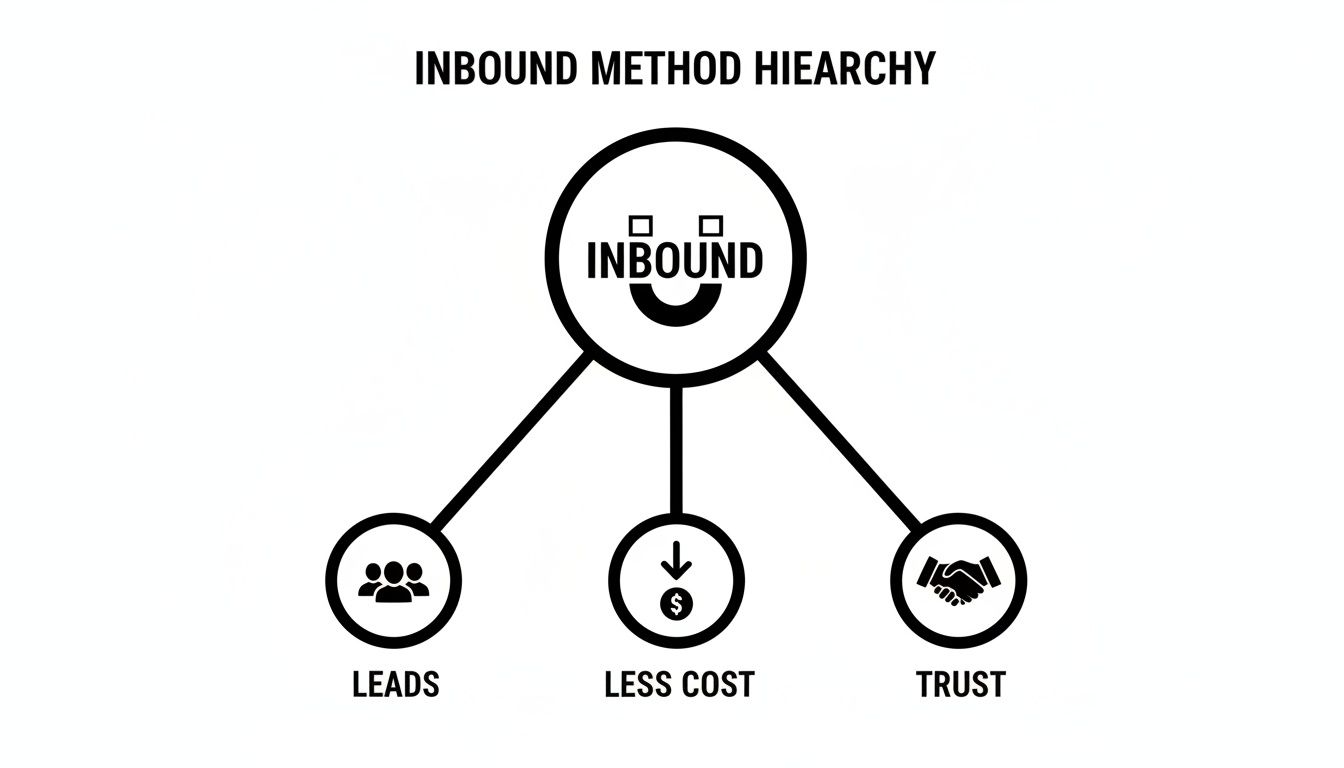
As you can see, a great inbound strategy naturally brings in better leads and strengthens customer relationships, all while costing less than traditional outbound methods.
Consideration Stage Content
Once someone has put a name to their problem, they enter the Consideration stage. Now they're actively researching and comparing all the different ways they could solve it. Your inbound content strategy has to pivot from defining the problem to showing them why your kind of solution is the smartest path forward.
This is where you go deeper with solution-focused content that really flexes your expertise and guides them toward a logical next step. For instance, if you're nurturing these leads with email, you need to know how to send the perfect email to get a response.
At this point, your prospect is weighing different approaches. Your job is to make a compelling case for your methodology, positioning your brand as a credible and effective problem-solver.
Examples of powerful Consideration content include:
- Case Studies: Tell detailed stories of how you helped a customer solve the exact same problem they're facing.
- Comparison Guides: Offer unbiased articles or charts that compare different solutions (e.g., "Manual Entry vs. Automation Software: Which is Right for You?").
- Webinars: Host live or recorded sessions that do a deep dive into a specific strategy or solution.
Decision Stage Content
Finally, we have the Decision stage. The prospect has settled on a solution category and is now making their shortlist of specific vendors—and you're on it. The content you serve up now has to be laser-focused on convincing them that you are, without a doubt, the best choice.
This is your chance to erase any last-minute hesitation and make it incredibly easy for them to say "yes." Be direct. Show off your product's features, benefits, and undeniable value.
- Free Trials or Demos: Let them get their hands on your product and see it in action. Nothing sells better than direct experience.
- Product Feature Pages: Create detailed breakdowns of what your service does and how it solves their specific problem.
- Pricing and ROI Calculators: Be transparent with costs and provide tools that help them justify the investment to their team.
Mapping your content to these three stages isn't just a "nice-to-have"—it's the core of a successful inbound strategy. The following table breaks down exactly what to create for each step of the journey.
Content Strategy for Each Buyer's Journey Stage
This table provides a clear roadmap for creating content that resonates with potential customers, no matter where they are in their decision-making process.
| Stage | Goal | Content Examples | Key Metrics |
|---|---|---|---|
| Awareness | Educate and attract new audiences | Blog posts, infographics, checklists, ebooks | Organic traffic, keyword rankings, social media reach |
| Consideration | Demonstrate expertise and compare solutions | Case studies, comparison guides, webinars | Lead generation, email subscribers, download rates |
| Decision | Convert leads into customers | Free trials, demos, pricing pages, testimonials | Conversion rate, demo requests, sales qualified leads |
By strategically planning your content around this journey, you move from simply publishing articles to building a reliable system that turns strangers into happy customers.
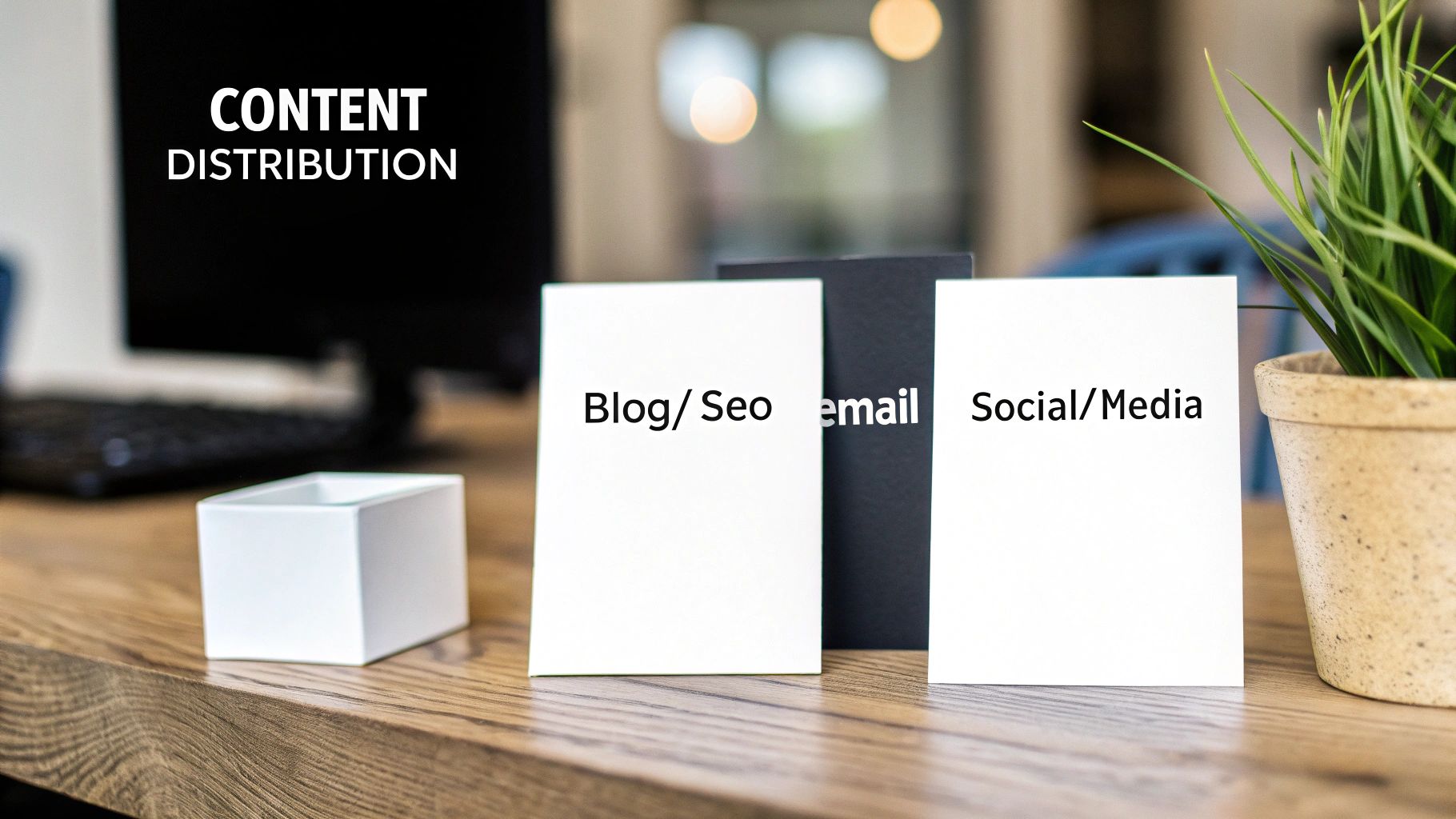
Choosing Your Core Content Distribution Channels
Let’s be honest: creating amazing content is only half the job. If your ideal customers never see it, even the most brilliant guide or eye-opening article won't bring in a single lead.
Think of it like this: your content is a powerful radio broadcast, but without the right transmission towers—your distribution channels—the message just fades into static.
The trick is to build a smart, focused distribution engine that gets your content in front of the right people at just the right moment. Instead of a "spray and pray" approach, you'll want to home in on a few core channels that work together to amplify your message.
Blogging and SEO: The Attraction Engine
Your blog is the cornerstone of your entire inbound strategy. It's the home base for all your content and your primary tool for pulling in organic search traffic through Search Engine Optimization (SEO).
When someone types a problem you can solve into Google, a well-optimized blog post is what makes you show up with a helpful answer. This is all about long-term, sustainable growth—a single great post can keep attracting qualified visitors for years, making it an incredibly powerful, evergreen asset.
Email Marketing: The Nurturing Channel
While SEO brings strangers to your digital front door, email marketing is how you invite them inside and build a real relationship. It’s the most direct and personal channel you have for talking to leads who’ve already raised their hands and shown some interest.
Email is the perfect vehicle for guiding people through their buyer’s journey. You can deliver targeted content, from educational articles to deep-dive case studies and product demos, right to their inbox. This consistent, helpful nurturing builds trust and keeps you top-of-mind for when they’re finally ready to buy.
Social Media: The Engagement Hub
Social media is where you join the conversation and connect with your community in real-time. It’s so much more than just broadcasting links to your latest blog post. It's about sharing valuable little snippets, asking questions, and building a genuine community around your brand’s expertise.
By using social media to share different formats of your core content—like turning a blog post into a visual infographic or a short video—you can reach new audiences and drive them back to your website or email list.
This whole ecosystem is booming. The global content marketing industry is projected to hit an incredible $1.95 trillion by 2032, a massive leap from $600 billion in 2024. That growth explains why 29% of marketers are all-in on content marketing and another 50% plan to increase their budgets. Read the full research about content marketing statistics on Reboot Online.
These channels, working together in harmony, are the engine behind that growth. They’re what turn your content from a simple collection of articles into a predictable source of traffic, leads, and loyal customers.
Automating Your Inbound Workflow with NotionSender
Great content gets you leads. Fantastic. But what do you do with them? This is where the rubber meets the road for your content marketing inbound strategy. Without a solid system, all those hard-won leads from contact forms and ebook downloads quickly devolve into a chaotic mess of manual data entry. You slow down, and worse, you let potential customers slip right through your fingers.
The real goal is to build a machine—a seamless, automated engine that captures, nurtures, and tracks leads without you having to poke it constantly. This is where automation isn't just a nice-to-have; it's your most powerful ally, turning a frantic scramble into a predictable, scalable workflow.
From Manual Entry to Automated Capture
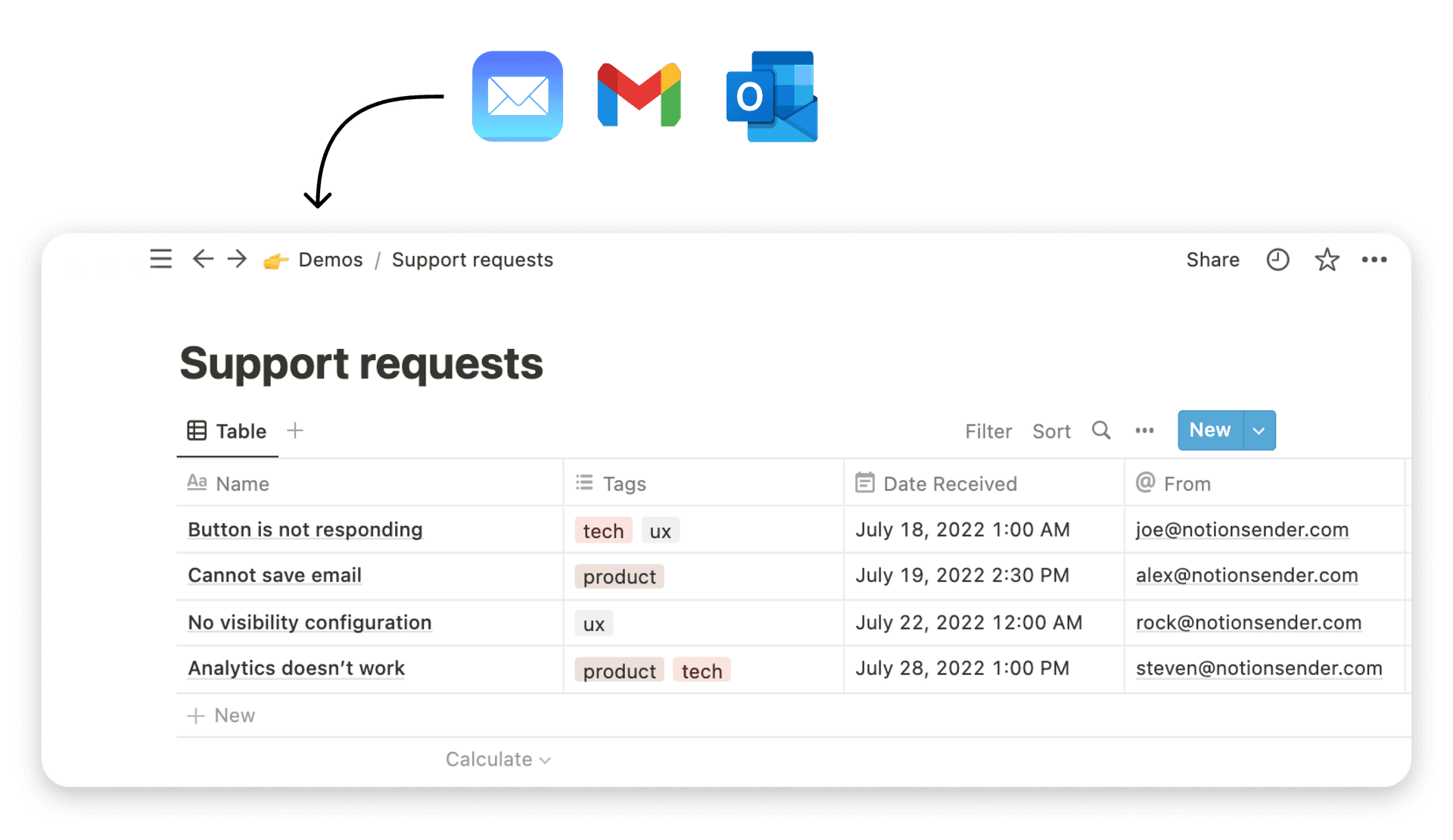
Picture this: someone downloads your latest guide. Instantly, their info pops up—perfectly formatted—inside your Notion workspace. No copy-pasting. No typos. That’s the first, and most crucial, step in automating your inbound process. A tool like NotionSender makes this a reality by giving your Notion database its very own email address.
You can wire this email address directly into your website’s forms. When a prospect hits "submit," their details are automatically forwarded and neatly filed as a new entry in your database. Say goodbye to the soul-crushing task of transcribing names and email addresses.
This simple connection breaks the biggest bottleneck in most inbound strategies: manual lead entry. It guarantees every lead is captured the second they show interest, freeing you up to focus on what you do best—creating more killer content.
This is what it looks like in practice—a Notion database set up to automatically catch and organize new inbound leads as they arrive.
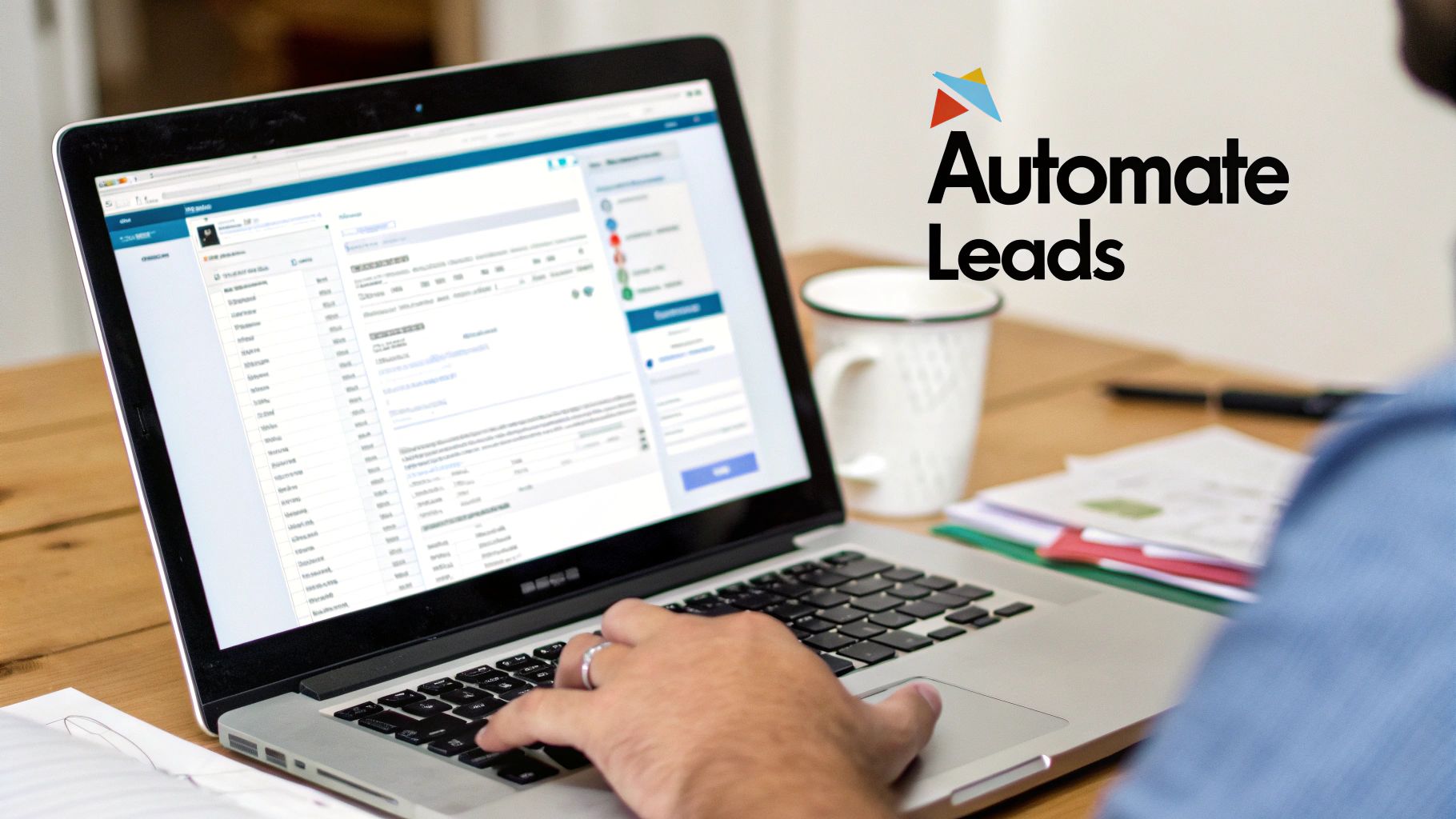
The magic here is centralizing everything. Your Notion workspace becomes the single source of truth for your entire sales funnel, from first touch to final sale.
Triggering Personalized Nurturing Sequences
Just capturing a lead isn't enough; that's only the starting line. The real work begins now: nurturing that new relationship with timely, relevant follow-ups. Automation lets you trigger personalized email sequences the moment a lead enters your system, essentially putting your buyer's journey on autopilot.
Using NotionSender, you can set up workflows that fire off a welcome email, followed by a series of helpful messages directly related to the content they just downloaded. This gives every single lead a consistent, high-value experience, building trust from the very first interaction. You can even create powerful email automations inside Notion to orchestrate this whole dance.
It’s a simple, powerful loop:
- Lead Capture: A user downloads your "Ultimate Guide to Project Management," and their info lands in your Notion database.
- Automation Trigger: This new database entry instantly kicks off a pre-written email sequence designed for aspiring project managers.
- Personalized Nurturing: Over the next few days, they receive a series of emails with more tips, a related case study, and eventually, an invitation for a demo.
This automated hand-holding ensures no lead ever gets cold. Every touchpoint adds value, gently guiding them toward a decision. And when you pair this lead management with the best AI tools for content creation, you can dramatically ramp up your entire operation. By automating both content production and lead follow-up, you build a powerful, self-sustaining inbound engine.
Measuring Your Inbound Marketing Success
<iframe width="100%" style="aspect-ratio: 16 / 9;" src="https://www.youtube.com/embed/uNKcis-wnro" frameborder="0" allow="autoplay; encrypted-media" allowfullscreen></iframe>
So, you've put in the work and created some fantastic content. That’s a huge first step. But how do you actually know if your inbound content marketing is working? Without a clear way to measure success, you’re just guessing—unable to prove your impact or figure out what to do next.
Success isn't about vanity metrics like page views. It’s about tracking the Key Performance Indicators (KPIs) that truly connect to business growth. Think of it as a health checkup for your entire marketing funnel, from the very first impression all the way to the final sale.
Top-of-Funnel Health Metrics
At the top of the funnel (the Awareness stage), your one and only job is to get in front of the right people. The health of this stage comes down to how well you’re pulling in relevant traffic and making your brand visible.
Here’s what you should be watching:
- Organic Traffic: This is the big one. It shows you how many people are discovering you through search engines like Google. If this number is climbing, your SEO efforts are paying off.
- Keyword Rankings: Are you showing up for the search terms your ideal customers are using? Tracking your rank for target keywords tells you if you’re becoming a known voice on the topics that matter.
- Social Media Reach: This number shows you the unique count of people who see your content on social media, giving you a pulse on your overall brand awareness.
Mid-Funnel Engagement Metrics
Once people land on your site, the game changes. Now, the goal is to turn those visitors into leads. The metrics in the middle of the funnel tell you how well your content is grabbing their attention and convincing them to take that next step.
This is where a passive reader becomes an active prospect. Strong engagement here is a loud and clear signal that your content is hitting the mark and building trust.
Keep your eyes on these conversion-focused KPIs:
- Lead Conversion Rate: This is the percentage of visitors who take a specific action, like downloading your latest ebook or signing up for your newsletter.
- Email Open and Click-Through Rates: For your email nurture sequences, these numbers tell you everything about how interested your leads are in what you have to say. You can learn more about increasing your email open rates in our guide.
Focusing on lead quality and nurturing isn't just effective; it's also incredibly cost-efficient. Inbound marketing already costs 62% less per lead than old-school outbound methods. When you layer in a tool like NotionSender to automate your follow-ups, the value just explodes—nurtured leads make 50% more purchases at a 33% lower cost. You can dig into more inbound marketing stats on Entrepreneur's HQ.
Bottom-Line Impact Metrics
At the end of the day, it all has to connect to revenue. The bottom-of-funnel metrics are what prove your return on investment (ROI) and show just how efficiently you're turning leads into paying customers.
Track your Customer Acquisition Cost (CAC) to get a clear picture of what you're spending to bring each new customer on board. By keeping a close watch on these KPIs, you're not just tracking numbers; you're building a dashboard that proves your value and guides smarter marketing decisions down the road.
Your Actionable Inbound Marketing Checklist
Alright, let's get down to brass tacks. Turning all this theory into actual results takes a clear, repeatable plan. This final section is your practical, step-by-step roadmap for launching (or just fine-tuning) your content marketing inbound strategy.
Think of this less as a simple list and more as a structured workflow. It's designed to build momentum and make sure you don't miss any of the crucial steps along the way.
Foundations and Strategy
First things first: you have to lay the groundwork. A solid foundation is what stops you from wasting a ton of effort down the road, ensuring your content actually connects with the right people from day one.
- Define Your Ideal Customer: Go deep and create detailed buyer personas. You need to understand their pain points, their goals, and where they actually hang out online to find information.
- Conduct Keyword Research: Figure out the exact search terms your personas are typing into Google when they're looking for solutions in the Awareness and Consideration stages.
- Map the Buyer’s Journey: For each stage—Awareness, Consideration, and Decision—outline the key questions they're asking and the kind of content that will give them the answers they need.
Content Creation and Distribution
With your strategy locked in, it’s time to fire up the content engine. This part is all about creating genuine value and making sure it gets in front of your audience.
- Build an Editorial Calendar: Plan your content topics, formats, and publishing schedule at least a month out. Consistency is everything here.
- Create Stage-Specific Content: Develop blog posts for the Awareness stage, whip up some case studies for Consideration, and have product demos ready for the Decision stage.
- Set Up Distribution Channels: Get your blog optimized for SEO, launch an email newsletter, and pick just one or two social media platforms where your audience is most active. Don't spread yourself too thin.
The real key to success is consistency. An inbound strategy is a marathon, not a sprint. Committing to a regular publishing and promotion schedule is what builds trust and search authority over time.
Automation and Measurement
Finally, it's time to make your life easier and prove this whole thing is working. Automation buys you back time, while solid measurement gives you the data you need to continuously tweak and improve your efforts.
For a great deep-dive into automating your business, check out this Business Process Automation Checklist For Smbs. Set up your lead capture forms so they feed directly into your system, trigger automated email nurture sequences for new leads, and build a simple analytics dashboard to keep an eye on your most important KPIs.
Frequently Asked Questions
Even with the best game plan, a few questions are bound to pop up. It happens to everyone. Here are some of the most common ones we hear about inbound content marketing, with straight-up answers to help you feel confident as you get rolling.
What Is the Core Difference Between Inbound and Outbound
Think of it like fishing with a net versus fishing with a lure.
Outbound marketing is the net. You cast it wide with ads, cold calls, and email blasts, trying to catch anyone and everyone. It's loud and often interrupts people who weren't even thinking about you.
Inbound marketing is the lure. You create something valuable and interesting (like a great blog post or a helpful guide) that naturally attracts the right kind of fish—the ones who are already hungry for what you've got. You're not shouting at a crowd; you're starting a helpful conversation with someone who's already looking for answers.
How Long Does It Take to See Results
Let’s be real: inbound is a marathon, not a sprint. While you might get a little buzz early on, you should expect to be in it for three to six months of consistent, quality work before you see a real uptick in traffic and leads.
This isn't like a paid ad that vanishes the second you stop funding it. You're building a long-term asset. A great piece of content can pull in leads for years, working for you around the clock. The payoff for your patience is a dramatically lower cost to acquire customers down the road.
Can Small Businesses Succeed with Inbound Marketing
Absolutely. In fact, it’s a small business’s secret weapon. You don't need a huge marketing budget to make a massive impact.
Your advantage is your expertise. By focusing on a specific niche and creating genuinely helpful content that answers your ideal customer's biggest questions, you can build authority and trust. This is how you outmaneuver the big guys with their massive ad spends. It levels the playing field and lets the best advice win.
Ready to automate your lead capture and build a seamless inbound machine right inside Notion? Get started with NotionSender and turn your content strategy into a predictable growth engine. Learn more and sign up at notionsender.com.