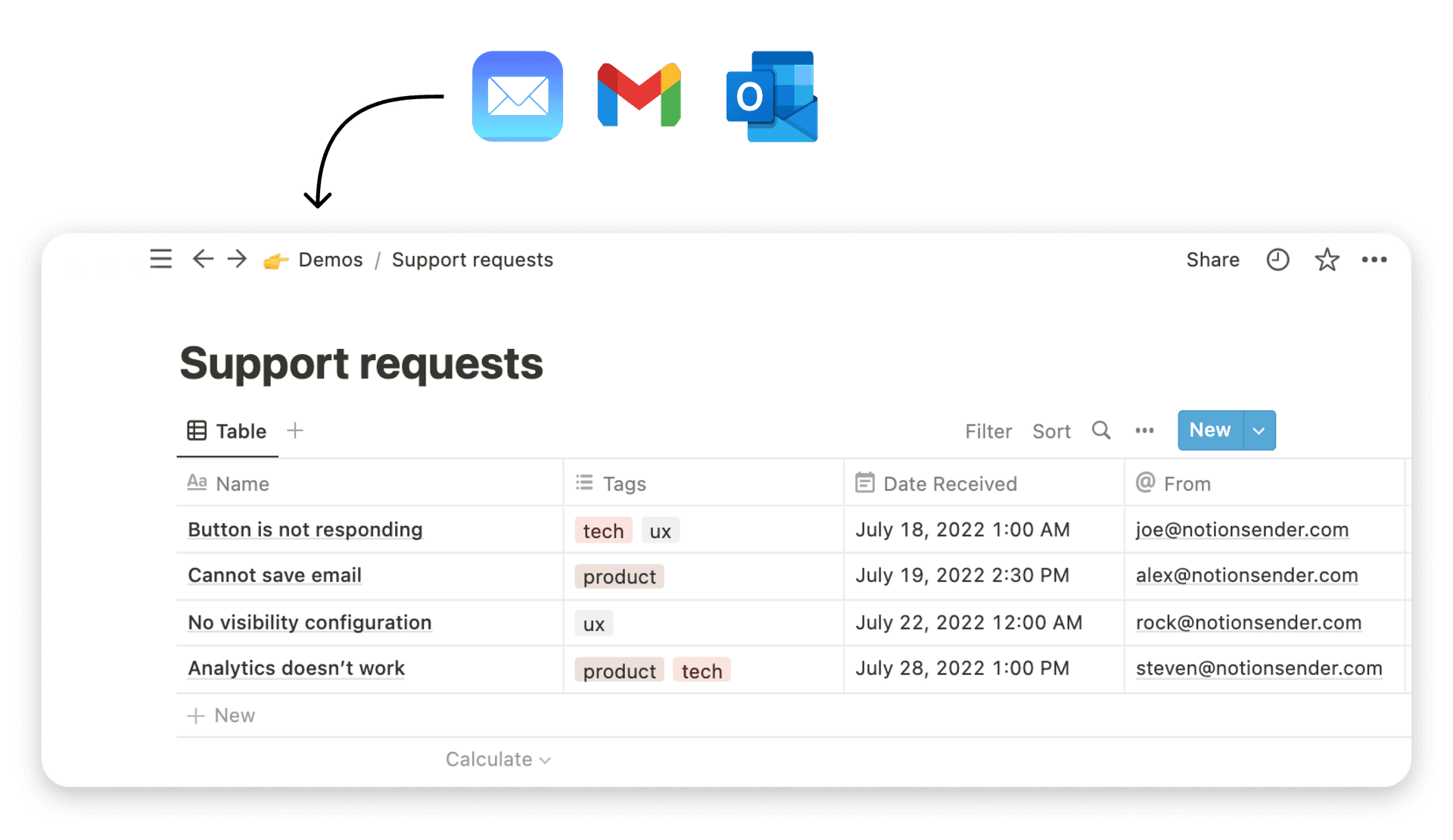
Notion Database Template: An Automation Workflow Guide

Your Notion workspace probably isn’t the problem. The problem is the gap between your inbox and your databases.
A lead emails you. You read it in Gmail or Outlook, then switch to Notion, create a page, paste in the name, copy the email address, add a follow-up task, attach a file, and hope you remember the next step later. That process feels small when it happens once. Repeated all week, it becomes the kind of admin drag that makes a good system feel broken.
That’s why a strong notion database template matters. Not as a prettier page layout, but as the structure that turns incoming work into clean, repeatable records. For small business owners especially, email is still where requests, approvals, invoices, and client conversations begin. A cited productivity survey notes that 70% of small business owners manage over 50 emails weekly, while most template guides stay focused on internal Notion properties instead of email ingestion (Notion template collection context).
The practical shift is simple. Stop treating Notion as the place where work gets documented after the fact. Start using it as the place where work begins, gets structured, and moves forward automatically.
Beyond To-Do Lists Your First Automated Workflow
A common setup looks organized on the surface. There’s a CRM in Notion, an email inbox for client communication, maybe a calendar for reminders, and a task board for delivery. The issue is that each tool holds one piece of the process, so the business owner becomes the integration layer.
That’s where time leaks out.
If a new client inquiry arrives, the useful data is already there. The sender name, email address, subject line, attachments, and message body all exist before you touch anything. Yet many users still rebuild that record by hand inside Notion. Basic tutorials usually stop at creating a nice-looking page template. They don’t address the harder and more valuable question: how do you get outside information into that template without retyping it?

What the command center actually looks like
A useful workflow starts with one database entry doing several jobs at once:
- Captures the contact so you don’t lose who reached out
- Stores the context from the original email
- Triggers next actions like follow-up, qualification, or invoicing
- Connects related records such as projects, tasks, and conversations
That’s the point where Notion stops being a note-taking app and starts acting like an operating system for the business.
A client page created from a database template can include a default status, a ready-made follow-up checklist, a section for discovery notes, and linked views showing related projects or invoices. If the incoming email can create that page automatically, the template becomes operational instead of decorative.
Most teams don’t need more pages. They need fewer manual handoffs between the tools they already use.
One practical example is a lead intake workflow. An email lands in your inbox. It gets routed into Notion, creates a contact record, applies your onboarding template, and gives you a clean page to work from. From there, one person can qualify the lead, assign a next step, and send a response without bouncing between tabs. If you want a deeper look at sending from inside your workspace, this guide on how to create and send email from Notion is a useful companion.
Where most setups fail
They fail before automation even starts. People build separate databases for every client type, every project type, and every request type. That feels tidy for a week, then reporting breaks, relations get messy, and nobody trusts the data.
The better move is to build the structure once, then let templates and email handling do the repetitive work inside that structure.
The Foundation Building Your Master Databases
If your workspace is cluttered, the fix usually isn’t another template. It’s a better database model.
The most reliable Notion setups follow a master database approach. Instead of creating isolated databases for “Prospects,” “Clients,” “Active Clients,” and “Past Clients,” keep one Contacts database and manage differences through properties, relations, and filtered views. The same logic applies to projects, tasks, invoices, and meetings.
According to the Bulletproof architecture approach, consolidating entities into master databases creates a single source of truth. Advanced users report a 70-80% reduction in workspace clutter and 2-3x faster loading times for filtered views when they avoid redundant databases (Notion VIP on master databases).

Start with two masters
For most service businesses, I’d begin with just two databases:
- Contacts
- Projects
That’s enough to support lead tracking, onboarding, delivery, and follow-up without overbuilding.
Your Contacts database
This database should hold every person or company you deal with. Don’t split it by stage yet. Use views for that.
A strong Contacts setup usually includes:
| Property | Type | Why it matters |
|---|---|---|
| Name | Title | Primary record name |
| Needed for communication and matching records | ||
| Company | Text or relation | Useful if you work with organizations |
| Status | Select | Tracks lead stage or client stage |
| Source | Select | Shows where the contact came from |
| Last Contacted | Date | Prevents dropped follow-ups |
| Projects | Relation | Connects contacts to work in progress |
| Notes | Text | Quick context without opening the full page |
A few practical rules matter here.
- Keep statuses simple. If the team can’t tell the difference between two adjacent statuses, merge them.
- Use one email field for the primary address. Add a second property only if you need billing or alternate contacts.
- Relate contacts to projects early. Even if a contact doesn’t have an active project yet, that relation becomes the backbone for later dashboards and outbound communication.
Practical rule: If two databases store the same kind of person, one of them probably shouldn’t exist.
Your Projects database
Projects hold the actual work. Tasks, invoices, deliverables, and milestones eventually connect within them.
Keep the first version lean:
- Project Name as the title
- Client as a relation to Contacts
- Status for pipeline or delivery stage
- Start Date
- Due Date
- Owner
- Priority
- Next Action
- Project Email or Intake Ref if you need to trace where work originated
What works well is designing projects around decision points, not documentation habits. A project record should answer: who is this for, what stage is it in, what happens next, and where is the latest context?
The architecture that scales
The reason this setup lasts is that templates sit on top of stable databases rather than replacing them. You’re not making a separate “Website Project Database” and “Retainer Project Database.” You’re making one Projects database and creating different project templates inside it.
That distinction matters because templates are for repeatable structure. Databases are for truth.
Here’s a straightforward model:
- Contacts holds people and companies
- Projects holds client work
- Tasks can be added later if needed
- Invoices can be added later if billing lives in Notion
This approach also keeps email workflows cleaner. If an incoming message creates a new page, you need to know exactly where that page belongs. Ambiguous architecture causes bad automation.
What to build before anything fancy
Before you touch formulas or automation, make sure you can answer yes to this checklist:
- One database per entity type. Contacts are all in one place. Projects are all in one place.
- Clear relation path. A project can always link back to a contact.
- Useful default views. You can filter New Leads, Active Clients, or Open Projects without creating new databases.
- Naming discipline. Property names are short, obvious, and stable.
A lot of broken systems come from renaming things casually after formulas and rollups already depend on them. Be conservative here. Clean names beat clever names.
The client-ready version
If I were building this for a consultant or agency owner, I’d create three views inside Contacts:
- New Leads
- Active Clients
- Dormant Relationships
And three inside Projects:
- Pipeline
- Active Delivery
- Waiting on Client
That’s enough structure to run the business day to day without overwhelming the workspace. Once those masters are in place, your notion database template can do real work instead of compensating for weak architecture.
Designing Your Notion Database Template for Workflows
A good notion database template saves time before you even notice it. The bad version is just a pretty blank page with a few headings. The useful version pre-fills decisions, embeds context, and reduces the number of clicks needed to move the work forward.
Notion’s own documentation confirms that database templates are a core feature with no restriction on quantity, so you can create as many different versions as you need inside a database. The platform also introduced button-based automated template creation in a 2023 update, which makes repeatable workflows easier to trigger (Notion database template help).

Build one template with a real job
Use your Contacts database and create a template called New Client Onboarding.
Open the database, click the arrow next to New, and create a template. Inside that template, don’t start with formatting. Start with the actions that always happen when a new client arrives.
For most service workflows, I’d pre-fill:
- Status = New Lead or Active Client, depending on where this template is used
- Source = Email Inquiry, Referral, Website, or other intake source
- Last Contacted = Today if you’re creating it manually
- Owner = default team member if one person handles intake
Then build the page body around work, not aesthetics.
A page structure that pulls its weight
Inside the template body, use a structure like this:
Client snapshot
A short section with the essentials:
- contact summary
- service requested
- urgency or deadline
- any attachment or reference note
Next steps
A compact checklist works well here:
- review inquiry
- send reply
- qualify fit
- create or link project
- schedule follow-up
Internal notes
This is where your team can keep context that doesn’t belong in email replies.
Related work
Embed linked views for projects, tasks, or invoices filtered to the current contact.
The most valuable part is the linked view. If your template includes a linked Projects database filtered by the current contact, each contact page becomes a lightweight dashboard. You open one record and see active work immediately.
The strongest templates don’t just standardize page layout. They standardize judgment.
That means the template should subtly guide the user toward the right next action. If every onboarding page includes a follow-up checklist and a project link area, people are less likely to skip critical steps.
Use multiple templates, not one universal template
One mistake I see often is trying to force one master template to handle every scenario. That creates clutter inside every page.
A better setup is to create several focused templates within the same database, such as:
| Template | Best for | Default difference |
|---|---|---|
| New Lead | Initial inquiries | Status starts at New Lead |
| Active Client | Signed or approved work | Status starts at Active |
| Partner Contact | Referral or collaborator records | Different checklist and notes |
| Vendor | External service providers | Different relation and review fields |
Because Notion allows unlimited templates in a database, there’s no need to make one page do everything.
Add views that adapt to the current record
The key move is embedding linked databases that are filtered to the page you’re on. In practice, that means:
- a Projects view showing only projects related to this contact
- a Tasks view showing only tasks where this contact’s project is involved
- an Invoices view if you manage billing in Notion
These views turn a single page into an operating console. They also reduce duplicate searching, which is one of the small frictions that slows teams down.
A quick visual walkthrough can help if you haven’t built templates this way before:
<iframe width="100%" style="aspect-ratio: 16 / 9;" src="https://www.youtube.com/embed/JGT7PSXHXaM" frameborder="0" allow="autoplay; encrypted-media" allowfullscreen></iframe>
What works and what doesn’t
What works:
- Pre-filled defaults that remove repeated setup
- Short checklists that anchor next actions
- Linked views filtered to the current record
- Template names based on workflow instead of decoration
What doesn’t:
- giant templates full of rarely used sections
- duplicate project lists pasted manually into pages
- long instruction text inside every template
- a single “master template” trying to serve ten use cases
If a page opens and the user has to decide where to write, what to do next, and what to relate, the template hasn’t solved much.
Keep the body lean
A template should feel like a launchpad. If it takes effort to scroll through, people will ignore parts of it. I prefer a short top section for immediate action and lower sections for reference material. Put active controls near the top. Archive-style notes can sit further down.
That’s also why filtered linked views matter more than static text. They update. Pasted instructions don’t.
When your architecture is clean, a notion database template becomes the front end of a repeatable business process. The page looks simple. The structure underneath does the heavy lifting.
Automating Email Capture with NotionSender
Once your database structure is stable, the main bottleneck is data entry. Email is usually where that friction shows up first.
A client sends an inquiry, invoice request, revision note, or approval. You read it, then manually convert it into a Notion record. That’s the exact handoff worth removing.

The practical setup
The cleanest approach is to connect a database to a dedicated email intake path. In practical terms, that means generating a unique email address tied to the database where incoming messages should land.
For example:
- emails for new client inquiries go to your Contacts intake
- invoice-related emails go to your Invoices intake
- project update emails go to your Projects or Interactions intake
When someone forwards or routes an email there, the message can become a database entry instead of sitting in your inbox waiting for manual processing.
If you want the exact mechanics for routing email into a database, this walkthrough on how to send email to Notion is the right reference.
What to extract from the email
The goal isn’t to dump raw email into Notion. The goal is to turn unstructured content into mapped properties.
A practical mapping looks like this:
| Email content | Notion property |
|---|---|
| Sender address | |
| Sender name | Contact Name or Title |
| Subject line | Project Name, Inquiry Title, or Summary |
| Message body | Notes or Description |
| Attachments | Files |
| Received time | Date |
Templates become more useful when records arrive already filled with core information, enabling your team to open the page and act, not transcribe.
Good automation uses restraint
Not every part of an email should become a property. I’d extract only the fields that directly affect workflow. The rest can remain in the page body or attached email content.
That usually means prioritizing:
- identity data such as sender and company
- actionable context like subject and message summary
- documents like briefs, invoices, or approval attachments
Everything else should support review, not clutter the database.
If your database starts reading like an email client, you mapped too much.
One important operational detail
If you’re using outbound email later in the workflow, basic deliverability hygiene matters. Before sending client-facing messages from any workflow, it’s worth checking your setup with an email spam checker so you can catch issues that would otherwise make automation look unreliable when inbox placement is the underlying issue.
Where this becomes useful fast
Three use cases show immediate value:
- Lead capture. New inquiries create contact records with the right template applied.
- Invoice intake. Billing emails become records tied to a client or project.
- Project communication logging. Important messages become searchable history inside the right page.
That’s the bridge most Notion setups miss. They organize the work after someone has already spent time entering it. Email capture changes the sequence. The record gets created first, and the admin work shrinks.
Advanced Workflows and Automation Triggers
Once inbound email is flowing into the right databases, the next step is making those records trigger useful work. Then, automation begins to feel like a system rather than a collection of shortcuts.
Scheduled database templates are one of the strongest native tools for this. They can repeat daily, weekly, monthly, or yearly, which makes them useful for recurring check-ins, review cycles, and routine admin tasks. Advanced users combining scheduled templates with buttons and formulas report up to 60% faster onboarding and a 40-50% reduction in manual data entry in project workflows (scheduled template workflow example).
Recurring workflows that actually help
The first recurring template I’d add is a Weekly Client Check-in task.
Not because it’s flashy. Because it solves a common service-business problem. Follow-up usually depends on memory unless the system generates it for you.
A weekly recurring record can include:
- the client relation already set
- a checklist for status review
- a prompt to send update email
- a field for blockers or approvals needed
That keeps communication from becoming reactive.
Buttons are better than duplicate pages
Buttons work best when they create downstream records from a source page. On a project page, add a button like Generate Invoice or Create Follow-up Task. The button should create a new record in the target database with the project relation already attached.
That’s useful for two reasons.
First, it reduces manual linking mistakes. Second, it keeps users inside the page where they already have context. They don’t have to open a second database and rebuild the relationships by hand.
A good button action might create:
| Button name | Creates | Pre-filled data |
|---|---|---|
| Generate Invoice | New invoice record | Client, project, issue date |
| Create Follow-up | New task | Project, owner, next due date |
| Start Handoff | New internal task set | Project, status, assignee |
Use formulas carefully
Formulas help when they answer a business question. They become a liability when they’re there just to impress.
Useful examples include:
- whether a task is due today
- whether a project is at risk based on dates
- whether an invoice is awaiting payment
Less useful examples include long nested formulas nobody on the team can maintain.
Keep formulas readable. If a property rename breaks an important workflow, the system becomes fragile. Simpler formulas survive longer.
Build automation around decisions people make often. Don’t automate edge cases first.
Closing the loop with outbound communication
The most valuable automation isn’t only inbound. It’s what happens after the data reaches Notion.
A common pattern is status-based communication. A project status changes from In Progress to Completed. That status change can trigger an outbound email using page properties such as client name, project title, and next-step details. The result is a message that feels personal without being manually written from scratch each time.
Email workflow tools transition from theoretical to practical application. One option is NotionSender, which can send and receive emails within a Notion-centered workflow, use template expressions for personalization, and fit database-triggered communication into an existing workspace. If you’re building custom actions or evaluating how a trigger-based setup could fit into a larger stack, the NotionSender API documentation shows the available integration surface.
A useful sequence for service work
A straightforward automated loop looks like this:
- Inbound email creates or updates a record
- Template applies the right page structure
- Button or rule creates related tasks or invoices
- Status changes trigger outbound communication
- Linked views keep the whole thread visible in one place
That sequence works because each step depends on stable databases and clear relations. If those are weak, the automation feels random. If those are solid, your notion database template becomes the control layer for work that used to live across inboxes, reminders, and scattered notes.
Common Pitfalls and Pro Tips for Your Templates
Most template problems don’t come from missing features. They come from overcomplication.
One common mistake is assuming every dashboard needs a huge formula stack to be useful. In practice, simpler systems are easier to trust. If a rollup breaks after a property rename, the issue usually isn’t Notion. It’s that the setup became too brittle for the team maintaining it.
Where people get stuck
The first trap is relation drift. A contact exists, a project exists, but nobody linked them because the template didn’t make that action obvious.
The second is dashboard clutter. Recurring pages pile into the same view, and the board becomes unreadable.
The third is formula vanity. Someone builds a progress bar, but no one can tell where the value comes from.
A better approach for metrics is the Checkbox Method, which connects a tasks database to a stats database through relations and rollups. That setup can produce real-time metrics like “X of Y tasks done” and visual progress bars, and some tutorials report 90%+ accuracy in metrics across hundreds of entries (Checkbox Method walkthrough).
Pro tips that hold up
- Protect important property names. Rename with care once formulas and rollups depend on them.
- Group recurring records intentionally. Create views that separate routine generated items from active manual work.
- Use one dashboard page. Pull in linked views from master databases rather than duplicating information.
- Personalize outbound messages from page data. Template expressions work best when your properties are clean and consistently named.
Clean relations beat clever formulas every time.
If a metric is useful, make sure someone can explain it in one sentence. If they can’t, the dashboard is probably serving the builder more than the business.
From Manual Tasks to an Automated Business Hub
A well-built notion database template does more than save a few clicks. It changes where work lives.
Instead of treating email as the inbox and Notion as the archive, you move to a model where incoming communication becomes structured work immediately. Contacts, projects, tasks, and follow-ups stay connected. The team stops rebuilding records by hand. The workspace starts reflecting reality in real time.
That’s the bigger payoff. You’re not just making Notion cleaner. You’re removing the repetitive translation work between apps.
This same mindset also helps outside project management. If you’re trying to streamline accounting tasks, the principle is the same. Build a stable source of truth, automate repeatable intake, and let templates handle the recurring structure.
Start small. Pick one email-driven process you repeat every week. Client inquiries, invoice requests, approval emails, or meeting follow-ups are all good candidates. Build one master database, one template, and one clean automation path. That’s enough to feel the difference.
If you want to centralize email capture and outbound communication inside your Notion workflow, NotionSender is worth exploring. It gives databases unique email addresses, supports email-to-database workflows, and helps turn your templates into working systems instead of static pages.