Notion Gmail Integration: The Complete 2026 Guide

Your Gmail inbox probably holds the history of your work. Client approvals, scope changes, invoices, meeting threads, and last-minute requests all live there. Your Notion workspace holds the plan. Tasks, projects, notes, and databases live there. Many users keep switching between the two and call that normal.
It works until it doesn't. A client replies to an old thread. A vendor sends a receipt you need later. A teammate asks, "What did they decide on pricing?" and now you're searching Gmail, checking Notion, then pasting fragments into a page that goes stale a week later.
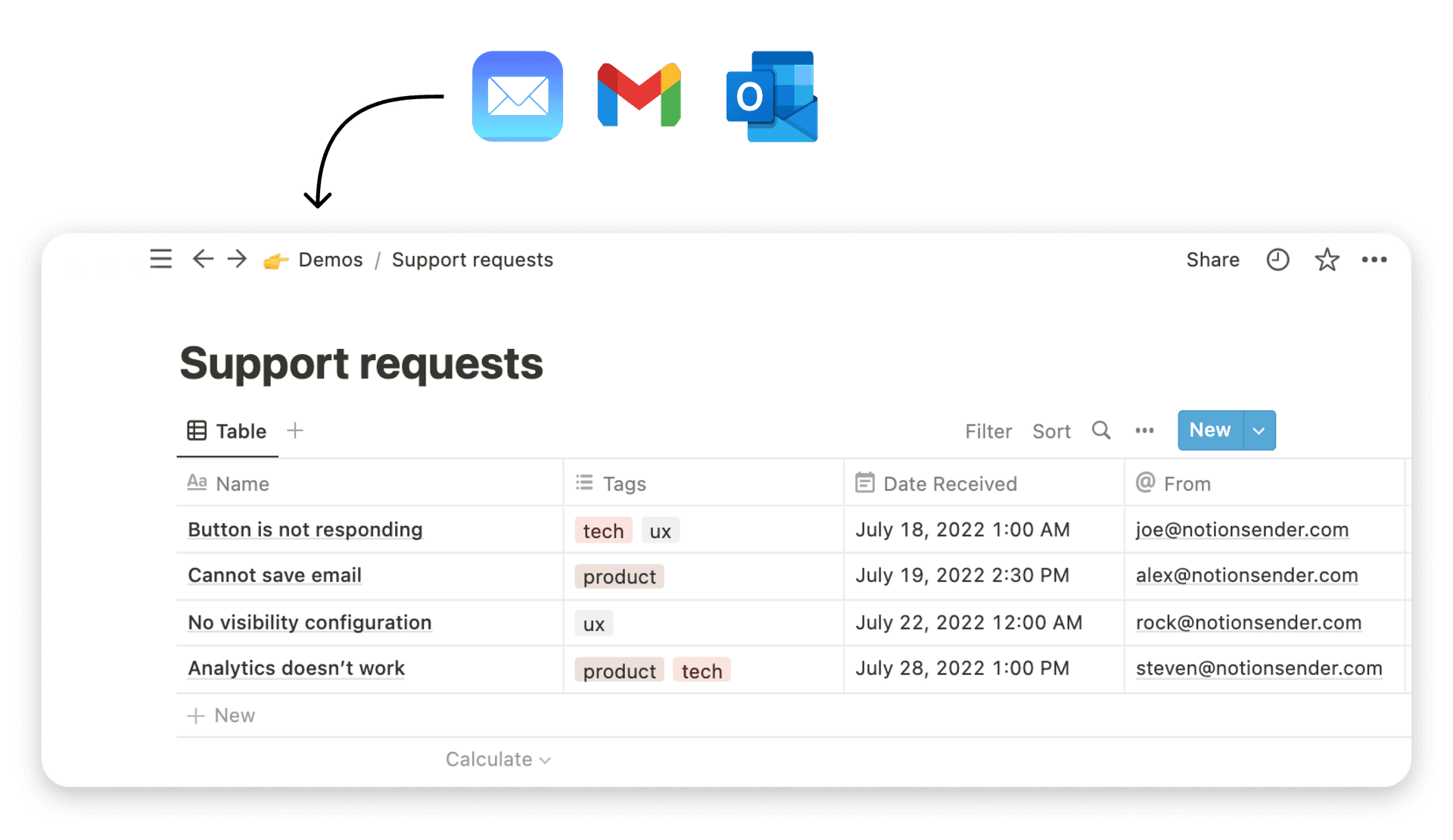
A solid notion gmail integration fixes that gap. It turns email from a separate channel into part of your operating system. Some setups are simple and free. Some are official but narrow. Some are powerful enough to build a proper email workflow inside Notion.
Notion has moved closer to that all-in-one model. Its push was especially visible with Notion Mail and the Notion AI Connector, which brought Gmail into the broader Notion ecosystem for reading, search, and summaries, while still leaving gaps for structured database saving, as noted in SQ Magazine's Notion statistics roundup.
If your setup also relies on filter-based workflows, it helps to make sure your mailbox settings are in good shape first. This Gmail IMAP setup guide is useful when you're troubleshooting Gmail access across tools.
Bridging Your Inbox and Your Workspace
The practical question isn't whether Gmail and Notion should work together. They should. The question is how much integration you need.
For a freelancer, the answer might be simple. Save client emails into a Notion CRM, keep receipts in an invoice database, and stop copy-pasting. For a small team, the answer usually goes further. They need inbox context tied to tasks, project records, and follow-up workflows.
Three different jobs people mean by integration
Teams frequently lump very different needs under one phrase.
- Archiving important emails: Save selected messages or filtered messages into a Notion database.
- Searching inbox content from Notion: Ask Notion AI what was decided in an email thread.
- Running email operations from Notion: Send, log, parse, and track replies from database records.
Those are different jobs, and each method handles them differently.
Practical rule: Pick the workflow first, then the tool. If you start with the tool, you'll usually end up forcing email into a system it wasn't built for.
The rest of this guide breaks the options into three paths. Free and manual methods cover basic capture. Official Notion tools cover AI search and a Notion-native mail experience. Third-party tools handle the operational side that most freelancers and small businesses need.
Choosing Your Notion Gmail Integration Path
There isn't one clean native switch for Gmail inside Notion. There are several routes, and each comes with a different mix of cost, setup effort, and workflow depth.
Some people only need a rule that forwards invoices into a database. Others need to search Gmail from inside Notion AI. Others want a two-way system where Notion stores the record and also sends or tracks email activity. Treat these as separate categories, not minor feature differences.

A useful dividing line is budget. Official integrations require paid Notion and Google plans, while a 2026 analysis found that free options like email forwarding can cover 80% of core functionality for many freelancers and solo operators, according to MailNotes' Gmail to Notion integration analysis.
Notion-Gmail Integration Methods Compared
| Method | Cost | Setup Effort | Core Function | Best For |
|---|---|---|---|---|
| Free/manual forwarding | Free option available | Low | Send selected or filtered emails into Notion | Freelancers, invoice tracking, simple archives |
| Official Notion tools | Paid Notion Business and paid Google Workspace required | High | AI inbox search, summaries, Gmail-style experience in Notion Mail | Teams already standardized on Notion and Google Workspace |
| Third-party automation | Varies by tool | Medium to high | Structured saving, parsing, workflow automation, possible sending from Notion | Small businesses, agencies, operations-heavy workflows |
How to choose without overbuilding
If you're unsure, use this decision filter:
- Need basic capture only? Use forwarding.
- Need AI answers about inbox threads? Consider the official connector.
- Need properties, workflows, reply handling, or outbound email from Notion? Use third-party automation.
That last group is where many readers land. Project managers and small business owners usually don't just want an email view. They want records. They want task creation. They want sender, date, project, and status attached to something they can filter and automate.
The trade-offs that matter most
A lot of guides compare tools by feature count. That's not how these systems fail in practice. They fail on three things:
- Reliability of capture: Did the email reach the right database?
- Structure of data: Did the sender, subject, dates, and body land in useful properties?
- Operational fit: Can your team work from the result without extra cleanup?
Free methods are good at getting email into Notion. They are not automatically good at turning email into clean, reusable business data.
That's the lens worth using for the rest of your decision.
The Free Method Saving Emails with a Unique Address
If you want the fastest path to a working notion gmail integration, start with email forwarding to a unique database address. It is simple, low-risk, and good enough for many solo workflows.

This method works best when the rule is predictable. Vendor receipts. Client inquiries from a specific address. Leads with a defined subject pattern. In those cases, forwarding is often cleaner than opening Gmail and manually logging every message.
A practical setup that works
Create a Notion database for the kind of email you want to capture. Keep the schema plain at first. A good starter setup includes:
- Title for subject or thread name
- Email sender for contact or source
- Received date for sorting
- Status for follow-up
- Notes for anything you add manually later
Then generate or copy the unique destination address tied to the tool or workflow you're using. Once that exists, go into Gmail and create a filter. Match the sender, subject keywords, or labels you care about, then forward matching mail to that destination.
If you work across clients who use different mail systems, the same logic applies outside Gmail too. This Receipt Router guide to automatic forwarding from Outlook is useful if part of your intake still comes through Microsoft-based inboxes.
What this method does well
The biggest win is consistency. You don't need to remember to save emails. The right messages land in the right place.
It also gives freelancers a clean starting point for simple operations:
- Invoice tracking: Forward billing emails into a finance database.
- Lead capture: Route inquiry emails into a lightweight CRM.
- Project references: Archive approval emails so they sit next to deliverables.
For a walkthrough focused on sending email content into Notion databases, this guide on how to send email to Notion shows the general model clearly.
A short demo helps if you want to see the workflow in motion:
<iframe width="100%" style="aspect-ratio: 16 / 9;" src="https://www.youtube.com/embed/IS0NPa0yqi4" frameborder="0" allow="autoplay; encrypted-media" allowfullscreen></iframe>
Where free forwarding starts to break
Forwarding is not the same as structured sync. You'll still hit limits:
- Limited parsing: Basic forwarding usually won't cleanly extract all fields you want.
- Thread messiness: Long reply chains can become hard to read or duplicate.
- No outbound workflow: You can save emails, but you can't manage sending from Notion with a simple forwarding setup.
- Team coordination gaps: Shared inbox behavior is limited unless another tool handles it.
Use forwarding for intake and archival. Don't expect it to behave like a full CRM or help desk.
For many freelancers, that's fine. It solves the immediate problem without extra spend. But if your workflow depends on accurate properties, reply handling, or sending from database records, you'll outgrow it quickly.
Using the Official Notion AI Connector for Gmail
Notion's official Gmail option is powerful in one narrow area. It helps you search and summarize inbox content from inside Notion AI. It is not a clean solution for saving emails as structured records in your databases.
That distinction matters. A lot of users assume "official Gmail integration" means email automatically becomes database items. It doesn't.
What the connector is for
The Gmail AI Connector is meant for teams that already use Notion AI as a working layer across docs, projects, and company knowledge. It allows people to ask questions like which decision was made in an email thread, without leaving Notion.
If you're a workspace owner on Notion Business at $15 per user per month and also a Google Workspace admin on a paid plan, you can connect Gmail through Notion's connector flow, as described in Notion's help documentation for the Gmail AI Connector.
What setup actually looks like
The setup is more technical than most small businesses expect. At a high level, it includes:
- Connecting Gmail from the Notion AI connector settings
- Installing the Notion AI for Gmail app through Google Marketplace
- Granting admin consent for the required scopes
- Returning to Notion and refreshing permissions
This is not just "click connect and go." Access, scopes, and admin rights all matter.
According to the same Notion help material, 25% of initial setups fail because of admin privilege or scope mismatch problems. That's a meaningful warning if you're a small team without a dedicated admin.
When it fits and when it doesn't
This is a strong fit if your team wants inbox intelligence inside Notion and already pays for the right stack. It helps with internal questions, summaries, and context retrieval.
It is a weak fit if your real goal is operational email management.
- Good fit: Leadership summaries, project context, decision lookup
- Weak fit: Saving emails into databases with properties
- Weak fit: Sending or replying from Notion
- Weak fit: Freelancer setups without paid admin plans
The official connector solves inbox search. It doesn't solve email operations.
Notion Mail sits nearby in the product family, but it's better understood as a Gmail client with a Notion-style interface than a database workflow tool. If your work depends on turning inbound email into trackable Notion records, the official route won't get you all the way there.
Unleash Full Power with Third-Party Automation
Third-party tools exist because the first two paths leave a gap. Free forwarding gets email into Notion, but not always cleanly. Official tools help with AI search, but not with structured workflow management. The missing layer is automation that treats email like process data.
That can mean no-code platforms such as Make.com. It can also mean specialized tools built around Notion-centric email workflows.

General automation platforms
Make.com is the classic example. You set a Gmail trigger like Watch Emails, then push matching data into a Notion database. This is useful when email is only one step in a larger chain.
A typical workflow might look like this:
- Trigger in Gmail: New message matches a filter
- Parsing step: Pull sender, subject, body, and attachments
- Action in Notion: Create a database item
- Follow-up action: Notify Slack or update another tool
That flexibility matters. It lets one incoming email create work across multiple systems, not just log a record.
Benchmarks cited by Quicktion show that tools of this type can be highly effective for email capture, and Quicktion reports a 98% success rate for saving emails in its workflows, based on its published integration benchmarks in Quicktion's Gmail-Notion integration guide.
Where specialized tools earn their keep
General automation is flexible, but it often takes more maintenance. If you need a full loop, inbound capture plus outbound sending plus structured records, a specialized tool can be a better operational fit.
That is where tools like NotionSender enter the picture. The model is straightforward: connect email behavior directly to Notion databases, assign a unique address for inbound mail, and support sending from Notion records when the workflow calls for it. If you want the implementation side, the NotionSender API documentation shows how these database-linked email workflows are structured.
The two capabilities small teams usually underestimate
The first is two-way workflow design. It isn't enough to capture an email if your team still has to jump back into Gmail to respond, log the response manually, and update status afterward.
The second is data extraction quality. Email is messy. Bodies include signatures, thread history, quoted replies, dates in different formats, and attachments that matter to the next step. A weak parser turns all of that into cleanup work.
If your process depends on email fields becoming usable Notion properties, parsing quality matters more than feature count.
This is why project managers outgrow simple forwarding. They don't just need a copy of the message. They need something their system can act on.
Example Workflows for Freelancers and Small Businesses
The easiest way to judge a notion gmail integration is to test it against a real workflow. Not a feature checklist. A workflow.

The freelancer client CRM
A solo consultant receives inquiries by email, manages active clients in Notion, and wants one record per relationship.
The workflow can look like this:
- A new inquiry email enters Gmail.
- A rule or integration creates a Notion database item.
- Sender details and subject are mapped into CRM properties.
- The email body becomes the source context for the lead.
- A follow-up task gets assigned inside the same workspace.
Structure matters. If the extraction is sloppy, the CRM fills with vague titles and hard-to-search notes. If the extraction is clean, the consultant works from one record.
For teams building outbound steps from those records, this guide on creating and sending email from Notion shows the database-to-email pattern well.
The small agency project hub
An agency receives feedback, approvals, and revision requests by email. Each project already lives in Notion. The goal is not to archive every message. The goal is to route the right message to the right project record.
A useful setup does three things well:
- Connect the sender or subject line to a client or project
- Save the message where the team already tracks delivery
- Preserve enough context to avoid reopening Gmail every time
Many generic automations often prove unreliable. In 2026 tests, standard automation tools reached 72% accuracy in parsing data from emails into Notion properties, according to the referenced YouTube workflow benchmark. For project work, that gap is expensive. Wrong dates, missed names, and broken thread context create manual cleanup.
The solopreneur invoice tracker
This is the cleanest use case. A founder forwards invoices and receipts into a Notion finance database, then reviews due dates and payment status in one place.
Even a simple setup works if the intake pattern is predictable. But as soon as the founder wants extraction of fields like due date, vendor, or category, the integration needs stronger parsing and more reliable property mapping.
A workflow is only automated if the data lands cleanly enough that you can trust it without retyping it.
That standard is worth using no matter how small your business is.
Your Notion Gmail Integration Questions Answered
Can I connect Notion with Outlook or Apple Mail too
Sometimes, but it depends on the method. Notion Mail is Gmail-only based on the product limitations discussed earlier. Forwarding-based approaches can work with other email providers as long as they support forwarding rules. Third-party workflow tools may support broader inbox options, but you need to confirm provider support before building around them.
Is giving a third-party tool access to Gmail and Notion risky
It can be, so treat permissions seriously. Check what level of access the tool requests, who manages the connection, and whether the access matches the workflow you need. For a small business, the safest pattern is to use the minimum required permissions and keep the integration tied to a business-owned account, not a personal one.
Can I reply to emails directly from Notion
Not with every setup. Forwarding methods are mainly for intake. The official Gmail AI Connector is for search and summaries, not reply handling. Replying from Notion generally requires a specialized workflow that supports outbound email from database records.
What happens to attachments
That varies a lot by tool. Some methods save the email record but don't give you useful attachment handling. Others preserve files better or let you route attachment data into the process. If attachments are central to your workflow, such as invoices, creative briefs, or approval documents, test this early before rolling the system out to clients or teammates.
What should most freelancers start with
Start simple. Use a forwarding workflow for repeatable intake. If that solves the problem, keep it. If you later need cleaner property mapping, outbound email, or reply tracking, move to a dedicated tool instead of stacking hacks on top of hacks.
If you want email to behave like part of your Notion system rather than a separate inbox, NotionSender is one option to consider. It supports database-linked email workflows, including sending and receiving inside Notion, which is useful when forwarding alone isn't enough and the official Gmail tools don't cover operational work.