Notion weekly planning: Streamline tasks and boost productivity

A truly effective Notion weekly planning system isn't just a collection of fancy to-do lists. It’s an interconnected powerhouse built on a few core databases that talk to each other. This is how you create a single source of truth—giving you a clear, top-down view of your entire week without the usual chaos.
Building Your Core Planning System in Notion
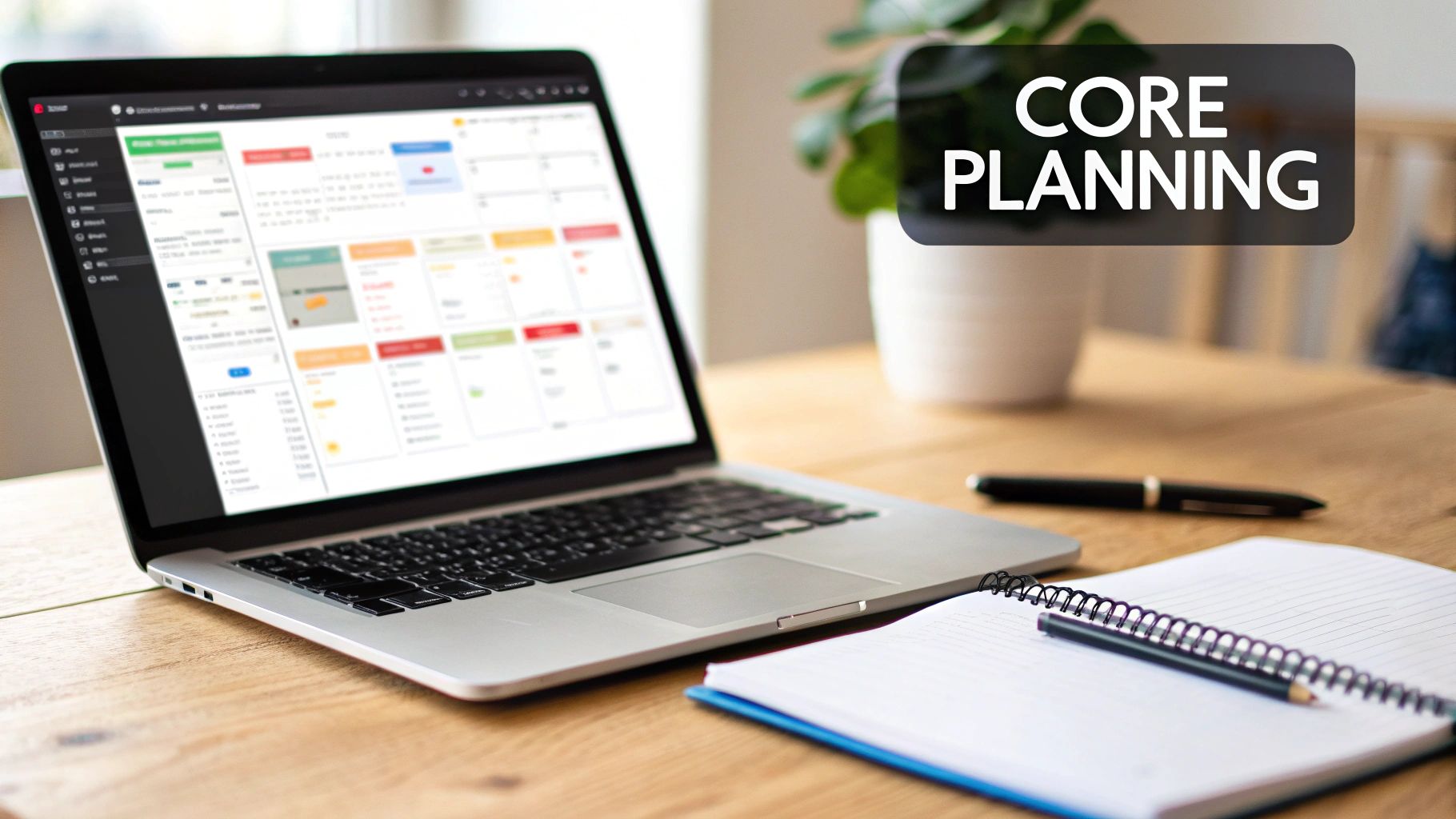
The secret to a killer weekly planning setup in Notion has nothing to do with complicated templates or mind-bending formulas. It’s all about laying a simple, rock-solid foundation with a few databases that are linked together. This is what finally gets you away from scattered to-do lists and calendars that don't sync up.
We're going to start by building the three essential databases that will run your entire workflow. Once these are connected, you'll have a single, reliable hub for every single one of your commitments.
The Master Tasks Database
This is ground zero. Every single action item you can think of—from "Email the design team" to "Buy groceries"—is going to live right here. Don't try to get fancy with it just yet. The first goal is simple: get everything out of your head and into one place.
A few key properties will get you started:
- Status: A simple dropdown menu (I use Not Started, In Progress, and Done) is perfect for tracking where things stand.
- Due Date: A standard date property for assigning deadlines.
- Priority: Another dropdown (High, Medium, Low) helps you immediately see what needs your attention first.
The Projects Database
While your Tasks database holds all the individual steps, the Projects database is where you track the big picture. Think of a project as a container that holds a bunch of related tasks. A project might be "Q3 Marketing Campaign" or "Plan Summer Vacation."
Each entry here represents a major goal you're working toward. Having this high-level view is crucial. It keeps you from getting bogged down in the day-to-day grind and helps you see exactly how those small actions are pushing your larger objectives forward.
The real magic happens when you connect your databases. By creating a 'Relation' property in your Tasks database that links to Projects, you can tie every single task back to its parent project. This is a game-changer for clarity.
The Calendar Database
This database is strictly for your time-bound commitments. It’s where you’ll log meetings, appointments, and other scheduled events. While you could technically add tasks with due dates here, I’ve found it’s much cleaner to keep appointments separate from your action items.
This distinction helps you manage your time much more effectively, creating a clear line between "things I must attend" and "things I must do."
To make sure you're setting these up correctly, here's a quick reference for the properties I recommend.
Essential Database Properties for Your Planner
| Database | Essential Properties | Purpose |
|---|---|---|
| Tasks | Status, Due Date, Priority, Relation to Projects | To capture and track individual action items and link them to larger goals. |
| Projects | Status, Timeline, Relation to Tasks | To manage high-level goals and see all associated tasks in one place. |
| Calendar | Date, Event Type (Meeting, Appointment) | To schedule and manage time-specific events, keeping them separate from your to-do list. |
Getting this foundation right is the most critical step. If you want to dive a little deeper into Notion's core features, check out these 10 tips to help you get the most out of Notion.so.
Once these three databases are set up and linked, you have a surprisingly robust framework for a dynamic and organized weekly plan.
Look, having separate databases for your tasks, projects, and calendar is a solid first step. But if you're constantly jumping between them, you're not really being productive, are you? The real magic happens when you build a central command center—a single dashboard that pulls everything together.
This isn't just about dumping data onto a page. It’s about creating clarity. The goal is to design a space that gives you that perfect bird's-eye view of your week, without feeling like you're drowning in information. By using linked database views, you can slice and dice your core databases into multiple, focused perspectives, all living on one page. Suddenly, your raw data becomes a dynamic, motivating roadmap you'll actually want to check every day.
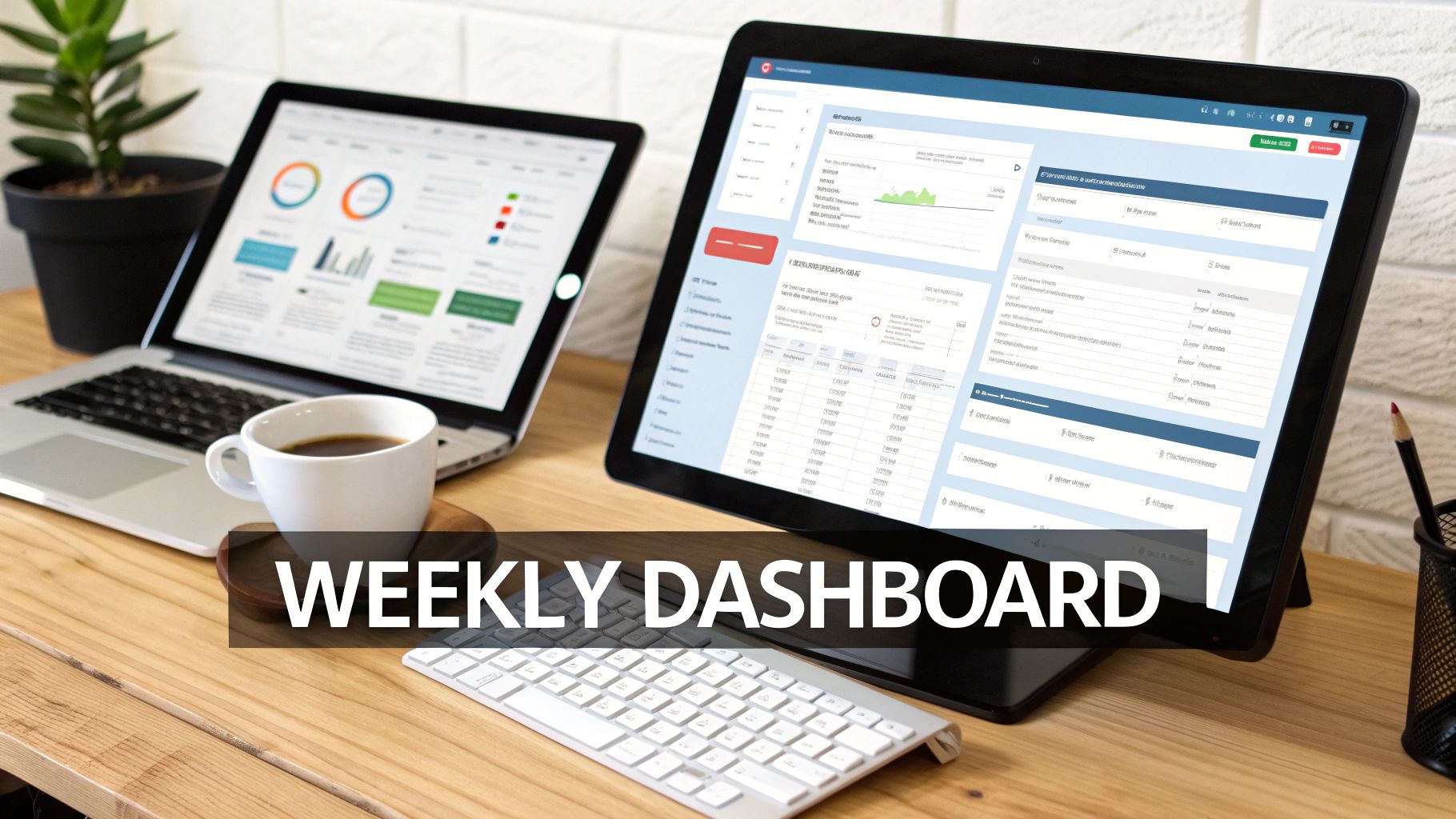
Crafting Your Weekly Command Center
Let’s get this built. Start with a fresh Notion page and call it something straightforward, like "Weekly Dashboard" or "My Command Center." My personal preference is to immediately set up two or three columns. This little trick keeps the layout clean and scannable, avoiding that dreaded "wall of text" that makes you want to close the tab.
Now, let's start pulling in your data. Use the /linked view of database command and point it to your Master Tasks database. This is where you'll build out the core sections of your dashboard.
For your main weekly task list, create a view and apply these two simple filters:
- Due Date is on or before this week.
- Status is not Done.
That’s it. This combo instantly hides completed tasks and anything not relevant to the current week, keeping your focus exactly where it needs to be.
Creating Filtered Views for Maximum Focus
Your main weekly list is the foundation, but a truly great dashboard offers different angles to guide your day. The beauty of Notion is that you can stack several linked views on the same page, each with its own unique set of filters to answer specific questions.
Here are a few powerful views I always include on my own dashboard:
- Today's Focus: A super compact list filtered to show only tasks where the Due Date is today. I always stick this right at the top so it's the first thing I see.
- Top Priorities: A board view grouped by your Priority property. This gives you a fantastic visual overview of your high, medium, and low-priority items at a glance.
- Upcoming Deadlines: A simple list view showing tasks due in the next week. This is my secret weapon for staying ahead of the curve and avoiding any last-minute panic.
This multi-view approach is really the heart of an effective Notion system. It’s no wonder there’s been a 60% adoption spike for these kinds of dashboards among project managers and small business owners. They’ve found that filtering tasks by active periods can slash planning time by 45%. You can read more on these productivity gains and how to apply them.
The most effective dashboards are designed to minimize decision fatigue. By pre-filtering your information into logical sections, you eliminate the mental energy spent figuring out what to work on next.
Integrating Your Calendar and Projects
To finish things off, let's bring in your other key databases to get the full picture.
Add another linked view, this time pointing to your Calendar database. Set it to a Week or List view to see your appointments right next to your tasks. Then, below that, drop in a linked view of your Projects database. I like to filter this one to show only Active projects, keeping the list lean and focused.
Now you have it all in one place. With a single glance, you can see your appointments, the high-level projects you're committed to, and the specific, granular tasks you need to knock out today and this week. This is how you transform scattered bits of information into a focused, actionable plan.
An effective productivity system should save you time, not pile on more admin work. Your Notion weekly planning setup is no different. This is where we can lean on Notion’s own automation features to handle all those repetitive, mundane tasks that just drain your mental energy.
When you automate the routine stuff, you're not just saving a few clicks here and there. You're actually preserving your focus for the high-impact work that moves the needle. It's all about building a system that works for you, even when you aren't actively messing with it.
Automating Project Kickoffs with Templates
One of the most practical ways to get started is by creating smart database templates for your common projects. Let's say you're a freelancer who regularly onboards new clients. Instead of manually typing out the same checklist every single time, you can build a "New Client" template right inside your Projects database.
The next time you add a new project and select that template, it can automatically spit out a pre-populated list of onboarding tasks into your Tasks database. Things like:
- Send welcome packet
- Schedule kickoff call
- Set up shared drive
- Send first invoice
This little trick builds consistency right into your process and guarantees no critical steps are ever missed. You can apply the same logic to pretty much any repeatable workflow, whether that's your content creation pipeline, a product launch sequence, or even a monthly financial review.
The goal of automation in your Notion weekly planning system isn't to create some rigid, hands-off machine. It’s to build reliable guardrails that handle the predictable parts of your work, freeing you up to be more creative and strategic.
Setting Up Recurring Tasks
Let's be real—a lot of weekly plans are filled with tasks that pop up on a regular schedule. Submitting a weekly report, prepping for a team meeting, or even personal habits like paying bills. Creating those entries from scratch every week is tedious, and it's easy to forget something.
Notion’s recurring templates feature is the perfect fix. You can set up a task template to create a new entry in your database automatically—daily, weekly, monthly, or even yearly.
Here’s a quick look at how you might set up a weekly recurring task in Notion.
With that simple setup, your "Submit Weekly Report" task will just appear on your to-do list every Friday. You don't even have to think about it. It’s a small tweak, but the impact it has on your cognitive load is massive.
By offloading these repetitive actions to Notion's automation, you make sure your weekly plan stays current and complete. That way, you can focus your energy on actually doing the work, not just setting it up.
Even the most meticulously crafted Notion weekly plan can get thrown off course by a single, relentless force: your inbox.
If your email feels more like a source of chaos than a communication tool, it’s a sign that you need to connect it directly to your planning workflow. This simple change can shift you from being reactive and distracted to proactive and organized.
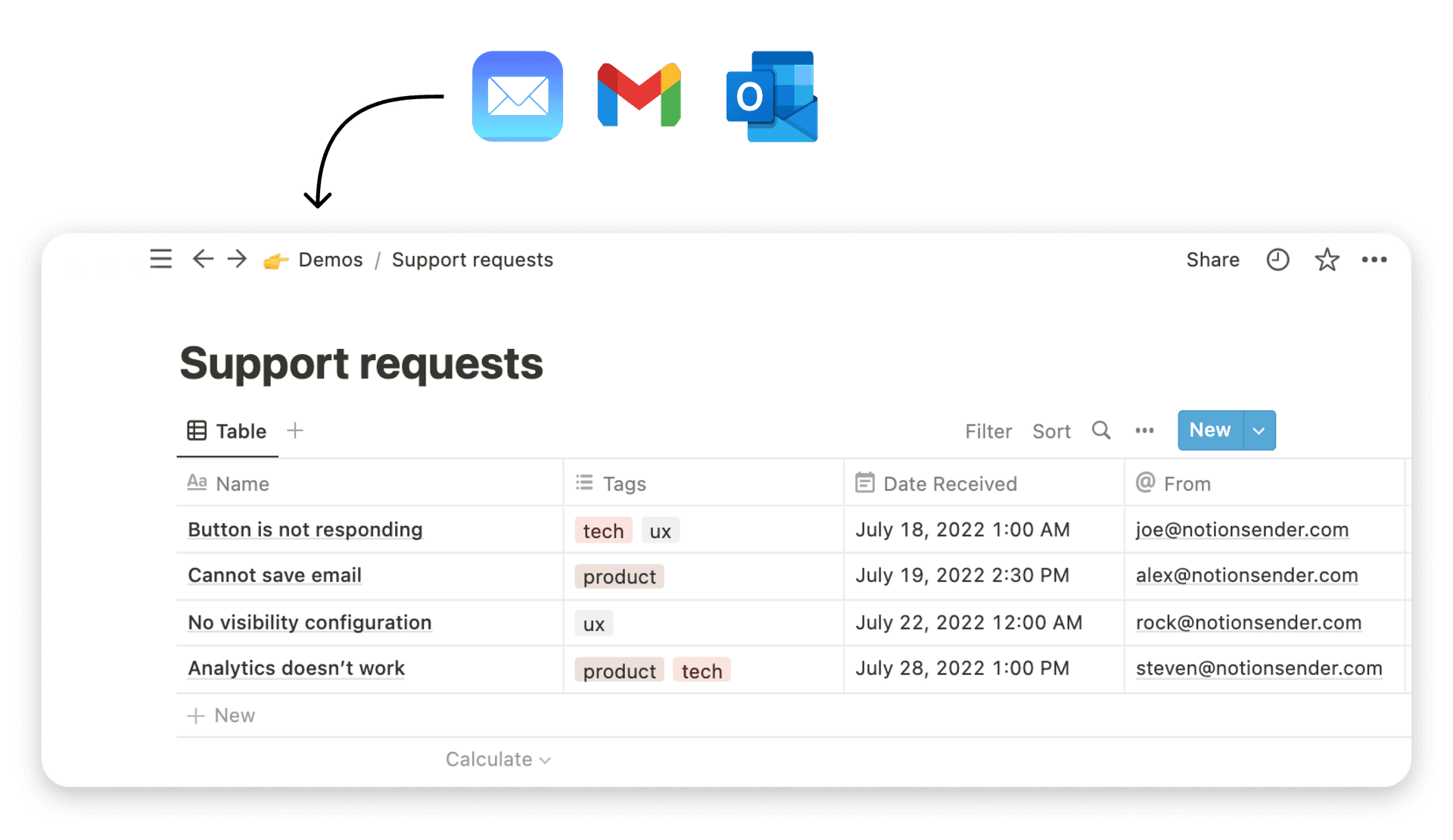
Think about it. Instead of the tedious copy-and-paste routine from an important email into a new Notion task, what if you could just forward it straight into your database? This is exactly where tools like NotionSender come in. They build a bridge between your inbox and your workspace, making sure no client request or critical action item gets buried.
Turning Emails into Actionable Tasks
Picture this common scenario: a client pings you with a new request. The old way means dropping everything you're doing, opening Notion, creating a task, copying the details over, picking a due date, and linking it to the right project. All that context-switching is a massive productivity drain.
Now, imagine this instead: you just forward that email to a unique address tied to your Tasks database. In seconds, a new task pops into Notion. The email’s subject becomes the task name, and the entire email body is saved right there in the page content.
This kind of simple automation is the bedrock of an efficient planning system, letting your projects, templates, and recurring actions all work together seamlessly.

When you connect an external tool like your inbox to your core Notion databases, you create an effortless flow of information that cuts out the manual grunt work.
This isn’t just about clawing back a few minutes here and there. It's about maintaining deep focus and ensuring your weekly plan is a true reflection of reality, without needing constant manual adjustments. For a full walkthrough on getting this set up, check out our guide on how to send email to Notion.
Practical Examples for Professionals
This kind of integration is a game-changer, especially for freelancers and small business owners who practically live in their inboxes. Being able to instantly turn communication into structured data is a huge leg up.
- Client Requests: A project update email comes in. Forward it to your Tasks database, and it’s immediately there, ready to be prioritized for the week.
- Invoices and Receipts: Send financial documents over to a dedicated "Finances" database. They're captured and recorded without you ever having to leave your email client.
- Content Ideas: Stumble upon an interesting newsletter or article? Forward it to a "Swipe File" or "Ideas" database to check out later.
The real win here is transforming your inbox from a to-do list that other people control into an intake system you manage. You get to decide what becomes a task and when it gets your attention, all inside your own weekly planning framework.
For freelancers juggling multiple clients, this works beautifully with templates. Using a tool like NotionSender, you can have email invoices flow directly into your weekly databases. Imagine saving 2-3 hours a week on manual data entry as the system automatically categorizes those communications for you.
To really lock in the automation, it's worth learning how to automatically forward emails from Outlook. Setting this up ensures that even the emails you don't forward manually are captured and sent to Notion for processing. It’s how you build a truly automated information pipeline.
Making Your Weekly Review a Powerful Habit
A slick Notion setup is one thing, but making it work for you week after week? That comes down to the ritual of the weekly review. This isn't just a quick glance at your calendar. It's the engine that powers your whole system, making sure you start every Monday with intention, not just cleaning up last week's mess.
<iframe width="100%" style="aspect-ratio: 16 / 9;" src="https://www.youtube.com/embed/78H4O73bTnQ" frameborder="0" allow="autoplay; encrypted-media" allowfullscreen></iframe>
Think of this habit as the connection between your big goals and your daily actions. It's where you honestly assess what happened over the last seven days and build a realistic plan for the next seven. Without it, the best system in the world is just a pretty collection of databases.
First, Reflect. Then, Plan.
Before you even think about dragging tasks into next week's schedule, you have to look back. What did you actually finish? Where did you get bogged down? This quick, honest reflection isn't about beating yourself up; it's about spotting patterns so you can make the next week better.
My own process involves a quick pass through a few key areas to get the full picture:
- Process Your Inboxes: I clear out everything. My email inbox, the quick-capture inbox in Notion where I dump random ideas, and any other collection points. The goal is a clean slate.
- Review What You Completed: Looking at the "Done" list isn't just for a pat on the back. It gives you a real-world sense of your capacity and helps build momentum.
- Analyze What's Left Over: What's still hanging around? If you've pushed the same task back for three weeks straight, that's a signal. It's either not a real priority, the task is too big and needs to be broken down, or something is blocking you.
This reflection phase is all about building awareness. It’s no surprise that notion weekly planning has become a lifeline for freelancers. Well-designed templates can drive a reported 50% jump in efficiency simply by making this review process more visual and structured.
Mindfully Mapping Out Your Week
Once you've cleared the decks and have a good sense of the past week, you can turn to the week ahead. Now you can mindfully pull tasks from your backlog into your "This Week" view. The real trick here is to resist the urge to cram your week full just because there's empty space. Be brutally honest about your time and energy levels.
Your weekly review is your chance to be the architect of your week, not just a firefighter reacting to every new blaze. It's the single highest-leverage activity you can do for your productivity.
As you plan, think about which Habits To Track you want to focus on to build consistency. This is also the perfect time to set your "Big 3"—the top three outcomes that will make the week a win. This simple act of prioritizing keeps you from getting lost in the weeds of busywork.
A huge part of this is getting a handle on incoming requests before they derail your plan. Brushing up on a few smart email management tips to boost your productivity can make a world of difference here.
Of course, here is the rewritten section with a more natural, human-written tone.
Answering Your Top Notion Planning Questions
Alright, so you've got the basic structure down. But we all know that even the best-laid plans meet reality. A new system always brings up those "what if" scenarios. Let's tackle some of the most common questions I hear from people moving their weekly planning into Notion.
"Help! How Do I Handle Urgent Tasks Without Blowing Up My Whole Week?"
This is a classic. The trick isn't to cram last-minute tasks into your already-packed schedule. It's about having a dedicated place to catch them before they cause chaos.
I always recommend setting up a simple "Inbox" view in your main Tasks database. The filter for this view is dead simple: it only shows tasks that have no due date assigned. When something unexpected pops up, your only job is to chuck it in here. No thinking, no prioritizing—just capture it and get back to what you were doing.
This simple act prevents your carefully planned day from getting immediately derailed. A couple of times a day, just glance at this inbox. From there, you can decide if a task is truly urgent, if it can be scheduled for later in the week, or if you can delegate it. Your plan stays intact, and nothing gets lost in the shuffle.
"What’s the Best Way to Juggle My Work and Personal Life in One Place?"
You can absolutely run your whole life out of Notion without it becoming a mess. The secret is a single "Category" or "Area" property in your databases. This one little property is a game-changer.
You can tag every single task, project, and calendar event with labels like "Work," "Personal," "Health," or "Family."
This gives you incredible power to slice and dice your views. You can keep a master calendar to see everything at once, but more importantly, you can create focused dashboards.
- During the workday? Switch to a "Work Mode" view that hides all your personal stuff.
- Logging off for the weekend? Flip to a "Weekend" view that only shows personal errands and family events.
This lets you switch contexts mentally without switching apps, helping you build a much healthier work-life boundary inside one organized system.
The most successful Notion weekly planning systems are living, breathing documents. Don't chase perfection on day one. If a view feels cluttered or you realize you never use a certain property, get in there and tweak it. Your system should bend to your needs, not the other way around.
"Okay, But How Do I Actually Stick With It?"
Motivation is fickle; habits are reliable. The single most effective thing you can do is to schedule your weekly review and treat it like an unbreakable appointment with yourself.
When you're starting out, make the process as frictionless as possible. Your goal is to build a routine you can lean on, not a complicated machine that requires tons of effort to maintain. The easier it is to use, the more you'll use it. That consistency is what builds the momentum you need to stick with it for the long haul.
Ready to stop your inbox from derailing your plans? NotionSender turns chaotic emails into organized tasks in seconds. Start connecting your inbox to Notion today and take back control of your week.