Create a Simple Project Tracking Template in Notion

Let's be honest: most project management software is just overkill. It’s loaded with features that look fantastic in a sales demo but end up creating more friction than they solve in your day-to-day work.
Before you know it, your team is spending more time managing the software than managing the actual project. It's a frustrating cycle that leads straight to burnout—a hidden tax on your team's productivity.
This is exactly why so many teams end up right back where they started: with spreadsheets. Or even worse, a chaotic mess of emails, Slack messages, and stray sticky notes. When the "official" tool is too clunky, a shadow system always pops up, scattering information everywhere and making it impossible to get a clear picture of what's going on.
The Downfall of Feature Overload
The root of the problem is that enterprise tools are built to solve every imaginable problem for every type of user. This one-size-fits-all approach results in a cluttered, confusing experience for teams who only need a small fraction of the functions.
Instead of bringing clarity, these bloated systems just create more administrative work.
- Steep Learning Curves: Getting new team members up to speed becomes a long training session on software, not a deep dive into the work itself.
- Scattered Information: With too many fields, views, and integrations, critical details get buried. Finding the single source of truth feels like a treasure hunt.
- Low Adoption Rates: If a tool is a pain to use, people will just... stop using it. That leads to outdated information and, inevitably, missed deadlines.
This friction is a huge reason the online project management software market is expected to hit US$13.1 billion by 2033, with cloud-based tools making up a 56.6% market share. Small, agile teams need tools that match their speed, not clunky legacy systems that slow them down.
It’s easy to get lost in the chaos of modern project management. You've got tasks falling through the cracks, endless status meetings that could have been an email, and a general sense of "who's doing what?" A simple, well-designed template cuts through that noise.
Here’s a look at some common project headaches and how a straightforward template solves them.
Common Project Chaos vs Simple Template Solutions
| Common Problem | Simple Template Solution |
|---|---|
| "Who owns this task?" | A clear Owner property assigns direct responsibility. No more confusion. |
| "Is this done yet?" | The Status field (e.g., To Do, In Progress, Done) provides an instant, at-a-glance update for everyone. |
| "When is this due?" | A non-negotiable Due Date property keeps deadlines front and center. |
| Information is scattered across different apps. | All project details, files, and conversations are centralized in one place, attached directly to the relevant task or item. |
| Endless "quick sync" meetings. | A shared, real-time view of the project board or list makes most status meetings obsolete. |
A simple system doesn't mean a less powerful one. It means you’re focusing everyone’s energy on what actually moves the needle, not on wrestling with software.
A simple project tracking template strips away all the unnecessary complexity. It forces you to focus on what truly matters: defining the work, assigning responsibility, and setting clear deadlines.
The Power of a Minimalist Approach
By opting for a simple template, especially in a flexible platform like Notion, you take back control. You build a system that works for your team, not the other way around.
This minimalist approach brings immediate clarity and cuts down on the mental overhead that comes with complex software. You might also want to check out our guide on simple email management tips, since taming your inbox is a huge part of effective project tracking.
This kind of clarity empowers everyone. People can see exactly what they need to do, which keeps projects moving forward without the need for constant check-in meetings.
Building Your Core Notion Project Database
The heart of any good project tracker is its database. This is the engine that holds all your project information, so it needs to be set up thoughtfully—but without getting bogged down in complexity. We're going to build this from the ground up in Notion, focusing only on the properties that give you the most bang for your buck right away.
I think of it as moving from total chaos to complete clarity, and a simple, well-structured template is what gets you there.

The whole point is to build a bridge from disorganized, tangled efforts to a workflow that’s clear and actionable. We're aiming for predictable progress, not constant guesswork.
Starting with a Blank Page
First things first, create a new page in Notion. When prompted, choose the "Database - Full page" option. This gives you a clean canvas to work with.
The very first property you'll see is "Name," which is Notion's default "Title" property. It's perfect for your project or task name, so just leave it as is. The key here is to be specific. Instead of something vague like "Marketing," name your project "Q3 Social Media Campaign Launch." That small bit of specificity is the first step toward real clarity.
Setting Up Essential Properties
Now, let's add the few core properties that make this whole system tick. It’s tempting to add every field you can possibly imagine, but trust me, less is more. We're starting with just the essentials, and each one is designed to answer a critical question about your project.
- Status (Select or Status Property): This tells you, "What's the current state of this project?" Notion's built-in "Status" property is perfect for this, coming with defaults like "Not started," "In progress," and "Done." Feel free to customize these—I often add "Blocked" or "In Review" to reflect how my team actually works.
- Owner (Person Property): This answers, "Who is responsible for moving this forward?" By using the "Person" property to tag a team member, you eliminate any confusion about who owns the task. It's a simple way to create accountability.
- Due Date (Date Property): This one’s obvious: "When does this need to be completed?" A "Date" property is non-negotiable for any real project tracking. Deadlines create clear targets and are crucial for prioritizing work.
- Priority (Select Property): This property answers, "How important is this right now?" All you need is a simple "Select" property with options like "High," "Medium," and "Low." I highly recommend color-coding these options so you can scan your database and instantly spot the most urgent items.
Believe it or not, this minimalist setup is incredibly powerful. You can get a massive amount of insight from just these five properties. If you're looking for more ideas on organizing your workspace, you might find some useful nuggets in these 10 tips to get the most out of Notion.
Strategic Configuration Tips
A little forethought in how you set up these properties will save you a ton of headaches later.
When you're configuring the Status property, really think about your team's workflow. If projects frequently get stuck waiting for client feedback, adding an "On Hold" status can give you a much clearer picture of where your bottlenecks are.
The same goes for the Priority property. You have to be disciplined here. It's easy to fall into the trap of marking everything as "High" priority, which just makes the label meaningless. A good rule of thumb is to limit each person to 2-3 "High" priority items at any given time.
By keeping your database properties minimal, you force clarity. Every piece of information has a clear purpose, making the entire system easier to maintain and faster to understand at a glance.
This focused approach ensures your simple project tracking template actually helps you make progress instead of just adding to the clutter. With this solid foundation in place, you’ve built a functional core that's ready for the real magic: custom views.
Turn Your Project List Into a Visual Command Center
Let's be honest, a database full of projects is just a list. It's organized, sure, but it isn't telling you what to do next. The real magic happens when you transform that raw data into a dynamic dashboard that gives you the story of your work at a glance. This is where Notion's custom views come in, turning your simple tracker into a true project command center.
Instead of hunting for information, you’ll build dedicated views that surface exactly what you need, right when you need it. This shift from a static list to a visual, interactive workflow is what separates a passive spreadsheet from an active project management tool.

See Your Workflow with a Kanban Board
The first view I always build is a Kanban board. It’s the most intuitive way to visualize your entire project pipeline, from "idea" to "done."
To get started, just add a new view to your database and choose the "Board" layout. The most important setting here is "Group by"—make sure you select your "Status" property. Instantly, your projects snap into columns representing each stage of your process. There's nothing quite as satisfying as dragging a project card from "In Progress" to "Done."
Never Miss a Deadline with a Calendar View
Next up, the Calendar view. This one is non-negotiable for spotting potential bottlenecks and managing deadlines before they creep up on you. Add another new view, but this time select "Calendar."
Notion will prompt you to pick a date property to display. Choose your "Due Date" field, and voilà! You get a bird's-eye view of your month, making it painfully obvious when deadlines are starting to pile up. This view is a lifesaver for balancing workloads and making sure you actually have enough time to deliver quality work.
Build Personalized Dashboards with Filters
This is where your template goes from a generic tool to a personalized powerhouse. Filters and sorts let you slice and dice your project data to create hyper-specific views for different people or situations.
The real goal of a custom view is to eliminate noise. Instead of showing everyone everything, you create focused dashboards that answer specific questions, like, "What do I need to work on today?"
Here are a few practical examples you can build in just a few minutes:
- My Active Projects: Create a new "List" or "Table" view. Add a filter where the "Owner" property "contains" the current user (you can literally select "Me"). Now every team member has a clean, personalized to-do list showing only what's on their plate.
- High-Priority Fire Drill: Duplicate your main table view and give it a new name. Add a filter where the "Priority" property "is" "High." This gives managers an instant snapshot of the most critical items that demand immediate attention.
- This Week's Deadlines: Create a Calendar view. Add a filter where the "Due Date" "is within" "The next week." This is the perfect view to pull up during your weekly planning meetings.
This kind of visual, adaptable approach is becoming more crucial than ever. The global market for project management software is on track to hit USD 23.09 billion by 2031. This explosive growth is all about teams needing simple, visual tools to manage work without getting bogged down in complexity. You can dive deeper into the market trends in this comprehensive industry report.
By mastering these simple views, you ensure your project tracker stays a clean, actionable hub for your entire team.
Connecting Your Tracker to Your Inbox with NotionSender
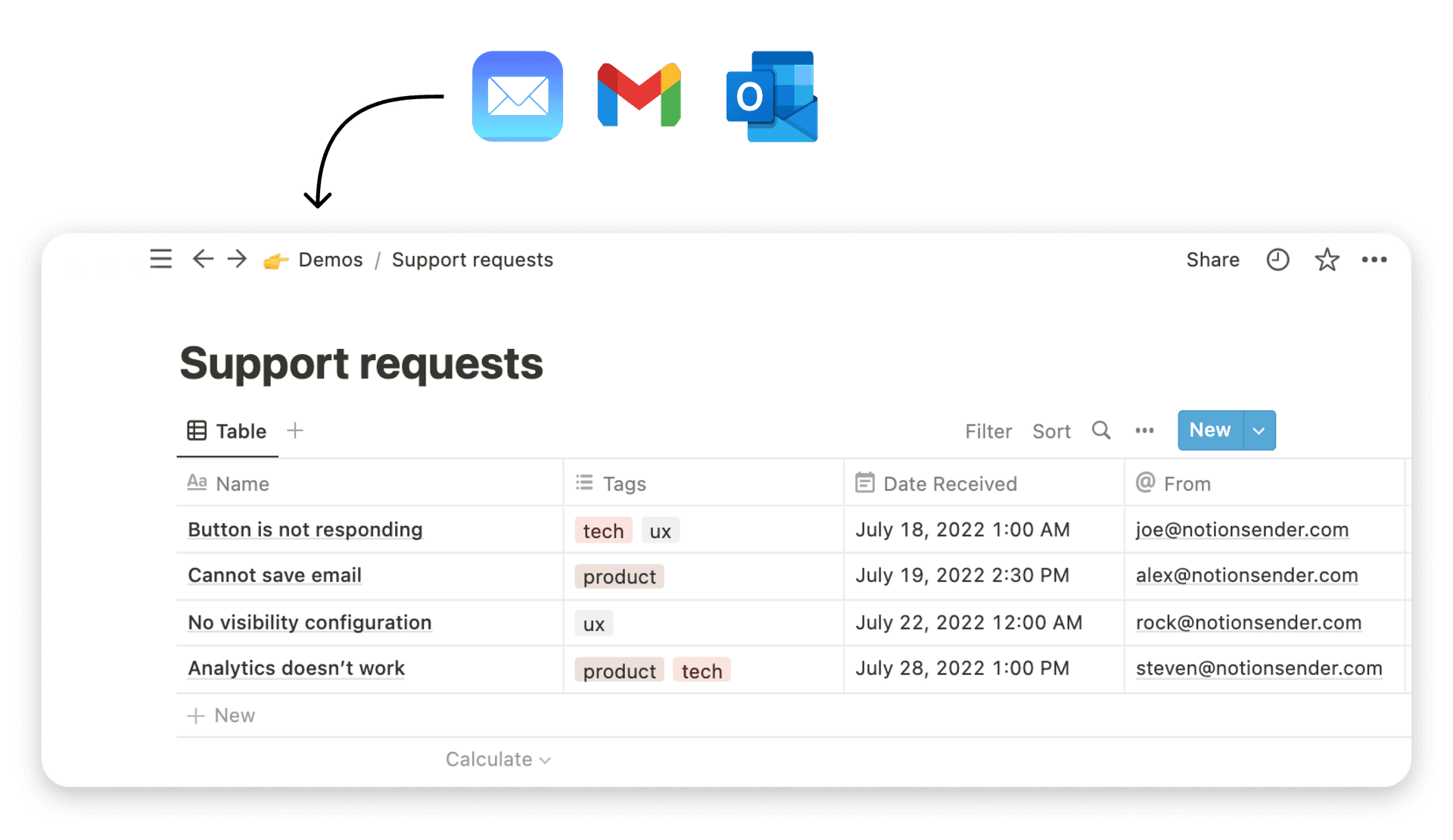
So, you’ve built a solid project tracker. It’s your command center, but right now, it’s probably a bit of an island. All the important stuff—client approvals, critical files, quick questions—is likely stuck in your email inbox, creating a frustrating disconnect. This is where we bridge that gap. By hooking up your Notion tracker with NotionSender, you can stop managing work in one place and communicating about it in another.
This simple connection turns your tracker from a static to-do list into a living, breathing hub for every project conversation. No more tedious copy-pasting from an email into a Notion page. You just forward the entire thread, and it lands exactly where it needs to go.

It’s surprisingly simple. NotionSender gives your project database its own unique email address. Send anything to that address, and it will automatically create a new item or append the email to an existing one, attachments and all.
How It Works in the Real World
Let's make this practical. Say you're a freelance designer. A client emails you with the final feedback on a design and attaches the signed contract. The old way? Download the file, open Notion, hunt for the project, upload the file, and copy-paste the feedback.
The new way? You just forward the email to your NotionSender address. Done. The email’s content shows up as a comment, and the contract is saved directly to the correct project page.
Here are a few other ways I’ve seen this work wonders:
- Logging Invoices: A contractor sends an invoice. Forward it, and bam—a "Pay Invoice" task is created in your tracker with the PDF already attached.
- Capturing Leads: A potential client fills out your contact form. Forward their inquiry to your "Sales Pipeline" database to instantly create a new lead.
- Saving Approvals: A stakeholder sends that magic one-word email: "Approved." Forward it. Now you have a permanent, time-stamped record of their sign-off right on the project page.
Why Centralizing Communication is a Game-Changer
This isn’t just a nice-to-have. It's a fundamental shift in how you handle project information. It makes your tracker the undisputed single source of truth. The project management software market is expected to hit $15.06 billion by 2030, yet a shocking 23% of organizations don’t use any dedicated PM software at all. This shows there’s a massive need for lightweight, integrated setups just like this one.
For freelancers and small teams, piping emails directly into a database cuts through the noise. It’s a simple solution to the chaos of scattered communication.
By connecting your inbox to your project tracker, you stop wasting mental energy on admin. Every important conversation and document finds its home automatically. Your project records stay complete and effortlessly up-to-date.
Setting this up is a one-time thing that pays you back every single day. You spend less time organizing and more time doing what you’re actually paid to do.
If you want a more detailed guide, check out our post on how to send an email to Notion. It walks you through every step. This integration is what elevates your project tracker from a simple plan to a living archive of your work.
Applying These Principles Outside of Notion
<iframe width="100%" style="aspect-ratio: 16 / 9;" src="https://www.youtube.com/embed/OldoLQZbnMw" frameborder="0" allow="autoplay; encrypted-media" allowfullscreen></iframe>
While Notion is fantastic for this kind of flexible setup, you don't need it to get the benefits. The core ideas behind a simple project tracker are universal. A good system is about clarity, not the specific tool you use.
You can absolutely adapt these powerful principles to the spreadsheets you're already familiar with, like Google Sheets or Microsoft Excel.
The goal isn't to perfectly replicate every interactive view from Notion. Instead, think of it as translating the concepts. Your Notion properties simply become spreadsheet columns: Project Name, Status, Owner, and Due Date. It’s that straightforward.
Building Your Tracker in a Spreadsheet
Want that clean, dropdown functionality you get with a Notion "Select" property? Use data validation.
In Google Sheets, for instance, just highlight your "Status" column, head over to Data > Data validation, and create a dropdown list with your predefined statuses (Not Started, In Progress, Blocked, etc.). This is a small step that makes a huge difference in keeping your data consistent and easy to filter.
Another great trick to borrow from Notion is color-coding. With conditional formatting, you can make a row’s color change automatically based on its status. A simple rule could be to make any row with the status "Blocked" turn bright red. Suddenly, you have the same at-a-glance visual cues you’d get from a Kanban board, right in your spreadsheet.
The tool is secondary to the system. A well-organized spreadsheet that your team actually uses is infinitely more valuable than a sophisticated software suite that sits empty. The fundamental goal is a shared understanding of project progress.
Notion vs Sheets and Excel for Project Tracking
To help you decide what's best for your team, here’s a quick rundown of how these tools stack up for project tracking.
| Feature | Notion | Google Sheets / Excel |
|---|---|---|
| Flexibility | Extremely high; combines docs, databases, and tasks in one interconnected space. | High, but confined to the grid format. Requires formulas and add-ons for advanced logic. |
| Visuals | Built-in Kanban, Calendar, Timeline, and Gallery views for dynamic visualization. | Requires manual setup with conditional formatting and charts for visual cues. |
| Collaboration | Real-time, with comments, mentions, and page-level permissions. | Real-time (Sheets) or version-based (Excel). Comments are available but less integrated. |
| Data Relationships | Can easily link related databases (e.g., Projects to Tasks to Meeting Notes). | Possible with complex formulas (VLOOKUP, INDEX/MATCH) but not as intuitive or native. |
| Ease of Use | Gentle learning curve for basics, but advanced features can take time to master. | Widely known and understood, making it very accessible for most teams. |
| Automation | Simple built-in automations and deep integrations with tools like Zapier/Make. | Requires scripting (Apps Script, VBA) or third-party tools for automation. |
| All-in-One Workspace | Yes, it can be your single source of truth for projects, wikis, and notes. | No, it's primarily a data analysis and calculation tool. |
While a spreadsheet can be a powerhouse, Notion's native database features and interconnectedness often make it a more seamless choice as projects grow.
Of course, sometimes you need even more firepower. When a project becomes truly complex, dedicated project management platforms like monday.com enter the picture. If you're exploring that route, it's crucial to get the implementation right, which is why some teams look into finding the right Monday partner to guide the transition.
Ultimately, whether you stick with Notion, build a killer spreadsheet, or upgrade to a dedicated platform, the lesson is the same: a simple project tracking template wins because it puts clarity first.
Even with the best templates, questions pop up. It’s natural. Let's walk through some of the most common ones I hear, so you can get the most out of your new project tracker without any guesswork.
Think of these as quick, practical answers to smooth out any bumps in the road.
What Is the Most Important Field to Include?
If I had to pick just one, it’s the Status field, hands down. It's the one property that gives you an immediate, honest look at where everything stands—whether a project is Not Started, In Progress, Blocked, or Complete.
A clear status isn't just for show; it's what drives effective prioritization. It helps you spot bottlenecks before they become full-blown disasters and makes team check-ins ridiculously efficient. When you use Notion's 'Select' or 'Status' property with some color-coding, your whole dashboard becomes scannable in seconds.
How Can I Track Sub-Tasks Without Complicating the Template?
This is a great question because it gets to the heart of keeping things simple. My go-to method? Just drop a 'To-do' list block right inside the Notion page for that project.
This approach keeps your main database view clean and simple, but still gives you that granular, task-level tracking where you need it. You can see the big picture on the board, and the nitty-gritty details inside each project card.
Down the road, you could get fancier by creating a separate 'Tasks' database and linking it with a 'Relation' property. But for a truly simple starting point, checklists on the page are the way to go.
The real magic of starting simple in a tool like Notion is how easily it can grow with you. You layer on complexity only when you need it, instead of getting bogged down by a system that's too heavy from the start.
As you get more comfortable, you might add properties for 'Budget' or link to a 'Team' database. Maybe you'll build out filtered views for 'Projects Due This Quarter.' If you're looking for inspiration on how different systems handle structured information, checking out a meeting minutes template sample can offer some surprisingly useful ideas.
How Does Integrating Email with NotionSender Save Time?
The time savings with NotionSender come from one place: eliminating manual work and context switching. We all know the drill—copying key info from an email, finding the right project in Notion, pasting it in, and hoping you didn't miss anything.
Instead of all that, you just forward the email.
NotionSender takes over from there. It automatically files the email into the right project, keeps the entire conversation archived, and ensures all communication lives right alongside the work it's about. Your project record stays complete and current without you having to be a full-time administrator.
Ready to stop the copy-paste grind and connect your inbox directly to your project tracker? Give NotionSender a try and see how simple it is to keep your projects and communications in sync. Head over to https://www.notionsender.com to get started.